SFMTAs Transit Policies for Federal Civil Rights Title VI 06 | 21 - - PowerPoint PPT Presentation

sfmta s transit policies for federal civil rights title vi
SMART_READER_LITE
LIVE PREVIEW

SFMTAs Transit Policies for Federal Civil Rights Title VI 06 | 21 - - PowerPoint PPT Presentation

SFMTA Municipal Transportation Agency Image: Historic Car number 1 and 162 on Embarcadero SFMTAs Transit Policies for Federal Civil Rights Title VI 06 | 21 | 2013 SAN FRANCISCO, CALIFORNIA Presentation Overview Title VI Overview


slide-1
SLIDE 1

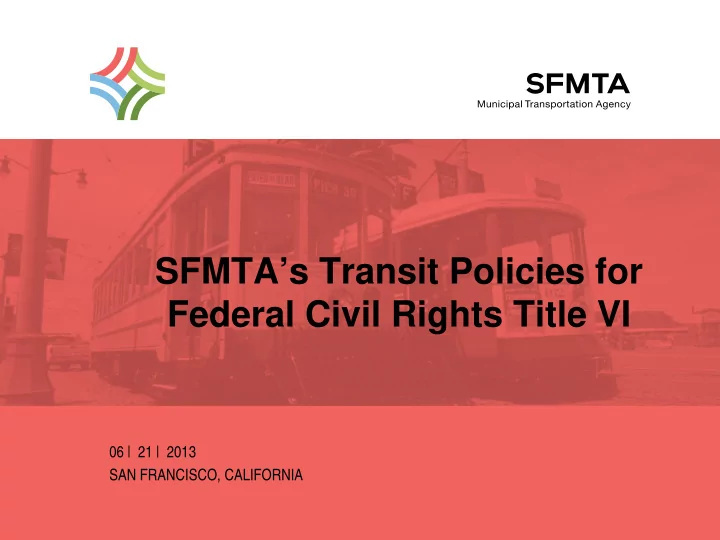
SFMTA’s Transit Policies for Federal Civil Rights Title VI

06 | 21 | 2013 SAN FRANCISCO, CALIFORNIA

SFMTA Municipal Transportation Agency Image: Historic Car number 1 and 162 on Embarcadero
slide-2
SLIDE 2

2

Presentation Overview

  • Title VI Overview
  • Service and Fare Change Process
  • Draft Major Service Change Definition
  • Draft Disparate Impact and

Disproportionate Burden Policies

  • Public Comment Opportunities
slide-3
SLIDE 3

3

What is Title VI?

  • Title VI of the Civil Rights Act of 1964 addressed

discrimination in most areas of public life in the U.S.

  • Title VI states:

– “No person in the United States shall, on the ground of race, color, or national origin, be excluded from participation in, be denied the benefits of, or be subjected to discrimination under any program or activity receiving federal financial assistance.”

  • Federal Transit Administration (FTA)

– Monitors transit providers for Title VI compliance; new circular issued October 1, 2012 provides guidance for transit agencies receiving federal funds

slide-4
SLIDE 4

4

Why is Title VI Important?

  • Ensures that public services, including transportation,

are provided in a nondiscriminatory manner

  • Requires opportunities for public participation in

decision-making without regard to race, color, or national origin, including populations with Limited English Proficiency (LEP)

  • Provides access to public services by LEP populations
  • Non-compliance with Title VI can cause federal funding

to be conditioned or withheld

slide-5
SLIDE 5

5

How Does the SFMTA Define…

  • Minority Population

– Census block group with minority residents at or above the Citywide average of 58%

  • Low Income Population

– Defined as 200% of the Federal poverty level (consistent with criteria for lifeline transit pass) – Census tract with low-income households at or above the Citywide average of 31%

  • On-board passenger survey underway to

supplement geographic information (will not be

available for 2013 Title VI program update)

slide-6
SLIDE 6

6

slide-7
SLIDE 7

7

slide-8
SLIDE 8

Service and Fare Change Process

The chart below illustrates the Title VI Equity Analysis process:

8

Service Change Fare Change Major? Yes Evaluate Impacts on Minority and Low- income Populations No Disparate Impact? Dispro- portionate Burden? Yes Evaluate Alternatives, Mitigate or Explain Rationale No

slide-9
SLIDE 9

9

FTA Title VI Circular New Requirements

Requires SFMTA Board of Directors to Adopt

  • Major Service Change Policy - determines when equity

analysis for service changes is needed

  • Disparate Impact, Disproportionate Burden Policies -

determine thresholds when fare or service changes would have a disparate impact on race, color, national

  • rigin, or disproportionate burden on low-income

populations

slide-10
SLIDE 10

10

Policy Development Approach

  • Reviewed draft and final Title VI Circular

– Submitted comments on draft document

  • Participated in Title VI webinars and Regional

Workshop

  • Arranged for phone interviews with Peer

Agencies and reviewed Peer processes

  • Conducting Multilingual Public Outreach on

proposed policies

slide-11
SLIDE 11

11

Multilingual Public Outreach

  • Presentations

– CAC (6/6), MAAC (6/20), PAG (6/21), CAC (7/11)

  • Public Workshops

– Saturday, June 22 10:30 am-noon – Tuesday, June 25 6:30-8:00 pm

  • Outreach to Community Based Organizations
  • Website/Email/Phone Input

– www.sfmta.com/TitleVIcomments – TitleVIcomments@sfmta.com – 311 Multilingual Customer Information Line

  • SFMTA Board of Directors – July 16
slide-12
SLIDE 12

Types of Service Changes

  • Route Change – changing the path of a route

by adding and/or eliminating all or a segment

  • f a route
  • Frequency Change – modifying how often the

bus arrives to pick up customers

  • Span of Service Change – changing the

hours of operation of a route

12

slide-13
SLIDE 13

13

Draft Major Service Change Policy

The SFMTA considers a change in transit service to be a Major Service Change when it is in effect for more than a 12 month period and any of the following criteria are met:

  • A schedule change resulting in a system wide change in annual revenue hours
  • f five percent or more;
  • A schedule change on a route resulting in:

– Introduction or elimination of a route; – A change in annual revenue hours on the route of 25 percent or more; – A change in the daily span of service on the route of four hours or more; or – A change in route-miles on a route of 25 percent or more, where the route miles move more than a quarter mile. Where 1) a route is defined as having at least 25 one-way trips per day and 2) on corridors served by multiple routes changes will be evaluated based on combined revenue hours, daily span of service, and/or route-miles.

  • The implementation of a New Start, Small Start, or other new fixed guideway

capital project, regardless of whether the proposed changes to existing service rise to the level of a “Major Service Change.”

slide-14
SLIDE 14

Draft Disparate Impact Policy

  • Determines the point when adverse effects of

a fare or service change are borne disparately by minority populations

  • Proposed recommendation:

8 percent cumulative threshold

14

slide-15
SLIDE 15

Draft Disproportionate Burden Policy

  • Determines the point when adverse effects of

a fare or service change are borne disproportionately by low-income populations

  • Proposed recommendation:

8 percent cumulative threshold

15

slide-16
SLIDE 16

Threshold Development

  • The threshold should be sensitive enough to distinguish

between minor and significant differences in service and fare impacts on minority and non-minority populations

  • SFMTA ran statistical analysis of the percentage of minorities

and low income residents along each route

  • SFMTA identified routes that based on our knowledge carry

significant number of minorities or low-income riders

  • Initially recommended 15% thresholds, but lowered to

8% based on further review of the technical data

  • Compared to peer agencies as a second check

16

slide-17
SLIDE 17

17

Methodology for selecting affected population

slide-18
SLIDE 18

Systemwide Improve Frequency Reduce Frequency Route/Segment Discontinuation

Baseline 58% Upper Limit 66% Lower Limit 52%

58% Minoritie s 79% Minoritie s 40% Minoritie s 63% Minoritie s

Dispar ate Impac t T hr e shold E xample s

Be low T hre shold

Above Within

slide-19
SLIDE 19

Cumulative Service Change Example

19

Route A Route B Routes A + B

Non-minority Population Effected Minority Population Effected

30,000 23,000

70% minor ity 52 % minor ity 62 % minor ity

53,000

66%

Uppe r L imit Ba se line

58%

slide-20
SLIDE 20

Hypothetical Example of Fare Change Analysis

20

F a re Me dia Cha ng e d Numb e r o f T

  • ta l Use rs*

Numb e r o f Mino rity Use rs* Pe rc e nt Mino ritie s Syste mwide Ave ra g e ** Diffe re nc e in Pe rc e nta g e T hre sho ld Dispa ra te Impa c t Ca sh 250,650 160,000 63.8% 58.1% 5.7% 8.0% no M-Pa ss 120,000 65,000 54.2% 58.1% 3.9% 8.0% no A-Pa ss 140,000 95,000 67.9% 58.1% 9.8% 8.0% ye s Se nio r Pa ss 50,000 40,000 80.0% 58.1% 21.9% 8.0% ye s Yo uth Pa ss 80,000 50,000 62.5% 58.1% 4.4% 8.0% no

* T he da ta pre se nte d a b o ve is no t a c tua l SF MT A da ta , b ut e xa mple da ta use d to illustra te ho w a fa re e q uity a na lysis wo uld b e e va lua te d. ** Will c ha ng e o nc e ride rship da ta is a va ila b le

F a re Me dia Cha ng e d Numb e r o f T

  • ta l Use rs*

Numb e r o f L

  • w

Inc o me Use rs* Pe rc e nt L

  • w-

inc o me Syste mwide Ave ra g e ** Diffe re nc e in Pe rc e nta g e T hre sho ld Dispro po rtio na te Burde n Ca sh 250,650 90,000 35.9% 31.0% 4.9% 8.0% no M-Pa ss 120,000 30,000 25.0% 31.0% 6.0% 8.0% no A-Pa ss 140,000 40,000 28.6% 31.0% 2.4% 8.0% no Se nio r Pa ss 50,000 24,000 48.0% 31.0% 17.0% 8.0% ye s Yo uth Pa ss 80,000 34,000 42.5% 31.0% 11.5% 8.0% ye s

* T he da ta pre se nte d a b o ve is no t a c tua l SF MT A da ta , b ut e xa mple da ta use d to illustra te ho w a fa re e q uity a na lysis wo uld b e e va lua te d. ** Will c ha ng e o nc e ride rship da ta is a va ila b le

Disparate Impact Disproportionate Burden

slide-21
SLIDE 21

Opportunities for Public Comment

  • Make public comments
  • CAC (6/6), MAAC (6/20), PAG (6/21), CAC (7/11)
  • Participate in public workshops
  • Saturday, June 22 10:30 am-noon
  • Tuesday, June 25 6:30-8:00 pm
  • Website/Email/Phone Input
  • www.sfmta.com/TitleVIcomments
  • TitleVIcomments@sfmta.com
  • 311 Multilingual Customer Information Line
  • Attend SFMTA Board of Directors Meeting – July 16

21

slide-22
SLIDE 22

Questions?

22