SFMTA Strategic Plan February 2, 2017 SFMTA Citizens Advisory - - PowerPoint PPT Presentation

sfmta strategic plan
SMART_READER_LITE
LIVE PREVIEW

SFMTA Strategic Plan February 2, 2017 SFMTA Citizens Advisory - - PowerPoint PPT Presentation

SFMTA Strategic Plan February 2, 2017 SFMTA Citizens Advisory Council Meeting 1 FY 2013 FY 2018 Strategic Plan SFMTA Vision San Francisco: great city, excellent transportation choices. SFMTA Mission Statement We work together to


slide-1
SLIDE 1

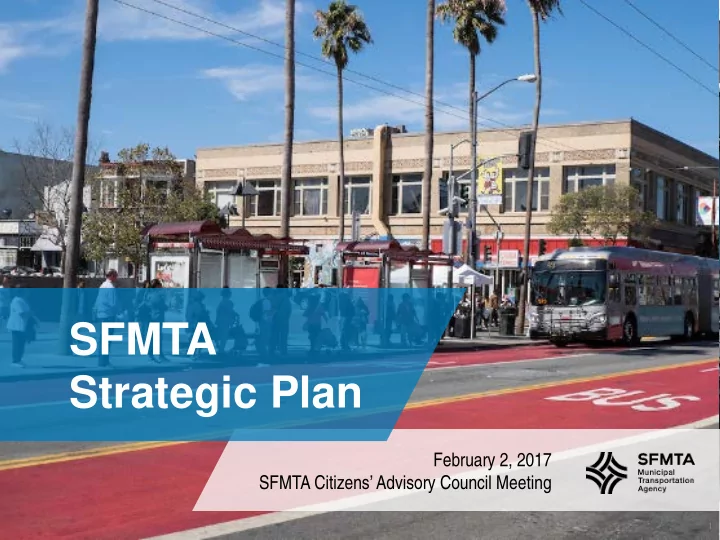
SFMTA Strategic Plan

February 2, 2017 SFMTA Citizens’ Advisory Council Meeting

1
slide-2
SLIDE 2

FY 2013 – FY 2018 Strategic Plan

SFMTA Vision

San Francisco: great city, excellent transportation choices.

SFMTA Mission Statement

We work together to plan, build, operate, regulate and maintain the transportation network, with our partners, to connect communities.

2

slide-3
SLIDE 3

3

FY 2013 – FY 2018 Strategic Plan Goals

GOAL 1: SAFETY

GOAL 2: TRAVEL CHOICES

GOAL 3: LIVABILITY GOAL 4: SERVICE

slide-4
SLIDE 4

Key Performance Indicators (FY2013–FY2016)

Improvements in:

  • Muni Security
  • Customer Ratings
  • Reducing gaps
  • On-time performance
  • % of SFpark Spaces with

No Rate Change

  • SFMTA CO2 Emissions
  • Economic Impact of Muni

Delays ($M)

  • Capital projects delivered
  • n-budget by phase

Keeping steady:

  • Workplace Injuries
  • Mode share
  • Transit Cost per Revenue

Hour

  • Employee Rating
  • Performance Plan &

Appraisal Completion Still need to improve:

  • Muni Collision Reduction
  • Transit Vehicle bunching

4

slide-5
SLIDE 5

San Francisco Growth

San Francisco has experienced a 17.6% growth in jobs since 2010, along with a 7.6% population increase.

5

Source: MTC Vital Signs, 2016

slide-6
SLIDE 6

San Francisco Commute Times

6

Source: MTC Vital Signs, 2016

Commute time has increased for both private auto and transit use

slide-7
SLIDE 7

San Francisco Transportation Mode Split

Mode share has remained steady over the past several years.

7

Source: SFMTA 2016 Annual Report

Travel Mode Share in San Francisco, Fiscal Year (FY) 2013 – FY 2016

slide-8
SLIDE 8

Alternative modes of travel to Muni

Ridesharing services have taken an increasing share of non- Muni transit modes between 2015 and 2016, with “driving alone” taking a smaller share of all modes.

8

Alternatives if Muni not available, 2015 vs. 2016

Direction of change Travel Mode 2015 2016 % Change Modes Increasing Ride a bicycle 3% 4% 1% Use other transit such as BART 9% 12% 3% Use ridesharing services 18% 29% 11% Walk 20% 21% 1% Modes Decreasing Drive 21% 14%

  • 7%

Get a ride 9% 6%

  • 3%

Use taxi 12% 9%

  • 3%

Would not have made a trip 8% 5%

  • 3%

Source: SFMTA Ridership Survey (Corey, Canapary & Galanis Research, 2016)

slide-9
SLIDE 9

Muni On-Time Performance

Muni on-time performance is relatively stable, with a 3% increase in FY 2016.

9

Source: SFMTA 2016 Annual Report

Muni On-Time Performance, Fiscal Year (FY) 2013 – FY 2016

slide-10
SLIDE 10

City & County of San Francisco

Overall ratings of Muni service have improved, with the share of “Excellent and “good” ratings increasing from 52% in 2014 to 70% in 2016.

10

Source: SFMTA Ridership Survey (Corey, Canapary & Galanis Research, 2016)

slide-11
SLIDE 11

SFMTA Carbon Footprint

An overall reduction in fuel use and a shift to renewable sources has reduced the agency’s footprint.

11

Source: https://www.sfmta.com/about-sfmta/reports/performance-metrics

CO2e Emissions by Type, Fiscal Year (FY) 2009 – FY 2016

slide-12
SLIDE 12

2016 Legislation – City & Regional measures

In the Bay Area, transit and infrastructure funding measures were passed:

  • Measure KK in Oakland to fund street improvements
  • Measure B in Santa Clara County approved a half-cent sales tax to

fund key transportation projects in the South Bay.

  • Measure C1 will fund more frequent, reliable bus service for AC

Transit in the East Bay.

  • Measure RR will fund much needed BART upgrades and system

improvements. In San Francisco, voters supported transit improvements (Proposition J) but rejected the sales tax that would have provided the funding (Proposition K). San Francisco voters also affordable housing legislation to issue over $260 million in affordable housing bonds (Proposition C) and increase the household income threshold for residents to qualify for affordable housing (Proposition U).

12

slide-13
SLIDE 13

Discussion of the Agency’s Strategic Direction

13