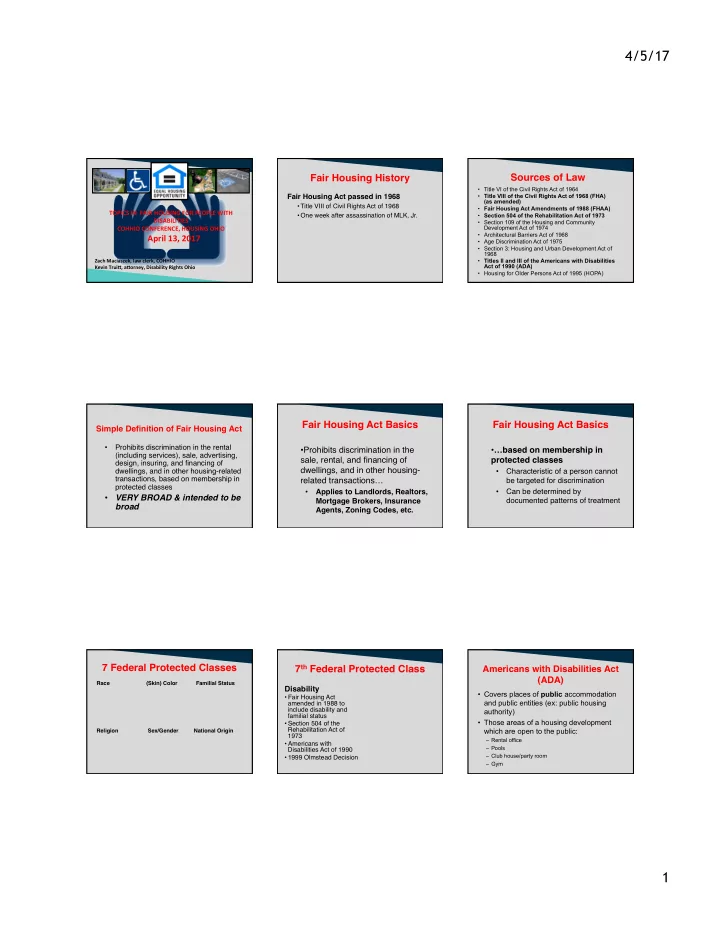
4/5/17 Sources of Law Fair Housing History Title VI of the Civil - - PDF document

4 5 17
SMART_READER_LITE
LIVE PREVIEW

4/5/17 Sources of Law Fair Housing History Title VI of the Civil - - PDF document

4/5/17 Sources of Law Fair Housing History Title VI of the Civil Rights Act of 1964 Title VIII of the Civil Rights Act of 1968 (FHA) Fair Housing Act passed in 1968 (as amended) Title VIII of Civil Rights Act of 1968 Fair Housing


slide-1
SLIDE 1

4/5/17 1

TOPICS IN FAIR HOUSING FOR PEOPLE WITH DISABILITIES COHHIO CONFERENCE, HOUSING OHIO April 13, 2017

Zach Maciaszek, law clerk, COHHIO Kevin TruiL, aLorney, Disability Rights Ohio

Fair Housing History

Fair Housing Act passed in 1968

  • Title VIII of Civil Rights Act of 1968
  • One week after assassination of MLK, Jr.

Sources of Law

  • Title VI of the Civil Rights Act of 1964
  • Title VIII of the Civil Rights Act of 1968 (FHA)

(as amended)

  • Fair Housing Act Amendments of 1988 (FHAA)
  • Section 504 of the Rehabilitation Act of 1973
  • Section 109 of the Housing and Community

Development Act of 1974

  • Architectural Barriers Act of 1968
  • Age Discrimination Act of 1975
  • Section 3: Housing and Urban Development Act of

1968

  • Titles II and III of the Americans with Disabilities

Act of 1990 (ADA)

  • Housing for Older Persons Act of 1995 (HOPA)

Simple Definition of Fair Housing Act

  • Prohibits discrimination in the rental

(including services), sale, advertising, design, insuring, and financing of dwellings, and in other housing-related transactions, based on membership in protected classes

  • VERY BROAD & intended to be

broad

Fair Housing Act Basics

  • Prohibits discrimination in the

sale, rental, and financing of dwellings, and in other housing- related transactions…

  • Applies to Landlords, Realtors,

Mortgage Brokers, Insurance Agents, Zoning Codes, etc.

Fair Housing Act Basics

  • …based on membership in

protected classes

  • Characteristic of a person cannot

be targeted for discrimination

  • Can be determined by

documented patterns of treatment

7 Federal Protected Classes

Race (Skin) Color Familial Status Religion Sex/Gender National Origin

7th Federal Protected Class

Disability

  • Fair Housing Act

amended in 1988 to include disability and familial status

  • Section 504 of the

Rehabilitation Act of 1973

  • Americans with

Disabilities Act of 1990

  • 1999 Olmstead Decision

Americans with Disabilities Act (ADA)

  • Covers places of public accommodation

and public entities (ex: public housing authority)

  • Those areas of a housing development

which are open to the public:

– Rental office – Pools – Club house/party room – Gym

slide-2
SLIDE 2

4/5/17 2

Disability Definition

  • A individual with a disability is any person who

has a physical or mental impairment that substantially limits one or more major life activities

  • Person who has a record of such impairment
  • Person regarded as having such an impairment

Physical or Mental Impairment

  • Visual or Hearing Impairment
  • Mobility Impairment
  • Mental Illness
  • Emo6onal Illness
  • Intellectual Disability
  • Alcoholism & Past Substance

Abuse

  • Chronic Disease: muscular

dystrophy, mul6ple sclerosis, HIV, Cancer, Au6sm, ADHD, asthma, etc.

  • Can be temporary

Major Life Activities

Including, but not limited to: Seeing Hearing Walking Breathing Performing Manual Tasks Caring for One’s Self Speaking Thinking

Why Focus on Disability

According to the US Census Bureau 2010:

  • 56.7 MM people in the US experience a

disability (19%)

  • 29.5 MM were between the ages of 21-64 and

41% of them were employed

  • 19.2 Million were 65 and over.

Why Focus on Disability

According to HUD:

  • Approximately 40% of all cases filed

in 2009 were disability-related

  • In 2013 the # of disability-related

cases was more than 50%

  • That % climbs every year

Reasonable Accommodations & Reasonable Modifications

Fair Housing Act requires that:

  • A landlord may not unreasonably refuse to

provide a reasonable accommodation of a rule, policy, or procedure to address the needs of a person with a disability

  • A landlord may not unreasonably deny permission

to a tenant to make a modification of the premises to address the needs of a person with a disability

Accommodation A change in rules, policies, practices, or services

Accommodation Example #1 Accommodation Example #1

  • ADA
  • Trained
  • Dogs or miniature horses
  • FHA
  • No training
  • No certification
  • Not limited to dogs & horses
  • No # limit
slide-3
SLIDE 3

4/5/17 3

Accommodation Example #2 Other examples of accommodations

  • Live-in aide for people with disabilities who

rely on others to care for them;

  • Ground floor apartment for someone who

has a mobility impairment and cannot use stairs;

  • Effective communication for people who

are deaf or blind.

Anderson v. City of Blue Ash

  • Important decision from the federal Sixth

Circuit Court of Appeals

  • This case involved a child with multiple

disabilities whose doctor prescribed her equine therapy (a miniature horse) to enable her to walk and play and exercise in the backyard of her home, which would provide her many therapeutic benefits and was important for her long-term health.

Anderson v. City of Blue Ash

  • A municipal ordinance prohibited the

presence of horses and other farm animals on residential property in the city. The district court dismissed the family’s case against the city.

  • The Sixth Circuit reversed the dismissal on

the basis of the ADA and FHAA.

Anderson v. City of Blue Ash

The case was eventually settled by the

  • parties. The family was permitted to keep

the miniature horse on their residential property and agreed to regularly remove waste from their property, obtain no more animals, and allow city employees to enter the exterior of their property without notice to ensure compliance.

Ellie, the miniature horse Fair Housing Modifications

Under the FHA, a landlord may not unreasonably deny permission to a tenant to make a modification of the premise to address the needs

  • f a person with a disability

Tenant’s wallet ↑

Modification

A structural change (interior or exterior) made to existing premises, occupied or to be occupied by a person with a disability

Modification Example # 1

Adding Grab Bars in the Shower

slide-4
SLIDE 4

4/5/17 4

Modification Example #2

Door Knob à Door Handle

Modification Example # 3

Removing Carpet à

Modification

  • Exterior v. Interior Modification
  • Exterior—under FHA, tenant cannot be

required to remove

  • Interior---under FHA, tenant can be

required to remove

“Reasonable” Definition

  • 1. Economically and architecturally feasible
  • 2. Does not alter the fundamental nature of the

program

  • 3. Each request must be considered on “case by

case” basis

Section 504

States: “No otherwise qualified individual with a disability in the United States… shall, solely by reason of her or his disability, be excluded from participation in, be denied the benefits of, or be subjected to discrimination under any program, service

  • r activity receiving federal financial

assistance… .”

Section 504 and Fair Housing

Although Section 504 imposes greater obligations than the Fair Housing Act, (e.g., providing and paying for reasonable modifications that involve structural modifications to units or public and common areas), the principles discussed in this Statement regarding reasonable accommodation under the Fair Housing Act generally apply to requests for reasonable accommodations to rules, policies, practices, and services under Section 504.

Who is covered under 504?

YES:

  • Owned by Public Housing Authority
  • Project-based Sec6on 8
  • 202/811 – senior/disabled
  • USDA Rural Development proper6es
  • Sec6on 236 (with a mortgage subsidy)
  • Other federal funding (CDBG, HOME, etc.)

NO:

  • Housing Choice Vouchers (aka METRO)
  • All other privately owned/financed property
  • LIHTC proper6es without federal gap financing

Paying for Section 504

504 requires that programs that receive FEDERAL FUNDING must make accommodations and modifications to permit full participation by people with disabilities

504? Landlord has to pay. Modifica]on = Accommoda]on

Preparing a RA/RM

Before submitting, make sure:

  • Person is considered to have a disability under

FHA/504

  • Not obvious? Then one may need documentation
  • Major Life Activity impaired in housing
  • Strong “nexus”
  • 504 eligible?
slide-5
SLIDE 5

4/5/17 5

Documentation: Disability

Unless the need is obvious and apparent, landlord allowed to ask for documentation of an individual’s disability-related need for the request

  • NOT entire medical history
  • Sources: Doctor, therapist, peer support group, non-

medical service agency, individual, etc.

Nexus

Nexus = Link between Disability and RA/RM request Given the person’s disability and the resulting impairment, is the RA/RM necessary?

Submitting a RA/RM

  • The basic 4-part test to determine

reasonableness:

– 1. Does the applicant/tenant have a disability? – 2. Is there a nexus between the disability and the problem? – 3. Will accommodation/modification fix the problem? – 4. Is it an undue burden?

Interactive Process

“…Both sides must communicate directly, exchange essen6al informa6on and neither side can delay or obstruct the process…”

  • Marilyn Tobocman,

Assistant A_orney General for Civil Rights Issues

  • Landlord has affirmative duty to participate in

Interactive Process

  • Skepticism ≠ Intrusiveness
  • Tenant’s duty to show the accommodation is

necessary and reasonable

Request Ignored or Denied?

VIOLATION A ALERT!

  • Document the details
  • File a complaint with HUD or OCRC
  • HUD/OCRC conducts investigation
  • Mediation – allows for creative remedies
  • Decision: NO Cause or FOR Cause
  • Remedies: Injunctions, damages, civil penalties,

court costs, and attorney fees

  • Can always go to court

Olmstead v. L.C.

  • Under the ADA and the U.S. Supreme

Court’s decision in Olmstead v. L.C., people with disabilities have the right to live and work and receive the services and support they need in the most integrated, least restrictive setting in the community instead of an institutional setting, like a nursing facility or hospital.

The developmental disabilities system in Ohio

  • DRO last year filed a class action

Olmstead lawsuit against state officials in Ohio, alleging that there are nearly 6,000 people with intellectual and developmental disabilities in large institutional settings across the state.

  • Many would prefer to live in their own

homes in the community with appropriate services and support.

Olmstead and the FHAA and ADA

  • Under the FHAA and ADA, municipalities

and other local governments cannot make zoning or land use decisions or policies that exclude or otherwise discriminate against people with disabilities.

  • They must also make reasonable

accommodations to allow people with disabilities an equal opportunity to live in

  • ur communities.

WHERE TO GET HELP

  • Fair Housing Organizations:
  • Fair Housing Contact Service:
  • 330-907-8473
  • www.fairhousingakron.org<http://

www.fairhousingakron.org>

  • Summit, Portage, Medina, Stark Counties

(and others where a private fair housing group does not exist)

slide-6
SLIDE 6

4/5/17 6

WHERE TO GET HELP

  • Fair Housing Advocates
  • 330-253-2450
  • Located in Akron but serve outside this

area

WHERE TO GET HELP

  • Housing Research and Advocacy Center
  • 216-361-9241
  • www.thehousingcenter.org<http://

www.thehousingcenter.org>

  • Cuyahoga & Lorain Counties (Cleveland

area)

WHERE TO GET HELP

  • Fair Housing Resource Center
  • 440-392-0147
  • www.fhrc.org<http://www.fhrc.org>
  • Lake, Geauga, Ashtabula Counties (far

Northeastern counties of OH)

WHERE TO GET HELP

  • Toledo Fair Housing Center
  • 419-243-6163
  • www.toledofhc.org<http://

www.toledofhc.org>

  • Lucas & Wood Counties

WHERE TO GET HELP

  • Miami Valley Fair Housing Center
  • 937-223-6035
  • www.mvfairhousing.com<

http://www.mvfairhousing.com>

  • Montgomery & Green Counties (Dayton

area)

WHERE TO GET HELP

  • Central Ohio Fair Housing Association
  • 614-344-4663
  • www.cofha.com<http://www.cofha.com>
  • Franklin & Delaware Counties (Columbus

area)

WHERE TO GET HELP

  • Housing Opportunities Made Equal

(HOME) Cincinnati

  • 513-721-4663
  • www.cincyfairhousing.com<http://

www.cincyfairhousing.com>

  • Greater Cincinnati area including Hamilton

County

WHERE TO GET HELP

  • Legal Aid (866-LAW-OHIO)(866-529-6446)
  • Disability Rights Ohio (800-282-9181)
  • COHHIO (tenant information line—

888-485-7999

  • OCRC (888-278-7101)

Joe Maskovyak, COHHIO

  • joemaskovyak@cohhio.org
  • Toll Free: 888-485-7999 (Housing Information Line)
  • Direct: 614-280-1984 x133
  • Kevin Truitt, Disability Rights Ohio
  • ktruitt@disabilityrightsohio.org
  • (614) 466-7264 or (888) 282-9181

Thank Thank you! u!

How to stay in touch: