
SLIDE 1
Technical Sessions Introduction
September 14, 2011
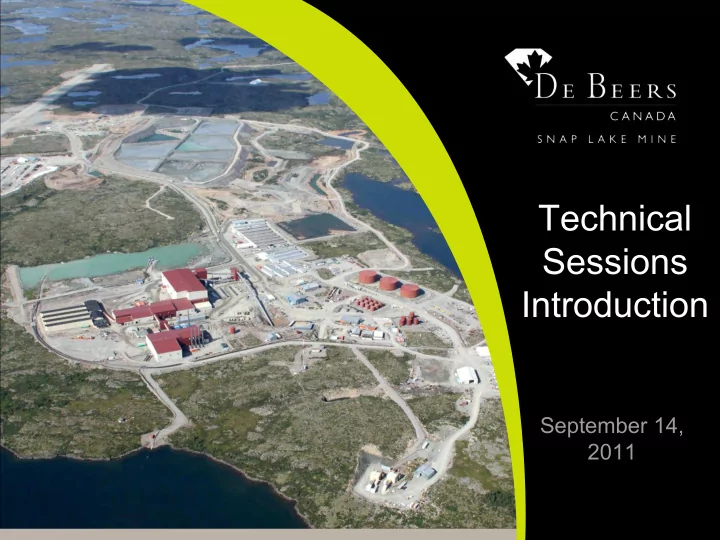
Sessions Introduction September 14, 2011 De Beers in Canada - - PowerPoint PPT Presentation
Technical Sessions Introduction September 14, 2011 De Beers in Canada Years Milestone 1961 to Exploration for diamond deposits present 2000 De Beers acquires Winspear Diamonds and Snap Lake Deposit 2004 Environmental
September 14, 2011
Years Milestone 1961 to present
2000
2004
build and operate 2005
2008
2009
2010
2
without harm to people or the environment – Care and respect for the environment, employees and communities – Benefits: employees, communities, businesses – Effective management systems; continuous improvement – Compliance with legal requirements and De Beers policies and standards
3
– Grade – Dilution – Recovery – Cost of production – Diamond prices
study
updates to hydro-geological modelling
4
5
6
– 15 year term of license – Change “project” to “mine” for clarity and consistency – Change of title of Ore Storage, Waste Rock, Processed Kimberlite Management Plan (OSWRPKMP) to North Pile Management Plan – Clarification of “major storm event” to inform monitoring – Combine waste and water management plans into one part of water license (separate subsections)
annually
7
Changes requested (cont’d):
8
Demobilization of temporary camp winter 2012 Sewage Treatment Plant: Being relocated to accommodate new accommodation complex Total Dissolved Solids (TDS) Currently De Beers is carrying out TDS toxicity studies to determine an effects threshold:
work conducted at University of Guelph Conditions within the water license can be changed through a Water Board Hearing without a full water license renewal
9
North Pile
– Installed and tied into the Starter Cell – Upgraded thickener pumps installed in Process Plant for increased density of PK – Current stand-by PK line will remain in place as back-up
Q1 2012 assuming trial successful
locations are required
10
ICRP
Reclamation Plan (ICRP) for the Snap Lake Mine – Document Approved by the MVLWB
– Updated goals and objectives for closure and reclamation – Refined predictions for closure conditions – Updated research program to address uncertainties and concerns – Updated schedule for progressive reclamation of the North Pile – Updated Gantt chart with estimated schedule for closure and reclamation of all mine elements
11
Progressive Reclamation (2011 ICRP)
Final Closure and Reclamation Activities
initiate in 2030 with mobilization of equipment on the 2029/2030 winter road
12
Closure of Mine Elements
Main Snap Lake Mine Features
North Pile Underground Mine Water Management Structures Process Facilities and Surface Infrastructure Crushed Rock/Ore and Concrete Facilities Roadways and Airstrip Solid Waste Facilities
Disposal Facility within North Pile Landfarm within North Pile area Camp Facilities Laydown Area Process Facilities and Related Infrastructure Mine Offices, Mine Dry and Maintenance Shops General Utilities Building Underground Heating Plant Crushed Rock/Ore Storage Facilities Construction Shops - Warehouses Fresh Water Intake and Pumphouse Fuel Storage Facilities Powder Magazines Site Roads, Culverts and Ditches Airstrip and Related Facilities Processed Kimberlite (PK) Water Management Pond (WMP) Pipelines Treatment Plants
Mine Water Sewage Water
Transfer Storage Area Rock Quarries Paste Backfill Non-Hazardous Wastes Hazardous Wastes and Magazines PAG Waste Rock Seepage and Sumps Diversion Ditches Mine Water (Collection and Removal) Cover
Fresh Water
Diversion Ditches and Site Hydrology Power Facilities and Related Infrastructure Paste Backfill Facilities Crusher and Related Facilities Winter Access Road Mobile Equipment Incinerator and Related Facilities Underground Workings Concrete Facilities
13
Reclamation Research Plans
14
Reclamation Research Plans (cont’d)
15
Financial Security (final determination by Board)
the Snap Lake mine and have exchanged information
the development of a financial security estimate that captures the “total liability associated with permanent closure, including any costs associated with progressive reclamation and temporary closure”
(Source: MVLWB 2009 DRAFT Closure and Reclamation Plans – Preparation Guidelines for Mines within the Mackenzie Valley)
16
Annual Mine Reclamation Status Report
MVLWB on an annual basis:
(Part I#8)
17
Hydrology
Lake over the life of the mine (3.3 to 5.3 cm)
lakes decreased approx 16 cm due to low precipitation and high evaporation
nearby lakes, primarily influenced by atmospheric conditions – not the mine
18
manganese1 are predicted to remain below applicable water license thresholds / benchmarks
TDS predicted to exceed Water License Limit (whole lake average)
quality guideline by 2016
benchmarks have changed since the EA (will be discussed under EQC)
1Manganese was measured not modeled
19
20
Water Quality
– fluoride (approx. ½ of the data above interim aquatic guideline) – manganese (4 of 134 samples collected above aesthetic drinking water guideline)
– field study near historic explosives storage pad: not a clear, dominant source of ammonia to lake; ammonia concentrations in Snap Lake low compared to water quality guidelines – sampling of downstream lakes to: estimate spatial extent of mine- related effects downstream of Snap Lake; aid in selection of future downstream AEMP stations; and, obtain data to compare/validate existing downstream lake water quality model
21
Plankton communities have changed since baseline:
– biomass increased in Snap Lake 2004-2009 then decreased in 2010 – shift from Cyanobacteria-Chrysophycea co-dominance to diatom dominance
– no clear trends in overall biomass – calanoid copepods were dominant taxa pre-mine, decreased biomass since 2006 – all species of rotifers have appeared and disappeared – no clear trend related to effluent discharge
22
Sediment Quality
cadmium, chromium, copper, zinc) in sediments
measured substances due to the Mine except available phosphate near diffuser
sediment sampling
surface runoff on Snap Lake sediment quality
23
Sediment Invertebrates
total densities) – predicted in EA
predicted in EA
mesh sieves at a sub-set of stations to address comment in 2009 AEMP that using a 500 µm sieve in the field may result in loss of small Chironomidae (midges) that are a dominant part of the benthic community in Snap Lake
24
Fish
Lake)
not increased over time in large fish
maximum in literature
25
Fish (cont’d)
February/March 2011: baited minnow traps with various attractants/food not successful method for capturing slimy sculpin in Snap Lake in spring / under ice conditions
– review of monitoring program design (monitoring should not put fish stocks at risk) – develop an appropriate monitoring response for fish that will link the AEMP with adaptive management
26
27