
SLIDE 1
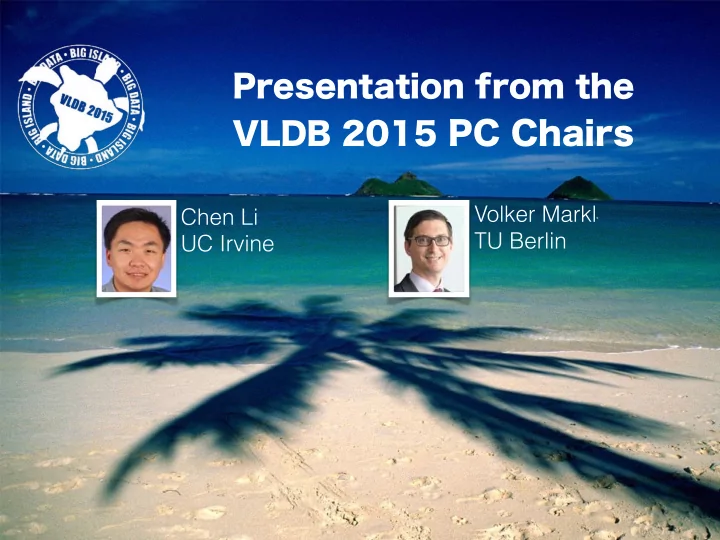
Presentation from the VLDB 2015 PC Chairs
Chen Li UC Irvine Volker Markl TU Berlin
VLDB 2015 PC Chairs Volker Markl Chen Li TU Berlin UC Irvine 33 - - PowerPoint PPT Presentation
Presentation from the VLDB 2015 PC Chairs Volker Markl Chen Li TU Berlin UC Irvine 33 6 Tutorials Research Sessions VLDB 4 7 Keynotes Industrial Sessions 2 3 Panels Demo Sessions 2 9 Poster Sessions Workshops 2015 Turing Award
Presentation from the VLDB 2015 PC Chairs
Chen Li UC Irvine Volker Markl TU Berlin
6 4 2 9
Tutorials Keynotes Panels
33 7 3
Research Sessions Industrial Sessions Demo Sessions Workshops
2
Poster Sessions 2015 Turing Award Lecture!
Fatma Özcan Jignesh M. Patel Magdalena Balazinska Felix Naumann Yi Chen Shivnath Babu Stefan Manegold Rainer Gemulla Kevin C. Chang
Demonstration Chair
Alfons Kemper
Industrial, Applications, & Experience Track Associate Editors
Anhai Doan Prasan Roy
Gregor Hackenbroich
Proceedings Chairs
Daisy Wang Tyson Condie
PhD Workshop Chairs Workshop Chair Tutorial Chairs Panel Chair
Jennie Duggan Rachel Pottinger Norman Paton Tova Milo Pierre Senellart Joe Hellerstein
Committee
Constructing an Interactive Natural Language Interface for Relational Databases Tuesday, 15:30-17:00 (Research Session 7)
The paper proposes an interactive natural language interface for relational databases, which enables novice users to construct complex queries. It improves the usability of an RDBMS, as it enables anyone to use to ask questions to a database system. This paper is likely to start a new line of research as well as products. For a query expressed in natural language, the interface interacts with the user in several steps (as we do in real life to make our questions more precise) in determining the query semantics and subsequently generating the corresponding SQL. At each step, the system interactively presents to the user its own understanding of the query through alternatives, as opposed to just final answers. The authors rely on a query tree structure to represent the interpretation of an NLP query from the database's perspective, which facilitates verification by users, and translation into SQL. The system (NLIDB) was implemented following the component-based approach, where each component can be independently constructed, optimized or Best Paper Award (Runner-up)
Resource Bricolage for Parallel Database Systems Wednesday, 13:30–15:00 (Research Session 15)
This is a core database systems paper that addresses a real problem, mainly how to deal with the heterogeneity in the machines composing a cluster-based database system. The paper proposes a mechanism ("Resource Bricolage") to make efficient use of heterogeneous hardware when processing a workload in a parallel database system. It addresses a very relevant problem (clusters don't grow homogeneously) and is the first paper on this subject. The approach is relatively simple and practical, using linear programming to optimize data distribution - and thus resource consumption - in a cluster. The techniques were implemented on top of Microsoft SQL server parallel data Committee
Best Demo Award
Vizdom: Interactive Analytics through Pen and Touch
Thursday, 15:30-17:00 (Demo Session 3)
Andrew Crotty (Brown University) Alex Galakatos (Brown University) Emanuel Zgraggen (Brown University) Carsten Binnig (Brown University) Tim Kraska (Brown University)
Mapping Talks to Posters
VLDB Journal Papers Tuesday Industrial Track Papers 7 Industrial Sessions 30 min/paper 1 min intro, 25 min presentation, 4 min Q&A Tuesday Research Track Papers (including Rollover Papers from VLDB 2014) 33 Research Sessions 18 min/paper, 1 min intro, 15 min presentation, 2 min Q&A Tuesday Sessions 1-12 Thursday Sessions 13-33
Papers Talks Posters
151 21 20 49
The total number of accepted papers in the Research Track out of 710 submissions: 139 will be presented this week and 12 will rollover to VLDB 2016. The total number
from VLDB 2014. The total number
papers in the Industrial Track
submissions. The total number
papers in the Demonstration Track out of 148 submissions.
12 Submission Acceptance
710 151
21.3%
Total Submissions Accepted Papers
Acceptance Rate
4.8% 84.6%
Acceptance Rate After the First Round Acceptance Rate After the Revision
14 Text, Data Types, and Semi-structured Data Database Engines Applications Novel Database Architectures
Submission Accepted 17 Information Integration Experiments and Analysis Languages, Usability, and User Interfaces Innovative Systems Benchmarks and Administrations
Submission Accepted 18 Submissions Acceptance
20 Subject Areas
20.02% 18.99% 17.26% 13.58% 11.28% 8.63% 3.91% 2.88% 1.38% 20.13% 14.47% 14.47% 13.84% 13.84% 8.81% 3.14% 2.52% 1.89% 21 8 Tutorials on Publicly Available Open Source Big Data Systems
To be held on Friday Bring your laptops! Each tutorial will be presented twice. As Senior Vice President of Systems Technology at Oracle, Juan Loaiza is in charge of developing the mission-critical capabilities of Oracle Database, including data and transaction management, high availability, performance, in-memory processing, enterprise replication, and Oracle Exadata.
computer science from the Massachusetts Institute of Technology.
Juan Loaiza, Oracle
Engineering Database Hardware and Software Together
Anastasia Ailamaki, EPFL
Databases and Hardware: The Beginning and Sequel of a Beautiful Friendship
Todd Walter, Teradata
Big Plateaus of Big Data on the Big Island
Magdalena Balazinska, University of Washington
Big Data Research: Will Industry Solve all the Problems?
Many thanks to everyone who devoted their time & energy to make VLDB 2015 possible.
Enjoy the conference!
We thank Reda Al Azmeh for his support in preparing figures and this PC Chair presentation!