However, would the limitation of surface heat fluxes always lead to - - PowerPoint PPT Presentation

however would the limitation of surface heat fluxes
SMART_READER_LITE
LIVE PREVIEW

However, would the limitation of surface heat fluxes always lead to - - PowerPoint PPT Presentation

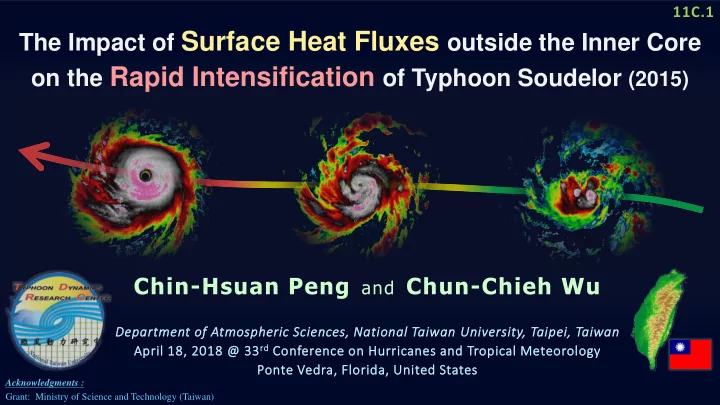
11C.1 The Impact of Surface Heat Fluxes outside the Inner Core on the Rapid Intensification of Typhoon Soudelor (2015) Chin-Hsuan Peng and Chun-Chieh Wu Department of Atmospheric Sciences, National Taiwan University, Taipei, Taiwan rd Conference on


slide-1
SLIDE 1

The Impact of Surface Heat Fluxes outside the Inner Core

  • n the Rapid Intensification of Typhoon Soudelor (2015)

Chin-Hsuan Peng and Chun-Chieh Wu

Department of Atmospheric Sciences, National Taiwan University, Taipei, Taiwan April 18, 2018 @ @ 33 33rd

rd Conference on Hurricanes and Tropical Meteorology

Ponte Vedra, Florida, United States

11C.1

Acknowledgments : Grant: Ministry of Science and Technology (Taiwan)

slide-2
SLIDE 2

2

Introduction – TC intensity change and rapid intensification (RI)

Challenge of TC intensity forecast

  • The forecast skill of TC intensity is regarded to be a challenging topic (NHC 2013; JMA 2013; Ito 2015).
  • Unexpected RI episodes could cause serious loss of life and property to the coastal regions (Chang and Wu 2017).

Definition of RI

  • In terms of minimum central pressure (Pmin) : ≥ 42 hPa / 24 hr drop (Holliday and Thompson 1979)
  • In terms of surface maximum tangential wind (Vmax) : ≥ 35 kts / 24 hr increase (Kaplan et al. 2010; Lee et al. 2016)

Favorable inner-core conditions to RI

Secondary circulation Convective burst Inertial stability Upper-level warming Low-level high θe air

(e.g., Eliassen 1951; Ooyama 1969; Ooyama 1982; Shapiro and Willoughby 1982)

(Schubert and Hack 1982; Vigh and Schubert 2009)

(Heymsfield et al. 2001; Reasor et al. 2009; Guimond et al. 2010; Zhang and Chen 2012; Chen and Zhang 2013; Rogers et al. 2013; Wang and Wang 2014; Chen and Gopalakrishnan 2015)

(Zhang and Chen 2012; Chen and Zhang 2013; Wang and Wang 2014)

(Montgomery et al. 2006; Barnes and Fuentes 2010; Miyamoto and Takemi 2013; Wang and Wang 2014)

11C.1

slide-3
SLIDE 3

3

Control

(Zhang and Emanuel 2016) (Green and Zhang 2013)

Intensity

Time

11C.1

Introduction – The role of surface heat fluxes in TC intensification

U = 20 m/s U = 10 m/s U = 5 m/s

  • When the surface wind speed (U) is artificially

capped (at ≥ 5 m/s) in the whole domain, TC still reach hurricane intensity while averaged intensification rate decrease due to the reduction of surface heat fluxes.

  • Surface sensible heat fluxes:

SHF = ρ cp CH U(Δθ)

  • Surface latent heat fluxes:

LHF = ρ Lv CQ U(Δq)

(Montgomery et al. 2015)

slide-4
SLIDE 4

4

However, would the limitation of surface heat fluxes always lead to a reduction of TC intensification rate?

11C.1

slide-5
SLIDE 5

5

Model and experimental design

Data

ERA-Interim reanalysis data (ECMWF)

Domain

Two-way interactive, movable, triply nested grid ( 15 / 5 / 1.67 km ) Vertical levels 41 eta levels (model top set at 30 hPa)

Simulation period

7/31 12Z ~ 8/3 12Z (including RI phase) Microphysics WSM 6-class graupel scheme

Boundary layer

Yonsei University parameterization (YSU) Radiation RRTMG scheme Cumulus Kain-Fritsch scheme (only for domain 1) Initialization Digital filter initialization (DFI)

Model setting in WRF simulation (V3.6.1) Sensitivity experiments CTRL 10IC 25IC 15IC 20IC 30IC 40IC 50IC

60km

300km

90km 120km 150km 180km 240km

  • The surface wind (U) is capped at 1 m/s.

(It means that surface fluxes are mostly suppressed.)

The flux-suppressed (blue shaded) regions are as follows:

11C.1

SHF = ρ cp CH U (Δθ) LHF = ρ Lv CQ U (Δq)

60km 500km

slide-6
SLIDE 6

6 Start

(RI-24hr) prior to RI during RI

RI onset 8/2 06Z

11C.1

slide-7
SLIDE 7

7

CTRL 10IC 15IC 30IC 40IC

Non-RI case RI case

Domain size: 370 × 370km Field: reflectivity (1km height) 11C.1

slide-8
SLIDE 8

8 10IC - CTRL

CTRL

15IC - CTRL 30IC - CTRL 40IC - CTRL

Shaded : Vertical wind (W) Vector : (Vr , W×10)

R

Z

11C.1

Sensitivity experiments – Secondary circulation difference (prior to RI)

RMW

slide-9
SLIDE 9

9 10IC - CTRL 15IC - CTRL 30IC - CTRL 40IC - CTRL

Shaded : Vertical wind (W) Vector : (Vr , W×10)

R

Z CTRL

Sensitivity experiments – Secondary circulation difference (during RI)

11C.1

slide-10
SLIDE 10

Sensitivity experiments – CFADs of vertical velocity within the RMW

10

(prior to RI) 11C.1

40IC - CTRL

slide-11
SLIDE 11

Sensitivity experiments – Inertial stability and diabatic heating

15IC 40IC

11

CTRL

Non-RI case RI case RI case

(prior to RI) 11C.1

Z R

10 20 10 20 10 20

slide-12
SLIDE 12

Sensitivity experiments – Surface fluxes & wind speed at the lowest level

12

R 40IC CTRL

RI + 12hr RI – 12hr

Shaded : Surface wind speed (Vs) Contour : Surface fluxes of moist entropy

Fss = CE 𝜍Vs ( Ss − S0 )

(Juračić and Raymond 2016)

Time

11C.1

RI onset

slide-13
SLIDE 13

Sensitivity experiments – Diabatic heating-generated vorticity (inner core)

13

X

Y

40IC CTRL

Shaded: Diabatic heating difference between 0.5 - 3km height Contour: Diabatic heating-generated vorticity averaged from 1 to 2km height 𝜖ζ 𝜖t ∝ 𝜖HD 𝜖z ζ :

Relative vorticity

HD :

Diabatic heating

(Juračić and Raymond 2016)

11C.1

slide-14
SLIDE 14

Sensitivity experiments – Instability in the lower troposphere (θe* & RH)

14

CTRL 40IC R

Z

(RI – 12hr)

Shaded: RH Contour: θe*

3km height

11C.1

Surface

slide-15
SLIDE 15

15

CTRL 40IC R

Z

Shaded: RH Contour: θe*

Sensitivity experiments – Instability in the lower troposphere (θe* & RH)

(RI onset)

3km height

11C.1

Surface

slide-16
SLIDE 16

16

CTRL 40IC R

Z

Shaded: RH Contour: θe*

Sensitivity experiments – Instability in the lower troposphere (θe* & RH)

(RI + 12hr)

3km height Surface

11C.1

80km

slide-17
SLIDE 17

Z Larger

Vmax

Stronger, More compact warm core

Suppressed heat fluxes

Less active rainbands Enhanced eyewall updraft

≥ 2.5 × inner-core size

25IC 30IC 40IC 50IC

11C.1

Conclusions – Schematic diagram

slide-18
SLIDE 18

Suppressed the surface fluxes outside the inner core Convection develops closer to TC center TC inner core gains more energy from the ocean Inertial stability ↑ in the inner-core region The most violent winds concentrate in the inner-core region Convectively-generated PV concentrates near TC center Less heat energy transported into the inner core Relatively dry air intrudes into a TC

Positive effect Negative effect

Stronger TC Weaker TC

25IC 40IC 30IC 50IC 10IC 15IC

11C.1

Conclusions – Flowchart

slide-19
SLIDE 19

Ongoing & future works

  • Cap the surface wind at 5, 10, 20 m/s in the calculation of surface heat fluxes.
  • Investigate the relation between TC intensification rate and the surface heat fluxes in

different radial extents.

  • Classify the asymmetric processes before and during RI, especially the relationship

between rainbands and inner core. 11C.1