Atmospheric Neutrino Fluxes: The use of muon fluxes to Improve the - - PowerPoint PPT Presentation

atmospheric neutrino fluxes the use of muon fluxes to
SMART_READER_LITE
LIVE PREVIEW

Atmospheric Neutrino Fluxes: The use of muon fluxes to Improve the - - PowerPoint PPT Presentation

Atmospheric Neutrino Fluxes: The use of muon fluxes to Improve the Accuracy in Low Energies. May, 28, 2018 M. Honda @ PANE 2018 1. Over view of the calculation of atmospheric neutrino and the Muon Calibration of Atmospheric Neutrino. 2.


slide-1
SLIDE 1

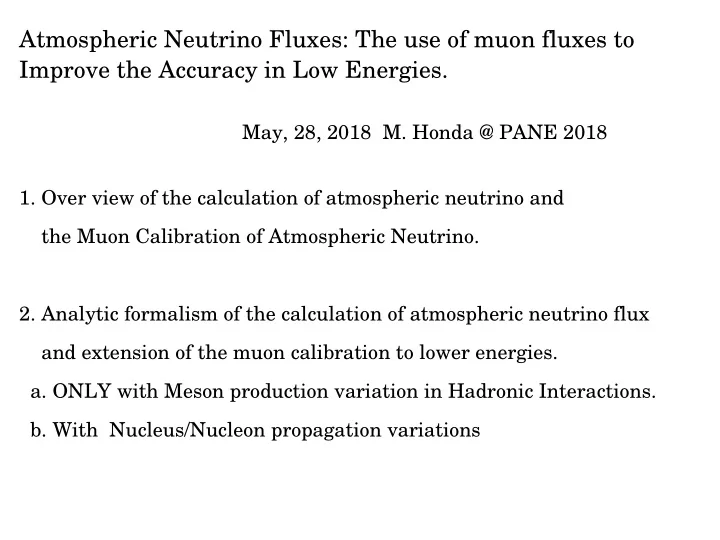
Atmospheric Neutrino Fluxes: The use of muon fluxes to Improve the Accuracy in Low Energies. May, 28, 2018 M. Honda @ PANE 2018

  • 1. Over view of the calculation of atmospheric neutrino and

the Muon Calibration of Atmospheric Neutrino.

  • 2. Analytic formalism of the calculation of atmospheric neutrino flux

and extension of the muon calibration to lower energies.

  • a. ONLY with Meson production variation in Hadronic Interactions.
  • b. With Nucleus/Nucleon propagation variations
slide-2
SLIDE 2

Gaisser Formula for the illustration (by T.K.Gaisser at Takayama, 1998)

Where : Cosmic Ray Flux : Geomagnetic fjeld : Hadronic Interaction Model, Air Profjle, and meson-muon decay : Hadronic Interaction Model, Air Profjle, and meson decay

Φν=Φ primary⊗Rcut⊗Y ν Rcut=Rcut(Rcr ,latt. , long. ,θ ,ϕ) Y ν=Yieldν(h ,θ) Φμ=Φ primary⊗Rcut⊗Y μ

Φ primary

Y μ=Yieldμ(h ,θ)

slide-3
SLIDE 3

Simulation Sphere (Rs = 10 x Re)

Full 3D-Calculation

Injection Sphere (Re +100lm)

Virtual Detector

The neutrino flux is calculated from the number of neutrinos path through with virtual detector correction.

Cosmic Rays are sampled and injected here

Re = 6378km

Cosmic ray go out this sphere are discarded. Cosmic rays go beyond are pass the rigidity cutofg test

slide-4
SLIDE 4

Balloon Borne (BESS) Satellite (ISS, AMS02)

Direct Observation

slide-5
SLIDE 5

Cosmic Ray Spectra Model Based on AMS02 Observation (2017 1ry model)

Looking forward to hearing from CALET and ISS-CREAM

slide-6
SLIDE 6

Kamioka INO site South Pole Near North Pole (Physalmi)

Atmosphere model (NRLMSISE-00) and seasonal variations

slide-7
SLIDE 7

IGRF10 Geomagnetic Horizontal Field Strength

slide-8
SLIDE 8

We use Modefied DPMJET3 as the Hadronic interactio model Modefied DPMJET3 = parameter fitting of the out put of DMPMJET3 Quick, Easy to modify, but conseration rules are statistical. Note, we have tried other interaction models, and they give a similar results when they are modified in our method to reproduce the

  • bserved muon fluxes.
slide-9
SLIDE 9

Muon Observations

L3(+C) BESS

Tsukuba (KEK) Mt Norikura Balloon Altitude

slide-10
SLIDE 10

Muon data used here

BESS-TeV at Tsukuba L3+C at Cern Mutron at Tanashi

slide-11
SLIDE 11
slide-12
SLIDE 12

Muon Calibration of Interaction Model

Quick 3D Calculation for Muon flux. As the muon flux is a “local quantity” (γ ct 〜 60km at10 GeV ), We can calculate it in a quick calculation method:

  • 1. Inject cosmic rays just above the observation point,
  • 2. Analyze all muons reach the surface of Earth.
slide-13
SLIDE 13

Comparison of Quick 3D and Full 3D calculations

Full 3D Quick 3D

μ

+

μ

This method works above 0.2 GeV/c.

slide-14
SLIDE 14

P=10 GeV/c P=100 GeV/c P=1 TeV/c P=1 GeV/c

Responsible 1ry CR energy and Interaction Energy for Vertical Muon

slide-15
SLIDE 15

P=10 GeV/c P=1 GeV/c

Responsible 1ry CR energy and Interaction Energy for Horizontal Muon

P=100 GeV/c P=1 TeV/c

slide-16
SLIDE 16

Median Energy of the Responsible 1ry and Interaction Energy for Muons

slide-17
SLIDE 17

P=10 GeV/c P=1 GeV/c

Responsible 1ry CR energy and Interaction Energy for Vertical Neutrino

P=100 GeV/c P=1 TeV/c

slide-18
SLIDE 18

P=10 GeV/c P=1 GeV/c

Responsible 1ry CR energy and Interaction Energy for Horizontal Neutrino

P=100 GeV/c P=1 TeV/c

slide-19
SLIDE 19

Median Energy of the Responsible 1ry and Interaction Energy for Neutrinos

slide-20
SLIDE 20

Contribution of Kaon for atmospheric muons and neutrinos

slide-21
SLIDE 21

Observation / Calculation ratio with 2004 peimey cosmic ray model and 2006 interaction model

slide-22
SLIDE 22

Muon Calibration of inclusive DPMJET-III Data are larger by ~15% Data are larger by ~0.05 Data are smaller by ~0.05 ==> DPMJET-III Should be Modifjed ~15% scatter ?

slide-23
SLIDE 23

Modification of DPMJET3 in 2006

slide-24
SLIDE 24

Cosmic Ray Spectra Model Based on AMS02 Observation (2017 1ry model)

Looking forward to hearing from CALET and ISS-CREAM

slide-25
SLIDE 25

Observation / Calculation ratio with 2017 primary cosmic ray moddel and 2006 interaction model

slide-26
SLIDE 26

Observation / Calculation ratio with 2017 primary cosmic ray model and 2017 interaction model A (Studied without MUTRON)

slide-27
SLIDE 27

Observation / Calculation ratio with 2017 primary cosmic ray model and 2017 interaction model B (Studied with MUTRON)

slide-28
SLIDE 28

Based On AMS02 Obervation (Preliminary)

slide-29
SLIDE 29

ΦL

  • bs( pL
  • bs , x
  • bs)=∑N CR∑N

int∑M brn∑M dcy∑L brn∫∫⋅

⋅∫ P L-prp(L

brn , pL brn , x brn→L

  • bs , pL
  • bs , x
  • bs)

×P M-dcy(M

dcy , pM dcy→ L brn , pL brn)

×P M-prp(M

brn , pM brn , x int→M dcy , pM dcy , x dcy)

×P H-int(N

int , pN int→M brn , pM brn)

×P N-prp(N CR , pCR

in , x in→ N int , pN int , x int)

×ΦCR(NCR , pCR

in , x in)

dpL

brn dpM dcy dx dcy dpM brn dpN int dx int dpCR in dx in

  • 2. Analytic expression of the Calculation of the

Atmospheric Lepton Flux

PL-prp(L

0 , x 0 , p 0→ L 1, x 1 , p 1)

PM-prp(M

0 , x 0 , p 0→M 1 , x 1 , p 1)

PN-int(N , pN→ M , pM) PN-prp(N

0, x 0 , p 0→ N 1 ,x 1 , p 1)

: The probablility of a -meson with momentum at propagates to as -meson with momentum . PM-dcy(M , pM→ L , pL)

M

1

x

1

p

1

x M p

: The probablility of a M-meson with momentum produces L-lepton with momentum in its decay.

pL pM

: The probablility of a -lepton with momentum at propagates to as -lepton with momentum .

L

1

x

1

p

1

x L p

: The probablility of a -nucleus with momentum at propagates to as -nucleus with momentum .

N

1

x

1

p

1

x N p

: The probablility of a N-nucleus with momentum produces M-mesion with momentum . in a

hadronic interaction with air. pM pN

slide-30
SLIDE 30
  • 2. The Variation of Lepton Fluxes caused by the “Variation”
  • f the Nucleus Hadronic Interactions

PL-prp(L

0 , x 0 , p 0→ L 1, x 1 , p 1)

PM-prp(M

0 , x 0 , p 0→M 1 , x 1 , p 1)

PN-int(N , pN→ M , pM) PN-prp(N

0, x 0 , p 0→ N 1 ,x 1 , p 1)

: The probablility of a -meson with momentum at propagates to as -meson with momentum . PM-dcy(M , pM→ L , pL)

M

1

x

1

p

1

x M p

: The probablility of a M-meson with momentum produces L-lepton with momentum in its decay.

pL pM

: The probablility of a -lepton with momentum at propagates to as -lepton with momentum .

L

1

x

1

p

1

x L p

: The probablility of a -nucleus with momentum at propagates to as -nucleus with momentum .

N

1

x

1

p

1

x N p

: The probablility of a N-nucleus with momentum produces M-mesion with momentum . in a

hadronic interaction with air. pM pN

~ Φ L

  • bs( pL
  • bs , x
  • bs)=∑N CR∑N

int∑M brn∑M dcy∑L brn∫∫⋅

⋅∫ P L-prp(L

brn , pL brn , x brn→ L

  • bs , pL
  • bs , x
  • bs)

×PM-dcy( M

dcy , pM dcy→L brn , pL brn)

×PM-prp(M

brn , pM brn , x int→M dcy , pM dcy , x dcy)

×PH-int(N

int , pN int→ M brn , pM brn)

⋅(1+δH-int( N

int , pN int , M brn , pM brn))

×P N-prp( NCR , pCR

in , x in→ N int , pN int , x int)

⋅(1+δN-prp(NCR , pCR , x

in , N int , pN int , x int))

×ΦCR(N CR , pCR

in , x in)

dpL

brn dpM dcy dx dcydpM brn dp N int dx int dpCR in dx in

slide-31
SLIDE 31

DD(N , pN

int , M , pM brn , L

  • bs , pL
  • bs , x
  • bs)≡∑N CR∑M

dcy∑L brn∫∫⋅

P L-prp(L

brn , pL brn , x brn→ L

  • bs , pL
  • bs , x
  • bs)

×PM-dcy(M

dcy , pM dcy→L brn , pL brn)

×PM-prp( M

brn , pM brn , x int→M dcy , pM dcy , x dcy)

×PH-int(N

int , pN int→M brn , pM brn)

×PN-prp(NCR , pCR

in , x in→ N int , pN int , x int)

×ΦCR(N CR , pCR

in , x in)

dpL

brn dpM dcy dx dcy dx int dpCR in dx in

Simplified Expression with the result of Monte Carlo Simulation

Where

ΦL

  • bs( pL
  • bs , x
  • bs)=∑N

int∑M brn∫∫ DD(N

int , pN int , M brn , pM brn , L

  • bs , pL
  • bs , x
  • bs) dpM

brn dpN int

Note, the DD function is calculated in Monte Carlo Simulation is the usual calculation.

slide-32
SLIDE 32

DD(N

int , pN int , M brn , pM brn , L

  • bs , pL
  • bs , x
  • bs)

in the Simulation for vertical Neutrino at Kamioka at 1 GeV

slide-33
SLIDE 33

DD(N

int , pN int , M brn , pM brn , L

  • bs , pL
  • bs , x
  • bs)

in the Simulation for vertical Muon at Kamioka at 1 GeV/c and 10 GeV/c

slide-34
SLIDE 34

DD(N

int , pN int , M brn , pM brn , L

  • bs , pL
  • bs , x
  • bs)

Site dependence for Muon at 0.1 GeV. ~3000 m A.S.L ~0 m A.S.L

slide-35
SLIDE 35

DD(N

int , pN int , M brn , pM brn , L

  • bs , pL
  • bs , x
  • bs)

Site dependence for Muon at 0.1 GeV. ~30k m A.S.L (Balloon) ~5000 m A.S.L

slide-36
SLIDE 36

Possible variation of the meson-producing Interaction with random numbers as: For , the ones calculated by our Simulation is used.

δH-int(N

int , pN int , M brn , pM brn)=λ⋅∑i , j ri , j Bi(log pm) B j(log pn)

DD(N

int , pN int , M brn , pM brn , L

  • bs , pL
  • bs , x
  • bs)

is the B-spline function of with constant grid separation of .

Bi(log p) Δ log p=0.5

where

ri, j

{ } is the set of Random Numbers with Normal Distribution for each grid point.

log p

~ Φ L

  • bs( pL
  • bs , x
  • bs)=∑N

int∑M brn∫∫ DD(N

int , pN int , M brn , pM brn , L

  • bs , pL
  • bs , x
  • bs)

×(1+δH-int(N

int , pN int , M brn , pM brn))

×(1+δN-prp(N CR , pCR , x

in , N int , pN int , x int)) dpM brn dpN int

The variation of lepton flux in simplified expression for MC

slide-37
SLIDE 37

δN-prp( N CR , pCR , x

in , N int , pN int , x int)=κ⋅r N

int

The estimation of possible errors in the the Propagation of Nucleus is rather difficult. We just assume for the possible variation of propagation process of Nucleus, where is the Random Number with Normal Distribution for each kind of projectile nucleus.

r

Nint

We consider those variation parameters are small, or our Interaction Model is already a Good Approximations for the real Cosmic Ray Interaction and Propagation in Air. The lepton flux variation is expanded with and we study

  • nly the lowest order of them as;

Now we can study the distribution of in MC.

Δ ΦL

  • bs( pL
  • bs , x
  • bs)=∑N

int∑M brn∫∫ DD(N

int , pN int , M brn , pM brn , L

  • bs , pL
  • bs , x
  • bs)

×(λ⋅∑i , j ri , j Bi(log pm)B j(log pn) + κ⋅r N

int) dpM

brn dpN int

λ, κ λ, κ

ΔΦL

slide-38
SLIDE 38

2.a We normally consider the error due to the propagation of nucleus is small. Therefore, we first assume , and just

λ≫κ

Δ ΦL

  • bs( pL
  • bs , x
  • bs)=∑N

int∑M brn∫∫ DD(N

int , pN int , M brn , pM brn , L

  • bs , pL
  • bs , x
  • bs)

×(λ⋅∑i , j ri , j Bi(log pm)B j(log pn)) dpM

brn dpN int

The correlation coefficient of variation between neutrino flux and muon fluxes is calculated as, Note, this correlation coefficient has different value even for the same and , when the observation sites for muon or neutrino is different. For a combination of muon and neutrino observation sites and a neutrino momentum , a maximum correlation coefficient and a muon momentum region with is determined.

c( pν,xν

  • bs, pμ,xμ
  • bs)≡<ΔΦν( pν, xν
  • bs)⋅ΔΦμ(pμ,xμ
  • bs)>

|ΔΦν(pν, xν

  • bs)||Δ Φμ( pμ, xμ
  • bs)|

pν pν

pμ cmax

c>0.7 cmax

slide-39
SLIDE 39

Correlation Coefficient calculate for With muon flux at Kamioka

For a combination of muon and neutrino observation sites and a neutrino momentum , a maximum correlation coefficient and a muon momentum region with is determined.

pν pν

pμ cmax

c>0.7 cmax

Eν=1.0GeV Eν=0.1GeV

νe

slide-40
SLIDE 40

Regions

Kamioka vertical neutrino Balloon altitude muon + Kamioka (>3GeV)

c>0.7 cmax

Kamioka vertical neutrino Kamioka muon

slide-41
SLIDE 41

|ΔΦν( pν

  • bs , x
  • bs)|

Φν( pν

  • bs , x
  • bs)

≾( R0+δ R) × max|ΔΦμ( pμ

  • bs , x
  • bs)in c>0.7cmax|

Φμ( pμ

  • bs , x
  • bs)

Estimating the distributiob region of R as and We may write

|R−R0|≾δ R

R≡ Δ Φν( pν

  • bs , x
  • bs)/Φν( pν
  • bs , x
  • bs)

max|ΔΦμ( pμ

  • bs , x
  • bs)/Φμ( pμ
  • bs , x
  • bs)in c>0.7 cmax|

we can estimate the calculation error of neutrino fluxc, and we call as Error Factor.

R0+δ R

max|Δ Φμ( pμ

  • bs , xobs)in c>0.7cmax|

Substituting the residual of muon flux reconstruction and experimental

error to

,

δ R=√ <(R−R0)>

2

distribution and Error Factor

slide-42
SLIDE 42

The error factor for vertical neutrino at Kamioka, using the muon observed at Kamioka

slide-43
SLIDE 43

The error factor for vertical neutrino at Kamioka, using the muon observed at Hanle, India (4500 A.S.L)

slide-44
SLIDE 44

The error factor for vertical neutrino at Kamioka, using the muon observed at Balloon Altitude (30km A.S.L)

slide-45
SLIDE 45

2.b With the variation of Nucleus/Nucleon propagation in air

In case, we need to come back to the expression

Δ ΦL

  • bs( pL
  • bs , x
  • bs)=∑N

int∑M brn∫∫ DD(N

int , pN int , M brn , pM brn , L

  • bs , pL
  • bs , x
  • bs)

×(λ⋅∑i , j ri , j Bi(log pm)B j(log pn) + κ⋅r N

int) dpM

brn dpN int

κ λ

The random numbers { } for the expression of muon flux and neutrino flux have relation to each other, but not the same in general. Here we simply assume the same random number for muon flux and neutrino flux calculations and calculate the Error Factor.

R≡ Δ Φν( pν

  • bs , x
  • bs)

max|ΔΦμ( pμ

  • bs , x
  • bs)|

κ∼λ r

Nint

The quantity is now dependent on the ratio .

slide-46
SLIDE 46

The error factor for vertical neutrino at Kamioka, using the muon observed at Kamioka with

κ λ =1

~20 % increase in all the energy region, but this is maximum for κ<λ

slide-47
SLIDE 47

Estimated Error in Atmospheric ν-flux Calculation (HKKMS07)   -observation error + Residual of reconstruction K  air

Kaon production uncertainty Mean free path (interaction crossection) uncertainty Atmosphere density profule uncertainty Possible Error with JAM (HKKM11)

slide-48
SLIDE 48

Summary

  • 1. An overview of the calculation of atmospheric neutrino flux and

the muon calibration are presented.

  • 2. To extend the muon calibratio to lower energy of neutrinos,

we study the analytic formulation of the atmospheric neutrino flux calculation, then apply the artificial random variations to the Hadronic Interactions. 2.a The possible error due to the uncertainty of Meson production in Hadronic Interactions is well studied by the comparison of the calculated muon flux with the observed ones especially that at high altitulde. 2.b The possible error due to Nucleus/Nucleon probagation is a little difficulat. However when it is not too large compared to that of Meson productons, the error is also estimated by the

  • bserved muon fluxes.