Sequential Logic Design Process Control Flaxer Eli - Process - - PDF document

sequential logic design
SMART_READER_LITE
LIVE PREVIEW

Sequential Logic Design Process Control Flaxer Eli - Process - - PDF document

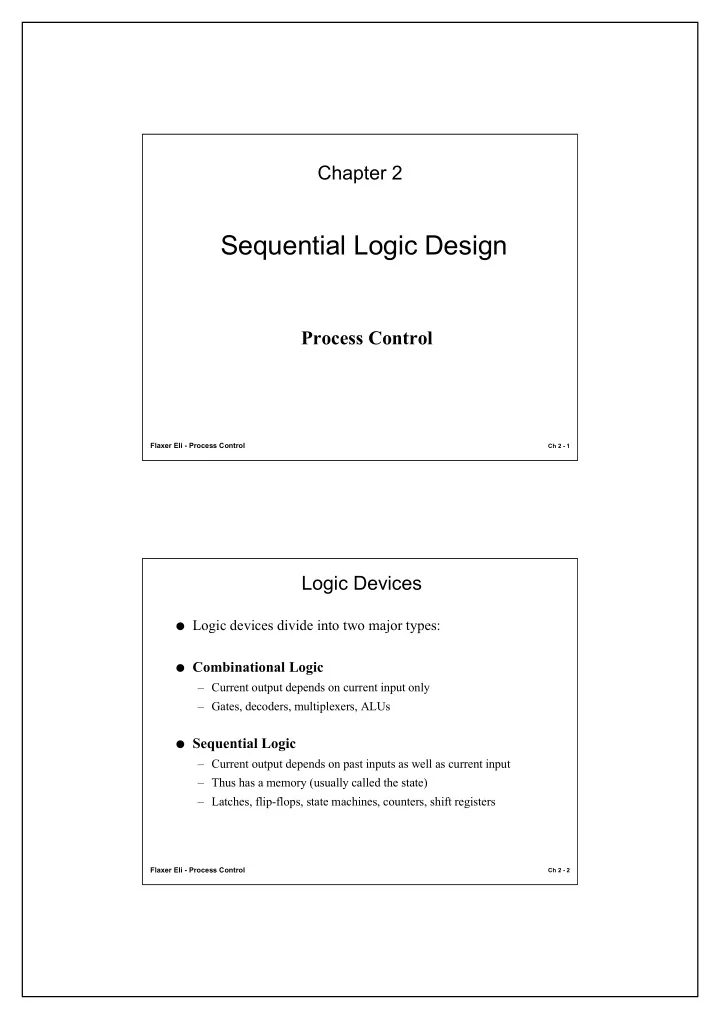
Chapter 2 Sequential Logic Design Process Control Flaxer Eli - Process Control Ch 2 - 1 Logic Devices Logic devices divide into two major types: Combinational Logic Current output depends on current input only Gates, decoders,


slide-1
SLIDE 1

Flaxer Eli - Process Control

Ch 2 - 1

Chapter 2 Process Control

Sequential Logic Design

Flaxer Eli - Process Control

Ch 2 - 2

Logic Devices

  • Logic devices divide into two major types:
  • Combinational Logic

– Current output depends on current input only – Gates, decoders, multiplexers, ALUs

  • Sequential Logic

– Current output depends on past inputs as well as current input – Thus has a memory (usually called the state) – Latches, flip-flops, state machines, counters, shift registers

slide-2
SLIDE 2

Flaxer Eli - Process Control

Ch 2 - 3

Sequential Logic Definitions

  • Clock - the master timing element behind the state changes of

most sequential circuits.

– a clock signal is active high if the state changes occur at the rising edge – and active low if state changes occur at the falling edge.

  • Clock Period - time between successive transitions in the

same direction.

  • Clock Frequency - reciprocal of the clock period.
  • Duty Cycle - the percentage of time that a clock is at its

assertion level.

Flaxer Eli - Process Control

Ch 2 - 4

Period tH tL State change

Active High

Period tH tL State change

Active Low

Duty Cycle = tL/Period Frequency = 1/Period

Clock Characteristics

Duty Cycle = tH/Period

slide-3
SLIDE 3

Flaxer Eli - Process Control

Ch 2 - 5

What Are Latches and Flip-flops?

  • Common feedback sequential circuits
  • Latch

– Single-bit storage (memory) – Changes state at any time due to input change

  • Flip-flop

– Also single-bit storage – Changes state ONLY when a clock edge or pulse is applied

Flaxer Eli - Process Control

Ch 2 - 6

Types of Latches and Flip-flops

  • Latches

– S-R Latch – S-R Latch with Enable – D Latch

  • Flip-flops

– Edge-Triggered D Flip-Flop – Edge-Triggered S-R Flip-Flop – Edge-Triggered J-K Flip-Flop – T Flip-Flop

slide-4
SLIDE 4

Flaxer Eli - Process Control

Ch 2 - 7

S-R Latch

S R Q /Q 1 1 1 1

Last Q

1

Last /Q

1 S R Q /Q S R Q Q Schematic Symbol Hold Reset Set ILLEGAL Function Table Qa /Qa Set Reset Consider: Timing Diagram Propagation delay Minimum pulse width Oscillation

Flaxer Eli - Process Control

Ch 2 - 8

D Flip-Flop

D C Q Q C D Q /Q 1 1 1 X 1 Last Q

1

Last /Q Store a data bit, not set/reset “Transparent latch” No illegal operation problem Setup and Hold time D C Q /Q R Q Q C D C S

slide-5
SLIDE 5

Flaxer Eli - Process Control

Ch 2 - 9

Positive-Edge-Triggered D Flip-Flop

D >CLK Q Q D CLK Q /Q 1 X X 1 1 Last Q Last Q

1

Last /Q Last /Q Q’ S R Q Q S R Q Q S R Q Q Q C D S R B A

C = 0 C = 1 D = 0 D = 1 D = 0 D = 1 B 1 1 S 1 1 1 R 1 1 1 A 1 1 Q N .C. N .C. 1 Q’ N .C. N .C. 1

Flaxer Eli - Process Control

Ch 2 - 10

Negative-Edge-Triggered D Flip-Flop

D CLK Q /Q 1 X X 1 1 Last Q Last Q

1

Last /Q Last /Q D >CLK Q Q

slide-6
SLIDE 6

Flaxer Eli - Process Control

Ch 2 - 11

Edge-Triggered J-K Flip-Flop

J K Q Q >CLK Q D >CLK Q Q /Q CLK J K C Q /Q J X X 1 1

Last Q Last Q

Last Q 1 Last /Q

Last /Q

Last /Q Last /Q 1 Last Q K X X 1 1 1

Flaxer Eli - Process Control

Ch 2 - 12

T (toggle) Flip-Flop

  • A T flip-flop changes state on every clock tick.
  • Possible circuit designs

– T without enable

D >CLK Q Q C Q /Q J K Q Q >CLK 1 C Q /Q J K Q Q >CLK T C Q /Q

T with enable T CLK Q

/Q

1 X X 1

Q

/Q Q Q /Q Q /Q /Q

slide-7
SLIDE 7

Flaxer Eli - Process Control

Ch 2 - 13

Flip-Flop

J K Q Q >CLK D >CLK Q Q S R Q Q >CLK T >CLK Q Q D F.F. SR F.F. T F.F. JK F.F.