September 29 October 1, 2012, YEMEN 1 Assoc. Prof. Dr. Ali Coskun - - PDF document

september 29 october 1 2012 yemen 1
SMART_READER_LITE
LIVE PREVIEW

September 29 October 1, 2012, YEMEN 1 Assoc. Prof. Dr. Ali Coskun - - PDF document


slide-1
SLIDE 1

Assoc.Prof.Dr. Ali COSKUN www.alicoskun.net

  • Assoc. Prof. Dr. Ali Coskun

Fatih University, Istanbul

  • Hospital and Healthcare Facilities Management and

Administration Training Program

September 30 – October 2, 2012, YEMEN

  • Assoc. Prof. Dr. Ali Coskun

Fatih University, Istanbul

  • Hospital and Healthcare Facilities Management and Administration Training Program

September 29 – October 1, 2012, YEMEN 1

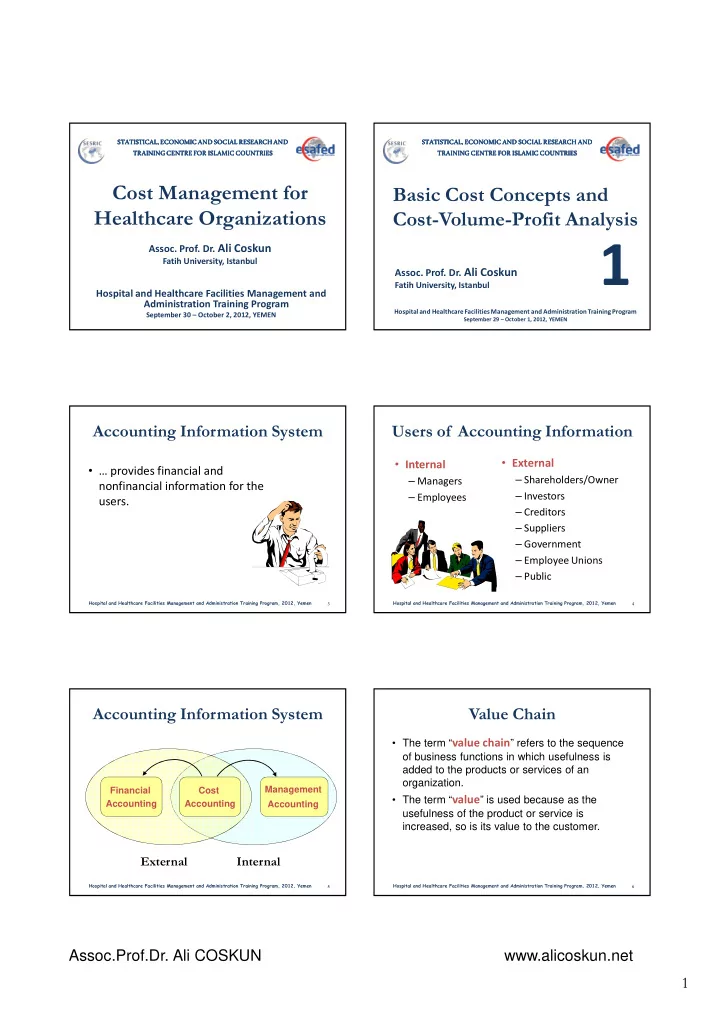
  • … provides financial and

nonfinancial information for the users.

  • !
  • Internal

– Managers – Employees

  • External

– Shareholders/Owner – Investors – Creditors – Suppliers – Government – Employee Unions – Public

"

  • #
  • $%

Financial Accounting Management Accounting Cost Accounting

  • The term “value chain” refers to the sequence
  • f business functions in which usefulness is

added to the products or services of an

  • rganization.
  • The term “value” is used because as the

usefulness of the product or service is increased, so is its value to the customer.

&

slide-2
SLIDE 2

Assoc.Prof.Dr. Ali COSKUN www.alicoskun.net

  • Management accountants provide decision

support for managers in the following six business functions:

'

  • (

Distribution Management Accounting Customer Services Marketing Production Design R&D

  • )
  • Manufacturing-sector companies –

produce and sell their own products (pharmaceutical factory)

  • Merchandising-sector companies –

product resellers (pharmacy)

  • Service-sector companies (hospital)

*

  • +
  • Basic Financial Statements

– Statement of Financial Position (Balance Sheet) – Income Statement – Statement of Cash Flows

  • Other Financial Statements

– Schedule of Cost of Goods Sold – Statement of Retained Earnings

,-

  • Net Sales

(-) Cost of Goods Sold Gross Margin (-) Operating Expenses Operating Income (-) Interest Expenses Net Income Before Tax (-) Tax Expenses Net Income

,,

  • .

,/

  • Direct Materials Inventory– resources

instock and available for use

  • Work-in-Process Inventory (or progress) –

products started but not yet completed. Often abbreviated as WIP

  • Finished Goods Inventory – products

completed and ready for sale

  • Merchandising Inventory
slide-3
SLIDE 3

Assoc.Prof.Dr. Ali COSKUN www.alicoskun.net

  • By Behavior

– Fixed – Variable

  • By Traceability

– Direct – Indirect

  • By Function

– Product – Period

,

  • 0)0

Direct Costs

  • Costs that can

be easily and conveniently traced to a unit of product or

  • ther cost objective.
  • Examples:

– Direct material – Direct labor

Indirect Costs

  • Costs cannot

be easily and conveniently traced to a unit of product or

  • ther cost objective.
  • Example:

– Manufacturing

  • verhead

,"

  • 0+

Product costs

Include expenditures that are necessary and integral to finished products. Capitalized on the balance sheet until sold.

Period costs

Include expenditures identified more with a time period than with finished products. Expensed on the income statement.

Inventory

Cost of Good Sold

Balance Sheet Income Statement

Sale Expense

Income Statement

,#

  • 0+

,&

Product Costs

  • Direct materials
  • Direct labor
  • Overhead

Period Costs

  • R&D
  • Marketing & Selling
  • Administrative
  • 0.

Cost Behavior How a cost will react to changes in the level of business activity. Total variable costs change when the level of activity changes. Total fixed costs remain unchanged when the level of activity changes.

,'

  • .

Behavior of Cost (within the relevant range)

Cost In Total Per Unit Variable Total variable cost changes Variable cost per unit remains as activity level changes. the same over wide ranges

  • f activity.

Fixed Total fixed cost remains Fixed cost per unit goes the same even when the down as activity level goes up. activity level changes.

  • ,(
slide-4
SLIDE 4

Assoc.Prof.Dr. Ali COSKUN www.alicoskun.net

  • In the long run, all costs are variable, and hence these

cost classifications hold only in the short run, say, for one year. Also, no costs are fixed throughout an infinite range of

  • volumes. Thus, the concept of cost classifications

according to volume must be applied within some relevant range of patient volume. What are some examples of fixed and variable costs, say, for a hospital’s clinical laboratory?

,*

  • $%1

/-

  • Variable Costs Per Visit

Variable Costs Per Visit Variable Costs Per Visit Variable Costs Per Visit Fixed Costs Per Year Fixed Costs Per Year Fixed Costs Per Year Fixed Costs Per Year Clinical supplies $20 Clinical supplies $20 Clinical supplies $20 Clinical supplies $20 Facilities $ 30,000 Facilities $ 30,000 Facilities $ 30,000 Facilities $ 30,000 Other supplies Other supplies Other supplies Other supplies 5 5 5 5 Salaries 190,000 Salaries 190,000 Salaries 190,000 Salaries 190,000 Variable cost rate $25 Variable cost rate $25 Variable cost rate $25 Variable cost rate $25 Overhead Overhead Overhead Overhead 80,000 80,000 80,000 80,000 $300,000 $300,000 $300,000 $300,000 Total Total Total Total Fixed Variable Total Average Fixed Variable Total Average Fixed Variable Total Average Fixed Variable Total Average Volume Volume Volume Volume Costs Costs Costs Costs Costs Costs Costs Costs Costs Costs Costs Costs Cost Cost Cost Cost 1 $300,000 $ 25 $300,025 $300,025 1 $300,000 $ 25 $300,025 $300,025 1 $300,000 $ 25 $300,025 $300,025 1 $300,000 $ 25 $300,025 $300,025 100 300,000 2,500 302,500 3,025 100 300,000 2,500 302,500 3,025 100 300,000 2,500 302,500 3,025 100 300,000 2,500 302,500 3,025 200 300,000 5,000 305,000 1,525 200 300,000 5,000 305,000 1,525 200 300,000 5,000 305,000 1,525 200 300,000 5,000 305,000 1,525 1,000 300,000 25,000 325,000 325 1,000 300,000 25,000 325,000 325 1,000 300,000 25,000 325,000 325 1,000 300,000 25,000 325,000 325 5,000 300,000 125,000 425,000 85 5,000 300,000 125,000 425,000 85 5,000 300,000 125,000 425,000 85 5,000 300,000 125,000 425,000 85 10,000 300,000 250,000 550,000 55 10,000 300,000 250,000 550,000 55 10,000 300,000 250,000 550,000 55 10,000 300,000 250,000 550,000 55 25,000 300,000 625,000 925,000 37 25,000 300,000 625,000 925,000 37 25,000 300,000 625,000 925,000 37 25,000 300,000 625,000 925,000 37

  • Consider a volume of 5,000:

Fixed costs = $300,000. Variable cost rate = $25. Total variable costs = $125,000. Total costs = $425,000. Average cost per visit = $85.

Now consider a volume of 10,000:

Fixed costs = $300,000. Variable cost rate = $25. Total variable costs = $250,000. Total costs = $550,000. Average cost per visit = $55.

/,

  • Costs

($) Volume (Number of Visits) Total Costs Fixed Costs Total Variable Costs

What is the slope of the total variable costs line? What is the relationship between total costs and total variable costs?

2

//

  • Contribution Margin equals sales less variable costs

CM = S – VC

  • Contribution Margin per unit equals unit selling price

less variable cost per unit CM per unit = SP – Unit VC

  • Contribution Margin also equals contribution margin

per unit multiplied by the number of units sold CM = CM per unit x Q

  • Contribution Margin Ratio (percentage) equals

contribution margin per unit divided by selling price CM % = CM per unit ÷ SP

/

  • 3.
  • A horizontal presentation of the Contribution

Margin Income Statement:

  • Sales – VC – FC = Operating Income (OI)
  • (SP x Q) – (UVC x Q) – FC = OI
  • Q (SP – UVC) – FC = OI
  • Q (CM per unit) – FC = OI
  • Remember this last equation, it will be used

again in a moment

/"
slide-5
SLIDE 5

Assoc.Prof.Dr. Ali COSKUN www.alicoskun.net

  • 42

To tal co st s lin e Operat ing loss area Breakeven point = 25 units Total costs line Operating loss area Operating income area Breakeven point Total revenues line Operating income Variable costs Fixed costs

5.

  • Recall the last equation in an earlier slide:

Q (CM per unit) – FC = OI

  • A simple manipulation of this formula, and setting OI

to zero will result in the Breakeven Point (quantity): Breakeven Quantity (BEQ) = FC ÷ CM per unit

  • At this point, a firm has no profit or loss at a given

sales level

  • If per-unit values are not available, the Breakeven

Point may be restated in its alternate format:

  • Breakeven Sales = FC ÷ CM %

/&

  • Profit analysis, also called cost-volume-profit

(CVP) analysis, is a technique used to assess the effects of alternative volume assumptions on costs and profits.

? Why is such information valuable to health

services managers?

/'

  • 67
  • A Clinic has forecasted the following cost data
  • n the basis of 75,000 expected visits:

Fixed costs $4,967,462 Total variable costs 2,113,500 Total costs $7,080,962

/(

  • What is the variable cost rate?

Variable cost rate Total variable costs Volume $2,113,500 75,000 = = = $28.18 per visit.

/*

  • What is Clinic’s cost behavior model?

Total costs = Fixed costs + Total variable costs = $4,967,462 + ($28.18 x Volume). For example, at 70,000 visits: Total costs = $4,967,462 + ($28.18 x 70,000) = $4,967,462 + $1,972,600 = $6,940,062.

slide-6
SLIDE 6

Assoc.Prof.Dr. Ali COSKUN www.alicoskun.net

  • Cost/Volume Summary:

Volume = 70,000 TC = $4,967,462 + $1,972,600 = $6,940,062. Volume = 75,000 (Base Case) TC = $4,967,462 + $2,113,500 = $7,080,962. Volume = 80,000 TC = $4,967,462 + $2,254,400 = $7,221,862.

,

  • ? What do Clinic’s managers learn from the data on the

previous slide?

? Now, suppose that the average revenue per visit is

expected to be $100. What does the clinic’s cost and revenue structure look like graphically?

/

  • Revenues

and Costs ($) Volume (Number of Visits) Total Costs Fixed Costs Total Revenues

Where are profits and losses? Where is the breakeven volume? Where is 75,000 visits?

  • 42

The projected P&L statement uses cost structure information along with the revenue forecast and projected volume to forecast profitability. Although it looks like an income statement, it does not have to follow GAAP. Because it is a forecast, it can be influenced by managerial actions

"

  • +687

9 6:97

#

  • :9

Total revenues ($100 x 75,000) $7,500,000 Total VC ($28.18 x 75,000) 2,113,500 Total CM ($71.82 x 75,000) $5,386,500 Fixed costs 4,967,462 Profit $ 419,038 VC = Variable costs. CM = Contribution margin. Note that base case total costs equal fixed costs plus total variable costs or $4,967,462 + $2,113,500 = $7,080,962. Thus, Clinic’s average per visit cost is $7,080,962 / 75,000 = $94.41.

? What happens to the average cost per visit as volume

increases?

? Why?

&

  • :9
slide-7
SLIDE 7

Assoc.Prof.Dr. Ali COSKUN www.alicoskun.net

  • '
  • The contribution margin is defined as the difference

between per visit (unit) revenue and the variable cost rate. It is the amount of each visit’s revenue that is available to:

  • First cover fixed costs.
  • Flow to profit when fixed costs are covered.

In this illustration, the contribution margin is $100 - $28.18 = $71.82.

? What is the total contribution margin?

5.

Breakeven analysis is performed in many different finance contexts. Here, it is used to determine the breakeven volume, defined as that volume needed for an organization (or service or program) to be financially self- sufficient. What is the breakeven for the Clinic? There are two approaches to answer this question: Projected P&L approach Graphical approach

(

  • 5.

P&L Approach Total revenues - Total VC - FC = Profit ($100 x V) - ($28.18 x V) - $4,967,462 = $0 $71.82 x V = $4,967,462 V = $4,967,462 / $71.82= 69,165 visits. Note that the P&L approach can be recast in a contribution margin format. P&L Approach (Contribution Margin Format) CM x V = Fixed costs $71.82 x V = $4,967,462 V = $4,967,462 / $71.82 = 69,165 visits.

*

  • 25.

Revenues and Costs ($) Volume (Number of Visits) Total Costs Fixed Costs Total Revenues 69,165

"-

  • 5.

What would be the sales volume if the desired profit level is $100,000? CM x V = Fixed costs + Profit $71.82 x V = $5,067,462 V = $5,067,462 / $71.82 = 70,558 visits. Note that the breakeven is 69,165 visits. The additional number of visits needed is 1,393. 1,393 x CM = 1,393 x $71.82 = $100,000.

",

  • !

3++

Suppose the Clinic is confronted with a situation in which a payer contributing 5,000 visits wants a 40 percent discount. Clinic’s managers might want to drop the contract because a $60 per visit payment is less than the $94.41 average per visit cost. But further analysis is required.

"/

slide-8
SLIDE 8

Assoc.Prof.Dr. Ali COSKUN www.alicoskun.net

  • :9;

'-4---

Total revenues ($100 x 70,000) $7,000,000 Total VC ($28.18 x 70,000) 1,973,600 Total CM ($71.82 x 70,000) $5,027,400 Fixed costs 4,967,462 Profit $ 39,938

"

  • :9;

3

Undiscounted revenue ($100 x 70,000) $7,000,000 Discounted revenue ($60 x 5,000) 300,000 Total revenues ($97.33 x 75,000) $7,300,000 Total VC ($28.18 x 75,000) 2,113,500 Total CM ($69.15 x 75,000) $5,186,500 Fixed costs 4,967,462 Profit $ 219,038

""

  • 2

Revenues and Costs ($) Volume (Number of Visits) Total Costs Fixed Costs Old Total Revenues New Total Revenues

69,165 71,836

"#

  • 67

Suppose the Clinic is approached by a new insurer. This payer is expected to contribute 5,000 additional visits. However, it wants a 40 percent discount, resulting in a revenue of $60 per visit. At a volume of 80,000, the clinic’s average cost per visit is $7,221,862 / 80,000 = $90.27, so again Clinic’s managers might be tempted to say “no.”

"&

  • :9

Total revenues ($100 x 75,000) $7,500,000 Total VC ($28.18 x 75,000) 2,113,500 Total CM ($71.82 x 75,000) $5,386,500 Fixed costs 4,967,462 Profit $ 419,038 VC = Variable costs. CM = Contribution margin.

"'

  • :9<
  • Undiscounted revenue ($100 x 75,000)

$7,500,000 Discounted revenue ($60 x 5,000) 300,000 Total revenues ($97.50 x 80,000) $7,800,000 Total VC ($28.18 x 80,000) 2,254,400 Total CM ($69.32 x 80,000) $5,545,600 Fixed costs 4,967,462 Profit $ 578,138

"(

slide-9
SLIDE 9

Assoc.Prof.Dr. Ali COSKUN www.alicoskun.net

  • 2

Revenues and Costs ($) Volume (Number of Visits) Total Costs Fixed Costs Old Total Revenues New Total Revenues

69,165 84,928

"*

  • 67

The marginal cost of each visit is the variable cost rate

  • f $28.18 per visit.

The marginal revenue on the new contract is $60 per visit, so the contribution margin is $60 - $28.18 = $31.82. Thus, 5,000 incremental visits would add 5,000 x $31.82 = $159,100 to the bottom line: $419,038 + $159,100 = $578,138.

#-

  • At this point, the numerical analysis indicates that

the offer should be accepted. Considering all the factors relevant to the decision, what should the Clinic’s managers do?

3

#,

  • !

Capitation changes the way in which profit analysis is conducted Perhaps the best way to see the effects of capitation is by graphical analysis. We will examine two approaches to graphical analysis: In terms of utilization (number of visits). In terms of membership (covered lives).

#/

  • Revenues

and Costs ($) Volume (Number of Visits) Total Costs Fixed Costs Total Revenues

#

  • On this graph, the profit and loss areas are reversed

from the fee-for-service graph. This “perverse” result occurs because the contribution margin on a per visit basis is negative. $0 - $28.18 = -$28.18. Each additional visit increases costs with no increase in revenues.

#"

slide-10
SLIDE 10

Assoc.Prof.Dr. Ali COSKUN www.alicoskun.net

  • 2

Revenues and Costs ($) Volume (Number of Members) Total Costs Fixed Costs Total Revenues Note: Average utilization is assumed regardless of volume.

##

  • Now, the profit and loss areas are the same as on the

fee-for-service graph. On a per member basis, the contribution margin is positive. Each additional member contributes positively to profits. If per member annual revenue is $400 per member and variable costs (based on 4 visits) is 4 x $28.18 = $112.72 per year, the contribution margin is $400 - $112.72 = $287.28.

#&

  • 3

? What do the graphs tell managers about the

importance of utilization management:

? Under FFS reimbursement? ? Under capitation? ? What do the graphs tell about the importance of

the number of members under capitation?

#'

  • )

=5

If reimbursement is tied exclusively to volume (FFS), then the provider’s financial risk is minimized if all costs are variable. If reimbursement is exclusively capitated, then the provider’s financial risk is minimized if all costs are fixed.

#(

  • 2++

Revenues and Costs ($) Volume (Number of Visits) Total Costs Total Revenues

!

Total VCs

#*

  • 2!
  • Revenues

and Costs ($) Volume (Number of Visits) Total Costs Fixed Costs Total Revenues

!

&-

slide-11
SLIDE 11

Assoc.Prof.Dr. Ali COSKUN www.alicoskun.net

  • Assoc. Prof. Dr. Ali Coskun

Fatih University, Istanbul

1

343; .

Hospital and Healthcare Facilities Management and Administration Training Program

September 29 – October 1, 2012, YEMEN 2

  • )
  • Cost – sacrificed resource to achieve a specific
  • bjective
  • Actual Cost – a cost that has occurred
  • Budgeted Cost – a predicted cost
  • Cost Object – anything of interest for which a cost is

desired

&/ &/

  • )
  • Cost Accumulation – a collection of cost data in an
  • rganized manner
  • Cost Assignment – a general term that includes

gathering accumulated costs to a cost object. This includes: – Tracing accumulated costs with a direct relationship to the cost object and – Allocating accumulated costs with an indirect relationship to a cost object

& &

  • The purpose of cost allocation is to assign all
  • verhead costs to the departments that create the

need for such costs, typically the patient service departments. To begin, we must define two terms used in cost

  • allocation. Then, we will illustrate two methods of

cost allocation.

&"

  • A cost pool is the overhead amount to be allocated.

In general, a cost pool consists of the direct costs of

  • ne overhead department.

However, if the costs of a single overhead department differ substantially in nature and are used in different proportions, multiple cost pools should be used. For example, Financial Services overhead might be divided as follows: Billing and collections cost pool Budgeting cost pool

&#

  • 3.

A cost driver is the basis on which the cost pool will be allocated. For example, the cost driver for facilities overhead (building space depreciation, maintenance, utilities, and so on) might be the amount of space used by each patient service department.

&&

slide-12
SLIDE 12

Assoc.Prof.Dr. Ali COSKUN www.alicoskun.net

  • 3.

The selection of cost drivers is critical to the cost allocation process. Cost drivers should create an allocation that is highly correlated with the actual amount of overhead services consumed. Good cost drivers will have these two important attributes: They should be perceived as being fair. They should promote organizational cost reduction.

&'

  • 3

Overhead cost allocation is a “pain.” Why is it necessary? Suppose a hospital uses amount of space occupied (square footage) as the cost driver for the allocation

  • f Housekeeping Services. Does this driver have the

attributes of a good driver?

&(

  • )
  • 1. Identify the cost pool

Identify the cost pool, which is the dollar cost of the

  • verhead activity to be allocated.

To illustrate, assume that a hospital’s Housekeeping Department has direct costs of $100,000.

&*

  • )
  • 2. Determine the cost driver

The cost driver is the basis on which the overhead costs will be allocated. Assume that the cost driver for Housekeeping services is the amount of space occupied. User departments in total occupy 200,000 square feet of space.

'-

  • )
  • 3. Calculate the allocation rate

Here, the allocation rate is $100,000 / 200,000 = $0.50 per square foot of space occupied. Allocation rate = Dollars in cost pool Total volume of cost driver The allocation rate is the numerical value used to make the allocation:

',

  • )
  • 4. Determine the allocation amount

Each user department is then allocated some portion

  • f Housekeeping overhead costs.

Assume the Critical Care Department occupies 10,000 square feet of space. Its allocation would be $0.50 x 10,000 = $5,000.

'/

slide-13
SLIDE 13

Assoc.Prof.Dr. Ali COSKUN www.alicoskun.net

  • Mechanically, cost allocation can be accomplished in a

variety of ways. Regardless of the method, all overhead costs must ultimately be allocated to the departments that create the need for such costs, which are the patient service departments. There are several allocation methods: Direct method Step-down method Reciprocal method

'

  • In the direct method, the costs of each support

department are allocated directly to, and only to, the patient services departments. In the step-down method, some (but not all) of the intra support department relationships are

  • recognized. This method is more complex than the

direct method, but still manageable.

'"

  • The reciprocal method recognizes all of the support

department interrelationships, but it requires a system of simultaneous equations or a complex set of iterative calculations.

? Which method is used most commonly in

practice?

'#

  • 3

67

Consider the direct cost allocation system used at Mercy Hospital. To simplify the illustration, we have reduced the number of departments to four: Support (overhead) departments

  • Facilities Services
  • General Administration

Patient service departments

  • Routine Care
  • Critical Care

'&

  • 3

SUPPORT DEPARTMENTS PATIENT SERVICE DEPARTMENTS

Facilities Services Routine Care Critical Care General Administration

''

  • 3

6>7

Mercy uses the following cost drivers: The cost driver for the Facilities Services cost pool is the amount of space used by each patient service department. The cost driver for the General Administration cost pool is the amount of revenue generated by each patient service department.

'(

slide-14
SLIDE 14

Assoc.Prof.Dr. Ali COSKUN www.alicoskun.net

  • 3637

Projected Revenues by Patient Service Department Routine Care $22,000,000 Critical Care 5,000,000 Total revenues $27,000,000 Projected Costs for All Departments: Patient Service Departments (Direct Costs) Routine Care $ 8,300,000 Critical Care 3,300,000 Total direct costs $11,600,000

'*

  • 3637

Projected Costs for All Departments (Cont.): Support Departments (Direct Costs)* Facilities Services $ 8,600,000 General Administration 5,250,000 Total overhead costs $13,850,000 Total costs of both patient and support services $25,450,000 Projected overall profit $ 1,550,000 *Note: The direct costs of the support departments will become the overhead costs of the patient services departments.

(-

  • 3637

Selected Patient Service Department Data: Square Feet Revenue Routine Care 261,000 $22,000,000 Critical Care 39,600 5,000,000 Total 300,600 $27,000,000

? Why aren’t the support departments listed here?

(,

  • 3

6=7

Facilities Services $8,600,000 in overhead costs to be allocated across 300,600 square feet: $8,600,000 / 300,600 ≈ $28.61 per sq. ft. This is the allocation rate. General Administration $5,250,000 in overhead costs to be allocated across $27,000,000 in revenue dollars: $5,250,000 / $27,000,000 ≈ $0.194 per revenue dollar.

(/

  • 3

67

From Facilities Services: To Routine Care $28.61 x 261,000 = $7,467,066 To Critical Care $28.61 x 39,600 = $1,132,934 $8,600,000

(

  • 3

67

From General Administration: To Routine Care $0.194 x 22,000,000 = $4,277,778 To Critical Care $0.194 x 5,000,000 = $ 972,222 $5,250,000

("

slide-15
SLIDE 15

Assoc.Prof.Dr. Ali COSKUN www.alicoskun.net

  • 36:97

Routine Care Margin Revenues $22,000,000 Direct costs 8,300,000 Profit on direct costs $13,700,000 62.3% Indirect costs: Facilities Services 7,467,066 General Administration 4,277,778 Profit on total(full)costs $ 1,955,156 8.8% Critical Care Revenues $ 5,000,000 Direct costs 3,300,000 Profit on direct costs $ 1,700,000 34.0% Indirect costs: Facilities Services 1,132,934 General Administration 972,222 Profit on total(full)costs

  • $ 405,156 -8.1%

(#

  • 3

Suppose you are the Critical Care department head at Mercy Hospital. Your bonus is dependent upon good financial performance. What would be your reaction to the allocation results? What would be your first line of defense?

(&

  • 3;

Now, assume that Mercy Hospital uses the step-down method. Assume the same cost drivers: Amount of space for Facilities Services. Salary dollars for General Administration. Mercy’s managers conclude that Facilities Services provides more support to General Administration than vice versa.

('

  • 3;

SUPPORT DEPARTMENTS PATIENT SERVICE DEPARTMENTS

Facilities Services Routine Care Critical Care General Administration

((

  • 3;

637

Selected Department Data: Square Feet Salary Dollars Routine Care 261,000 $ 8,148,000 Critical Care 39,600 2,035,000 General Administration 15,000

  • Total

315,600 $10,183,000

? What is the difference here from the direct

method?

(*

  • 3;

6=7

Facilities Services $8,600,000 to be allocated across 315,600 square feet: $8,600,000 / 315,600 ≈ $27.25 per square foot.

? How does this allocation rate differ from the one

used in the direct method?

*-

slide-16
SLIDE 16

Assoc.Prof.Dr. Ali COSKUN www.alicoskun.net

  • 3;

67

From Facilities Services: To General Administration $27.25 x 15,000 = $ 408,745 To Routine Care $27.25 x 261,000 = $7,112,167 To Critical Care $27.25 x 39,600 = $1,079,088 $8,600,000

*,

  • 3;

6=7

General Administration $5,250,000 + $408,745 = $5,658,745 to be allocated across $10,183,000 in salaries: $5,658,745 / $10,183,000 ≈ $0.56 per dollar.

? How does this allocation rate differ from the one

used in the direct method?

*/

  • 3;

67

From General Administration: To Routine Care $0.56 x 8,148,000 = $4,527,885 To Critical Care $0.56 x 2,035,000 = $1,130,860 $5,658,645

*

  • 3;6:97

Routine Care Revenues $22,000,000 Direct costs 8,300,000 Indirect costs Facilities Services 7,112,167 General Administration 4,527,885 Projected profit $ 2,059,948 Critical Care Revenues $ 5,000,000 Direct costs 3,300,000 Indirect costs Facilities Services 1,079,088 General Administration 1,130,860 Projected profit ($ 509,948)

*"

  • 3;6=7

Routine Care Total Overhead Direct method $11,744,844 Step-down method $11,640,052 Difference (-1.0%)

  • $ 104,792

Critical Care Total Overhead Direct method $ 2,105,156 Step-down method $ 2,209,948 Difference (+5.0%) +$ 104,972

*#

  • 3

If you were the CEO of Mercy, what would you conclude from the consistency of the results between the direct and step-down methods?

*&

slide-17
SLIDE 17

Assoc.Prof.Dr. Ali COSKUN www.alicoskun.net

  • .67

Unlike traditional cost allocation, which is a top- down system, activity-based costing (ABC) begins with the individual activities that comprise the services provided. Although it holds great promise for costing (and hence pricing) individual services, it requires more information and is more complex than traditional costing.

*'

  • .
  • Assume a physician practice only does executive

physicals, which (ignoring lab tests) consist of three separate activities: Patient check in Physical examination (minor or major) Report and consultation The following slide contains the ABC analysis for the practice.

*(

  • .

Annual Activity Data Allocation Costs Driver Minor Major Total Rate Check in $ 25,000 Exams 1,500 500 2,000 $12.50 Physical exam 300,000 Minutes 60 120 150,000 2.00 Report/Consult 75,000 Minutes 30 60 75,000 1.00 $400,000 Minor Exam Major Exam Rate Consumption Cost Consumption Cost Check in $12.50 1 $ 12.50 1 $ 12.50 Physical exam 2.00 60 120.00 120 240.00 Report/Consult 1.00 30 30.00 60 60.00 Cost per exam $162.50 $312.50 Allocation Rate Calculation: Service Cost Calculation (Per Exam):

**

slide-18
SLIDE 18

Assoc.Prof.Dr. Ali COSKUN www.alicoskun.net

  • Assoc. Prof. Dr. Ali Coskun

Fatih University, Istanbul

35 =.

Hospital and Healthcare Facilities Management and Administration Training Program

September 30 – October 2, 2012, YEMEN 3

  • 3
  • Top management faces a challenge – that is, making

sure that the performance-evaluation model of subordinate managers is consistent with the decision model.

  • A decision model is a formal method for making a

choice, often involving quantitative and qualitative analysis.

,-"

  • +.3

1 Gathering information 2 Making predictions about future costs 3 Choosing an alternative 4 Implementing the decision 5 Evaluating performance to provide feedback

,-#

  • =.
  • Relevant Information has two characteristics:

– It occurs in the future – It differs among the alternative courses of action

  • Relevant Costs – expected future costs
  • Relevant Revenues – expected future revenues
  • Historical costs are past costs that are irrelevant to

decision making – Also called Sunk Costs

,-&

  • )
  • Quantitative factors are outcomes that can be

measured in numerical terms

  • Qualitative factors are outcomes that are difficult to

measure accurately in numerical terms, such as satisfaction – Are just as important as quantitative factors even though they are difficult to measure

,-'

  • )
  • Incremental Cost – the additional total cost incurred

for an activity

  • Differential Cost – the difference in total cost

between two alternatives

  • Incremental Revenue – the additional total revenue

from an activity

  • Differential Revenue – the difference in total revenue

between two alternatives

,-(

slide-19
SLIDE 19

Assoc.Prof.Dr. Ali COSKUN www.alicoskun.net

  • ) 3
  • One-Time-Only Special Orders
  • Insourcing vs. Outsourcing
  • Make or Buy
  • Product-Mix
  • Customer Profitability
  • Branch / Segment: Adding or Discontinuing
  • Equipment Replacement

,-*

  • )
  • Accepting or rejecting special orders when there is

idle production capacity and the special orders have no long-run implications

  • Decision Rule: does the special order generate

additional operating income? – Yes – accept – No – reject

  • Compares relevant revenues and relevant costs to

determine profitability

,,-

  • )
  • Gabriela Company manufactures fancy bath towels.
  • The plant has a production capacity of 44,000 towels

each month.

  • Current monthly production is 30,000 towels.
  • The assumption is made that costs can be classified as

either variable with respect to units of output or fixed.

,,,

  • )

Variable Fixed Costs Costs Per Unit Per Unit Direct materials $6.50 $ -0- Direct labor 0.50 1.50 Manufacturing costs 1.50 3.50 Total $8.50 $5.00

,,/

  • )
  • Total fixed direct manufacturing labor amounts to

$45,000.

  • Total fixed overhead is $105,000.
  • Marketing costs per unit are $7 ($5 of which is

variable).

  • What is the full cost per towel?

,,

  • )

Variable ($8.50 + $5.00): $13.50 Fixed: 7.00 Total $20.50

  • A hotel in Puerto Rico has offered to buy 5,000

towels from Gabriela & Co. at $11.50 per towel for a total of $57,500.

,,"

slide-20
SLIDE 20

Assoc.Prof.Dr. Ali COSKUN www.alicoskun.net

  • )
  • No marketing costs will be incurred for this one-time-
  • nly special order.
  • Should Gabriela & Co. accept this order?
  • Yes!
  • Why?

,,#

  • )
  • The relevant costs of making the towels are $42,500.

$8.50 × 5,000 = $42,500 incremental costs $57,500 – $42,500 = $15,000 incremental revenues $11.50 – $8.50 = $3.00 contribution margin per towel Decision criteria:

  • Accept the order if the revenue differential is greater

than the cost differential.

,,&

  • 0;

=.

Avoid incorrect general assumptions about information, especially: – “All variable costs are relevant and all fixed costs are irrelevant” – There are notable exceptions for both costs Problems with using unit-cost data: – Including irrelevant costs in error – Using the same unit-cost with different output levels

  • Fixed costs per unit change with different levels of
  • utput

,,'

  • .0;

=.

  • Focus on Total Revenues and Total Costs, not their

per-unit equivalents

  • Continually evaluate data to ensure that they meet

the requirements of relevant information

,,(

  • .>
  • Insourcing – producing goods or services within an
  • rganization
  • Outsourcing – purchasing goods or services from
  • utside vendors
  • Also called the “Make or Buy” decision
  • Decision Rule: Select the option that will provide the

firm with the lowest cost, and therefore the highest profit.

,,*

  • ?.+
  • Nonquantitative factors may be extremely important

in an evaluation process, yet do not show up directly in calculations: – Quality Requirements – Reputation of Outsourcer – Employee Morale – Logistical Considerations – distance from plant, etc.

,/-

slide-21
SLIDE 21

Assoc.Prof.Dr. Ali COSKUN www.alicoskun.net

  • 53
  • Gabriela & Co. also manufactures bath accessories.
  • Management is considering producing a part it needs

(#2) or using a part produced by Alec Enterprises.

,/,

  • 53
  • Gabriela & Co. has the following costs for 150,000

units of Part #2: Direct materials $ 28,000 Direct labor 18,500 Mixed overhead 29,000 Variable overhead 15,000 Fixed overhead 30,000 Total $120,500

,//

  • 53
  • Mixed overhead consists of material handling and

setup costs.

  • Gabriela & Co. produces the 150,000 units in 100

batches of 1,500 units each.

  • Total material handling and setup costs equal fixed

costs of $9,000 plus variable costs of $200 per batch.

,/

  • 53
  • What is the cost per unit for Part #2?

$120,500 ÷ 150,000 units = $0.8033/unit

  • Alec Enterprises offers to sell the same part for

$0.55.

  • Should Gabriela & Co. manufacture the part or buy

it from Alec Enterprises?

,/"

  • 53
  • The answer depends on the difference in expected

future costs between the alternatives.

  • Gabriela & Co. anticipates that next year the

150,000 units of Part #2 expected to be sold will be manufactured in 150 batches of 1,000 units each.

,/#

  • 53
  • Variable costs per batch are expected to decrease to

$100.

  • Gabriela & Co. plans to continue to produce 150,000

next year at the same variable manufacturing costs per unit as this year.

  • Fixed costs are expected to remain the same as this

year.

,/&

slide-22
SLIDE 22

Assoc.Prof.Dr. Ali COSKUN www.alicoskun.net

  • 53
  • What is the variable manufacturing cost per unit?

Direct material $28,000 Direct labor 18,500 Variable overhead 15,000 Total $61,500 $61,500 ÷ 150,000 = $0.41 per unit

,/'

  • 53
  • Expected relevant cost to make Part #2:

Manufacturing $61,500 Material handling and setups 15,000* Total relevant cost to make $76,500 * 150 × $100 = $15,000

  • Cost to buy: (150,000 × $0.55)

$82,500

  • Gabriela & Co. will save $6,000 by making the part.

,/(

  • 53
  • Now assume that the $9,000 in fixed clerical salaries

to support material handling and setup will not be incurred if Part #2 is purchased from Alec Enterprises.

  • Should Gabriela & Co. buy the part or make the part?

,/*

  • 53
  • Relevant cost to make:

Variable $76,500 Fixed 9,000 Total $85,500

  • Cost to buy:

$82,500

  • Gabriela would save $3,000 by buying the part.

, -

  • Opportunity Cost is the contribution to operating

income that is forgone by not using a limited resource in its next-best alternative use – “How much profit did the firm ‘lose out on’ by not selecting this alternative?”

  • Special type of Opportunity Cost: Holding Cost for
  • Inventory. Funds tied up in inventory are not

available for investment elsewhere

, ,

  • 4

4

  • Assume that if Gabriela buys the part from Alec

Enterprises, it can use the facilities previously used to manufacture Part #2 to produce Part #3 for Krysta’s Company.

  • The expected additional future operating income is

$18,000.

  • What should Gabriela & Co. do?

, /

slide-23
SLIDE 23

Assoc.Prof.Dr. Ali COSKUN www.alicoskun.net

  • 4

4

  • Gabriela & Co. has three options:

1 Make Part #2 and do not make Part #3 for Krysta. 2 Buy Part #2 and do not make Part #3 for Krysta. 3 Buy the Part #2 and use the facilities to produce Part #3 for Krysta.

,

  • 4

4

  • Expected cost of obtaining 150,000 parts:

Buy Part #2 Buy Part #2 and do not and make Make make Part #3 Part #3 Part #2 $82,500 $64,500* $76,500 *$82,500 – $18,000 = $64,500

, "

  • 4

4

  • Opportunity cost is the contribution to income that is

foregone (rejected) by not using a limited resource in its next-best alternative use.

, #

  • 4

4

  • Opportunity costs are not recorded in formal

accounting records since they do not generate cash

  • utlays.
  • These costs also are not ordinarily incorporated into

formal reports.

, &

  • 4

4

  • The opportunity cost of holding inventory is the

income forgone from tying up money in inventory and not investing it elsewhere.

, '

  • 4

4

  • Carrying costs of inventory can be a significant
  • pportunity cost and should be incorporated into

decisions regarding lot purchase sizes for materials.

, (

slide-24
SLIDE 24

Assoc.Prof.Dr. Ali COSKUN www.alicoskun.net

  • %3
  • The decisions made by a company about which

products to sell and in what quantities

  • Decision Rule (with a constraint): choose the product

that produces the highest contribution margin per unit of the constraining resource

  • When multiple constraints exist, optimization

techniques such as linear programming can be used in making decisions.

, *

  • %3!
  • What product should be emphasized to maximize
  • perating income in the face of capacity constraints?
  • Gabriela & Co. produces Product #2 and Product #3.
  • The company has 3,000 machine hours available to

produce these products.

,"-

  • %3

!

Per unit Product #2 Product #3 Sales price $2.11 $14.50 Variable expenses 0.41 13.90 Contribution margin $1.70 $ 0.60 Contribution margin ratio 81% 4%

,",

  • %3

!

  • One unit of Product #2 requires 7 machine hours.
  • One unit of Product #3 requires 2 machine hours.
  • What is the contribution of each product per

machine hour?

  • Product #2: $1.70 ÷ 7 = $0.24
  • Product #3: $0.60 ÷ 2 = $0.30

,"/

  • %3

!

  • Which product should be emphasized?
  • The product with the highest contribution margin

per unit of the constraining resource.

,"

  • 04.

4=.

  • Companies must often make decisions about adding
  • r discontinuing a product line, branch, or business

segment.

  • Companies must also make decisions about adding
  • r dropping customers.

,""

slide-25
SLIDE 25

Assoc.Prof.Dr. Ali COSKUN www.alicoskun.net

  • 3
  • Decision Rule: Does adding or dropping a customer

add operating income to the firm? – Yes – add or don’t drop – No – drop or don’t add

  • Decision is based on profitability of the customer, not

how much revenue a customer generates

,"#

  • 3
  • Decision Rule: Does adding or discontinuing a branch
  • r segment add operating income to the firm?

– Yes – add or don’t discontinue – No – discontinue or don’t add

  • Decision is based on profitability of the branch or

segment, not how much revenue the branch or segment generates

,"&

  • 04.

4=.

  • Blowing Rock Furniture supplies specialized furniture

to two local retailers – Stevens and Cohen.

  • Blowing Rock Furniture has a monthly capacity of

3,000 machine hours.

  • Fixed costs are allocated on the basis of revenues.

,"'

  • 04.

4=.

Stevens Cohen Revenues $200,000 $100,000 Variable costs 70,000 60,000 Fixed costs 100,000 50,000 Total operating costs $170,000 $110,000 Operating income $ 30,000 $ (10,000) Machine-hours required 2,000 1,000

,"(

  • 04.

4=.

Total Revenues $300,000 Variable costs 130,000 Fixed costs 150,000 Total operating costs $280,000 Operating income $ 20,000 Machine-hours required 3,000

,"*

  • 04.

4=.

  • Should Blowing Rock Furniture drop the Cohen

business, assuming that dropping Cohen would decrease its total fixed costs by 10%?

  • New fixed costs would be: $150,000 – $15,000 =

$135,000

,#-

slide-26
SLIDE 26

Assoc.Prof.Dr. Ali COSKUN www.alicoskun.net

  • 04.

4=.

Stevens Alone Revenues $200,000 Variable costs 70,000 Fixed costs 135,000 Total operating costs $205,000 Operating income $ (5,000) Machine-hours required 3,000

,#,

  • 04.

4=.

  • Cohen’s business is providing a contribution margin
  • f $40,000.
  • $40,000 decrease in contribution margin – $15,000

decrease in fixed costs = $25,000 decrease in

  • perating income.

,#/

  • 04.

4=.

  • Assume that if Blowing Rock Furniture drops Cohen’s

business it can lease the excess capacity to the Perez Corporation for $50,000.

  • Fixed costs would not decrease.
  • Should Blowing Rock Furniture lease to Perez?

,#

  • 04.

4=.

  • $50,000 would be Blowing Rock Furniture’s
  • pportunity cost of continuing serving Cohen.
  • The $50,000 offsets the $40,000 contribution of

Cohen’s business.

,#"

  • $@=

3

  • Sometimes difficult due to amount of information at

hand that is irrelevant: – Cost, Accumulated Depreciation, and Book Value

  • f existing equipment

– Any potential Gain or Loss on the transaction – a Financial Accounting phenomenon only

  • Decision Rule: Select the alternative that will

generate the highest operating income

,##

  • $@=

3

  • Assume that Gabriela & Co. is considering replacing a

cutting machine with a newer model.

  • The new machine is more efficient than the old

machine.

  • Revenues will be unaffected.

,#&

slide-27
SLIDE 27

Assoc.Prof.Dr. Ali COSKUN www.alicoskun.net

  • $@=

3

Existing Replacement Machine Machine Original cost $80,000 $105,000 Useful life 4 years 4 years Accumulated depreciation $50,000 Book value $30,000 Disposal price $14,000 Annual costs $46,000 $ 10,000

,#'

  • $@=

3

  • Ignoring the time value of money and income taxes,

should Gabriela replace the existing machine?

  • Yes!
  • The cost savings per year are $36,000.
  • The cost savings over a 4-year period will be $36,000

× 4 = $144,000.

  • Investment = $105,000 – $14,000 = $91,000
  • $144,000 – $91,000 = $53,000 advantage of the

replacement machine.

  • ,#(

REFERENCES

  • Healthcare Finance, Louis C. Gapenski, Association of

University Programs in Health Administration

  • Cost Accounting, A Managerial Emphasis, Charles T.

Horngren, George Foster & Srikant M. Datar, Prentice Hall International

  • Financial and Managerial Accounting: Basis for

Business Decisions; Williams (editor); Mc-Graw Hill

  • Cost management: Accounting and Control, Hansen

and Mowen; Thomson.

  • Managerial Accounting, Ray Garrison, Eric Noreen,

Peter Brewer. Mc Graw Hill

,#*

  • Thank you

ز ار

Teşekkür ederim

  • Hospital and Healthcare Facilities Management and

Administration Training Program

September 30-October 2, 2012, Sana’a - Yemen