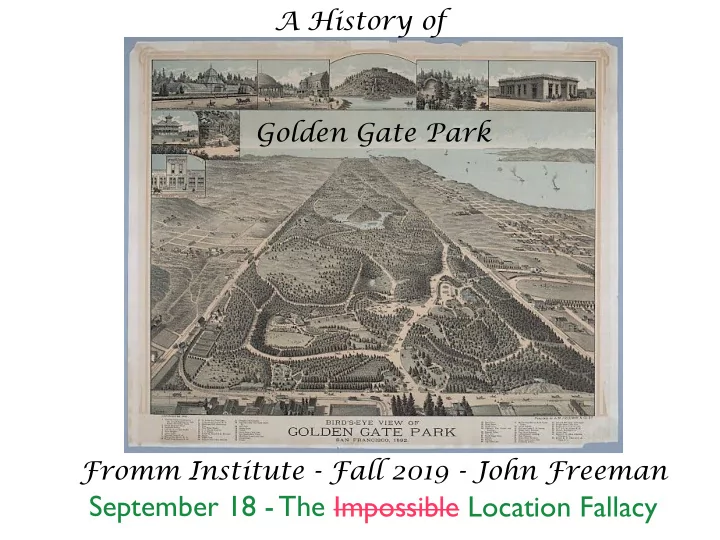
SLIDE 1 A H i s t
y
Golden Gate Park Fromm Institute - Fall 2019 - John Freeman
September 18 - The Impossible Location Fallacy
SLIDE 2
Birds Eye View of SF Bay Area - 1868
SLIDE 3 C h i l d r e n ’ s P l a y g r
n d ( fi l l e d ) D e L a v e a g a D e l l ( A i d s M e m
i a l G r
e ) ( fi l l e d ) Botanical Garden Lake (now pumps) Mallard Lake Chain of Lakes Strawberry Hill
SLIDE 4
SLIDE 5 Lone Mountain 468 ft. Grand View Pk. 673 ft. Larsen Peak 783 ft.
320 426 673
Edgehill Mt. 733 ft.
938 ft. Mount Sutro 920 ft.
1869 Map
P
n t L
T
l R
d ( 1 8 6 3 )
H
W a t e r S h a p e d D e v e l
m e n t
t h e O u t s i d e L a n d s
www.outsidelands.org/ westsidewater.php
Twin Peaks 925 ft.
925
938 733
783
468 920
Washington Hts.
320 ft.
Strawberry Hill
426 ft.
SLIDE 6
SLIDE 7
But there was more than sand if you knew where to look .....
SLIDE 8 Other obstacles to overcome to creating a thriving park in a place that Frederick Law Olmsted described as “a dreary waste of shifting sand hills where a blade of grass cannot be raised without four posts to keep it from blowing away.”
Obstacles to overcome:
- Inexperience - Ham Hall had experience with surveying, but not horticulture.
He was 25 years old, and a “quick study” of all things scientific.
- Water resources - Hall had some experience with hydrology, and while surveying
the boundaries of the park, paid close attention to where to find water, and origins
- f the aquifers.
- The challenge of the westerly winds. Planting would have to be protected from the
winds until they could take root.
- Use native or plants from similar regions of the world.
- Turn sand into soil - follow the horses!
SLIDE 9
From his surveying, Hall determined that of the approximate 1,000 acres, about 270 acres (~ 27%) in the eastern end was good, arable land, already covered with trees, shrubs and native grasses. The remaining 730 acres (~73%), west of Strawberry Hill and stretching down to the Ocean, was a wasteland of drifting sand, that would take more time and experimentation to get plants and trees to grow. Course of Action: After grading and establishing roads and filling in low spots, start at the eastern end with a nursery and stables as a base of operation. Begin planting in the Avenue (Panhandle) section with selected trees, surrounded by bushes to protect the trees until their root took hold. Do the same along the northern ridge further west, among live oak trees.
SLIDE 10 Children’s Quarter
Hall’s plan Eastern End of Park in 1872
Transverse Road #1 11th Ave. crossing Nursery Avenue Drive (The Panhandle)
SLIDE 11 Panhandle - c.1888 (“The Avenue” until 1889)
The Panhandle was where they experimented with growing techniques and species.
Baker St.
SLIDE 12
Native California Live Oak
SLIDE 13
Only Tree Native to Golden Gate Park
SLIDE 14
Phil Arnold Trail Oak Woodlands West of Superintendent’s Lodge, along north ridge, exit near 6th Avenue Entrance.
SLIDE 15
Eucalyptus - one of 15 species Ham Hall planted in his first two years.
Native of Australia, where ~ 700 species are found, but fossilized samples have been found in South America. The source of most eucalyptus introduced in California came from the southern state of Victoria (Melbourne).
SLIDE 16
Blue Gum Eucalyptus: grew from seed: 18 ft. in first two years
1,500 planted in first two years
SLIDE 17
SLIDE 18
Monterey Cypress
grew from seed: 14 ft. in first two years
3,500 planted in first two years
SLIDE 19
SLIDE 20
SLIDE 21
Monterey Pine
grew from seed: 14 ft. in first two years
3,500 planted in first two years
SLIDE 22
SLIDE 23
Plume Albizia (Acacia) Sydney Golden Wattle (Acacia)
Other trees or bushes planted in first two years
Peruvian Peppertree (350 plants) Sequoia giganteum (400 plants) Sequoia sempervirens (500 plants) 1,200 planted in first two years
SLIDE 24 Elizabeth May McClintock
1912 - 2004 curator in the Department of Botany at the California Academy of Sciences (1949 - 1977) Founder of Pacific Horticulture magazine
SLIDE 25 25
Taming the Dunes
SLIDE 26 John McLaren 1846 - 1943 Park Superintendent 53 years John McLaren
Hall’s plan for Eastern End
Transverse Road #3 Transverse Road #2
26th Ave.
38th Ave.
39th Ave. 24th Ave.
41st Ave. 43rd Ave.
Western Half of Golden Gate Park
Much less developed, primarily because of proximity to the Ocean
SLIDE 27 Did barley conquers the dunes?
27
SLIDE 28
Barley:
Seed Sprouted Growing
SLIDE 29 Yellow Lupine - native species
29
SLIDE 30 Letter of strong rebuke from Wm. Ham. Hall to John McLaren - April 26, 1927
After publication of Gardening in California, 1924 by John McLaren Two paragraphs about sowing of barley-seed and yellow lupin “John McLaren, – if you were in your right mind when you wrote and published the above paragraphs…. you must have known that you were LYING…as a basis for building up a….record for yourself as Park Superintendent.”
30
SLIDE 31 European Beach Grass
(Atlantic Coast of U.S. too)
Marram Grass Ammophila arenria Who brought in this non-native species?
31
SLIDE 32
William Hammond Hall 1846 - 1934
“brilliant, idealistic and irascible…”
Kevin Starr described Hall as
“a little stiff-necked and defensively arrogant….”
SLIDE 33 View SW from Strawberry Hill - new trees c. 1880 B y 1 8 7 6 : 6 , t r e e s p l a n t e d B y 1 8 7 9 : 1 5 5 , t r e e s p l a n t e d S p e c i e s
t e r e y P i n e , M
t e r e y C y p r u s a n d A u s t r a l i a n B l u e G u m E u c a l y p t u s
SLIDE 34 Olmstead’s response to Hall’s Third Biannual Report
January, 1876 I cannot too strongly express my admiration of the spirit and method which characterize your undertaking, and I do not doubt that it will be rewarded with results such as I have not hitherto thought reasonable to expect under the
- circumstances. There is no like enterprise anywhere else which, so far as I can
judge, has been conducted with equal foresight, ingenuity and economy. Very Truly Yours,
Update on Golden Gate Park
The park is approached by a serpentine drive, winding among the grove of shrubbery. The drives are many, and have been laid out judiciously. Picnic grounds with lovely rustic buildings and dancing pavilions are being laid out by skilled workmen. The picnic area embraces twenty-five acres......The chief improvement is the reclamation of the sand and establishing thereon a growth of forest trees......The management of the park is in excellent hands
San Francisco Chronicle, October 24, 1875
SLIDE 35 Daniel C. Sullivan’s Vendetta Against Superintendent Ham Hall
- Hall’s previous dealings with Mr. Sullivan
- Sullivan’s rise in local politics to State Assembly
- Accusations against the Superintendent, Fall, 1875:
- wanton & useless destruction of 1/3 of all trees planted
- neglect of duty by making private surveys in San Mateo & Marin
- waste of money: dug wells that were not in continuous use
- moving granite surveying markers used in 1870 to private property
- Hearings & scandal, Spring, 1876
- Results.....
William Hammond Hall’s salary was cut in half, which prompted him to resign. He did remain as a consulting engineer for Golden Gate Park until 1890
SLIDE 36
William Bond Prichard Superintendent 1876 - 1881
The years of neglect and mismanagement in Golden Gate Park
SLIDE 37
1876 - Hall is appointed the first California State Engineer - he worked on a number of State water projects, but his experience with the hydrology of Golden Gate Park was applied to the first San Joaquin Water Project. 1886 - Hall resigned as State Engineer, and was briefly hired back to advise the San Francisco Park Commission on the plans for a children’s playground and the construction of the Sharon Building. One of his other tasks was the selecting and training a new Park Superintendent.
SLIDE 38 The Gift That Altered the Park’s Original Concept From James Lick Estate - 1878 James Lick
1796 - 1876
SLIDE 39
James Lick Miser and Philanthropist
Born in rural Pennsylvania in 1796, James Lick learned fine cabinetmaking from his father, and from his mother inherited a passion for gardening. He fell in love with the daughter of the local miller, and when she became pregnant with his child he sought her hand in marriage. Lick relocated to Baltimore, where he learned to build pianos, then in 1821 moved to South America to start his own piano manufacturing business. Lick remained there for twenty-seven years, living first in Buenos Aires, Argentina, then in Valparaiso, Chile, and finally in Lima, Peru. In 1832, after making his first fortune, he returned briefly to Pennsylvania to claim his bride and 14-year-old son, only to learn that she had married another. James Lick never married. Already in his 50s when, believing California would soon become part of the United States, he sold his considerable South American assets and boarded a ship north. He arrived in San Francisco on January 7, 1848 – 17 days before James Marshall discovered gold at Sutter’s Mill. With him, he also brought 600 pounds of chocolate his former neighbor in Lima, Domingo Ghirardelli, and $30,000 in gold coins from selling his piano business. His letter to Ghirardelli, of the opportunities in California, prompted him to bring his business north too.
SLIDE 40 Upon his arrival in the village of San Francisco, Lick set about buying land. In three months, he spent $7,000 to buy 50 San Francisco lots in what would become downtown San Francisco. Lick also bought large tracts in Santa Clara County as well as parcels near Lake Tahoe, in Napa County, in Virginia City, Nevada, and in present-day Griffith Park in Los Angeles. He also acquired Catalina Island. Lick became the wealthiest man in the new state of California, yet he lived like a pauper! In 1874, at he age of 77, Lick had a stroke. He spent the next two year establishing trusts to distribute his wealth. At his death two years later totaled $2,930,654 ($73 Million today). He specified the following gifts:
- Lick Observatory
- California School of Mechanical Arts (today’s Lick Wilmerding High School in SF
- Lick Public Baths
- Pioneer Monument in San Francisco
- 2 Protestant orphanages and one Ladies Relief Society
- Mechanics’ Institute
- SPCA
- Money set aside for the Francis Scott Key Monument
- Society of California Pioneers
- California Academy of Sciences
James Lick died October 1, 1876 The Conservatory of Flowers was purchased by 19 San Francisco investors as a gift to Golden Gate Park in 1877
SLIDE 41
Consevatory of Flowers - 1878
SLIDE 42
Sunday Concert
SLIDE 43
SLIDE 44
Victoria Regia