Non Elderly Uninsured Rate Federal Politics and Californias - - PowerPoint PPT Presentation

non elderly uninsured rate
SMART_READER_LITE
LIVE PREVIEW

Non Elderly Uninsured Rate Federal Politics and Californias - - PowerPoint PPT Presentation

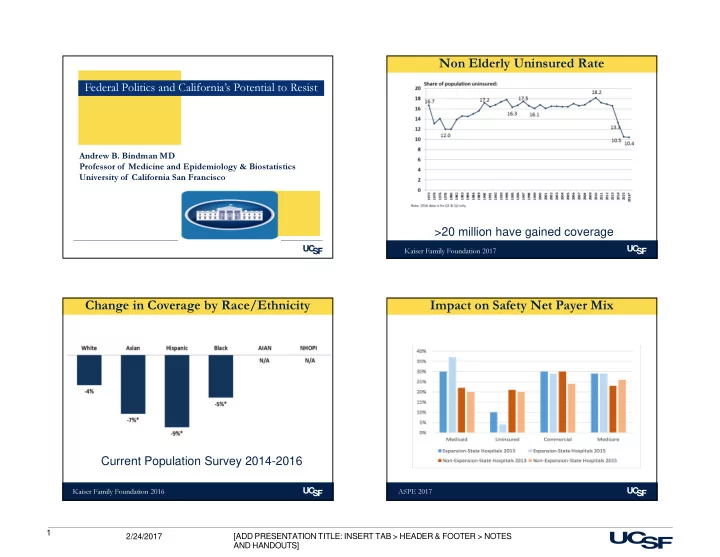
Non Elderly Uninsured Rate Federal Politics and Californias Potential to Resist Andrew B. Bindman MD Professor of Medicine and Epidemiology & Biostatistics University of California San Francisco >20 million have gained coverage


slide-1
SLIDE 1

[ADD PRESENTATION TITLE: INSERT TAB > HEADER & FOOTER > NOTES AND HANDOUTS] 2/24/2017 1

Federal Politics and California’s Potential to Resist

Andrew B. Bindman MD Professor of Medicine and Epidemiology & Biostatistics University of California San Francisco

Non Elderly Uninsured Rate

>20 million have gained coverage

Kaiser Family Foundation 2017

Change in Coverage by Race/Ethnicity

Current Population Survey 2014-2016

Kaiser Family Foundation 2016

Impact on Safety Net Payer Mix

ASPE 2017

slide-2
SLIDE 2

[ADD PRESENTATION TITLE: INSERT TAB > HEADER & FOOTER > NOTES AND HANDOUTS] 2/24/2017 2

Impact on Safety Net Financing

ASPE 2017

For the first time since Medicare and Medicaid enacted, Republicans control White House and Congress Will a change in the White House bring a change in health policy and practice of medicine

Presidential Politics Republican Critique of ACA

Focus on access/coverage rather than cost Expansion of entitlement programs

  • Medicaid
  • Subsidies in Exchanges

Makes floor of what insurance covers too high Individual mandate 17.6 million have gained coverage since ACA

Actual Projected

slide-3
SLIDE 3

[ADD PRESENTATION TITLE: INSERT TAB > HEADER & FOOTER > NOTES AND HANDOUTS] 2/24/2017 3

Federal Mandatory Entitlements: 2015

882 634 350 38 9

Social Security Medicare Medicaid Exchange Subsides CHIP

Billions $

Elderly Poor

Aging of the US Population Repeal, Replace or Repair

Full repeal would require 60 Senate votes Partial repeal possible with 50 Senate votes (reconciliation) Extent of replacement/repair will determine whether need 50 or 60 Senate votes

Reach of Reconciliation

Federal budget items

  • Tax on individual and

employer mandates

  • Medicaid expansion
  • Tax credits for exchange
  • Cadillac tax
  • CMMI, PCORI

Not private insurance regs

  • Dependent coverage <26
  • Non exclusion for pre-

existing conditions

slide-4
SLIDE 4

[ADD PRESENTATION TITLE: INSERT TAB > HEADER & FOOTER > NOTES AND HANDOUTS] 2/24/2017 4

Problem of Repeal without Replace

Steep insurance enrollment declines among low income individuals Insurers will leave individual market for everyone if have to provide coverage to the sick without guarantee of healthy pool from individual mandate

Republican Health Care Alternatives

No consensus yet

  • WH, House and Senate

not in agreement House leadership has issued a policy brief but no legislation Senate has not organized around a specific approach Final product will need to be scored by CBO to result in federal savings

Tax credits to voluntarily purchase coverage Cross-state purchasing of health insurance Protection for those with pre- existing health conditions High-Risk Pools Consumer-directed arrangements like HSAs Greater flexibility for states in Medicaid program design

No Recipe But Some Ingredients

Purchasing insurance in Exchange (Covered CA) Similar but very different from ACA ACA

  • Premium tax credits vary by income, age, and

local premiums, rising with premium growth rate. Additional cost-sharing subsidies available. GOP replacement proposals

  • Tax credits vary by age but not local premiums

and not necessarily by income, rising at a fixed growth rate. No cost sharing subsidies.

Republican Tax Credits

slide-5
SLIDE 5

[ADD PRESENTATION TITLE: INSERT TAB > HEADER & FOOTER > NOTES AND HANDOUTS] 2/24/2017 5

Eliminate the floor of essential health benefits Allow low-cost, less comprehensive, catastrophic insurance plans Undermine states with higher insurance standards by allowing cross state purchasing of coverage

Cross State Insurance

Guaranteed coverage with continuous enrollment without the guarantee it will be affordable Cost of maintaining continuous coverage between jobs could create a significant financial barrier Could contribute to job lock High risk pools in which government subsidizes high cost individuals never proven to work

Pre-Existing Conditions Health Savings Accounts

Tax-free savings account for health care expenses Typically combined with high deductible plan “Individual self insured plan”- no insurance pool Poor and sick least prepared to save Regressive tax benefit which favors the wealthy

  • Reduced federal requirements of state run

programs

  • Limits on federal contribution

‒Block grants ‒Capitation

  • Based on a prior Republican legislation anticipate

20% reduction in federal spending ‒$1 trillion over 10 years

Medicaid Program Flexibility

slide-6
SLIDE 6

[ADD PRESENTATION TITLE: INSERT TAB > HEADER & FOOTER > NOTES AND HANDOUTS] 2/24/2017 6

Medicaid Program Flexibility Medicaid Program Flexibility =

First Law of Motion (Inertia):

  • A health policy law (e.g. ACA) in motion will tend

to stay in motion unless an external force is applied to it (i.e. a new law is passed)

Applying “Physical Laws” to Health Policy

Swing 3 Republican senators to prevent repeal through reconciliation House is also option but requires turning about 25 Republican members Activate stakeholders who will be hurt by a repeal

  • Individuals at risk for losing coverage
  • Hospitals/health systems at risk for losing $
  • Red state governors who expanded Medicaid

Undermine ability of WH and Congress to work together by emphasizing differences in local vs national agenda

Federal Resistance Strategy

slide-7
SLIDE 7

[ADD PRESENTATION TITLE: INSERT TAB > HEADER & FOOTER > NOTES AND HANDOUTS] 2/24/2017 7

Congressman McClintock Town Hall

First Law of Motion (Inertia):

  • A health policy law (e.g. ACA) in motion will tend

to stay in motion unless an external force is applied to it (e.g a new law is passed) Second Law of Thermodynamics (Entropy):

  • It is easier to undermine a health policy law (e.g.

ACA) by not maintaining it than to pass a new law

Applying “Physical Laws” to Health Policy HHS Secretary

HHS Secretary is a physician

  • Orthopedic surgeon
  • Former congressman from

Georgia Advocate for ACA repeal Authored 2015 legislation which was vetoed by Obama Has power over ACA regs

  • > 700 places where it says

“Secretary shall..”

  • > 200 places where it says

“Secretary may ..”

Tom Price, MD

Supreme Court made ACA Medicaid expansion

  • ptional

Current federal statute provides opportunities for states to modify implementation of ACA through waivers Federal executive branch has approval authority for state waivers:

  • requests to modify Medicaid rules
  • requests to modify the rules on the availability of

subsidies to purchase insurance through an exchange

State Flexibility

slide-8
SLIDE 8

[ADD PRESENTATION TITLE: INSERT TAB > HEADER & FOOTER > NOTES AND HANDOUTS] 2/24/2017 8

Medicaid waivers to reduce enrollment/use

  • Co-payments
  • Financial penalties for unhealthy behaviors
  • Linking entitlement to work requirements
  • Limit benefits? Income eligibility?

State basic health plan waivers can

  • Redirect low income subsidies to state control
  • Remove minimum benefit floor of exchange plans
  • Remove individual mandate

Unraveling ACA Through State Flexibility

Support state efforts to push back on federal reform and to maximize federal funds for health care If state given more “flexibility” resist efforts to adopt counterproductive cost-saving measures Hold state accountable for our values universal access, equity, patient-centered care Pursue higher value care Promote primary care Lower administrative costs –single payer?

State Resistance Strategy Safety Net Providers

You will be on the frontlines

  • f witnessing impact of

changes in ACA Share what you observe Confront adversity with solidarity Remember to care for yourself so you can continue to care for others

Thank You

Any Questions?