Social Obligation to Guarantee Health Care? Why? How Much? - - PDF document

social obligation to guarantee health care
SMART_READER_LITE
LIVE PREVIEW

Social Obligation to Guarantee Health Care? Why? How Much? - - PDF document

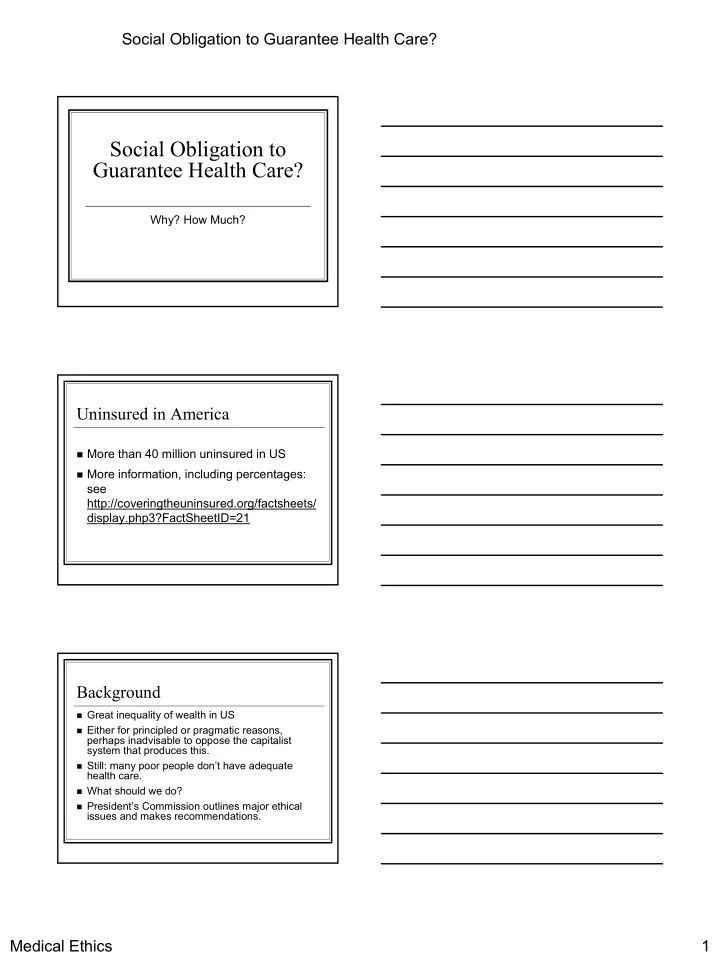
Social Obligation to Guarantee Health Care? Social Obligation to Guarantee Health Care? Why? How Much? Uninsured in America More than 40 million uninsured in US More information, including percentages: see


slide-1
SLIDE 1

Social Obligation to Guarantee Health Care? Medical Ethics 1

Social Obligation to Guarantee Health Care?

Why? How Much?

Uninsured in America

More than 40 million uninsured in US More information, including percentages:

see http://coveringtheuninsured.org/factsheets/ display.php3?FactSheetID=21

Background

Great inequality of wealth in US Either for principled or pragmatic reasons,

perhaps inadvisable to oppose the capitalist system that produces this.

Still: many poor people don’t have adequate

health care.

What should we do? President’s Commission outlines major ethical

issues and makes recommendations.

slide-2
SLIDE 2

Social Obligation to Guarantee Health Care? Medical Ethics 2 Health Care Is Special Because of its Relation to…

Well being

Avoidance of pain, suffering, disability, death. Health care a primary good: something we desire

regardless of our particular life goals

Opportunity Information Existential significance of illness, birth, death

Other Factors Making Health Care Special

Need for it is not predictable; can’t easily

plan for it

Much of health and illness is beyond

individual control: genetics, environment, chance.

Cost of care can be overwhelming (e.g., unpredictable catastrophe from accident)

Spirit of Report (contrast with Sade)

“The depth of a society’s concern about health

care can be seen as a measure of its sense of solidarity in the face of suffering and death.”

“A society’s commitment to health care reflects

some of its most basic attitudes about what it is to be a member of the human community.”

(p. 832-2)

We should provide equitable access to health

care, but what is “equitable”?

slide-3
SLIDE 3

Social Obligation to Guarantee Health Care? Medical Ethics 3

Equity is not equality

(equality would mean: “whatever one gets, everyone gets”) If generous, too great a drain on nation’s

resources that are needed for other goods.

If restrictive, then would need to restrict

economic liberty (recall chart distributed in class)

Wealthy could use their greater wealth for frivolous things

but not for better health care for their children.

Is this unjust?

Equity is not providing all that would benefit people

Too expensive; must consider costs as well Cannot even provide all that people “need”

because need to hard to define.

Philosophically: important distinction between

wants and needs

Can this be formulated in a way to overcome the

  • Pres. Commission’s objection here?

Equitable access should provide an adequate level of care

Task: sharpen this vague term into a workable

foundation for U.S. health policy

Recognizes that resources are limited; we need to

set priorities

Overcomes objection that equitable health care is

an “impossible ideal.”

Avoids an unacceptable restriction on economic

liberty (e.g., disallowing rich to spend for health care)

This notion is “society-relative. Interesting to consider how we’d define “adequate” in South Africa

slide-4
SLIDE 4

Social Obligation to Guarantee Health Care? Medical Ethics 4

Other Key Elements

Should impose only “acceptable burdens”

  • n people

Contrasting view (Gutmann): health care so related

to human dignity that unequal burden immoral.

The obligation is provide equitable health

care belongs to society

This is a public, communal responsibility Contrast with Sade.

Why is health care not a private responsibility?

Cannot be provided by individuals’ own efforts Unpredictable and great costs Undeserved (generally)

(Above repeat earlier points. But also, not explicitly stated but important—EB):

Medical knowledge has been acquired with public

funds, so doctors’ skill is not their private property.

(“a social product requiring the skills and efforts of many individuals”)

What Is the Role of Government?

A social responsibility, but not necessarily

  • nly government: a “pluralistic approach of

public and private.”

The ultimate responsibility for health care

rests with the Federal Government.

(Doesn’t mean government should be provider)

slide-5
SLIDE 5

Social Obligation to Guarantee Health Care? Medical Ethics 5

Is There a RIGHT to health care

Back to Ethics 101: every right implies an

  • bligation but not every obligation implies a right.

(Can you explain this clearly?) Commission couldn’t decide the philosophical

question whether people are entitled to health care (and how right relates to other rights).

Simply: social obligation to provide equitable

access to health care.

How much care is “adequate”?

Next week: managed care, age-based restrictions

and other specific “tests”

Clear cases: cosmetic surgery need not be

included

Key question: how does the health care relate to

welfare, opportunity, information, and interpersonal caring—the things that made health care “special.”

Mental health coverage?

Must Consider Costs

Cost-benefit analysis to determine what health

care offered, what not.

Costs and benefits must be conceived broadly:

Benefits need not be monetarily quantifiable; includes

improved quality of life, reassurance from information, social benefit of strengthening a sense of community

Costs include diverting funds from other possible non-

medical goods.

slide-6
SLIDE 6

Social Obligation to Guarantee Health Care? Medical Ethics 6

Defining “adequate” level

Does not mean the highest possible level of

quality.

So there may be an expensive treatment that will provide best care that will have to be denied.

Outcomes research has become

increasingly important (EB)

  • Pres. Commission: how it should be

Reinhardt: the way it is falls far short

Clearly starts from opposite premises from Sade.

As national policy, should child of a poor family

have same chance of avoiding preventable illness as rich family?

Reinhardt: in US answer is no; most other

industrialized countries have said yes.

Is this true? Would Pres Comm. Report say yes or no?

Reinhardt: American Health Care System Unfairly Favors Rich

True that generous care for unproductive

frail people compromises a nation’s long- term material wealth.

Powerful elite in US have favored material

wealth at expense of poor.

Rawlsian position would dictate otherwise.