SEMAFOR: Frame Argument Resolution with Log-Linear Models or, The - - PDF document

semafor frame argument resolution with log linear models
SMART_READER_LITE
LIVE PREVIEW

SEMAFOR: Frame Argument Resolution with Log-Linear Models or, The - - PDF document

SemEval Task 10: Linking Events and their Participants in Discourse SEMAFOR: Frame Argument Resolution with Log-Linear Models or, The Case of the Missing Arguments Desai Chen Nathan Schneider Dipanjan Das Noah A. Smith School of Computer


slide-1
SLIDE 1

SEMAFOR: Frame Argument Resolution with Log-Linear Models

Dipanjan Das Nathan Schneider Desai Chen Noah A. Smith

SemEval July 16, 2010 School of Computer Science Carnegie Mellon University

  • r, The Case of the Missing Arguments

SemEval Task 10: Linking Events and their Participants in Discourse

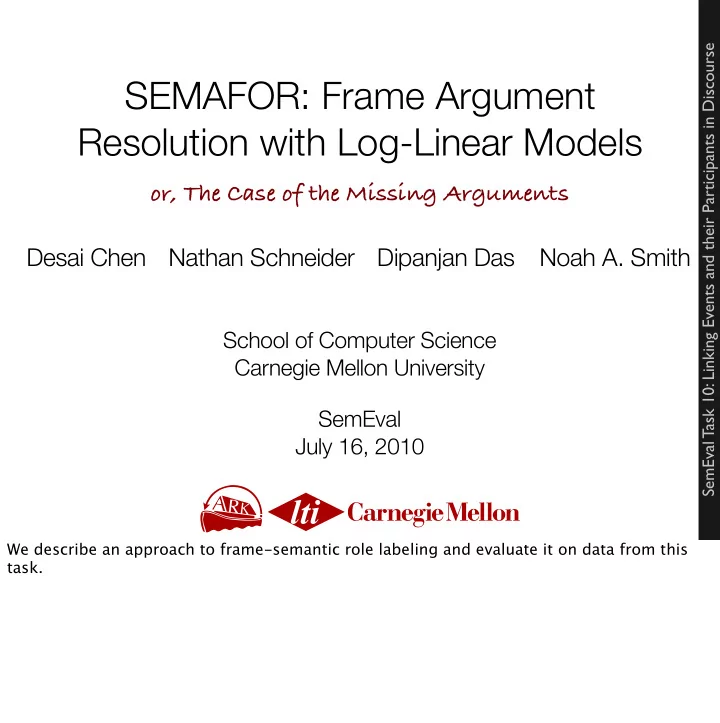
We describe an approach to frame-semantic role labeling and evaluate it on data from this task.

slide-2
SLIDE 2

SEMAFOR: Frame Argument Resolution with Log-Linear Models

Dipanjan Das Nathan Schneider Desai Chen Noah A. Smith

(guy in the front of the room)

  • r, The Case of the Missing Arguments

SemEval Task 10: Linking Events and their Participants in Discourse

We describe an approach to frame-semantic role labeling and evaluate it on data from this task.

slide-3
SLIDE 3

Chen, Schneider, Das, and Smith ~ SemEval 2010

Holmes sprang in his chair as if he had been stung when I read the headline.

Frame SRL

2

(SemEval 2010 trial data)

NNP VBP IN PRP NN IN IN PRP VBD VBN VBN WRB PRP VBD DT NN .

This is a full annotation of a sentence in terms of its frames/arguments. Note that this is a *partial* semantic representation: it shows a certain amount of relational meaning but doesn’t encode, for instance, that “as if he had been stung” is a hypothetical used to provide imagery for the manner of motion (we infer that it must have been rapid and brought upon by a shocking stimulus). The SRL task: Given a sentence with POS tags, syntactic dependencies, predicates, and frame names, predict the arguments for each frame role. New wrinkle in this version of the task: classifying and resolving missing arguments.

slide-4
SLIDE 4

Chen, Schneider, Das, and Smith ~ SemEval 2010

Holmes sprang in his chair as if he had been stung when I read the headline.

Frame SRL

2

(SemEval 2010 trial data)

NNP VBP IN PRP NN IN IN PRP VBD VBN VBN WRB PRP VBD DT NN . EXPERIENCER_OBJ READING SELF_MOTION

This is a full annotation of a sentence in terms of its frames/arguments. Note that this is a *partial* semantic representation: it shows a certain amount of relational meaning but doesn’t encode, for instance, that “as if he had been stung” is a hypothetical used to provide imagery for the manner of motion (we infer that it must have been rapid and brought upon by a shocking stimulus). The SRL task: Given a sentence with POS tags, syntactic dependencies, predicates, and frame names, predict the arguments for each frame role. New wrinkle in this version of the task: classifying and resolving missing arguments.

slide-5
SLIDE 5

Chen, Schneider, Das, and Smith ~ SemEval 2010

Holmes sprang in his chair as if he had been stung when I read the headline.

Reader Text Self_mover Place Manner Time

Frame SRL

2

Experiencer Stimulus: INI

(SemEval 2010 trial data)

NNP VBP IN PRP NN IN IN PRP VBD VBN VBN WRB PRP VBD DT NN . EXPERIENCER_OBJ READING SELF_MOTION

This is a full annotation of a sentence in terms of its frames/arguments. Note that this is a *partial* semantic representation: it shows a certain amount of relational meaning but doesn’t encode, for instance, that “as if he had been stung” is a hypothetical used to provide imagery for the manner of motion (we infer that it must have been rapid and brought upon by a shocking stimulus). The SRL task: Given a sentence with POS tags, syntactic dependencies, predicates, and frame names, predict the arguments for each frame role. New wrinkle in this version of the task: classifying and resolving missing arguments.

slide-6
SLIDE 6

Chen, Schneider, Das, and Smith ~ SemEval 2010

Holmes sprang in his chair as if he had been stung when I read the headline.

Reader Text Self_mover Place Manner Time

Frame SRL

2

Experiencer Stimulus: INI

(SemEval 2010 trial data)

NNP VBP IN PRP NN IN IN PRP VBD VBN VBN WRB PRP VBD DT NN .

What the Experiencer felt is missing!

EXPERIENCER_OBJ READING SELF_MOTION

This is a full annotation of a sentence in terms of its frames/arguments. Note that this is a *partial* semantic representation: it shows a certain amount of relational meaning but doesn’t encode, for instance, that “as if he had been stung” is a hypothetical used to provide imagery for the manner of motion (we infer that it must have been rapid and brought upon by a shocking stimulus). The SRL task: Given a sentence with POS tags, syntactic dependencies, predicates, and frame names, predict the arguments for each frame role. New wrinkle in this version of the task: classifying and resolving missing arguments.

slide-7
SLIDE 7

Chen, Schneider, Das, and Smith ~ SemEval 2010

3

Contributions

  • Evaluate frame SRL on new data
  • Experiment with a classifier for null

instantiations (NIs)

  • implicit interactions in a discourse
slide-8
SLIDE 8

Chen, Schneider, Das, and Smith ~ SemEval 2010

4

Overview

➡ Background: frame SRL

  • Overt argument identification
  • Null instantiation resolution
  • Conclusion
slide-9
SLIDE 9

Chen, Schneider, Das, and Smith ~ SemEval 2010

5

FrameNet

  • FrameNet (Fillmore et al., 2003) defines

semantic frames, roles, and associated predicates

  • provides a linguistically rich

representation for predicate-argument structures based on the theory of frame semantics (Fillmore, 1982)

slide-10
SLIDE 10

Chen, Schneider, Das, and Smith ~ SemEval 2010

6

http://framenet.icsi.berkeley.edu

MAKE_NOISE Noisy_event Sound Sound_source Place Time

cough.v, gobble.v, hiss.v, ring.v, yodel.v, ...

FrameNet

The FrameNet lexicon is a repository of expert information, storing the semantic frames and a number of (frame-specific) roles. Each frame represents a holistic event or scenario, generalizing over specific predicates. It also defines roles for the participants, props, and attributes of the scenario.

slide-11
SLIDE 11

Chen, Schneider, Das, and Smith ~ SemEval 2010

MAKE_NOISE Noisy_event Sound Sound_source Place Time

cough.v, gobble.v, hiss.v, ring.v, yodel.v, ...

7

group of predicates (“lexical units”) frame name roles

FrameNet

http://framenet.icsi.berkeley.edu

For example, here we show the Make_noise frame that has several roles such as Sound, Noisy_event, Sound_Source, etc. FrameNet also lists some possible lexical units which could evoke these frames. Examples for this frame are cough, gobble, hiss, ring, and so on.

slide-12
SLIDE 12

Chen, Schneider, Das, and Smith ~ SemEval 2010

8

relationships between frames and between roles

EVENT Place Time Event TRANSITIVE_ACTION Agent Patient Event Cause Place Time OBJECTIVE_INFLUENCE Dependent_entity Influencing_situation Place Time Influencing_entity CAUSE_TO_MAKE_NOISE Agent Sound_maker Cause Place Time MAKE_NOISE Noisy_event Sound Sound_source Place Time

cough.v, gobble.v, hiss.v, ring.v, yodel.v, ... blare.v, honk.v, play.v, ring.v, toot.v, ... — affect.v, effect.n, impact.n, impact.v, ... event.n, happen.v,

  • ccur.v, take place.v, ...

Inheritance relation Causative_of relation Excludes relation

Purpose

FrameNet

http://framenet.icsi.berkeley.edu

The FrameNet lexicon also provides relationships between frames and between roles

slide-13
SLIDE 13

Chen, Schneider, Das, and Smith ~ SemEval 2010

9

Annotated Data

[SE’07] has ANC travel guides, PropBank news, and (mostly) NTI reports on weapons stockpiles. Unlike other participants, we do not use the 139,000 lexicographic exemplar sentences (except indirectly through features) because the annotations are partial (only 1 frame) and the sample of sentences is biased (they were chosen manually to illustrate variation of arguments). [SE’10] also has coreference, though we do not make use of this information.

slide-14
SLIDE 14

Chen, Schneider, Das, and Smith ~ SemEval 2010

9

Annotated Data

  • Full-text annotations: all frames + arguments
  • [SE’07] SemEval 2007 task data:

news, popular nonfiction, bureaucratic

2000 sentences, 50K words

[SE’07] has ANC travel guides, PropBank news, and (mostly) NTI reports on weapons stockpiles. Unlike other participants, we do not use the 139,000 lexicographic exemplar sentences (except indirectly through features) because the annotations are partial (only 1 frame) and the sample of sentences is biased (they were chosen manually to illustrate variation of arguments). [SE’10] also has coreference, though we do not make use of this information.

slide-15
SLIDE 15

Chen, Schneider, Das, and Smith ~ SemEval 2010

9

Annotated Data

  • Full-text annotations: all frames + arguments
  • [SE’07] SemEval 2007 task data:

news, popular nonfiction, bureaucratic

  • [SE’10] New SemEval 2010 data:

fiction

1000 sentences, 17K words ½ train, ½ test 2000 sentences, 50K words

[SE’07] has ANC travel guides, PropBank news, and (mostly) NTI reports on weapons stockpiles. Unlike other participants, we do not use the 139,000 lexicographic exemplar sentences (except indirectly through features) because the annotations are partial (only 1 frame) and the sample of sentences is biased (they were chosen manually to illustrate variation of arguments). [SE’10] also has coreference, though we do not make use of this information.

slide-16
SLIDE 16

Chen, Schneider, Das, and Smith ~ SemEval 2010

10

Overview

✓ Background: frame SRL ➡ Overt argument identification

  • Null instantiation resolution
  • Conclusion
slide-17
SLIDE 17

Chen, Schneider, Das, and Smith ~ SemEval 2010

Frame SRL: Overt Arguments

We train a classifier to pick an argument for each role of each frame.

11

SRL

SELF_MOTION.Place

(parse)

sprang

IN PRP NN

in his chair

(Das et al., 2010)

See NAACL 2010 paper

slide-18
SLIDE 18

Chen, Schneider, Das, and Smith ~ SemEval 2010

Frame SRL: Overt Arguments

We train a classifier to pick an argument for each role of each frame.

11

SRL

SELF_MOTION.Place

(parse)

sprang

IN PRP NN

in his chair

(Das et al., 2010)

a probabilistic model with features looking at the span, the frame, the role, and the observed sentence structure

See NAACL 2010 paper

slide-19
SLIDE 19

Chen, Schneider, Das, and Smith ~ SemEval 2010

Frame SRL: Overt Arguments

12

sprang ~ SELF_MOTION

An example of the desired mapping. For the predicate ‘sprang’, each role of the evoked frame is considered separately, and filled with a phrase in the sentence or left empty.

slide-20
SLIDE 20

Chen, Schneider, Das, and Smith ~ SemEval 2010

Frame SRL: Overt Arguments

12

sprang ~ SELF_MOTION

Self_mover Place Path Goal Time Manner ...

An example of the desired mapping. For the predicate ‘sprang’, each role of the evoked frame is considered separately, and filled with a phrase in the sentence or left empty.

slide-21
SLIDE 21

Chen, Schneider, Das, and Smith ~ SemEval 2010

Frame SRL: Overt Arguments

12

sprang ~ SELF_MOTION

Self_mover Place Path Goal Time Manner ...

IN PRP NN

in his chair I

PRP WRB PRP VBD DT NN DT NN

when I read the headline

DT NN

the headline Holmes

NNP PRP NN

his chair

IN IN PRP VBD VBN VBN

as if he had been stung

PRP VBD VBN VBN

he had been stung

PRP

he ...

An example of the desired mapping. For the predicate ‘sprang’, each role of the evoked frame is considered separately, and filled with a phrase in the sentence or left empty.

slide-22
SLIDE 22

Chen, Schneider, Das, and Smith ~ SemEval 2010

Frame SRL: Overt Arguments

12

sprang ~ SELF_MOTION

Self_mover Place Path Goal Time Manner ...

IN PRP NN

in his chair I

PRP WRB PRP VBD DT NN DT NN

when I read the headline

DT NN

the headline Holmes

NNP PRP NN

his chair

IN IN PRP VBD VBN VBN

as if he had been stung

PRP VBD VBN VBN

he had been stung

PRP

he ...

An example of the desired mapping. For the predicate ‘sprang’, each role of the evoked frame is considered separately, and filled with a phrase in the sentence or left empty.

slide-23
SLIDE 23

Chen, Schneider, Das, and Smith ~ SemEval 2010

Frame SRL: Overt Arguments

12

sprang ~ SELF_MOTION

Self_mover Place Path Goal Time Manner ...

IN PRP NN

in his chair

I

PRP

WRB PRP VBD DT NN DT NN

when I read the headline

DT NN

the headline

Holmes

NNP

PRP NN

his chair

IN IN PRP VBD VBN VBN

as if he had been stung

PRP VBD VBN VBN

he had been stung

PRP

he

...

An example of the desired mapping. For the predicate ‘sprang’, each role of the evoked frame is considered separately, and filled with a phrase in the sentence or left empty.

slide-24
SLIDE 24

Chen, Schneider, Das, and Smith ~ SemEval 2010

Frame SRL: Overt Arguments

12

sprang ~ SELF_MOTION

Self_mover Place Path Goal Time Manner ...

IN PRP NN

in his chair I

PRP WRB PRP VBD DT NN DT NN

when I read the headline

DT NN

the headline Holmes

NNP PRP NN

his chair

IN IN PRP VBD VBN VBN

as if he had been stung

PRP VBD VBN VBN

he had been stung

PRP

he

...

∅ ∅

An example of the desired mapping. For the predicate ‘sprang’, each role of the evoked frame is considered separately, and filled with a phrase in the sentence or left empty.

slide-25
SLIDE 25

Chen, Schneider, Das, and Smith ~ SemEval 2010

Frame SRL: Overt Arguments

13

stung ~ EXPERIENCER_OBJ

Experiencer Stimulus Degree Time Manner ...

IN PRP NN

in his chair I

PRP WRB PRP VBD DT NN DT NN

when I read the headline

DT NN

the headline Holmes

NNP PRP NN

his chair

IN IN PRP VBD VBN VBN

as if he had been stung

PRP VBD VBN VBN

he had been stung

PRP

he ...

...and likewise for ‘stung’, etc.

slide-26
SLIDE 26

Chen, Schneider, Das, and Smith ~ SemEval 2010

Frame SRL: Overt Arguments

13

stung ~ EXPERIENCER_OBJ

Experiencer Stimulus Degree Time Manner ...

IN PRP NN

in his chair I

PRP WRB PRP VBD DT NN DT NN

when I read the headline

DT NN

the headline Holmes

NNP PRP NN

his chair

IN IN PRP VBD VBN VBN

as if he had been stung

PRP VBD VBN VBN

he had been stung

PRP

he ...

∅ ∅ ∅ ∅

...and likewise for ‘stung’, etc.

slide-27
SLIDE 27

Chen, Schneider, Das, and Smith ~ SemEval 2010

14

Frame SRL: Experimental Setup

  • SRL component of SEMAFOR 1.0

(Das et al., 2010; http://www.ark.cs.cmu.edu/SEMAFOR)

  • Task scoring script for overt argument

precision, recall, F1 on test set

  • Strict matching criterion: argument spans

must be exact

slide-28
SLIDE 28

Chen, Schneider, Das, and Smith ~ SemEval 2010

P

  • Ch. 13

F

0.1 0.2 0.3 0.4 0.5 0.6 0.7 0.8 0.9 1.0

0.57 0.49 0.67 0.54 0.46 0.67 0.50 0.40 0.65

15

SRL on SE’10 Test Data

Training Sets

2000

# sentences

2250 2500 (2 documents, ~500 sentences)

SE’07 SE’07 + ½ SE’10 SE’07 + SE’10

R P F1

SE’07: SEMAFOR trained only on old data (difgerent domain from test set) SE’10: new training data included (same domain as test set) Adding a small amount of new data helps a lot: (~7% F1): domain issue + so little data to begin with. Suggests even more data might yield substantial improvements! Scores are microaveraged according to the number of frames in each of the 2 test documents.

slide-29
SLIDE 29

Chen, Schneider, Das, and Smith ~ SemEval 2010

16

Overview

✓ Background: frame SRL ✓ Overt argument identification ➡ Null instantiation resolution

  • Conclusion
slide-30
SLIDE 30

Chen, Schneider, Das, and Smith ~ SemEval 2010

Null Instantiations

  • New this year: classification and resolution of null

instantiations (NIs), arguments that are nonlocal

  • r implicit in the discourse
  • a role is said to be null-instantiated if it has no

(overt) argument in the sentence, but has an implicit contextual filler

  • see also (Gerber & Chai, 2010), which considers

implicit argument resolution for several (nominal) predicates

17

(Fillmore, 1986; Ruppenhofer, 2005)

slide-31
SLIDE 31

Chen, Schneider, Das, and Smith ~ SemEval 2010

Null Instantiations

  • indefinite null instantiation (INI): the referent is

vague/deemphasized

  • We ate ∅Thing_eaten .
  • He was stung ∅Stimulus .
  • definite null instantiation (DNI): a specific

referent is obvious from the discourse

  • They’ll arrive soon ∅Goal .

(the goal is implicitly the speaker’s location)

18

(Fillmore, 1986; Ruppenhofer, 2005)

slide-32
SLIDE 32

Chen, Schneider, Das, and Smith ~ SemEval 2010

Null Instantiations

  • indefinite null instantiation (INI): the referent is

vague/deemphasized

  • We ate ∅Thing_eaten .
  • He was stung ∅Stimulus .
  • definite null instantiation (DNI): a specific

referent is obvious from the discourse

  • They’ll arrive soon ∅Goal .

(the goal is implicitly the speaker’s location)

18

(Fillmore, 1986; Ruppenhofer, 2005)

slide-33
SLIDE 33

Chen, Schneider, Das, and Smith ~ SemEval 2010

DNI Example: overt nonlocal referent

“I think I Experiencer shall be in a position to make the situation rather more clear to you before long. It has been an exceedingly difficult and most complicated business ∅Experiencer.

19

(SemEval 2010 test data)

The other frame-evoking words are bolded, but their arguments are not shown.

slide-34
SLIDE 34

Chen, Schneider, Das, and Smith ~ SemEval 2010

DNI Example: overt nonlocal referent

“I think I Experiencer shall be in a position to make the situation rather more clear to you before long. It has been an exceedingly difficult and most complicated business ∅Experiencer.

19

(SemEval 2010 test data)

DIFFICULTY Degree Activity

The other frame-evoking words are bolded, but their arguments are not shown.

slide-35
SLIDE 35

Chen, Schneider, Das, and Smith ~ SemEval 2010

DNI Example: overt nonlocal referent

“I think I Experiencer shall be in a position to make the situation rather more clear to you before long. It has been an exceedingly difficult and most complicated business ∅Experiencer.

19

(SemEval 2010 test data)

DIFFICULTY Degree Activity

The other frame-evoking words are bolded, but their arguments are not shown.

slide-36
SLIDE 36

Chen, Schneider, Das, and Smith ~ SemEval 2010

Prevalence of NIs

20

(SemEval 2010 new training data)

2,589 62 90 91 60 277

INI DNI, unresolved DNI, referent in same sentence DNI, referent within 3 previous sentences DNI, other referent Overt

82%

303 DNIs

These numbers may be approximate. They show how few NIs there are compared to overt args, and why the DNI resolution task is so hard.

slide-37
SLIDE 37

Chen, Schneider, Das, and Smith ~ SemEval 2010

Modeling Approach for NIs

We try a straightforward approach for null instantiations: a second classifier

21

SRL NI Resolution

SELF_MOTION.Place

(parse)

sprang

IN PRP NN

in his chair

INI DNI DNI+referent NONE

if a core role

The SRL module selects an argument span or none for each role. For core roles, we then build a second classifier for disambiguating types of null elements. This uses the same mathematical techniques to predict a difgerent kind of outputs. Ideally, the NI module would be able to predict whether each core role was INI, DNI + its referent, if applicable, or not NI. Our system only considers DNIs with referents in the previous 3 sentences. Experiments show that a large search space, while leading to high *oracle* recall, confuses the model in practice.

slide-38
SLIDE 38

Chen, Schneider, Das, and Smith ~ SemEval 2010

Modeling Approach for NIs

We try a straightforward approach for null instantiations: a second classifier

21

SRL NI Resolution

SELF_MOTION.Place

(parse)

sprang

IN PRP NN

in his chair

INI DNI DNI+referent NONE

if a core role

features encode roles’ null instantiation preferences

The SRL module selects an argument span or none for each role. For core roles, we then build a second classifier for disambiguating types of null elements. This uses the same mathematical techniques to predict a difgerent kind of outputs. Ideally, the NI module would be able to predict whether each core role was INI, DNI + its referent, if applicable, or not NI. Our system only considers DNIs with referents in the previous 3 sentences. Experiments show that a large search space, while leading to high *oracle* recall, confuses the model in practice.

slide-39
SLIDE 39

Chen, Schneider, Das, and Smith ~ SemEval 2010

Modeling Approach for NIs

We try a straightforward approach for null instantiations: a second classifier

21

SRL NI Resolution

SELF_MOTION.Place

(parse)

sprang

IN PRP NN

in his chair

INI DNI DNI+referent NONE

if a core role

nominals, NPs from previous 3 sentences as possible referents

The SRL module selects an argument span or none for each role. For core roles, we then build a second classifier for disambiguating types of null elements. This uses the same mathematical techniques to predict a difgerent kind of outputs. Ideally, the NI module would be able to predict whether each core role was INI, DNI + its referent, if applicable, or not NI. Our system only considers DNIs with referents in the previous 3 sentences. Experiments show that a large search space, while leading to high *oracle* recall, confuses the model in practice.

slide-40
SLIDE 40

Chen, Schneider, Das, and Smith ~ SemEval 2010

  • Ch. 13

R F

0.1 0.2 0.3 0.4 0.5 0.6 0.7 0.8 0.9 1.0

0.53 0.62 0.47 0.49 0.36 0.74

P F1

22

NI-only results on SE’10 Test Data

Training Sets

250

# sentences

R

500

½ SE’10 SE’10

(2 documents, ~500 sentences)

Also: NI subtask confusion matrix

NIs only, oracle overt args

Evaluating NI performance only. We train only on the new SemEval 2010 data because the SemEval 2007 data used difgerent annotation practices for null instantiations. The evaluation criterion actually doesn’t distinguish between INIs and unresolved DNIs. We predicted only the former.

slide-41
SLIDE 41

Chen, Schneider, Das, and Smith ~ SemEval 2010

23

Overview

✓ Background: frame SRL ✓ Overt argument identification ✓ Null instantiation resolution ➡ Conclusion

slide-42
SLIDE 42

Chen, Schneider, Das, and Smith ~ SemEval 2010

24

Contributions & Claims

  • 1. Evaluated frame SRL on new data
  • Amount of training data makes a big difference
  • Still lots of room for improvement
  • 2. Experimented with a classifier for null instantiations, with

mixed success

  • Resolving nonlocal referents is much harder than classifying

the instantiation type

  • 3. Learned models achieve higher recall, and consequently F1,

than custom heuristics used by other teams

  • Our modeling framework is extensible: it should allow us to

incorporate many of these in a soft way as features

slide-43
SLIDE 43

Chen, Schneider, Das, and Smith ~ SemEval 2010

Size of Data

25

SE’07 SE’10 train SE’10 test PropBank

Sizes of frame-annotated data provided for SemEval ’07 and ’10 tasks, as compared to

  • PropBank. The bottom graph is in terms of tokens. Whereas FrameNet provides a

linguistically rich representation, PropBank has much higher coverage/annotated data.

slide-44
SLIDE 44

Chen, Schneider, Das, and Smith ~ SemEval 2010

Size of Data

25

5 10 15 20 25 30 35 40 45 50

SE PropBank

thousands of sentences

SE’07 SE’10 train SE’10 test PropBank

3,000 sentences

Sizes of frame-annotated data provided for SemEval ’07 and ’10 tasks, as compared to

  • PropBank. The bottom graph is in terms of tokens. Whereas FrameNet provides a

linguistically rich representation, PropBank has much higher coverage/annotated data.

slide-45
SLIDE 45

Chen, Schneider, Das, and Smith ~ SemEval 2010

Size of Data

25

5 10 15 20 25 30 35 40 45 50

SE PropBank

thousands of sentences

SE’07 SE’10 train SE’10 test PropBank

3,000 sentences 50,000 sentences

Sizes of frame-annotated data provided for SemEval ’07 and ’10 tasks, as compared to

  • PropBank. The bottom graph is in terms of tokens. Whereas FrameNet provides a

linguistically rich representation, PropBank has much higher coverage/annotated data.

slide-46
SLIDE 46

Chen, Schneider, Das, and Smith ~ SemEval 2010

Size of Data

25

SE frame annotations PropBank predicates

16 33 49 66 82 99 115 thousands of instances 5 10 15 20 25 30 35 40 45 50

SE PropBank

thousands of sentences

SE’07 SE’10 train SE’10 test PropBank

3,000 sentences 50,000 sentences 15,000 frames 113,000 predicates

Sizes of frame-annotated data provided for SemEval ’07 and ’10 tasks, as compared to

  • PropBank. The bottom graph is in terms of tokens. Whereas FrameNet provides a

linguistically rich representation, PropBank has much higher coverage/annotated data.

slide-47
SLIDE 47

Chen, Schneider, Das, and Smith ~ SemEval 2010

26

Conclusion

  • Next challenge: data sparseness in frame SRL
  • btaining quality frame annotations from experts is

expensive

  • pportunity for semi-supervised learning
  • additional knowledge/constraints in modeling
  • non-expert annotations?
  • bridging across lexical-semantic resources

(FrameNet, WordNet, PropBank, VerbNet, NomBank, …)

slide-48
SLIDE 48

Chen, Schneider, Das, and Smith ~ SemEval 2010

Task 10 (Frame SRL) Posters

(101) CLR: Linking Events and Their Participants in Discourse Using a Comprehensive FrameNet Dictionary Ken Litkowski (102) VENSES++: Adapting a deep semantic processing system to the identification of null instantiations Sara Tonelli & Rodolfo Delmonte

27

if you’re interested in this task…

slide-49
SLIDE 49

Thank you !

http://www.ark.cs.cmu.edu/SEMAFOR

Image from http://commons.wikimedia.org/wiki/File:SherlockHolmes.jpg

slide-50
SLIDE 50

Thank you !

http://www.ark.cs.cmu.edu/SEMAFOR

Addressee Communicator: DNI Reason: DNI

JUDGMENT_DIRECT_ADDRESS

Image from http://commons.wikimedia.org/wiki/File:SherlockHolmes.jpg

slide-51
SLIDE 51

Chen, Schneider, Das, and Smith ~ SemEval 2010

Extra Slides

  • NI subtask confusion matrix
  • NI-only and full results table

29

slide-52
SLIDE 52

Chen, Schneider, Das, and Smith ~ SemEval 2010

Predicted

  • vert

DNI INI masked inc. total Gold

  • vert

2068 (1630) 5 362 327 2762 DNI 64 12 (3) 182 90 348 INI 41 2 214 96 353 masked 73 240 1394 1707 inc. 12 2 55 2 71 total 2258 21 1053 1909 3688 correct

30

5 362 327 12 (3) 182 90 2 214 96 240 1394 2 55 2

NI-only Subtask: Confusion Matrix

from the paper

slide-53
SLIDE 53

Chen, Schneider, Das, and Smith ~ SemEval 2010

31

Results Table: NI-only and Full

Chapter 13 Chapter 14 Training Data Prec. Rec. F1 Prec. Rec. F1 NI-only SemEval 2010 new: 100% 0.40 0.64 0.50 0.53 0.60 0.56 SemEval 2010 new: 75% 0.66 0.37 0.50 0.70 0.37 0.48 SemEval 2010 new: 50% 0.73 0.38 0.51 0.75 0.35 0.48 Full All 0.35 0.55 0.43 0.56 0.49 0.52