
SLIDE 1
1
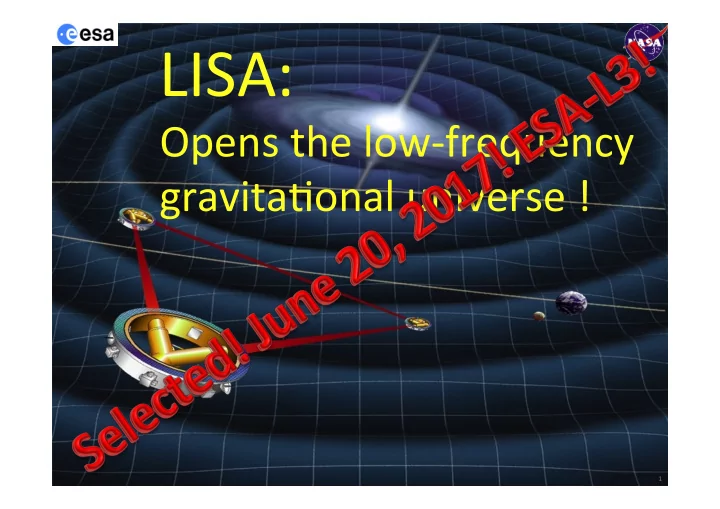
LISA: Opens the low-frequency gravita=onal universe ! 1 22 Years - - PowerPoint PPT Presentation
LISA: Opens the low-frequency gravita=onal universe ! 1 22 Years aAer the First LISA Symposium at RAL 1996 2 LISA: A Mature Concept M3 proposal for 4 S/C ESA/NASA collabora=ve mission in 1993 LISA selected as ESA Cornerstone in 1995
1
2
collabora=ve mission in 1993
1995
appears in 1997
study 2005-2011
ESA-led eLISA (evolving LISA)
3
4
5
6
7
Credit: LIGO/Caltech/Sonoma State (Aurore Simonnet)
8
Satellite
– Tech demo for LISA and Darwin – Launch date 2006
– Darwin demo cancelled
9
10
100 Years since GR Publica=on: Dec. 2, 2015
11
12
HYSICAL EVIEW ETTERS
P R L
American Physical Society
Member Subscription Copy Library or Other Institutional Use Prohibited Until 2017 Articles published week ending10 JUNE 2016 Volume 116, Number 23
Published by 13
1 hour 1 minute 1 sec
14
LISA Requirement LISA Pathfinder Requirement LISA Pathfinder Performance Feb 2017
15
16
17
January 13th, 2017
12 EU Member States plus the US ! hdps://www.lisamission.org/proposal/LISA.pdf
– Transfer =me ~400 days – Direct escape V∞ = 260 m/s – Propulsion module and S/C composite
18
– ESA: spacecraA bus – ESA member state agencies: science instrument
– Payload was European contribu=on paid for by ESA – Different from other L1 mission candidates
– Use tradi=onal approach of na=onal consor=um
19
mission
– Satellite plamorm, including:
moun=ng
– Scien=fic consor=um to deliver instrument consis=ng of:
Phasemeter, Payload Computer
20
21
S/C mounted FEE PM ULU DMU Op=cal Bench (OB) Gravita=onal Reference Sensor (GRS)
(D, F, I, UK, ES, CH, DK, NL, SE, PT, HU, RO) plus USA
www.lisamission.org
22
23
24
25
26
27
28
29
30
31
LISA Requirement LISA Pathfinder Requirement LISA Pathfinder Performance Feb 2017
– When did the first Black Holes appear in pre-galac=c halos and what is their mass and spin? – How did Black Holes form, assemble and evolve from cosmic dawn to present =me, due to accre=on and mergers? – What role did Black Holes play in re-ionisa=on, galaxy evolu=on and structure forma=on? – What is the precise luminosity distance to loud standard siren black hole binaries? – What is the distance – redshiA rela=on and the evolu=on history of the universe? – Does the Graviton have mass?
– How is the stellar dynamics in dense galac=c nuclei? – How does dynamical relaxa=on and mass segrega=on work in dense galac=c nuclei? – What is the occupa=on frac=on of black holes in low-mass galaxies? – How large are devia=ons from Kerr Metric, and what new physics causes them? – Are there horizonless objects like boson stars or gravastars? – Are alterna=ves to GR viable, like Chern-Simons or scalar tensor theories or braneworld scenarios?
– What is the explosion mechanism of type Ia supernovae? – What is the forma=on and merger rate of compact binaries? – What is the endpoint of stellar evolu=on?
– Directly probe Planck scale epoch at 1 TeV to 1000 TeV before decoupling of microwave background – Were there phase transi=ons and of which order? – Probe Higgs field self coupling and poten=al, and search for supersymmetry. – Are there warped sub-millimetre extra-dimensions? – Can we see braneworld scenarios with rehea=ng temperatures in the TeV range? – Do topological defects like Cosmic Strings exist?
???
32
33
Redshift Z à Mass [log M/M☉]à
aLIGO, aVIRGO, KAGRA SKA, Pulsar Timing Future EM Obs. LSST, JWST, EELT ET (proposed)
5 10 15 20 102 103 104 105 106 107 108 109 1010 z M 10 20 50 100 200 500 1000
34
Redshift Z à Mass [log M/M☉]à
SNR
35
Time
36
to < 0.001 M⊙
3G2/c4
– New objects in General Rela=vity
– Devia=ons from General Rela=vity
hole bomb instabili=es
changes inspiral GW phase
interac=ng only gravita=onally
37
ρDM = ρ0 r r ! " # $ % &
α
gives accurate and independent measurements of H0 and w.
§ MBH mergers out to z = 3, no EM counterparts: § Dark energy equa=on of state parameter
w to ±2-4% in 3 years (Pe=teau et al, ApJ, 2011; Millennium).
§ Compare EUCLID: ±2%. § EMRIs, without EM counterparts: § Hubble const. H0 to ±0.4% = ±0.3 km s-1 Mpc-1
aAer 20 EMRI detec=ons: ~3 months LISA (MacLeod & Hogan, PRD, 2008; SDSS)
§ Compare WMAP: ±1.2 km s-1 Mpc-1.
No identifications With identifications
Dark Energy equa=on-of-state parameter w
39
– hdps://gitlab.in2p3.fr/stas/MLDC (sign up is required)
– Each data set aims at par=cular data analysis problem
– Build a robust data analysis pipeline for the LISA mission.
up for the challenge and download the simulated data set.
42
GW150914
43