
SLIDE 1
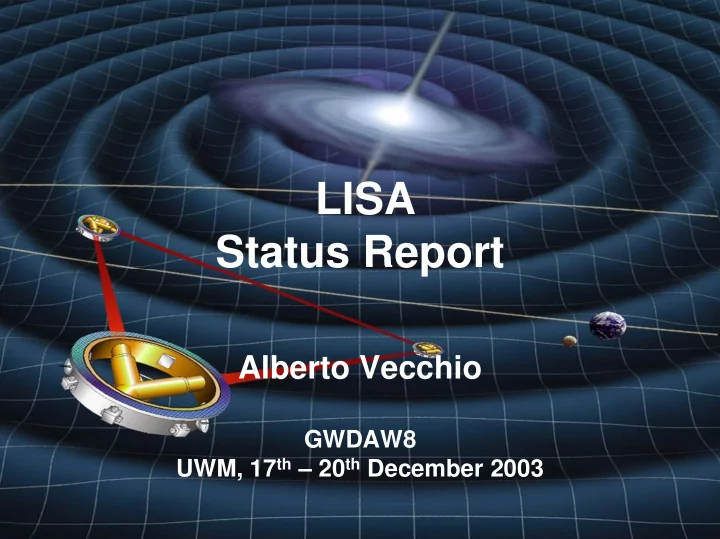
LISA Status Report Alberto Vecchio GWDAW8 UWM, 17 th 20 th - - PowerPoint PPT Presentation
LISA Status Report Alberto Vecchio GWDAW8 UWM, 17 th 20 th December 2003 Outline LISA Status of the project LISA Pathfinder: SMART-2 Data analysis challenges Band cleaning Extreme mass ratio binary systems
– Status of the project – LISA Pathfinder: SMART-2
– Band “cleaning” – Extreme mass ratio binary systems – Foregrounds detection
GWDAW8 – UWM, 17th – 20th December 2003 A Vecchio – LISA: Status report
5 106 km
Test Masses Telescopes Spacecrafts
masses: 3x10-15 ms-2 Hz-1/2 @ 0.1 mHz
shielding spacecraft
Michelson Interferometers with Laser Transponders: 40 pm Hz-1/2
mHz – 0.1 Hz
21
−
GWDAW8 – UWM, 17th – 20th December 2003 A Vecchio – LISA: Status report
Symmetrized-Sagnac allows noise calibration
(Tinto et al, 2000)
GWDAW8 – UWM, 17th – 20th December 2003 A Vecchio – LISA: Status report
sources are long lived
modulations introduced by the instrument motion allow reconstruction of source position
GWDAW8 – UWM, 17th – 20th December 2003 A Vecchio – LISA: Status report
GWDAW8 – UWM, 17th – 20th December 2003 A Vecchio – LISA: Status report
Advanced resonant Acceleration noise Optical path noise Arm length
F
GWDAW8 – UWM, 17th – 20th December 2003 A Vecchio – LISA: Status report
(surface disturbances)
(Carbone et al, 2003)
1<z<30 Galactic and z<1 D ~ 1 Gpc t ~ 10-10 sec
GWDAW8 – UWM, 17th – 20th December 2003 A Vecchio – LISA: Status report
(Nelemans et al, 2001; Nelemans, 2003) 19 know n galactic binaries 19 know n galactic binaries “Calibration sources” “Calibration sources”
Actually many more:
GWDAW8 – UWM, 17th – 20th December 2003 A Vecchio – LISA: Status report
GWDAW8 – UWM, 17th – 20th December 2003 A Vecchio – LISA: Status report
(Nelemans et al, 2001)
Stochastic foreground
GWDAW8 – UWM, 17th – 20th December 2003 A Vecchio – LISA: Status report
(Farmer and Phinney, 03)
Is NS-NS foreground an issue? (PSR J 0737-3039)
GWDAW8 – UWM, 17th – 20th December 2003 A Vecchio – LISA: Status report
particle – WD, NS, low mass BH - in completely generic (eccentric, non- equatorial, spins) orbit around a Kerr black hole
– Number of cycles in a yr ~ a few 105
– Map of the black hole spacetime (Ryan, 1996) – Test “no-hair theorem”
– Dynamics in galaxy cores – MBH’s demographics and properties – Mass distribution, isotropy, dispersion of “swarms”
GWDAW8 – UWM, 17th – 20th December 2003 A Vecchio – LISA: Status report
(Finn and Thorne, 2000; Barak and Cutler, 2003)
D = 1 Gpc
GWDAW8 – UWM, 17th – 20th December 2003 A Vecchio – LISA: Status report
– In principle the theoretical problem is very well posed: perturbation theory (“point” particle around massive black hole:Teukolsky formalism) – Prescription for rigorous radiation reaction available (Mino et al, 1997; Quinn and Wald, 1997) – Emphasis is on implementation: we need waveforms
– Check SNR loss – Estimate number of filters – Design effective/efficient search strategy
GWDAW8 – UWM, 17th – 20th December 2003 A Vecchio – LISA: Status report
– Exploit correlations among templates – Use a sub-optimal hierarchical approach
GWDAW8 – UWM, 17th – 20th December 2003 A Vecchio – LISA: Status report
– Several ways of recombining the readouts, e.g. “symmetrized-Sagnac”
(Tinto et al, 00)
– Michelson+Sagnac: detection of the isotropic component with one instrument
(Hogan and Bender, 2001)
GWDAW8 – UWM, 17th – 20th December 2003 A Vecchio – LISA: Status report
GWDAW8 – UWM, 17th – 20th December 2003 A Vecchio – LISA: Status report
GWDAW8 – UWM, 17th – 20th December 2003 A Vecchio – LISA: Status report