Self-similar growth-fragmentations & random planar maps Igor - - PowerPoint PPT Presentation

self similar growth fragmentations random planar maps
SMART_READER_LITE
LIVE PREVIEW

Self-similar growth-fragmentations & random planar maps Igor - - PowerPoint PPT Presentation

Self-similar growth-fragmentations & random planar maps Igor Kortchemski (joint work with J. Bertoin, T. Budd, N. Curien) CNRS & cole polytechnique Stable Processes November 2016 Oaxaca Planar maps BienaymGaltonWatson


slide-1
SLIDE 1

Self-similar growth-fragmentations & random planar maps

Igor Kortchemski (joint work with J. Bertoin, T. Budd, N. Curien)

CNRS & École polytechnique
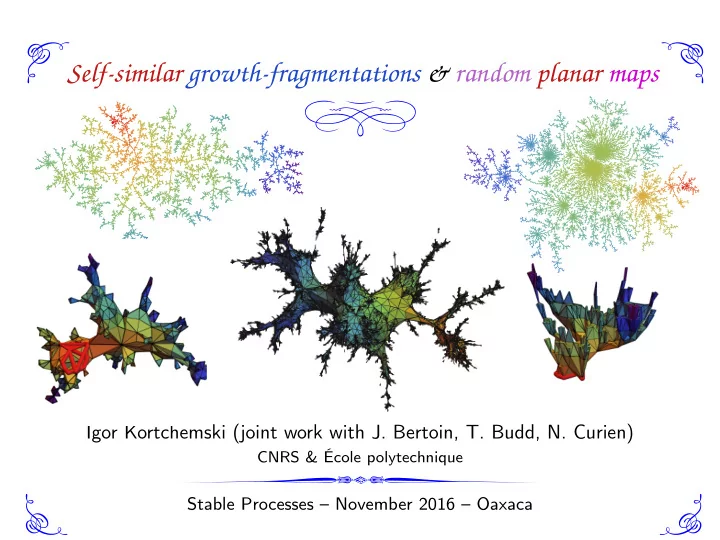
Stable Processes – November 2016 – Oaxaca

slide-2
SLIDE 2

Planar maps Bienaymé–Galton–Watson trees Level sets of random maps

Goal

y Goal: study a random surface by studying its level sets.

Igor Kortchemski Growth-fragmentations & random planar maps 1 / 2016

slide-3
SLIDE 3

Planar maps Bienaymé–Galton–Watson trees Level sets of random maps

Goal

y Goal: study a random surface by studying its level sets.

Igor Kortchemski Growth-fragmentations & random planar maps 1 / 2016

slide-4
SLIDE 4

Planar maps Bienaymé–Galton–Watson trees Level sets of random maps

Goal

y Goal: study a random surface by studying its level sets.

Igor Kortchemski Growth-fragmentations & random planar maps 1 / 2016

slide-5
SLIDE 5

Planar maps Bienaymé–Galton–Watson trees Level sets of random maps

Goal

y Goal: study a random surface by studying its level sets. Random surface Level sets of a random surface

Igor Kortchemski Growth-fragmentations & random planar maps 1 / 2016

slide-6
SLIDE 6

Planar maps Bienaymé–Galton–Watson trees Level sets of random maps

Goal

y Goal: study a random surface by studying its level sets. Approach from the discrete side. Random surface Level sets of a random surface

Igor Kortchemski Growth-fragmentations & random planar maps 1 / 2016

slide-7
SLIDE 7

Planar maps Bienaymé–Galton–Watson trees Level sets of random maps

Goal

y Goal: study a random surface by studying its level sets. Approach from the discrete side. Discretized random surface Random surface Level sets of a random surface

scaling limit

Igor Kortchemski Growth-fragmentations & random planar maps 1 / 2016

slide-8
SLIDE 8

Planar maps Bienaymé–Galton–Watson trees Level sets of random maps

Goal

y Goal: study a random surface by studying its level sets. Approach from the discrete side. Discretized random surface Random surface Level sets of a discretized random surface Level sets of a random surface

scaling limit

Igor Kortchemski Growth-fragmentations & random planar maps 1 / 2016

slide-9
SLIDE 9

Planar maps Bienaymé–Galton–Watson trees Level sets of random maps

Goal

y Goal: study a random surface by studying its level sets. Approach from the discrete side. Discretized random surface Random surface Level sets of a discretized random surface Level sets of a random surface

scaling limit scaling limit

Igor Kortchemski Growth-fragmentations & random planar maps 1 / 2016

slide-10
SLIDE 10

Planar maps Bienaymé–Galton–Watson trees Level sets of random maps

Goal

y Goal: study a random surface by studying its level sets. Approach from the discrete side. Discretized random surface Level sets of a discretized random surface ?

scaling limit

Igor Kortchemski Growth-fragmentations & random planar maps 1 / 2016

slide-11
SLIDE 11

Planar maps Bienaymé–Galton–Watson trees Level sets of random maps

Motivation for studying scaling limits

Let (Xn)n>1 be “discrete” objects converging towards a “continuous” object X: Xn − →

n→∞

X.

Igor Kortchemski Growth-fragmentations & random planar maps 2 / 2016

slide-12
SLIDE 12

Planar maps Bienaymé–Galton–Watson trees Level sets of random maps

Motivation for studying scaling limits

Let (Xn)n>1 be “discrete” objects converging towards a “continuous” object X: Xn − →

n→∞

X. Several consequences:

  • From the discrete world to the continuous world: if a property P is satisfied

by all the Xn and passes to the limit, then X satisfies P.

Igor Kortchemski Growth-fragmentations & random planar maps 2 / 2016

slide-13
SLIDE 13

Planar maps Bienaymé–Galton–Watson trees Level sets of random maps

Motivation for studying scaling limits

Let (Xn)n>1 be “discrete” objects converging towards a “continuous” object X: Xn − →

n→∞

X. Several consequences:

  • From the discrete world to the continuous world: if a property P is satisfied

by all the Xn and passes to the limit, then X satisfies P.

  • From the continuous world to the discrete world: if a property P is satisfied

by X and passes to the limit, Xn satisfies “approximately” P for n large.

Igor Kortchemski Growth-fragmentations & random planar maps 2 / 2016

slide-14
SLIDE 14

Planar maps Bienaymé–Galton–Watson trees Level sets of random maps

Motivation for studying scaling limits

Let (Xn)n>1 be “discrete” objects converging towards a “continuous” object X: Xn − →

n→∞

X. Several consequences:

  • From the discrete world to the continuous world: if a property P is satisfied

by all the Xn and passes to the limit, then X satisfies P.

  • From the continuous world to the discrete world: if a property P is satisfied

by X and passes to the limit, Xn satisfies “approximately” P for n large.

  • Universality: if (Yn)n>1 is another sequence of objects converging towards

X, then Xn and Yn share approximately the same properties for n large.

Igor Kortchemski Growth-fragmentations & random planar maps 2 / 2016

slide-15
SLIDE 15

Planar maps Bienaymé–Galton–Watson trees Level sets of random maps

Motivation for studying scaling limits

Let (Xn)n>1 be “discrete” objects converging towards a “continuous” object X: Xn − →

n→∞

X. Several consequences:

  • From the discrete world to the continuous world: if a property P is satisfied

by all the Xn and passes to the limit, then X satisfies P.

  • From the continuous world to the discrete world: if a property P is satisfied

by X and passes to the limit, Xn satisfies “approximately” P for n large.

  • Universality: if (Yn)n>1 is another sequence of objects converging towards

X, then Xn and Yn share approximately the same properties for n large. What is the sense of the convergence when the objects are random?

Igor Kortchemski Growth-fragmentations & random planar maps 2 / 2016

slide-16
SLIDE 16

Planar maps Bienaymé–Galton–Watson trees Level sets of random maps

Motivation for studying scaling limits

Let (Xn)n>1 be “discrete” objects converging towards a “continuous” object X: Xn − →

n→∞

X. Several consequences:

  • From the discrete world to the continuous world: if a property P is satisfied

by all the Xn and passes to the limit, then X satisfies P.

  • From the continuous world to the discrete world: if a property P is satisfied

by X and passes to the limit, Xn satisfies “approximately” P for n large.

  • Universality: if (Yn)n>1 is another sequence of objects converging towards

X, then Xn and Yn share approximately the same properties for n large. What is the sense of the convergence when the objects are random? y Convergence in distribution in a certain metric space.

Igor Kortchemski Growth-fragmentations & random planar maps 2 / 2016

slide-17
SLIDE 17

Planar maps Bienaymé–Galton–Watson trees Level sets of random maps

Outline

  • I. Planar maps
  • II. Bienaymé–Galton–Watson trees
  • III. Random maps and growth-fragmentations

Igor Kortchemski Growth-fragmentations & random planar maps 3 / 2016

slide-18
SLIDE 18

Planar maps Bienaymé–Galton–Watson trees Level sets of random maps

Motivation

Igor Kortchemski Growth-fragmentations & random planar maps 4 / 2016

slide-19
SLIDE 19

Planar maps Bienaymé–Galton–Watson trees Level sets of random maps

Motivation

What does a typical random surface look like?

Igor Kortchemski Growth-fragmentations & random planar maps 5 / 42

slide-20
SLIDE 20

Planar maps Bienaymé–Galton–Watson trees Level sets of random maps

y Idea: construct a random surface as a limit of random discrete surfaces.

Igor Kortchemski Growth-fragmentations & random planar maps 6 / 42

slide-21
SLIDE 21

Planar maps Bienaymé–Galton–Watson trees Level sets of random maps

y Idea: construct a random surface as a limit of random discrete surfaces. Consider n triangles, and glue them together at random to obtain a surface homeomorphic to a sphere.

Igor Kortchemski Growth-fragmentations & random planar maps 6 / 42

slide-22
SLIDE 22

Planar maps Bienaymé–Galton–Watson trees Level sets of random maps

y Idea: construct a random surface as a limit of random discrete surfaces. Consider n triangles, and glue them together at random to obtain a surface homeomorphic to a sphere.

Figure: A large random triangulation

Igor Kortchemski Growth-fragmentations & random planar maps 6 / 42

slide-23
SLIDE 23

Planar maps Bienaymé–Galton–Watson trees Level sets of random maps

y Idea: construct a random surface as a limit of random discrete surfaces. Consider n triangles, and glue them together at random to obtain a surface homeomorphic to a sphere.

Figure: A large random triangulation

Igor Kortchemski Growth-fragmentations & random planar maps 6 / 42

slide-24
SLIDE 24

Planar maps Bienaymé–Galton–Watson trees Level sets of random maps

The Brownian map

Problem (Schramm, ICM ’06): Let Tn be a random uniform triangulation of the sphere with n triangles.

Igor Kortchemski Growth-fragmentations & random planar maps 7 / 42

slide-25
SLIDE 25

Planar maps Bienaymé–Galton–Watson trees Level sets of random maps

The Brownian map

Problem (Schramm, ICM ’06): Let Tn be a random uniform triangulation of the sphere with n triangles. View Tn as a compact metric space, by equipping its vertices with the graph distance.

Igor Kortchemski Growth-fragmentations & random planar maps 7 / 42

slide-26
SLIDE 26

Planar maps Bienaymé–Galton–Watson trees Level sets of random maps

The Brownian map

Problem (Schramm, ICM ’06): Let Tn be a random uniform triangulation of the sphere with n triangles. View Tn as a compact metric space, by equipping its vertices with the graph distance. Show that n−1/4 · Tn converges to a random compact metric space homeomorphic to the sphere (the Brownian map)

Igor Kortchemski Growth-fragmentations & random planar maps 7 / 42

slide-27
SLIDE 27

Planar maps Bienaymé–Galton–Watson trees Level sets of random maps

The Brownian map

Problem (Schramm, ICM ’06): Let Tn be a random uniform triangulation of the sphere with n triangles. View Tn as a compact metric space, by equipping its vertices with the graph distance. Show that n−1/4 · Tn converges to a random compact metric space homeomorphic to the sphere (the Brownian map), in distribution for the Gromov–Hausdorff topology.

Igor Kortchemski Growth-fragmentations & random planar maps 7 / 42

slide-28
SLIDE 28

Planar maps Bienaymé–Galton–Watson trees Level sets of random maps

The Brownian map

Problem (Schramm, ICM ’06): Let Tn be a random uniform triangulation of the sphere with n triangles. View Tn as a compact metric space, by equipping its vertices with the graph distance. Show that n−1/4 · Tn converges to a random compact metric space homeomorphic to the sphere (the Brownian map), in distribution for the Gromov–Hausdorff topology. Solved by Le Gall (as well as for other families of maps including quadrangulations) in 2011, and independently by Miermont in 2011 for quadrangulations.

Igor Kortchemski Growth-fragmentations & random planar maps 7 / 42

slide-29
SLIDE 29

Planar maps Bienaymé–Galton–Watson trees Level sets of random maps

The Brownian map

Problem (Schramm, ICM ’06): Let Tn be a random uniform triangulation of the sphere with n triangles. View Tn as a compact metric space, by equipping its vertices with the graph distance. Show that n−1/4 · Tn converges to a random compact metric space homeomorphic to the sphere (the Brownian map), in distribution for the Gromov–Hausdorff topology. Solved by Le Gall (as well as for other families of maps including quadrangulations) in 2011, and independently by Miermont in 2011 for quadrangulations. Since, convergence to the Brownian map has been established for many different models of random maps (Beltran & Le Gall, Addario-Berry & Albenque, Bettinelli, Bettinelli & Jacob & Miermont, Abraham, Bettinelli & Miermont, Baur & Miermont & Ray)

Igor Kortchemski Growth-fragmentations & random planar maps 7 / 42

slide-30
SLIDE 30

Planar maps Bienaymé–Galton–Watson trees Level sets of random maps

The Brownian map

Problem (Schramm, ICM ’06): Let Tn be a random uniform triangulation of the sphere with n triangles. View Tn as a compact metric space, by equipping its vertices with the graph distance. Show that n−1/4 · Tn converges to a random compact metric space homeomorphic to the sphere (the Brownian map), in distribution for the Gromov–Hausdorff topology. Solved by Le Gall (as well as for other families of maps including quadrangulations) in 2011, and independently by Miermont in 2011 for quadrangulations. Since, convergence to the Brownian map has been established for many different models of random maps (Beltran & Le Gall, Addario-Berry & Albenque, Bettinelli, Bettinelli & Jacob & Miermont, Abraham, Bettinelli & Miermont, Baur & Miermont & Ray), using different techniques, such as bijections with labeled trees (Cori–Vauquelin–Schaeffer, Bouttier–Di Francesco–Guitter).

Igor Kortchemski Growth-fragmentations & random planar maps 7 / 42

slide-31
SLIDE 31

Planar maps Bienaymé–Galton–Watson trees Level sets of random maps

y Other motivations: – connections with 2D Liouville Quantum Gravity (David, Duplantier, Garban, Kupianen, Maillard, Miller, Rhodes, Sheffield, Vargas, Zeitouni). – study of random planar maps decorated with statistical physics models (Angel, Berestycki, Borot, Bouttier, Guitter, Chen, Curien, Gwynne, K., Kassel, Laslier, Mao, Ray, Richier, Sheffield, Sun, Wilson).

Igor Kortchemski Growth-fragmentations & random planar maps 8 / 42

slide-32
SLIDE 32

Planar maps Bienaymé–Galton–Watson trees Level sets of random maps

Level sets of the Brownian Map

Igor Kortchemski Growth-fragmentations & random planar maps 9 / 42

slide-33
SLIDE 33

Planar maps Bienaymé–Galton–Watson trees Level sets of random maps

Level sets of the Brownian Map

Imagine the Brownian map in such a way that every point at metric distance x from the root is at height x.

Igor Kortchemski Growth-fragmentations & random planar maps 10 / 42

slide-34
SLIDE 34

Planar maps Bienaymé–Galton–Watson trees Level sets of random maps

Level sets of the Brownian Map

Imagine the Brownian map in such a way that every point at metric distance x from the root is at height x.

Igor Kortchemski Growth-fragmentations & random planar maps 10 / 42

slide-35
SLIDE 35

Planar maps Bienaymé–Galton–Watson trees Level sets of random maps

Level sets of the Brownian Map

Imagine the Brownian map in such a way that every point at metric distance x from the root is at height x. Now, for every h > 0, remove all the points which are not in the ball of radius h centered at the root, and look at the lengths of the cycles as h grows (level set process).

Igor Kortchemski Growth-fragmentations & random planar maps 10 / 42

slide-36
SLIDE 36

Planar maps Bienaymé–Galton–Watson trees Level sets of random maps

Level sets of the Brownian Map

Imagine the Brownian map in such a way that every point at metric distance x from the root is at height x. Now, for every h > 0, remove all the points which are not in the ball of radius h centered at the root, and look at the lengths of the cycles as h grows (level set process). y Questions (related to the “breadth-first search” of the Brownian map of Miller & Sheffield):

Igor Kortchemski Growth-fragmentations & random planar maps 10 / 42

slide-37
SLIDE 37

Planar maps Bienaymé–Galton–Watson trees Level sets of random maps

Level sets of the Brownian Map

Imagine the Brownian map in such a way that every point at metric distance x from the root is at height x. Now, for every h > 0, remove all the points which are not in the ball of radius h centered at the root, and look at the lengths of the cycles as h grows (level set process). y Questions (related to the “breadth-first search” of the Brownian map of Miller & Sheffield): – What is the law of the level set process of the Brownian map as h grows?

Igor Kortchemski Growth-fragmentations & random planar maps 10 / 42

slide-38
SLIDE 38

Planar maps Bienaymé–Galton–Watson trees Level sets of random maps

Level sets of the Brownian Map

Imagine the Brownian map in such a way that every point at metric distance x from the root is at height x. Now, for every h > 0, remove all the points which are not in the ball of radius h centered at the root, and look at the lengths of the cycles as h grows (level set process). y Questions (related to the “breadth-first search” of the Brownian map of Miller & Sheffield): – What is the law of the level set process of the Brownian map as h grows? Brownian map Level sets of the Brownian map

?

Igor Kortchemski Growth-fragmentations & random planar maps 10 / 42

slide-39
SLIDE 39

Planar maps Bienaymé–Galton–Watson trees Level sets of random maps

Level sets of the Brownian Map

Imagine the Brownian map in such a way that every point at metric distance x from the root is at height x. Now, for every h > 0, remove all the points which are not in the ball of radius h centered at the root, and look at the lengths of the cycles as h grows (level set process). y Questions (related to the “breadth-first search” of the Brownian map of Miller & Sheffield): – What is the law of the level set process of the Brownian map as h grows? – Can one reconstruct the Brownian map from the level set processes? Brownian map Level sets of the Brownian map

?

Igor Kortchemski Growth-fragmentations & random planar maps 10 / 42

slide-40
SLIDE 40

Planar maps Bienaymé–Galton–Watson trees Level sets of random maps

Level sets of the Brownian Map

Imagine the Brownian map in such a way that every point at metric distance x from the root is at height x. Now, for every h > 0, remove all the points which are not in the ball of radius h centered at the root, and look at the lengths of the cycles as h grows (level set process). y Questions (related to the “breadth-first search” of the Brownian map of Miller & Sheffield): – What is the law of the level set process of the Brownian map as h grows? – Can one reconstruct the Brownian map from the level set processes? y Our result: scaling limit of the level set process of random triangulations (discrete maps). Brownian map Level sets of the Brownian map

?

Igor Kortchemski Growth-fragmentations & random planar maps 10 / 42

slide-41
SLIDE 41

Planar maps Bienaymé–Galton–Watson trees Level sets of random maps

Level sets of the Brownian Map

Imagine the Brownian map in such a way that every point at metric distance x from the root is at height x. Now, for every h > 0, remove all the points which are not in the ball of radius h centered at the root, and look at the lengths of the cycles as h grows (level set process). y Questions (related to the “breadth-first search” of the Brownian map of Miller & Sheffield): – What is the law of the level set process of the Brownian map as h grows? – Can one reconstruct the Brownian map from the level set processes? y Our result: scaling limit of the level set process of random triangulations (discrete maps). Random triangulations Brownian map Level sets of random triangulations ?

scaling limit scaling limit

Igor Kortchemski Growth-fragmentations & random planar maps 10 / 42

slide-42
SLIDE 42

Planar maps Bienaymé–Galton–Watson trees Level sets of random maps

Triangulations

Igor Kortchemski Growth-fragmentations & random planar maps 11 / 42

slide-43
SLIDE 43

Planar maps Bienaymé–Galton–Watson trees Level sets of random maps

Definitions

A map is a finite connected graph properly embedded in the sphere (up to continuous orientation preserving deformations).

Igor Kortchemski Growth-fragmentations & random planar maps 12 / 42

slide-44
SLIDE 44

Planar maps Bienaymé–Galton–Watson trees Level sets of random maps

Definitions

A map is a finite connected graph properly embedded in the sphere (up to continuous orientation preserving deformations).

Figure: Two identical maps.

Igor Kortchemski Growth-fragmentations & random planar maps 12 / 42

slide-45
SLIDE 45

Planar maps Bienaymé–Galton–Watson trees Level sets of random maps

Definitions

A map is a finite connected graph properly embedded in the sphere (up to continuous orientation preserving deformations). A map is a triangulation when all the faces are triangles.

Figure: Two identical triangulations.

Igor Kortchemski Growth-fragmentations & random planar maps 12 / 42

slide-46
SLIDE 46

Planar maps Bienaymé–Galton–Watson trees Level sets of random maps

Definitions

A map is a finite connected graph properly embedded in the sphere (up to continuous orientation preserving deformations). A map is a triangulation when all the faces are triangles. A map is rooted when an oriented edge is distinguished.

Figure: Two identical triangulations.

Igor Kortchemski Growth-fragmentations & random planar maps 12 / 42

slide-47
SLIDE 47

Planar maps Bienaymé–Galton–Watson trees Level sets of random maps

Definitions

A map is a finite connected graph properly embedded in the sphere (up to continuous orientation preserving deformations). A map is a triangulation when all the faces are triangles. A map is rooted when an oriented edge is distinguished.

Figure: Two identical rooted triangulations.

Igor Kortchemski Growth-fragmentations & random planar maps 12 / 42

slide-48
SLIDE 48

Planar maps Bienaymé–Galton–Watson trees Level sets of random maps

Triangulations with a boundary

Igor Kortchemski Growth-fragmentations & random planar maps 13 / 42

slide-49
SLIDE 49

Planar maps Bienaymé–Galton–Watson trees Level sets of random maps

Definitions

A triangulation with a boundary is a map where all the faces are triangles, except maybe the one on the right of the root edge which is called the external face.

Igor Kortchemski Growth-fragmentations & random planar maps 14 / 42

slide-50
SLIDE 50

Planar maps Bienaymé–Galton–Watson trees Level sets of random maps

Definitions

A triangulation with a boundary is a map where all the faces are triangles, except maybe the one on the right of the root edge which is called the external face.

Figure: A triangulation with a boundary with two internal vertices (not adjacent to the external face).

Igor Kortchemski Growth-fragmentations & random planar maps 14 / 42

slide-51
SLIDE 51

Planar maps Bienaymé–Galton–Watson trees Level sets of random maps

Definitions

A triangulation with a boundary is a map where all the faces are triangles, except maybe the one on the right of the root edge which is called the external face.

Figure: A triangulation with a boundary with two internal vertices (not adjacent to the external face).

A triangulation of the p-gon is a triangulation whose boundary is simple and has length p.

Igor Kortchemski Growth-fragmentations & random planar maps 14 / 42

slide-52
SLIDE 52

Planar maps Bienaymé–Galton–Watson trees Level sets of random maps

Definitions

A triangulation with a boundary is a map where all the faces are triangles, except maybe the one on the right of the root edge which is called the external face.

Figure: A triangulation of the 4-gon with two internal vertices (not adjacent to the external face).

A triangulation of the p-gon is a triangulation whose boundary is simple and has length p.

Igor Kortchemski Growth-fragmentations & random planar maps 14 / 42

slide-53
SLIDE 53

Planar maps Bienaymé–Galton–Watson trees Level sets of random maps

y what probability measure of planar maps?

Igor Kortchemski Growth-fragmentations & random planar maps 15 / 42

slide-54
SLIDE 54

Planar maps Bienaymé–Galton–Watson trees Level sets of random maps

Outline

  • I. Planar maps
  • II. Bienaymé–Galton–Watson trees
  • III. Random maps and growth-fragmentations

Igor Kortchemski Growth-fragmentations & random planar maps 16 / 42

slide-55
SLIDE 55

Planar maps Bienaymé–Galton–Watson trees Level sets of random maps

Plane trees

We only consider rooted plane trees.

Igor Kortchemski Growth-fragmentations & random planar maps 17 / 42

slide-56
SLIDE 56

Planar maps Bienaymé–Galton–Watson trees Level sets of random maps

Plane trees

We only consider rooted plane trees.

Figure: Two different plane trees.

Igor Kortchemski Growth-fragmentations & random planar maps 17 / 42

slide-57
SLIDE 57

Planar maps Bienaymé–Galton–Watson trees Level sets of random maps

Plane trees

We only consider rooted plane trees.

Figure: Two different plane trees.

y Natural question: what does a large “typical” plane rooted tree look like?

Igor Kortchemski Growth-fragmentations & random planar maps 17 / 42

slide-58
SLIDE 58

Planar maps Bienaymé–Galton–Watson trees Level sets of random maps

Plane trees

We only consider rooted plane trees.

Figure: Two different plane trees.

y Natural question: what does a large “typical” plane rooted tree look like? y Let tn be a large random plane tree, chosen uniformly at random among all rooted plane trees with n vertices.

Igor Kortchemski Growth-fragmentations & random planar maps 17 / 42

slide-59
SLIDE 59

Planar maps Bienaymé–Galton–Watson trees Level sets of random maps

A simulation of a large random tree

Igor Kortchemski Growth-fragmentations & random planar maps 18 / 42

slide-60
SLIDE 60

Planar maps Bienaymé–Galton–Watson trees Level sets of random maps

Uniform plane trees

y To study a uniform plane rooted tree with n vertices, a key fact is that they can be seen as a BGW tree conditioned to have n vertices, with offspring distribution µ(i) =

1 2i+1 for i > 0.

Igor Kortchemski Growth-fragmentations & random planar maps 19 / 42

slide-61
SLIDE 61

Planar maps Bienaymé–Galton–Watson trees Level sets of random maps

Uniform plane trees

y To study a uniform plane rooted tree with n vertices, a key fact is that they can be seen as a BGW tree conditioned to have n vertices, with offspring distribution µ(i) =

1 2i+1 for i > 0.

Reason: a tree with n vertices then has probability 2−2n−1.

Igor Kortchemski Growth-fragmentations & random planar maps 19 / 42

slide-62
SLIDE 62

Planar maps Bienaymé–Galton–Watson trees Level sets of random maps

Uniform plane trees

y To study a uniform plane rooted tree with n vertices, a key fact is that they can be seen as a BGW tree conditioned to have n vertices, with offspring distribution µ(i) =

1 2i+1 for i > 0.

Reason: a tree with n vertices then has probability 2−2n−1. y Where does this geometric distribution come from?

Igor Kortchemski Growth-fragmentations & random planar maps 19 / 42

slide-63
SLIDE 63

Planar maps Bienaymé–Galton–Watson trees Level sets of random maps

Uniform plane trees

y To study a uniform plane rooted tree with n vertices, a key fact is that they can be seen as a BGW tree conditioned to have n vertices, with offspring distribution µ(i) =

1 2i+1 for i > 0.

Reason: a tree with n vertices then has probability 2−2n−1. y Where does this geometric distribution come from? One looks for a random tree T such that for every tree τ P (T = τ) = xsize of τ W(x)

Igor Kortchemski Growth-fragmentations & random planar maps 19 / 42

slide-64
SLIDE 64

Planar maps Bienaymé–Galton–Watson trees Level sets of random maps

Uniform plane trees

y To study a uniform plane rooted tree with n vertices, a key fact is that they can be seen as a BGW tree conditioned to have n vertices, with offspring distribution µ(i) =

1 2i+1 for i > 0.

Reason: a tree with n vertices then has probability 2−2n−1. y Where does this geometric distribution come from? One looks for a random tree T such that for every tree τ P (T = τ) = xsize of τ W(x) , W(x) = X

n>1

1 n ✓2n − 2 n − 1 ◆ xn = 1 − √1 − 4x 2 .

Igor Kortchemski Growth-fragmentations & random planar maps 19 / 42

slide-65
SLIDE 65

Planar maps Bienaymé–Galton–Watson trees Level sets of random maps

Uniform plane trees

y To study a uniform plane rooted tree with n vertices, a key fact is that they can be seen as a BGW tree conditioned to have n vertices, with offspring distribution µ(i) =

1 2i+1 for i > 0.

Reason: a tree with n vertices then has probability 2−2n−1. y Where does this geometric distribution come from? One looks for a random tree T such that for every tree τ P (T = τ) = xsize of τ W(x) , W(x) = X

n>1

1 n ✓2n − 2 n − 1 ◆ xn = 1 − √1 − 4x 2 . The radius of convergence is 1/4, and by taking x = 1/4, one gets a BGW tree with offspring distribution µ.

Igor Kortchemski Growth-fragmentations & random planar maps 19 / 42

slide-66
SLIDE 66

Planar maps Bienaymé–Galton–Watson trees Level sets of random maps

Simply generated trees

In particular, uniform plane trees are particular cases of so-called simply generated (or Boltzmann) trees:

Igor Kortchemski Growth-fragmentations & random planar maps 20 / 42

slide-67
SLIDE 67

Planar maps Bienaymé–Galton–Watson trees Level sets of random maps

Simply generated trees

In particular, uniform plane trees are particular cases of so-called simply generated (or Boltzmann) trees: Given a sequence w = (w(i); i > 0) of nonnegative real numbers, with every τ ∈ T, associate a weight Ωw(τ): Ωw(τ) = Y

u∈τ

w(number of children of u).

Igor Kortchemski Growth-fragmentations & random planar maps 20 / 42

slide-68
SLIDE 68

Planar maps Bienaymé–Galton–Watson trees Level sets of random maps

Simply generated trees

In particular, uniform plane trees are particular cases of so-called simply generated (or Boltzmann) trees: Given a sequence w = (w(i); i > 0) of nonnegative real numbers, with every τ ∈ T, associate a weight Ωw(τ): Ωw(τ) = Y

u∈τ

w(number of children of u). Then, if Tn is the set of all trees with n vertices, for every τ ∈ Tn, set Pw

n (τ) =

Ωw(τ) P

T∈Tn Ωw(T).

Igor Kortchemski Growth-fragmentations & random planar maps 20 / 42

slide-69
SLIDE 69

Planar maps Bienaymé–Galton–Watson trees Level sets of random maps

Scaling limits of large simply generated trees

Igor Kortchemski Growth-fragmentations & random planar maps 21 / 42

slide-70
SLIDE 70

Planar maps Bienaymé–Galton–Watson trees Level sets of random maps

Large simply generated trees

y If the weight sequence is sufficiently regular, the scaling limit of simply generated trees is the Brownian tree (Aldous).

Igor Kortchemski Growth-fragmentations & random planar maps 22 / 42

slide-71
SLIDE 71

Planar maps Bienaymé–Galton–Watson trees Level sets of random maps

Large simply generated trees

y If the weight sequence is sufficiently regular, the scaling limit of simply generated trees is the Brownian tree (Aldous).

Figure: A non isometric embedding of a realization of the Brownian tree.

Igor Kortchemski Growth-fragmentations & random planar maps 22 / 42

slide-72
SLIDE 72

Planar maps Bienaymé–Galton–Watson trees Level sets of random maps

Large simply generated trees

y If the weight sequence is sufficiently regular, the scaling limit of simply generated trees is the Brownian tree (Aldous). y If the weight sequence has a heavy tail behavior, the scaling limit of simply generated trees is a stable tree (Duquesne, Le Gall, Le Jan).

Igor Kortchemski Growth-fragmentations & random planar maps 22 / 42

slide-73
SLIDE 73

Planar maps Bienaymé–Galton–Watson trees Level sets of random maps

Large simply generated trees

y If the weight sequence is sufficiently regular, the scaling limit of simply generated trees is the Brownian tree (Aldous). y If the weight sequence has a heavy tail behavior, the scaling limit of simply generated trees is a stable tree (Duquesne, Le Gall, Le Jan).

Figure: A non isometric embedding of a realization of a stable tree with index 1.2.

Igor Kortchemski Growth-fragmentations & random planar maps 22 / 42

slide-74
SLIDE 74

Planar maps Bienaymé–Galton–Watson trees Level sets of random maps

Outline

  • I. Planar maps
  • II. Bienaymé–Galton–Watson trees
  • III. Scaling limits of level sets of random maps

Igor Kortchemski Growth-fragmentations & random planar maps 23 / 42

slide-75
SLIDE 75

Planar maps Bienaymé–Galton–Watson trees Level sets of random maps

Random maps

y What probability distribution on plane triangulations?

Igor Kortchemski Growth-fragmentations & random planar maps 24 / 42

slide-76
SLIDE 76

Planar maps Bienaymé–Galton–Watson trees Level sets of random maps

Random maps

y What probability distribution on plane triangulations? For BGW trees: how to force a BGW tree to be large?

Igor Kortchemski Growth-fragmentations & random planar maps 24 / 42

slide-77
SLIDE 77

Planar maps Bienaymé–Galton–Watson trees Level sets of random maps

Random maps

y What probability distribution on plane triangulations? For BGW trees: how to force a BGW tree to be large? One way is to condition it to have size p.

Igor Kortchemski Growth-fragmentations & random planar maps 24 / 42

slide-78
SLIDE 78

Planar maps Bienaymé–Galton–Watson trees Level sets of random maps

Random maps

y What probability distribution on plane triangulations? For BGW trees: how to force a BGW tree to be large? One way is to condition it to have size p. Another way is to consider a forest of p BGW trees.

Igor Kortchemski Growth-fragmentations & random planar maps 24 / 42

slide-79
SLIDE 79

Planar maps Bienaymé–Galton–Watson trees Level sets of random maps

Random maps

y What probability distribution on plane triangulations? For BGW trees: how to force a BGW tree to be large? One way is to condition it to have size p. Another way is to consider a forest of p BGW trees. y Similarly, for planar triangulations we will take a Boltzmann distribution on planar triangulations with a large boundary p.

Igor Kortchemski Growth-fragmentations & random planar maps 24 / 42

slide-80
SLIDE 80

Planar maps Bienaymé–Galton–Watson trees Level sets of random maps

Definitions

Let Tn,p denote the set of all triangulations of the p-gon with n internal vertices.

Igor Kortchemski Growth-fragmentations & random planar maps 25 / 42

slide-81
SLIDE 81

Planar maps Bienaymé–Galton–Watson trees Level sets of random maps

Definitions

Let Tn,p denote the set of all triangulations of the p-gon with n internal

  • vertices. We have (Krikun)

#Tn,p = 4n−1 p (2p)! (2p + 3n − 5)!! (p!)2 n! (2p + n − 1)!!

Igor Kortchemski Growth-fragmentations & random planar maps 25 / 42

slide-82
SLIDE 82

Planar maps Bienaymé–Galton–Watson trees Level sets of random maps

Definitions

Let Tn,p denote the set of all triangulations of the p-gon with n internal

  • vertices. We have (Krikun)

#Tn,p = 4n−1 p (2p)! (2p + 3n − 5)!! (p!)2 n! (2p + n − 1)!! ∼

n→1

C(p) (12 √ 3)n n−5/2.

Igor Kortchemski Growth-fragmentations & random planar maps 25 / 42

slide-83
SLIDE 83

Planar maps Bienaymé–Galton–Watson trees Level sets of random maps

Definitions

Let Tn,p denote the set of all triangulations of the p-gon with n internal

  • vertices. We have (Krikun)

#Tn,p = 4n−1 p (2p)! (2p + 3n − 5)!! (p!)2 n! (2p + n − 1)!! ∼

n→1

C(p) (12 √ 3)n n−5/2. Therefore, the radius of convergence of P

n>0 #Tn,pzn is (12

√ 3)−1.

Igor Kortchemski Growth-fragmentations & random planar maps 25 / 42

slide-84
SLIDE 84

Planar maps Bienaymé–Galton–Watson trees Level sets of random maps

Definitions

Let Tn,p denote the set of all triangulations of the p-gon with n internal

  • vertices. We have (Krikun)

#Tn,p = 4n−1 p (2p)! (2p + 3n − 5)!! (p!)2 n! (2p + n − 1)!! ∼

n→1

C(p) (12 √ 3)n n−5/2. Therefore, the radius of convergence of P

n>0 #Tn,pzn is (12

√ 3)−1. Set Z(p) =

1

X

n=0

⇣ 1 12 √ 3 ⌘n #Tn,p < 1.

Igor Kortchemski Growth-fragmentations & random planar maps 25 / 42

slide-85
SLIDE 85

Planar maps Bienaymé–Galton–Watson trees Level sets of random maps

Definitions

Let Tn,p denote the set of all triangulations of the p-gon with n internal

  • vertices. We have (Krikun)

#Tn,p = 4n−1 p (2p)! (2p + 3n − 5)!! (p!)2 n! (2p + n − 1)!! ∼

n→1

C(p) (12 √ 3)n n−5/2. Therefore, the radius of convergence of P

n>0 #Tn,pzn is (12

√ 3)−1. Set Z(p) =

1

X

n=0

⇣ 1 12 √ 3 ⌘n #Tn,p < 1. A triangulation of the p-gon chosen at random with probability (12 √ 3)−#(internal vertices)Z(p)−1 is called a Boltzmann triangulation of the p-gon.

Igor Kortchemski Growth-fragmentations & random planar maps 25 / 42

slide-86
SLIDE 86

Planar maps Bienaymé–Galton–Watson trees Level sets of random maps

Figure: A Boltzmann triangulation of the 9-gon.

Igor Kortchemski Growth-fragmentations & random planar maps 26 / 42

slide-87
SLIDE 87

Planar maps Bienaymé–Galton–Watson trees Level sets of random maps

Level sets of Boltzmann triangulations with a boundary

Igor Kortchemski Growth-fragmentations & random planar maps 27 / 42

slide-88
SLIDE 88

Planar maps Bienaymé–Galton–Watson trees Level sets of random maps

Large Boltzmann triangulations with a boundary

Let T (p) be a random Boltzmann triangulation of the p-gon

Igor Kortchemski Growth-fragmentations & random planar maps 28 / 42

slide-89
SLIDE 89

Planar maps Bienaymé–Galton–Watson trees Level sets of random maps

Large Boltzmann triangulations with a boundary

Let T (p) be a random Boltzmann triangulation of the p-gon, let Br(T (p)) be the map made of the vertices with distance at most r from the boundary

Igor Kortchemski Growth-fragmentations & random planar maps 28 / 42

slide-90
SLIDE 90

Planar maps Bienaymé–Galton–Watson trees Level sets of random maps

Large Boltzmann triangulations with a boundary

Let T (p) be a random Boltzmann triangulation of the p-gon, let Br(T (p)) be the map made of the vertices with distance at most r from the boundary

t Br(t) r

Igor Kortchemski Growth-fragmentations & random planar maps 28 / 42

slide-91
SLIDE 91

Planar maps Bienaymé–Galton–Watson trees Level sets of random maps

Large Boltzmann triangulations with a boundary

Let T (p) be a random Boltzmann triangulation of the p-gon, let Br(T (p)) be the map made of the vertices with distance at most r from the boundary, and L(p)(r) := ⇣ L(p)

1

(r), L(p)

2

(r), . . . ⌘ . be lengths (or perimeters) of the cycles of Br(T (p)), ranked in decreasing order.

t Br(t) r

Igor Kortchemski Growth-fragmentations & random planar maps 28 / 42

slide-92
SLIDE 92

Planar maps Bienaymé–Galton–Watson trees Level sets of random maps

Large Boltzmann triangulations with a boundary

Let T (p) be a random Boltzmann triangulation of the p-gon, let Br(T (p)) be the map made of the vertices with distance at most r from the boundary, and L(p)(r) := ⇣ L(p)

1

(r), L(p)

2

(r), . . . ⌘ . be lengths (or perimeters) of the cycles of Br(T (p)), ranked in decreasing order.

t Br(t) r

y Goal: obtain a functional invariance principle of (L(p)(r); r > 0).

Igor Kortchemski Growth-fragmentations & random planar maps 28 / 42

slide-93
SLIDE 93

Planar maps Bienaymé–Galton–Watson trees Level sets of random maps

Large Boltzmann triangulations with a boundary

Let T (p) be a random Boltzmann triangulation of the p-gon, let Br(T (p)) be the map made of the vertices with distance at most r from the boundary, and L(p)(r) := ⇣ L(p)

1

(r), L(p)

2

(r), . . . ⌘ . be lengths (or perimeters) of the cycles of Br(T (p)), ranked in decreasing order.

t Br(t) r

y Goal: obtain a functional invariance principle of (L(p)(r); r > 0). In this spirit, a “breadth-first search” of the Brownian map is given by Miller & Sheffield.

Igor Kortchemski Growth-fragmentations & random planar maps 28 / 42

slide-94
SLIDE 94

Planar maps Bienaymé–Galton–Watson trees Level sets of random maps

Simulation

Igor Kortchemski Growth-fragmentations & random planar maps 29 / 42

slide-95
SLIDE 95

Planar maps Bienaymé–Galton–Watson trees Level sets of random maps

The theorem

Recall that L(p)(r) = ⇣ L(p)

1

(r), L(p)

2

(r), . . . ⌘ are the lengths of the cycles of Br(T (p)) ranked in decreasing order.

Igor Kortchemski Growth-fragmentations & random planar maps 30 / 42

slide-96
SLIDE 96

Planar maps Bienaymé–Galton–Watson trees Level sets of random maps

The theorem

Recall that L(p)(r) = ⇣ L(p)

1

(r), L(p)

2

(r), . . . ⌘ are the lengths of the cycles of Br(T (p)) ranked in decreasing order. We have ✓ 1 p · L(p) t√p

  • ; t > 0

(d)

− − − →

p→∞

✓ X ✓ 3 2√⇡ · t ◆ ; t > 0 ◆ , Theorem (Bertoin, Curien, K. ’15).

Igor Kortchemski Growth-fragmentations & random planar maps 30 / 42

slide-97
SLIDE 97

Planar maps Bienaymé–Galton–Watson trees Level sets of random maps

The theorem

Recall that L(p)(r) = ⇣ L(p)

1

(r), L(p)

2

(r), . . . ⌘ are the lengths of the cycles of Br(T (p)) ranked in decreasing order. We have ✓ 1 p · L(p) t√p

  • ; t > 0

(d)

− − − →

p→∞

✓ X ✓ 3 2√⇡ · t ◆ ; t > 0 ◆ , in distribution in `↓

3, where X = (X(t); t > 0) is a càdlàg process with

values in `↓

3

Theorem (Bertoin, Curien, K. ’15).

Igor Kortchemski Growth-fragmentations & random planar maps 30 / 42

slide-98
SLIDE 98

Planar maps Bienaymé–Galton–Watson trees Level sets of random maps

The theorem

Recall that L(p)(r) = ⇣ L(p)

1

(r), L(p)

2

(r), . . . ⌘ are the lengths of the cycles of Br(T (p)) ranked in decreasing order. We have ✓ 1 p · L(p) t√p

  • ; t > 0

(d)

− − − →

p→∞

✓ X ✓ 3 2√⇡ · t ◆ ; t > 0 ◆ , in distribution in `↓

3, where X = (X(t); t > 0) is a càdlàg process with

values in `↓

3, which is a self-similar growth-fragmentation process (Bertoin

’15). Theorem (Bertoin, Curien, K. ’15).

Igor Kortchemski Growth-fragmentations & random planar maps 30 / 42

slide-99
SLIDE 99

Planar maps Bienaymé–Galton–Watson trees Level sets of random maps

The main tool: a peeling exploration

Igor Kortchemski Growth-fragmentations & random planar maps 31 / 42

slide-100
SLIDE 100

Planar maps Bienaymé–Galton–Watson trees Level sets of random maps

Geometry of random maps

Several techniques to study random maps:

Igor Kortchemski Growth-fragmentations & random planar maps 32 / 42

slide-101
SLIDE 101

Planar maps Bienaymé–Galton–Watson trees Level sets of random maps

Geometry of random maps

Several techniques to study random maps: – bijective techniques,

Igor Kortchemski Growth-fragmentations & random planar maps 32 / 42

slide-102
SLIDE 102

Planar maps Bienaymé–Galton–Watson trees Level sets of random maps

Geometry of random maps

Several techniques to study random maps: – bijective techniques, – peeling, which is a Markovian way to iteratively explore a random map (Watabiki ’95, Angel ’03, Budd ’14).

Igor Kortchemski Growth-fragmentations & random planar maps 32 / 42

slide-103
SLIDE 103

Planar maps Bienaymé–Galton–Watson trees Level sets of random maps

Branching peeling

Intuitively, a branching peeling of a triangulation with a boundary t is an iterative exploration of t starting from the boundary and by discovering a new triangle at each step by peeling an edge using a deterministic algorithm A.

Igor Kortchemski Growth-fragmentations & random planar maps 33 / 42

slide-104
SLIDE 104

Planar maps Bienaymé–Galton–Watson trees Level sets of random maps

Branching peeling

Intuitively, a branching peeling of a triangulation with a boundary t is an iterative exploration of t starting from the boundary and by discovering a new triangle at each step by peeling an edge using a deterministic algorithm A.

Igor Kortchemski Growth-fragmentations & random planar maps 33 / 42

slide-105
SLIDE 105

Planar maps Bienaymé–Galton–Watson trees Level sets of random maps

Branching peeling

Intuitively, a branching peeling of a triangulation with a boundary t is an iterative exploration of t starting from the boundary and by discovering a new triangle at each step by peeling an edge using a deterministic algorithm A.

Igor Kortchemski Growth-fragmentations & random planar maps 33 / 42

slide-106
SLIDE 106

Planar maps Bienaymé–Galton–Watson trees Level sets of random maps

Branching peeling

Intuitively, a branching peeling of a triangulation with a boundary t is an iterative exploration of t starting from the boundary and by discovering a new triangle at each step by peeling an edge using a deterministic algorithm A.

Igor Kortchemski Growth-fragmentations & random planar maps 33 / 42

slide-107
SLIDE 107

Planar maps Bienaymé–Galton–Watson trees Level sets of random maps

Branching peeling

Intuitively, a branching peeling of a triangulation with a boundary t is an iterative exploration of t starting from the boundary and by discovering a new triangle at each step by peeling an edge using a deterministic algorithm A.

Igor Kortchemski Growth-fragmentations & random planar maps 33 / 42

slide-108
SLIDE 108

Planar maps Bienaymé–Galton–Watson trees Level sets of random maps

Branching peeling

Intuitively, a branching peeling of a triangulation with a boundary t is an iterative exploration of t starting from the boundary and by discovering a new triangle at each step by peeling an edge using a deterministic algorithm A.

Igor Kortchemski Growth-fragmentations & random planar maps 33 / 42

slide-109
SLIDE 109

Planar maps Bienaymé–Galton–Watson trees Level sets of random maps

Branching peeling

Intuitively, a branching peeling of a triangulation with a boundary t is an iterative exploration of t starting from the boundary and by discovering a new triangle at each step by peeling an edge using a deterministic algorithm A.

Igor Kortchemski Growth-fragmentations & random planar maps 33 / 42

slide-110
SLIDE 110

Planar maps Bienaymé–Galton–Watson trees Level sets of random maps

Branching peeling

Intuitively, a branching peeling of a triangulation with a boundary t is an iterative exploration of t starting from the boundary and by discovering a new triangle at each step by peeling an edge using a deterministic algorithm A.

Igor Kortchemski Growth-fragmentations & random planar maps 33 / 42

slide-111
SLIDE 111

Planar maps Bienaymé–Galton–Watson trees Level sets of random maps

Branching peeling

Intuitively, a branching peeling of a triangulation with a boundary t is an iterative exploration of t starting from the boundary and by discovering a new triangle at each step by peeling an edge using a deterministic algorithm A.

Igor Kortchemski Growth-fragmentations & random planar maps 33 / 42

slide-112
SLIDE 112

Planar maps Bienaymé–Galton–Watson trees Level sets of random maps

Branching peeling

Intuitively, a branching peeling of a triangulation with a boundary t is an iterative exploration of t starting from the boundary and by discovering a new triangle at each step by peeling an edge using a deterministic algorithm A.

Igor Kortchemski Growth-fragmentations & random planar maps 33 / 42

slide-113
SLIDE 113

Planar maps Bienaymé–Galton–Watson trees Level sets of random maps

Branching peeling

Intuitively, a branching peeling of a triangulation with a boundary t is an iterative exploration of t starting from the boundary and by discovering a new triangle at each step by peeling an edge using a deterministic algorithm A.

Igor Kortchemski Growth-fragmentations & random planar maps 33 / 42

slide-114
SLIDE 114

Planar maps Bienaymé–Galton–Watson trees Level sets of random maps

Branching peeling

Intuitively, a branching peeling of a triangulation with a boundary t is an iterative exploration of t starting from the boundary and by discovering a new triangle at each step by peeling an edge using a deterministic algorithm A.

Igor Kortchemski Growth-fragmentations & random planar maps 33 / 42

slide-115
SLIDE 115

Planar maps Bienaymé–Galton–Watson trees Level sets of random maps

Branching peeling

Intuitively, a branching peeling of a triangulation with a boundary t is an iterative exploration of t starting from the boundary and by discovering a new triangle at each step by peeling an edge using a deterministic algorithm A.

Igor Kortchemski Growth-fragmentations & random planar maps 33 / 42

slide-116
SLIDE 116

Planar maps Bienaymé–Galton–Watson trees Level sets of random maps

Branching peeling

Intuitively, a branching peeling of a triangulation with a boundary t is an iterative exploration of t starting from the boundary and by discovering a new triangle at each step by peeling an edge using a deterministic algorithm A. And so on...

Igor Kortchemski Growth-fragmentations & random planar maps 33 / 42

slide-117
SLIDE 117

Planar maps Bienaymé–Galton–Watson trees Level sets of random maps

Following the locally largest cycle

y Idea: at each peeling step, peel along the current locally largest cycle. Let e L(p)(i) its length after i peeling steps. e L(4)(0) = 4

Igor Kortchemski Growth-fragmentations & random planar maps 34 / ℵ1

slide-118
SLIDE 118

Planar maps Bienaymé–Galton–Watson trees Level sets of random maps

Following the locally largest cycle

y Idea: at each peeling step, peel along the current locally largest cycle. Let e L(p)(i) its length after i peeling steps. e L(4)(0) = 4

Igor Kortchemski Growth-fragmentations & random planar maps 34 / ℵ1

slide-119
SLIDE 119

Planar maps Bienaymé–Galton–Watson trees Level sets of random maps

Following the locally largest cycle

y Idea: at each peeling step, peel along the current locally largest cycle. Let e L(p)(i) its length after i peeling steps. e L(4)(0) = 4, e L(4)(1) = 5

Igor Kortchemski Growth-fragmentations & random planar maps 34 / ℵ1

slide-120
SLIDE 120

Planar maps Bienaymé–Galton–Watson trees Level sets of random maps

Following the locally largest cycle

y Idea: at each peeling step, peel along the current locally largest cycle. Let e L(p)(i) its length after i peeling steps. e L(4)(0) = 4, e L(4)(1) = 5

Igor Kortchemski Growth-fragmentations & random planar maps 34 / ℵ1

slide-121
SLIDE 121

Planar maps Bienaymé–Galton–Watson trees Level sets of random maps

Following the locally largest cycle

y Idea: at each peeling step, peel along the current locally largest cycle. Let e L(p)(i) its length after i peeling steps. e L(4)(0) = 4, e L(4)(1) = 5, e L(4)(2) = 3

Igor Kortchemski Growth-fragmentations & random planar maps 34 / ℵ1

slide-122
SLIDE 122

Planar maps Bienaymé–Galton–Watson trees Level sets of random maps

Following the locally largest cycle

y Idea: at each peeling step, peel along the current locally largest cycle. Let e L(p)(i) its length after i peeling steps. e L(4)(0) = 4, e L(4)(1) = 5, e L(4)(2) = 3

Igor Kortchemski Growth-fragmentations & random planar maps 34 / ℵ1

slide-123
SLIDE 123

Planar maps Bienaymé–Galton–Watson trees Level sets of random maps

Following the locally largest cycle

y Idea: at each peeling step, peel along the current locally largest cycle. Let e L(p)(i) its length after i peeling steps. e L(4)(0) = 4, e L(4)(1) = 5, e L(4)(2) = 3, e L(4)(3) = 3

Igor Kortchemski Growth-fragmentations & random planar maps 34 / ℵ1

slide-124
SLIDE 124

Planar maps Bienaymé–Galton–Watson trees Level sets of random maps

Following the locally largest cycle

y Idea: at each peeling step, peel along the current locally largest cycle. Let e L(p)(i) its length after i peeling steps. e L(4)(0) = 4, e L(4)(1) = 5, e L(4)(2) = 3, e L(4)(3) = 3

Igor Kortchemski Growth-fragmentations & random planar maps 34 / ℵ1

slide-125
SLIDE 125

Planar maps Bienaymé–Galton–Watson trees Level sets of random maps

Following the locally largest cycle

y Idea: at each peeling step, peel along the current locally largest cycle. Let e L(p)(i) its length after i peeling steps. e L(4)(0) = 4, e L(4)(1) = 5, e L(4)(2) = 3, e L(4)(3) = 3, e L(4)(4) = 2

Igor Kortchemski Growth-fragmentations & random planar maps 34 / ℵ1

slide-126
SLIDE 126

Planar maps Bienaymé–Galton–Watson trees Level sets of random maps

Following the locally largest cycle

y Idea: at each peeling step, peel along the current locally largest cycle. Let e L(p)(i) its length after i peeling steps. e L(4)(0) = 4, e L(4)(1) = 5, e L(4)(2) = 3, e L(4)(3) = 3, e L(4)(4) = 2

Igor Kortchemski Growth-fragmentations & random planar maps 34 / ℵ1

slide-127
SLIDE 127

Planar maps Bienaymé–Galton–Watson trees Level sets of random maps

Following the locally largest cycle

y Idea: at each peeling step, peel along the current locally largest cycle. Let e L(p)(i) its length after i peeling steps. e L(4)(0) = 4, e L(4)(1) = 5, e L(4)(2) = 3, e L(4)(3) = 3, e L(4)(4) = 2, e L(4)(5) = 0.

Igor Kortchemski Growth-fragmentations & random planar maps 34 / ℵ1

slide-128
SLIDE 128

Planar maps Bienaymé–Galton–Watson trees Level sets of random maps

Scaling limit of the locally largest cycle

Recall that e L(p)(i) is the length of the locally largest cycle after i peeling steps

  • f T (p).

Igor Kortchemski Growth-fragmentations & random planar maps 35 / ℵ2

slide-129
SLIDE 129

Planar maps Bienaymé–Galton–Watson trees Level sets of random maps

Scaling limit of the locally largest cycle

Recall that e L(p)(i) is the length of the locally largest cycle after i peeling steps

  • f T (p).

y Key point: (e L(p)(i); i > 0) is a Markov chain starting at p, absorbed at 0 and with explicit transitions.

Igor Kortchemski Growth-fragmentations & random planar maps 35 / ℵ2

slide-130
SLIDE 130

Planar maps Bienaymé–Galton–Watson trees Level sets of random maps

Scaling limit of the locally largest cycle

Recall that e L(p)(i) is the length of the locally largest cycle after i peeling steps

  • f T (p).

y Key point: (e L(p)(i); i > 0) is a Markov chain starting at p, absorbed at 0 and with explicit transitions. In addition, the triangulations filling-in the holes of non-explored regions are independent Boltzmann triangulations with a boundary.

Igor Kortchemski Growth-fragmentations & random planar maps 35 / ℵ2

slide-131
SLIDE 131

Planar maps Bienaymé–Galton–Watson trees Level sets of random maps

Scaling limit of the locally largest cycle

Recall that e L(p)(i) is the length of the locally largest cycle after i peeling steps

  • f T (p).

y Key point: (e L(p)(i); i > 0) is a Markov chain starting at p, absorbed at 0 and with explicit transitions. In addition, the triangulations filling-in the holes of non-explored regions are independent Boltzmann triangulations with a boundary. If L(p)

height(r) is the length of the locally largest cycle at height r

Igor Kortchemski Growth-fragmentations & random planar maps 35 / ℵ2

slide-132
SLIDE 132

Planar maps Bienaymé–Galton–Watson trees Level sets of random maps

Scaling limit of the locally largest cycle

Recall that e L(p)(i) is the length of the locally largest cycle after i peeling steps

  • f T (p).

y Key point: (e L(p)(i); i > 0) is a Markov chain starting at p, absorbed at 0 and with explicit transitions. In addition, the triangulations filling-in the holes of non-explored regions are independent Boltzmann triangulations with a boundary. If L(p)

height(r) is the length of the locally largest cycle at height r, using Bertoin &

  • K. ’14 and Curien & Le Gall ’14, we get that

We have ✓ 1 pL(p)

height (bpp · tc) ; t > 0

(d)

  • !

p→∞

✓ X ✓ 3 2pπ · t ◆ ; t > 0 ◆ , Proposition (Bertoin, Curien & K. ’15).

Igor Kortchemski Growth-fragmentations & random planar maps 35 / ℵ2

slide-133
SLIDE 133

Planar maps Bienaymé–Galton–Watson trees Level sets of random maps

Scaling limit of the locally largest cycle

Recall that e L(p)(i) is the length of the locally largest cycle after i peeling steps

  • f T (p).

y Key point: (e L(p)(i); i > 0) is a Markov chain starting at p, absorbed at 0 and with explicit transitions. In addition, the triangulations filling-in the holes of non-explored regions are independent Boltzmann triangulations with a boundary. If L(p)

height(r) is the length of the locally largest cycle at height r, using Bertoin &

  • K. ’14 and Curien & Le Gall ’14, we get that

We have ✓ 1 pL(p)

height (bpp · tc) ; t > 0

(d)

  • !

p→∞

✓ X ✓ 3 2pπ · t ◆ ; t > 0 ◆ , Proposition (Bertoin, Curien & K. ’15). where X is a càdlàg self-similar Markov process with index −1/2

Igor Kortchemski Growth-fragmentations & random planar maps 35 / ℵ2

slide-134
SLIDE 134

Planar maps Bienaymé–Galton–Watson trees Level sets of random maps

Scaling limit of the locally largest cycle

Recall that e L(p)(i) is the length of the locally largest cycle after i peeling steps

  • f T (p).

y Key point: (e L(p)(i); i > 0) is a Markov chain starting at p, absorbed at 0 and with explicit transitions. In addition, the triangulations filling-in the holes of non-explored regions are independent Boltzmann triangulations with a boundary. If L(p)

height(r) is the length of the locally largest cycle at height r, using Bertoin &

  • K. ’14 and Curien & Le Gall ’14, we get that

We have ✓ 1 pL(p)

height (bpp · tc) ; t > 0

(d)

  • !

p→∞

✓ X ✓ 3 2pπ · t ◆ ; t > 0 ◆ , Proposition (Bertoin, Curien & K. ’15). where X is a càdlàg self-similar Markov process with index −1/2 (i.e. t 7! c · X(c−1/2t) has the same law as X started at c), with X(0) = 1 and only negative jumps

Igor Kortchemski Growth-fragmentations & random planar maps 35 / ℵ2

slide-135
SLIDE 135

Planar maps Bienaymé–Galton–Watson trees Level sets of random maps

Scaling limit of the locally largest cycle

Recall that e L(p)(i) is the length of the locally largest cycle after i peeling steps

  • f T (p).

y Key point: (e L(p)(i); i > 0) is a Markov chain starting at p, absorbed at 0 and with explicit transitions. In addition, the triangulations filling-in the holes of non-explored regions are independent Boltzmann triangulations with a boundary. If L(p)

height(r) is the length of the locally largest cycle at height r, using Bertoin &

  • K. ’14 and Curien & Le Gall ’14, we get that

We have ✓ 1 pL(p)

height (bpp · tc) ; t > 0

(d)

  • !

p→∞

✓ X ✓ 3 2pπ · t ◆ ; t > 0 ◆ , Proposition (Bertoin, Curien & K. ’15). where X is a càdlàg self-similar Markov process with index −1/2 and absorbed at 0.

Igor Kortchemski Growth-fragmentations & random planar maps 35 / ℵ2

slide-136
SLIDE 136

Planar maps Bienaymé–Galton–Watson trees Level sets of random maps

A simulation of X

500 1000 1500 2000 2500

Igor Kortchemski Growth-fragmentations & random planar maps 36 / ℵ2

slide-137
SLIDE 137

Planar maps Bienaymé–Galton–Watson trees Level sets of random maps

The self-similar Markov process X

Let ξ be a spectrally negative Lévy process with Laplace exponent Ψ(q) = −8 3q + Z 1

1/2

(xq − 1 + q(1 − x))

  • x(1 − x)

−5/2dx, so that E[exp(qξ(t))] = exp(tΨ(q)) for every t > 0, q > 0 and ξ(t) → −1 when t → 1.

Igor Kortchemski Growth-fragmentations & random planar maps 37 / ℵ2

slide-138
SLIDE 138

Planar maps Bienaymé–Galton–Watson trees Level sets of random maps

The self-similar Markov process X

Let ξ be a spectrally negative Lévy process with Laplace exponent Ψ(q) = −8 3q + Z 1

1/2

(xq − 1 + q(1 − x))

  • x(1 − x)

−5/2dx, so that E[exp(qξ(t))] = exp(tΨ(q)) for every t > 0, q > 0 and ξ(t) → −1 when t → 1. Then X(t) = exp (ξ(τ(t))) , t > 0

Igor Kortchemski Growth-fragmentations & random planar maps 37 / ℵ2

slide-139
SLIDE 139

Planar maps Bienaymé–Galton–Watson trees Level sets of random maps

The self-similar Markov process X

Let ξ be a spectrally negative Lévy process with Laplace exponent Ψ(q) = −8 3q + Z 1

1/2

(xq − 1 + q(1 − x))

  • x(1 − x)

−5/2dx, so that E[exp(qξ(t))] = exp(tΨ(q)) for every t > 0, q > 0 and ξ(t) → −1 when t → 1. Set τ(t) = inf

  • u > 0;

Z u eξ(s)/2ds > t

  • ,

t > 0 with the convention inf ∅ = 1, i.e. τ(t) = 1 when t > R1

0 eξ(s)/2ds.

Then X(t) = exp (ξ(τ(t))) , t > 0

Igor Kortchemski Growth-fragmentations & random planar maps 37 / ℵ2

slide-140
SLIDE 140

Planar maps Bienaymé–Galton–Watson trees Level sets of random maps

The self-similar Markov process X

Let ξ be a spectrally negative Lévy process with Laplace exponent Ψ(q) = −8 3q + Z 1

1/2

(xq − 1 + q(1 − x))

  • x(1 − x)

−5/2dx, so that E[exp(qξ(t))] = exp(tΨ(q)) for every t > 0, q > 0 and ξ(t) → −1 when t → 1. Set τ(t) = inf

  • u > 0;

Z u eξ(s)/2ds > t

  • ,

t > 0 with the convention inf ∅ = 1, i.e. τ(t) = 1 when t > R1

0 eξ(s)/2ds.

Then X(t) = exp (ξ(τ(t))) , t > 0 with the convention exp (ξ(1)) = 0.

Igor Kortchemski Growth-fragmentations & random planar maps 37 / ℵ2

slide-141
SLIDE 141

Planar maps Bienaymé–Galton–Watson trees Level sets of random maps

Description of the limiting process: a growth-fragmentation process

Igor Kortchemski Growth-fragmentations & random planar maps 38 / ℵ2

slide-142
SLIDE 142

Planar maps Bienaymé–Galton–Watson trees Level sets of random maps

Growth-fragmentations: genealogical vision

We use X to define a self-similar growth-fragmentation process with binary dislocations.

Igor Kortchemski Growth-fragmentations & random planar maps 39 / ℵ2

slide-143
SLIDE 143

Planar maps Bienaymé–Galton–Watson trees Level sets of random maps

Growth-fragmentations: genealogical vision

We use X to define a self-similar growth-fragmentation process with binary

  • dislocations. We view X(t) as the size of a typical particle or cell at age t.

Igor Kortchemski Growth-fragmentations & random planar maps 39 / ℵ2

slide-144
SLIDE 144

Planar maps Bienaymé–Galton–Watson trees Level sets of random maps

Growth-fragmentations: genealogical vision

We use X to define a self-similar growth-fragmentation process with binary

  • dislocations. We view X(t) as the size of a typical particle or cell at age t.

– Start at time 0 with one cell of size 1, whose size evolves according to X.

Igor Kortchemski Growth-fragmentations & random planar maps 39 / ℵ2

slide-145
SLIDE 145

Planar maps Bienaymé–Galton–Watson trees Level sets of random maps

Growth-fragmentations: genealogical vision

We use X to define a self-similar growth-fragmentation process with binary

  • dislocations. We view X(t) as the size of a typical particle or cell at age t.

– Start at time 0 with one cell of size 1, whose size evolves according to X. Interpret each (negative) jump of X as the division of a cell, that is if X(t) = X(t) − X(t−) = −y < 0, the cell divides at time t into a mother cell (with size X(t)) and one daughter cell (of size y).

Igor Kortchemski Growth-fragmentations & random planar maps 39 / ℵ2

slide-146
SLIDE 146

Planar maps Bienaymé–Galton–Watson trees Level sets of random maps

Growth-fragmentations: genealogical vision

We use X to define a self-similar growth-fragmentation process with binary

  • dislocations. We view X(t) as the size of a typical particle or cell at age t.

– Start at time 0 with one cell of size 1, whose size evolves according to X. Interpret each (negative) jump of X as the division of a cell, that is if X(t) = X(t) − X(t−) = −y < 0, the cell divides at time t into a mother cell (with size X(t)) and one daughter cell (of size y). y After the division, the size of the daughter cell evolves as an independent version of X (started from y)

Igor Kortchemski Growth-fragmentations & random planar maps 39 / ℵ2

slide-147
SLIDE 147

Planar maps Bienaymé–Galton–Watson trees Level sets of random maps

Growth-fragmentations: genealogical vision

We use X to define a self-similar growth-fragmentation process with binary

  • dislocations. We view X(t) as the size of a typical particle or cell at age t.

– Start at time 0 with one cell of size 1, whose size evolves according to X. Interpret each (negative) jump of X as the division of a cell, that is if X(t) = X(t) − X(t−) = −y < 0, the cell divides at time t into a mother cell (with size X(t)) and one daughter cell (of size y). y After the division, the size of the daughter cell evolves as an independent version of X (started from y), independently of all the other evolutions.

Igor Kortchemski Growth-fragmentations & random planar maps 39 / ℵ2

slide-148
SLIDE 148

Planar maps Bienaymé–Galton–Watson trees Level sets of random maps

Growth-fragmentations: genealogical vision

We use X to define a self-similar growth-fragmentation process with binary

  • dislocations. We view X(t) as the size of a typical particle or cell at age t.

– Start at time 0 with one cell of size 1, whose size evolves according to X. Interpret each (negative) jump of X as the division of a cell, that is if X(t) = X(t) − X(t−) = −y < 0, the cell divides at time t into a mother cell (with size X(t)) and one daughter cell (of size y). y After the division, the size of the daughter cell evolves as an independent version of X (started from y), independently of all the other evolutions. And so one for the daughters, great grand-daughters, and so on...

Igor Kortchemski Growth-fragmentations & random planar maps 39 / ℵ2

slide-149
SLIDE 149

Planar maps Bienaymé–Galton–Watson trees Level sets of random maps

Growth-fragmentations: genealogical vision

We use X to define a self-similar growth-fragmentation process with binary

  • dislocations. We view X(t) as the size of a typical particle or cell at age t.

– Start at time 0 with one cell of size 1, whose size evolves according to X. Interpret each (negative) jump of X as the division of a cell, that is if X(t) = X(t) − X(t−) = −y < 0, the cell divides at time t into a mother cell (with size X(t)) and one daughter cell (of size y). y After the division, the size of the daughter cell evolves as an independent version of X (started from y), independently of all the other evolutions. And so one for the daughters, great grand-daughters, and so on... By Bertoin ’15, for every t > 0, the family of all the cells alive at time t is cube summable

Igor Kortchemski Growth-fragmentations & random planar maps 39 / ℵ2

slide-150
SLIDE 150

Planar maps Bienaymé–Galton–Watson trees Level sets of random maps

Growth-fragmentations: genealogical vision

We use X to define a self-similar growth-fragmentation process with binary

  • dislocations. We view X(t) as the size of a typical particle or cell at age t.

– Start at time 0 with one cell of size 1, whose size evolves according to X. Interpret each (negative) jump of X as the division of a cell, that is if X(t) = X(t) − X(t−) = −y < 0, the cell divides at time t into a mother cell (with size X(t)) and one daughter cell (of size y). y After the division, the size of the daughter cell evolves as an independent version of X (started from y), independently of all the other evolutions. And so one for the daughters, great grand-daughters, and so on... By Bertoin ’15, for every t > 0, the family of all the cells alive at time t is cube summable, and can thus be rearranged in decreasing order.

Igor Kortchemski Growth-fragmentations & random planar maps 39 / ℵ2

slide-151
SLIDE 151

Planar maps Bienaymé–Galton–Watson trees Level sets of random maps

Growth-fragmentations: genealogical vision

We use X to define a self-similar growth-fragmentation process with binary

  • dislocations. We view X(t) as the size of a typical particle or cell at age t.

– Start at time 0 with one cell of size 1, whose size evolves according to X. Interpret each (negative) jump of X as the division of a cell, that is if X(t) = X(t) − X(t−) = −y < 0, the cell divides at time t into a mother cell (with size X(t)) and one daughter cell (of size y). y After the division, the size of the daughter cell evolves as an independent version of X (started from y), independently of all the other evolutions. And so one for the daughters, great grand-daughters, and so on... By Bertoin ’15, for every t > 0, the family of all the cells alive at time t is cube summable, and can thus be rearranged in decreasing order. This yields a random variable with values in `↓

3 denoted by X(t) = (X1(t), X2(t), . . .).

Igor Kortchemski Growth-fragmentations & random planar maps 39 / ℵ2

slide-152
SLIDE 152

Planar maps Bienaymé–Galton–Watson trees Level sets of random maps

Growth-fragmentations: temporal vision

One can view X as the evolution of particle sizes that grow and divide as time passes:

Igor Kortchemski Growth-fragmentations & random planar maps 40 / ℵ2

slide-153
SLIDE 153

Planar maps Bienaymé–Galton–Watson trees Level sets of random maps

Growth-fragmentations: temporal vision

One can view X as the evolution of particle sizes that grow and divide as time passes: y X satisfies a branching property and is self-similar with index −1/2

Igor Kortchemski Growth-fragmentations & random planar maps 40 / ℵ2

slide-154
SLIDE 154

Planar maps Bienaymé–Galton–Watson trees Level sets of random maps

Growth-fragmentations: temporal vision

One can view X as the evolution of particle sizes that grow and divide as time passes: y X satisfies a branching property and is self-similar with index −1/2, that is for every c > 0, the process (cX(c−1/2t), t > 0) has the same law as X starting from (c, 0, 0, . . .).

Igor Kortchemski Growth-fragmentations & random planar maps 40 / ℵ2

slide-155
SLIDE 155

Planar maps Bienaymé–Galton–Watson trees Level sets of random maps

Growth-fragmentations: temporal vision

One can view X as the evolution of particle sizes that grow and divide as time passes: y X satisfies a branching property and is self-similar with index −1/2, that is for every c > 0, the process (cX(c−1/2t), t > 0) has the same law as X starting from (c, 0, 0, . . .). y The divisions of X are binary, i.e. they amount to dividing m into smaller masses m1 and m2 with m1 + m2 = m.

Igor Kortchemski Growth-fragmentations & random planar maps 40 / ℵ2

slide-156
SLIDE 156

Planar maps Bienaymé–Galton–Watson trees Level sets of random maps

Growth-fragmentations: temporal vision

One can view X as the evolution of particle sizes that grow and divide as time passes: y X satisfies a branching property and is self-similar with index −1/2, that is for every c > 0, the process (cX(c−1/2t), t > 0) has the same law as X starting from (c, 0, 0, . . .). y The divisions of X are binary, i.e. they amount to dividing m into smaller masses m1 and m2 with m1 + m2 = m. Informally, in X, each size m > 0 divides into smaller masses (xm, (1 − x)m) at a rate m−1/2ν(dx), with ν(dx) = (x(1 − x))−5/2dx, x ∈ (1/2, 1)

Igor Kortchemski Growth-fragmentations & random planar maps 40 / ℵ2

slide-157
SLIDE 157

Planar maps Bienaymé–Galton–Watson trees Level sets of random maps

Growth-fragmentations: temporal vision

One can view X as the evolution of particle sizes that grow and divide as time passes: y X satisfies a branching property and is self-similar with index −1/2, that is for every c > 0, the process (cX(c−1/2t), t > 0) has the same law as X starting from (c, 0, 0, . . .). y The divisions of X are binary, i.e. they amount to dividing m into smaller masses m1 and m2 with m1 + m2 = m. Informally, in X, each size m > 0 divides into smaller masses (xm, (1 − x)m) at a rate m−1/2ν(dx), with ν(dx) = (x(1 − x))−5/2dx, x ∈ (1/2, 1) y We have R1(1 − x)2ν(dx) < 1, but R1(1 − x)ν(dx) = 1 which underlines the necessity of compensating the dislocations.

Igor Kortchemski Growth-fragmentations & random planar maps 40 / ℵ2

slide-158
SLIDE 158

Planar maps Bienaymé–Galton–Watson trees Level sets of random maps

An artistic representation of a growth-fragmentation

Figure: An artistic representation (by N. Curien) of the cycle lengths at fixed heights of a Boltzmann triangulation with a large boundary: horizontal segments correspond to cycle lengths (the darker the cycle is, the longer it is).

Igor Kortchemski Growth-fragmentations & random planar maps 41 / ℵ2

slide-159
SLIDE 159

Planar maps Bienaymé–Galton–Watson trees Level sets of random maps

The theorem

Recall that L(p)(r) = ⇣ L(p)

1

(r), L(p)

2

(r), . . . ⌘ are the lengths of the cycles of Br(T (p)) ranked in decreasing order. We have ✓ 1 p · L(p) t√p

  • ; t > 0

(d)

− − − →

p→∞

✓ X ✓ 3 2√⇡ · t ◆ ; t > 0 ◆ , in distribution in `↓

3, where X = (X(t); t > 0) is a càdlàg process with

values in `↓

3, which is a self-similar growth-fragmentation process (Bertoin

’15). Theorem (Bertoin, Curien, K. ’15).

Igor Kortchemski Growth-fragmentations & random planar maps 42 / ℵ2

slide-160
SLIDE 160

Planar maps Bienaymé–Galton–Watson trees Level sets of random maps

Characterization of the growth-fragmentation

y The law of the cell process does not characterize the law of the growth-fragmentation.

Igor Kortchemski Growth-fragmentations & random planar maps 43 / ℵ2

slide-161
SLIDE 161

Planar maps Bienaymé–Galton–Watson trees Level sets of random maps

Characterization of the growth-fragmentation

y The law of the cell process does not characterize the law of the growth-fragmentation. However by Shi ’15, the law of the growth-fragmentation is characterized by the so called cumulant function κ defined by κ(q) = Ψ(q) + Z

(−1,0)

(1 − ey)qΛ(dy), where Ψ is the Laplace exponent of the Lévy process associated to the self-similar cell process and Λ is its Lévy measure.

Igor Kortchemski Growth-fragmentations & random planar maps 43 / ℵ2

slide-162
SLIDE 162

Planar maps Bienaymé–Galton–Watson trees Level sets of random maps

Characterization of the growth-fragmentation

y The law of the cell process does not characterize the law of the growth-fragmentation. However by Shi ’15, the law of the growth-fragmentation is characterized by the so called cumulant function κ defined by κ(q) = Ψ(q) + Z

(−1,0)

(1 − ey)qΛ(dy), where Ψ is the Laplace exponent of the Lévy process associated to the self-similar cell process and Λ is its Lévy measure. In our case, κ(q) = 4√π 3 Γ(q − 3

2)

Γ(q − 3) , q > 3/2.

Igor Kortchemski Growth-fragmentations & random planar maps 43 / ℵ2

slide-163
SLIDE 163

Planar maps Bienaymé–Galton–Watson trees Level sets of random maps

Characterization of the growth-fragmentation

y The law of the cell process does not characterize the law of the growth-fragmentation. However by Shi ’15, the law of the growth-fragmentation is characterized by the so called cumulant function κ defined by κ(q) = Ψ(q) + Z

(−1,0)

(1 − ey)qΛ(dy), where Ψ is the Laplace exponent of the Lévy process associated to the self-similar cell process and Λ is its Lévy measure. In our case, κ(q) = 4√π 3 Γ(q − 3

2)

Γ(q − 3) , q > 3/2.

2.0 2.5 3.0 3.5 4.0

  • 1

1 2 3 4 5 6

Figure: A plot of the function κ.

Igor Kortchemski Growth-fragmentations & random planar maps 43 / ℵ2

slide-164
SLIDE 164

Planar maps Bienaymé–Galton–Watson trees Level sets of random maps

Useful tools: martingales

Bertoin, Budd, Curien, K: y Zeros of the cumulant function allow to define martingales. In our case, two martingales: one for ω− = 2 and one for ω+ = 3.

Igor Kortchemski Growth-fragmentations & random planar maps 44 / ℵ2

slide-165
SLIDE 165

Planar maps Bienaymé–Galton–Watson trees Level sets of random maps

Useful tools: martingales

Bertoin, Budd, Curien, K: y Zeros of the cumulant function allow to define martingales. In our case, two martingales: one for ω− = 2 and one for ω+ = 3. y These martingales can be used to biais the genealogical structure à la Lyons–Pemantle–Peres.

Igor Kortchemski Growth-fragmentations & random planar maps 44 / ℵ2

slide-166
SLIDE 166

Planar maps Bienaymé–Galton–Watson trees Level sets of random maps

Useful tools: martingales

Bertoin, Budd, Curien, K: y Zeros of the cumulant function allow to define martingales. In our case, two martingales: one for ω− = 2 and one for ω+ = 3. y These martingales can be used to biais the genealogical structure à la Lyons–Pemantle–Peres. y The evolution of the size of the tagged cell when biasing with the martingale associated with ω− = 2 is a spectrally negative 3/2-stable process conditioned to die at 0 continuously (Caballero & Chaumont), which can be interpreted as the evolution of the cycle targeting a random leaf.

Igor Kortchemski Growth-fragmentations & random planar maps 44 / ℵ2

slide-167
SLIDE 167

Planar maps Bienaymé–Galton–Watson trees Level sets of random maps

Useful tools: martingales

Bertoin, Budd, Curien, K: y Zeros of the cumulant function allow to define martingales. In our case, two martingales: one for ω− = 2 and one for ω+ = 3. y These martingales can be used to biais the genealogical structure à la Lyons–Pemantle–Peres. y The evolution of the size of the tagged cell when biasing with the martingale associated with ω− = 2 is a spectrally negative 3/2-stable process conditioned to die at 0 continuously (Caballero & Chaumont), which can be interpreted as the evolution of the cycle targeting a random leaf. y Conversely, if one assumes that the evolution of the tagged cell when biasing with the martingale associated with ω− is a spectrally negative α-stable process conditioned to die at 0 continuously, then α = 3/2 and κ(q) = 4√π

3 Γ(q− 3

2 )

Γ(q−3) , q > 3/2 (use Kuznetsov & Pardo).

Igor Kortchemski Growth-fragmentations & random planar maps 44 / ℵ2

slide-168
SLIDE 168

Planar maps Bienaymé–Galton–Watson trees Level sets of random maps

Extension to other models of planar maps

Igor Kortchemski Growth-fragmentations & random planar maps 45 / ℵ2

slide-169
SLIDE 169

Planar maps Bienaymé–Galton–Watson trees Level sets of random maps

Extension to other models

In Bertoin, Budd, Curien, K, we consider a different family of random planar maps which have large degrees

Igor Kortchemski Growth-fragmentations & random planar maps 46 / ℵ2

slide-170
SLIDE 170

Planar maps Bienaymé–Galton–Watson trees Level sets of random maps

Extension to other models

In Bertoin, Budd, Curien, K, we consider a different family of random planar maps which have large degrees, for which the level set process scales to a one parameter family of self-similar growth-fragmentations with cumulant functions (κθ)1/2<θ63/2 given by κθ(q) = cos(π(q − θ)) sin(π(q − 2θ)) · Γ(q − θ) Γ(q − 2θ), θ < q < 2θ + 1.

Igor Kortchemski Growth-fragmentations & random planar maps 46 / ℵ2

slide-171
SLIDE 171

Planar maps Bienaymé–Galton–Watson trees Level sets of random maps

Extension to other models

In Bertoin, Budd, Curien, K, we consider a different family of random planar maps which have large degrees, for which the level set process scales to a one parameter family of self-similar growth-fragmentations with cumulant functions (κθ)1/2<θ63/2 given by κθ(q) = cos(π(q − θ)) sin(π(q − 2θ)) · Γ(q − θ) Γ(q − 2θ), θ < q < 2θ + 1. In this case ω− = θ + 1/2, ω+ = θ + 3/2, and the evolution of the size of the tagged cell when biasing with the martingale associated to ω− is a θ-stable process, with positivity parameter ρ such that θ(1 − ρ) = 1/2, conditioned die at 0 continuously.

Igor Kortchemski Growth-fragmentations & random planar maps 46 / ℵ2

slide-172
SLIDE 172

Planar maps Bienaymé–Galton–Watson trees Level sets of random maps

Extension to other models

In Bertoin, Budd, Curien, K, we consider a different family of random planar maps which have large degrees, for which the level set process scales to a one parameter family of self-similar growth-fragmentations with cumulant functions (κθ)1/2<θ63/2 given by κθ(q) = cos(π(q − θ)) sin(π(q − 2θ)) · Γ(q − θ) Γ(q − 2θ), θ < q < 2θ + 1. In this case ω− = θ + 1/2, ω+ = θ + 3/2, and the evolution of the size of the tagged cell when biasing with the martingale associated to ω− is a θ-stable process, with positivity parameter ρ such that θ(1 − ρ) = 1/2, conditioned die at 0 continuously.

  • Question. Find the asymptotic behavior of the tail of the extinction time of

these growth-fragmentations.

Igor Kortchemski Growth-fragmentations & random planar maps 46 / ℵ2