Selenium catalyzed oxidation of alkynes in aqueous media Claudio - - PDF document

selenium catalyzed oxidation of alkynes in aqueous media
SMART_READER_LITE
LIVE PREVIEW

Selenium catalyzed oxidation of alkynes in aqueous media Claudio - - PDF document

[d002] Selenium catalyzed oxidation of alkynes in aqueous media Claudio Santi*, Benedetta Battistelli, Blerina Gjoka, Stefano Santoro, Chun-wing Steven Si, Lorenzo Testaferri, Marcello Tiecco. employed on the synthesis of the imidazole core 4


slide-1
SLIDE 1

Selenium catalyzed oxidation of alkynes in aqueous media

Claudio Santi*, Benedetta Battistelli, Blerina Gjoka, Stefano Santoro, Chun-wing Steven Si, Lorenzo Testaferri, Marcello Tiecco.

Abstract

3 equivalents of ammonium persulfate in a 3:1 mixture of MeCN and water slowly convert alkynes into the corresponding 1,2-dicarbonyl compounds. The oxidation rate is enhanced by the presence of diphenyl diselenide that form in situ the electrophilic PhSeOSO3H able to promote a “one pot” hydroxyselenenyilation-deselenenylation reaction.

Introducrtion The development of improved and eco-friendly oxidation reactions is an area of great current interest in both academic and industrial laboratories. Recently we reported the use of diphenyl diselenide as a pre-catalyst in the ammonium persulfate as well as in the hydrogen peroxide mediated dihydroxylation of olefins.1 In the first case1a the reactions were performed in a mixture

  • f acetonitrile and water at 70° C proceeding through an

hydroxyselenenylation followed by an oxidation of the corresponding selenide and a subsequent substitution by a molecule of water. This method resulted to be effective for the conversion of cyclic alkenes in 1,2-diols but it failed when applied to acyclic olefins. Using hydrogen peroxide as

  • xidant1b the method is of more general application and the

mechanism has been demonstrated to involve an epoxidation by the “in situ” formed peracid, followed by the attack of a molecule of water that occurs as a SN2 ring-opening reaction

  • r through the formation of a carbocationic intermediate.

As an extension of our investigation concerning the use of

  • rganoselenium compounds as catalysts for greener synthetic

procedures we take in consideration the oxidation of carbon carbon triple bond. Tiecco et al.2 previously demonstrated that diphenyl diselenide, in refluxing methanol in the presence of an excess

  • f ammonium persulfate converts alkynes into the

corresponding di- or monoprotected α-dicarbonylic compounds reporting also one example in which a stoichiometric amount of diphenyl diselenide produce the unprotected derivatives when the solvent is an MeCN/H2O mixture. 1,2-Dicarbonyl derivatives are known to be useful and versatile synthones.3 Recently they were successfully employed on the synthesis of the imidazole core4 present in a series of well known drugs such as: hystidine, etomidate, cimetidine, omeprazole, ketoconazole and flumazenil. Several methods are reported in literature for the preparation

  • f these products starting from different compounds.

Particular attention has been devoted to the oxidation of alkynes that, in most cases, are complicated by the

  • veroxidation that afford the corresponding carboxylic acids.5

Results and Discussion Here we report that ammonium persulfate in aqueous conditions can effect this oxidation and that the diphenyl diselenide can catalyze the process leading directly to the formation of unprotected 1,2-dicarbonyl derivatives.

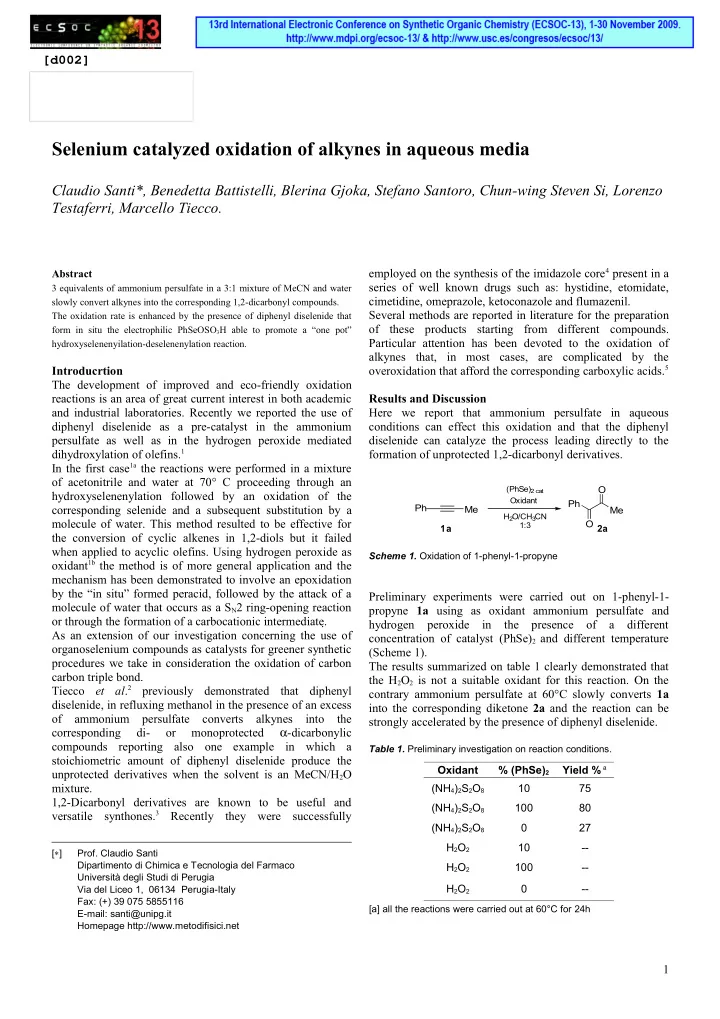
Ph Me O O Me Ph 1a 2a

Oxidant (PhSe)2 cat H2O/CH3CN 1:3

Scheme 1. Oxidation of 1-phenyl-1-propyne

Preliminary experiments were carried out on 1-phenyl-1- propyne 1a using as oxidant ammonium persulfate and hydrogen peroxide in the presence of a different concentration of catalyst (PhSe)2 and different temperature (Scheme 1). The results summarized on table 1 clearly demonstrated that the H2O2 is not a suitable oxidant for this reaction. On the contrary ammonium persulfate at 60°C slowly converts 1a into the corresponding diketone 2a and the reaction can be strongly accelerated by the presence of diphenyl diselenide.

Table 1. Preliminary investigation on reaction conditions.

Oxidant % (PhSe)2 Yield % a (NH4)2S2O8 10 75 (NH4)2S2O8 100 80 (NH4)2S2O8 27 H2O2 10

  • H2O2

100

  • H2O2
  • [a] all the reactions were carried out at 60°C for 24h

1

[∗]

  • Prof. Claudio Santi

Dipartimento di Chimica e Tecnologia del Farmaco Università degli Studi di Perugia Via del Liceo 1, 06134 Perugia-Italy Fax: (+) 39 075 5855116 E-mail: santi@unipg.it Homepage http://www.metodifisici.net

[d002]

slide-2
SLIDE 2

Non appreciable differences have been observed between the reactions carried out with catalytic or stoichiometric amounts of diselenide. The role of the (PhSe)2 is depicted in the mechanism proposed in scheme 2. The actual catalyst is the strong electophilic PhSe-sulfate produced by the reaction

  • f diphenyl diselenide with ammonium persulfate.

Resonably the electrophile, in the presence of water, promote an hydroxyselenenylation on the triple bond leading to the enol 3 that exists in a tautomeric equilibrium with the ketone

  • 4. The excess of ammonium persulfate activate the phenyl

selenium moiety to the nuclephilic substitution by a molecule

  • f water as we reported for the dihydroxylation of olefins.

The formation of the α-hydroxyketone 6 is demonstrated by the presence of a GC-MS peak [M+ m/z = 150] in the analysis effected during the ongoing reaction. In the used experimental conditions it is resonable to suppose a quick

  • xidation of 6 to afford the corresponding 1,2-dicarbonyl 2.

Noteworthy these experimental evidences suggest that the reaction mechanism, in the presence of water, is different from those observed in 1991 by Tiecco et al2 for similar reactions effected in methanol.

R R' R' PhSe R OH R' PhSe R O R' OH R O R' O R O R' SePh R O OSO3- PhSeOSO3H S2O8

=

S2O8=

H2O 1 3 4 5 6 2 (PhSe)2 + (NH4)2S2O8 H2O

Scheme 2. Proposed mechanism

With the optimized conditions in hand we investigated the scope of this methodology starting from a series of substituted alkynes 1a-g. The results are collected in table 2. All the reaction were stopped after 24 hours and the corresponding 1,2-dicarbonyl derivatives 2a-g were purified by flash chromatography and fully characterized on the basis of GC-MS analysis, 1H and

13C-NMR spectral data. The yields, referred to the amount of

isolated compounds, are from moderate to good. Starting from the alkynes 1b (entry 2), 1e (entry 5) and 1f (entry 6), we demonstrated that longer reaction time produce a positive effect on the yields even if for reaction time longer than 200 hours in some substrates the overoxidation seems to be the main process. The alkynes 1a, 1d, 1e, and 1g were quantitatively converted into benzoic acid in one week. In all the cases after purification on silica gel column chromatography the pre-catalyst (PhSe)2 can be completely recovered and then reused. Starting from a terminal alkyne 1g, in contrast with a previously reported result,2 the α-ketoaldehyde 2g cannot be isolated and its formation has been observed only from the

1H-NMR of the crude in which it is in equilibrium with the

hydrated form 7g.

Table 2. Scope of the reaction

H2O/CH3CN 1:3 60 °C, 24h

O R O R1 R R1

1a-g

2a-g

(NH4)2S2O8 (PhSe)2 cat

Entry Substrate Product Yield % 1

Ph Me 1a Ph Me O O 2a

75 2

C3H7 C3H7 1b C3H7 O O C3H7 2b

20 47a 3

Ph 1c Ph O O 2c

20 4

Ph C3H7 1d Ph O O 2d

30 5

Ph Ph 1e Ph Ph O O 2e

5 85b 6

C8H17 Me 1f C8H17 Me O O 2f

30 57a 7

Ph H 1g Ph OMe OH O 8g

65c

[a] reaction time 48h [b] reaction time 200h [c] after chromatography SiO2-eluant CH2Cl2/MeOH

After silica gel chromatography, using a dichloromethane/methanol (99:1) mixture as eluant the methoxy hemiacetal 8g is recovered in 65% of yield. 2

slide-3
SLIDE 3

It is resonably to suppose that the equilibrium between 2g and 7g for the presence of methanol and the acidic catalysis

  • f SiO2 is shifted towards the more stable form 8g (Scheme

3).

Ph OMe OH O 8g Ph OH OH O 7g Ph H O O 2g SiO2, MeOH Scheme 3. Silica mediated formation of hemiacetal 8g

Conclusion In conclusion we present here a detailed study on the

  • xidation of internal alkynes using ammonium persulfate

and diphenyl diselenide as catalyst in aqueous conditions. These reactions lead directly to unprotected 1,2-dicabonyl derivatives in moderate to good yields. Experimental evidences allow us to suppose a different reaction mechanism in respect to those previously observed for similar oxidations effected in methanol. From terminal alkynes an interesting convertion of the resulting α-ketoaldehyde to the corresponding hemiacetal by treatment of the crude with silica gel and methanol has been

  • bserved and it will be the object of further investigation.

Acknowledgment Financial support from M.I.U.R. (Ministero Italiano Università e Ricerca), National Projects PRIN2007 (Progetto di Ricerca d’Interesse Nazionale), Consorzio CINMPIS, Bari (Consorzio Interuniversitario Nazionale di Metodologie e Processi Innovativi di Sintesi) and University of Perugia is gratefully acknowledged. References

[1] [a] Santi, C.; Tiecco, M.; Testaferri, L.; Tomassini, C.; Santoro, S., Bizzoca, G. Phosphorus Sulfur Silicon Relat. Elem. 2008, 183, 956. [b] Santoro, S.; Santi, C.; Sabatini, M.; Testaferri, L.; Tiecco, M. Adv.

  • Synth. Catal. 2008, 350, 2881.

[2] Tiecco, M.; Testaferri, L.; Tingoli, M.; Chianelli, D.; Batoli, D. J.

  • Org. Chem. 1991, 56, 4529.

[3] [a] Hillis, L. R.; Ronald, R. C. J. Org. Chem. 1985, 50, 470. [b] Mattay, J.; Runsik, J. J. Org. Chem. 1985, 50, 2815. [4] Zuliani, V.; Cocconcelli, G.; Fantini, M.; Ghiron, C.; Rivara, M. J.

  • Org. Chem. 2007, 72, 4551 and references therein cited.

[5] [a] Schrӧder, M. Chem. Rev. 1980, 80, 187. [b] Muller, P.; Godey, J.

  • Helv. Chim. Acta 1981, 64, 2531. [b] Chang, C-L.; Kumar, M. P.; Liu,

R-S. J. Org. Chem. 2004, 69, 2793. [c] Kashimura, S.; Murai, Y.; Washika, C.; Yoshihara, D.; Kataoka, Y.; Murase, H.; Shono, T. Tetrahedron Lett. 1997, 38, 6717. [d] Crich, D.; Zou, Y. J. Org.

  • Chem. 2005, 70, 3309. [e] Srinivasan, N.S.; Lee, D.G. .J. Org. Chem.

1979, 44, 1574. [f] Dayan, S.; Ben-David, I.; Rozen, S. . J. Org.

  • Chem. 2000, 65, 8816.

3