Laboratory Grease Analysis with Grease Thief Sampling & Analysis - - PowerPoint PPT Presentation

laboratory grease analysis with grease thief sampling
SMART_READER_LITE
LIVE PREVIEW

Laboratory Grease Analysis with Grease Thief Sampling & Analysis - - PowerPoint PPT Presentation

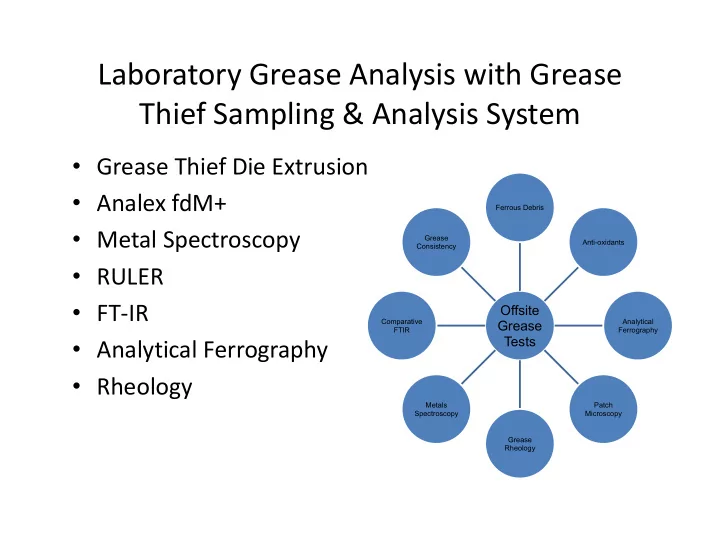
Laboratory Grease Analysis with Grease Thief Sampling & Analysis System Grease Thief Die Extrusion Analex fdM+ Ferrous Debris Metal Spectroscopy Grease Anti-oxidants Consistency RULER FT IR Offsite Comparative


slide-1
SLIDE 1

Laboratory Grease Analysis with Grease Thief Sampling & Analysis System

  • Grease Thief Die Extrusion
  • Analex fdM+
  • Metal Spectroscopy
  • RULER
  • FT‐IR
  • Analytical Ferrography
  • Rheology

Offsite Grease Tests

Ferrous Debris Anti-oxidants Analytical Ferrography Patch Microscopy Grease Rheology Metals Spectroscopy Comparative FTIR Grease Consistency

slide-2
SLIDE 2

Prep for Analysis

  • When grease is tested for consistency, it can

be extruded onto sample substrates:

– IR Card for FTIR – Substrate for weighing and dissolution in RULER vial – Substrate for weighing and dissolution for spectroscopy; same dissolved grease can be used for Ferrography/MicroPatch

slide-3
SLIDE 3

Sample Handling and Preservation

  • Sampling Procedures: ASTM Standard Practice

D7718

  • Use proper PPE
  • Instrumentation

– Wipe down between runs – Do not reuse Extrusion Dies or Grease Thieves (GT)

slide-4
SLIDE 4

Analysis Techniques

Sample is received. fdM+ is run

Grease Thief Analyzer is performed and substrate is made

Two strips are used to make a dilution to run RDE/ICP. One Strip is used for FT-IR. One Strip is Dissolved in Green RULER solution to run RULER.

slide-5
SLIDE 5

Wear Monitoring with the ANALEX fdM+

  • Hall effect type sensor to

determine the amount of ferrous debris present in the sample.

  • Instrument has calibration

standards for Grease Thief.

  • The instrument measures the

entire sample which is important due to the non‐ homogenous nature of grease.

slide-6
SLIDE 6

Wear Monitoring Method Comparison

  • Sample was taken in grease sampler
  • Extruded sample was weighed and dissolved for

direct reading ferrography

  • Results were normalized to 0.1 gram grease
  • Full sampler analyzed by ferrous density

instrument (Hall effect sensor) for ppm Fe result

  • Quantity of grease in sampler weighed and tared,

and result in ppm normalized to 1.0 gram grease

Method Average Standard Deviation Relative Standard Deviation fdM+ 277 ppm 7 2.53 DR- 205 46 22.44 RDE 57 ppm 16 28.07 Method Average Standard Deviation Relative Standard Deviation fdM+ 277 ppm 7 2.53 DR- 205 46 22.44 RDE 57 ppm 16 28.07

slide-7
SLIDE 7

Grease Thief Die Extrusion Test

  • This instrument detects changes in the consistency of a

grease.

  • It is sensitive to the presence of hard particles, seen as

spikes in the data, and hardened chunks of grease, seen as broad peaks in the graph.

  • This test only requires one gram of grease.
  • Grease Thief Index (GTI) calculates the deviation in

percent of the force of the sample compared to that of the baseline. A GTI of 100 shows a perfect match to the baseline.

slide-8
SLIDE 8

Die extrusion and sample preparation

  • Grease extruded through die to create ribbon on substrate
  • Load profile at varying speeds developed for consistency evaluation
  • Sample prepared for subsequent analyses
slide-9
SLIDE 9

Predicted Response Graph

  • Average stable load value

after speed change related to NLGI grade, or penetration values

  • Rapid speed changes used

to leverage non‐Newtonian response

  • Critical areas expected

immediately after speed change; possible data rich regions to characterize rheology, oil shear, “dryness”, etc.

slide-10
SLIDE 10

Grease Thief Analysis Profiles

Normal Profile

100 200 300 400 500 600 700 800 900 1000 272 372 472 572 672 772 872

Force (grams)

Sample Baseline

GTI = 89 Hardened Sample

100 200 300 400 500 600 700 800 900 1000 320 420 520 620 720 820

Force (grams) sample baseline GTI = 183 Sample with Hard Particles

200 400 600 800 1000 1200 1400 300 400 500 600 700 800

Force (grams) Sample Baseline GTI = 76 Softened Grease

100 200 300 400 500 600 700 800 900 1000 272 372 472 572 672 772

Force (grams) Sample Baseline GTI = 31

slide-11
SLIDE 11

Actual Load Response Graphs

slide-12
SLIDE 12

Consistency Testing

slide-13
SLIDE 13

Standard Laboratory Tests

  • FT‐IR – Takes a fingerprint of the grease. Helps

determine if mixing is present. It is also used to determine the presence and origin of unknown contaminants and oxidation.

  • RULER – Measures the amount of anti‐oxidant

remaining in the grease.

  • Metal Spectroscopy – RDE/ICP/XRF determines the

wear metals, additive metals and thickener metals used in the grease formulation. This test also aids in the detecting mixing of greases.

  • Optical Spectroscopy – Uses visual color absorbance

to evaluate degradation and potential mixing.

slide-14
SLIDE 14

FTIR Analysis

slide-15
SLIDE 15

Prep for Analysis

slide-16
SLIDE 16

Linear Sweep Voltammetry (RULER) analysis for grease

  • Preparation of thin‐

film substrate streamlines and standardizes analysis

  • Additive levels

normalized to mass of grease

slide-17
SLIDE 17

Linear Sweep Voltammetry

  • Samples from similar coal

crushers, same time in service

  • Both have an adequate

remaining anti‐oxidant level to protect grease from oxidation

  • Lower sample shows more

rapid degradation of anti‐

  • xidants, due to higher

temperatures, contaminants,

  • r other oxidation stressors.
  • Differences in time of service
  • r relubrication quantities or

effectiveness could also affect anti‐oxidant amount

slide-18
SLIDE 18

Optical Spectroscopy Cell

slide-19
SLIDE 19

In‐Service Spectrum

0.0000 0.1000 0.2000 0.3000 0.4000 0.5000 0.6000 400 413 426 439 452 465 478 491 504 517 530 543 556 569 582 595 608 621 634 647 660 673 686 699 New Fluid in‐service Fluid

Mobilith SHC 220

slide-20
SLIDE 20

50:50 Mixture

slide-21
SLIDE 21

New Lubricant to End of Life

0.00 0.05 0.10 0.15 0.20 0.25 0.30 0.35 0.40 0.45 0.50 400 450 500 550 600 650 700 Wavelength (nm) Transmission

New Fluid In-Service Fluid End of Life Fluid

New: Mobil XHP 222 S, In-service: Used Mobil XHP 222, EOT: Used Unirex N2 (both were the same at end of life).

slide-22
SLIDE 22

Chemometric Techniques

  • Evaluate particulate contamination of new and in‐

service greases

  • Coal dust, other known and common contaminants
  • Establishing contaminant level targets
slide-23
SLIDE 23

Carbon Residue Experiment

  • Carbon residue

used to make a 1% by mass mixture.

  • Dilutions made to

prepare 9 additional samples.

  • Extruded samples
  • nto substrates.
  • Analyzed samples

with the i‐Lab using the optical spectroscopy box.

y = 564.03x + 56.949 R² = 0.969 y = -640.87x + 58.179 R² = 0.9534 40 45 50 55 60 65 70 0.00% 0.20% 0.40% 0.60% 0.80% 1.00%

Carbon Residue (percent mass)

CIE and L* Vs. % Carbon Residue

CIE ∆E L*

slide-24
SLIDE 24

Carbon Residue Experiment

Carbon Residue Experiment 2 Visual Spectra Comparison

0.1 0.2 0.3 0.4 0.5 0.6 0.7 400 450 500 550 600 650 700

wavelength (nm) Transmittance

1.00% 0.90% 0.80% 0.70% 0.60% 0.50% 0.40% 0.30% 0.20% 0.10% 0.00%

slide-25
SLIDE 25

Advanced Laboratory Testing

  • Rheometric Analysis is a

newer technique that utilizes a rheometer to analyze the physical properties of a grease. These properties are –

– Resistance to flow (pumpability) – Consistency – Recoverable Compliance (tunneling)

  • Analytical Ferrography

microscopic technique used in oil and grease

  • analysis. It is used to –

– Discover the origins of the wear. – The size of the particles. – Detect signs of acid corrosion.

slide-26
SLIDE 26

Rheometer testing

  • Work by Nolan and Sivik to evaluate grease

properties with rheometer

  • Bryan Johnson published method for

correlating penetration to rheometer

  • German DIN draft method
  • Yield stress point and equilibrium recoverable

compliance

  • Measuring flow point and elastic recoil
slide-27
SLIDE 27

Rheometer Consistency Testing

slide-28
SLIDE 28

Elasticity or Recoverable Compliance

slide-29
SLIDE 29

Consistency Testing

slide-30
SLIDE 30

New fresh grease G’= 18,260Pa

slide-31
SLIDE 31

Suspected Mixture G’=10,510Pa

G’ is 57% of new

slide-32
SLIDE 32

Ferrographic and Micro‐Patch inspections

slide-33
SLIDE 33

Ferrographic and Micro‐Patch inspections

  • Analytical ferrography more difficult than oil; may

require special “fixer” mixtures

  • Patch can be clouded by residual grease particles,

but can be more effective at finding non‐ferrous

slide-34
SLIDE 34

Wind Turbine grease sampling and analysis

  • 2‐year project conducted with DONG Energy and

Vattenfall, two largest offshore wind operators in the world

  • Dr. Kim Esbensen, internationally recognized expert in

Theory of Sampling (TOS), Denmark

  • Rich Wurzbach, MRG Labs, inventor of Grease Thief
  • Systematic evaluation of grease heterogeneity,

sampling methodology, and analysis validity and repeatability for wind turbine main bearings in on‐ shore and off‐shore applications

  • Results published at OilDoc, LUBMAT, and AWEA
slide-35
SLIDE 35
  • Fundamental Sampling Principle

–Using the Grease Thief

  • Representative sampling

–Thorough characterization of the heterogeneity of grease in main bearings

slide-36
SLIDE 36

Test parameters of Grease

  • For the heterogeneity characterization of

grease in main bearings of wind turbines the following parameters were used:

–Consistency and flow characteristics –Ferromagnetic iron (Hall‐effect sensor) –Wear metals –Particle characterization (size & distribution) –Residual oil in grease –Antioxidants

slide-37
SLIDE 37

Heterogeneity characterization – Ferromagnetic iron

  • Sampling of grease while draining the main bearing through

the drain plug

  • 27 increments collected (each sample approximately 20

grams)

On site sampling

10000 12000 14000 16000 18000 20000 1 2 3 4 5 6 7 8 9 10 11 12 13 14 15 16 17 18 19 20 21 22 23 24 25 26 27 Sample no Iro n (F d M P lu s)