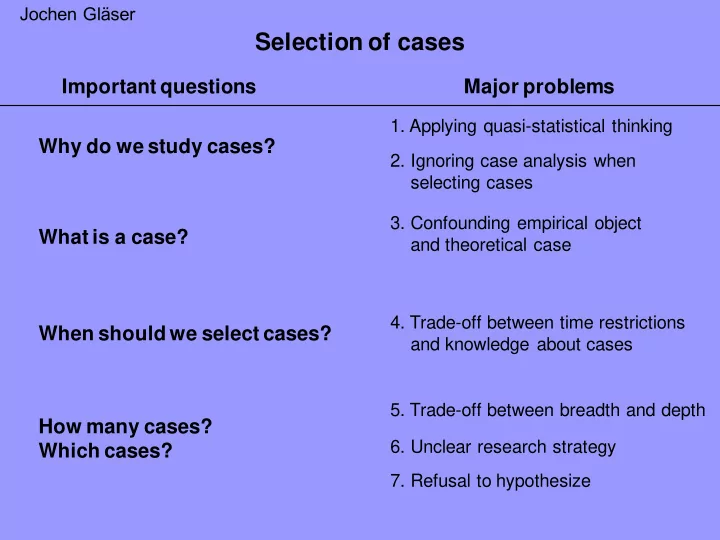
SLIDE 1 Selection of cases
Jochen Gläser
What is a case? Why do we study cases? How many cases? Which cases? Important questions Major problems
- 3. Confounding empirical object
and theoretical case
- 1. Applying quasi-statistical thinking
- 6. Unclear research strategy
- 5. Trade-off between breadth and depth
- 7. Refusal to hypothesize
When should we select cases?
- 4. Trade-off between time restrictions
and knowledge about cases
- 2. Ignoring case analysis when
selecting cases
SLIDE 2
Why do we study cases?
[Discussion limited to multiple-case studies. See e.g. Siggelkow 2007 on the uses of single-case studies.]
[Distinctions like testing theory - creating theory are useless] Two approaches to case studies in the literature: „Weak approximation of the statistical method“ 1) Intensive study of a small number of cases in order to shed light on a population. 2) Intensive study of a small number of cases in order to explain a specific social phenomenon. Representativeness of cases remains central concern Theory development by (predominantly) qualitative research Generalization on the basis of a match to the underlying theory rather than a larger universe
SLIDE 3 Why do we study cases?
Causes and effects
Description Explanation
Implicit Causal relationships Causal mechanisms Thick description Exploratory
To what extent has NPM permeated German universities? How has NPM been adopted by two Technical Universities? What conditions enable, promote, prevent, or hinder the adoption of NPM?
Description
How is NPM adopted?
Initial conditions Sequence of causally linked events Outcomes
SLIDE 4
What is a case?
Empirical object or theoretical construct? It is impossible to use empirical objects as cases. 1) We cannot dismiss our social scientific perspective. 2) All empirical analysis is selective.
Case: Social phenomenon (event, process, constellation of actors) that can be analytically separated from its environment.
[We routinely use names of empirical objects as labels for cases.] 3) Our decisions about the boundaries of our case are based on theory.
SLIDE 5
When should we select cases?
Two ways to go about this Advantages Insufficient a priori - knowledge about cases may distort investigation Efficient, consistent Time-consuming, first results may distort the investigation All at once Select as you go case selection data analysis data collection case selection data collection data analysis Disadvantages Adaptation of case selection to new insights
SLIDE 6
How many cases? Which cases?
Major problem: Trade-off between breadth and depth The universe of case selection strategies and its black hole Maximum variation Convenience Opportunistic Criterion Stratified purposeful Random purposeful Intense case Typical case Extreme or deviant case Snowball or chain Confirming and disconfirming cases Theory-based Critical (crucial) case Homogenous Politically important cases
Which strategy for which research question?
SLIDE 7 How many cases? Which cases?
Theoretical and practical considerations Theoretical considerations:
Importance of variation Degree of variation needed
Practical considerations:
Number of cases that can be studied External audiences that must be kept happy Access to empirical objects
Depend on
(Description? Which kind of explanation?)
- 3. Assumptions about cases
Depend on
- 1. Resources
- 2. Conditions of funding
- 3. Empirical methods,
empirical objects
SLIDE 8
How many cases? Which cases?
What should vary between cases? Research strategy and variation
irrelevant All relevant variables* At least independent and intervening variables
*See Lieberson 1992
Description Explanation
Implicit Causal relationships Causal mechanisms Exploratory At least independent and intervening variables
Why?
Representativeness Few cases, typical cases, crucial cases Causality is established from covariation Causality is established from process-tracing
SLIDE 9
Questions for group sessions
How are cases defined in the project? What constitutes a case? How can ‘cases’ be best accessed and co-operation be gained? What role do pragmatic criteria play (ease of access to empirical objects, costs …)? How can information about these variables be collected for all possible cases? Which variables should vary between cases, which should not? Which empirical entities correspond to these cases?