Select Slides Kai Palenscar May 15, 2014 17 Non-native fish - - PowerPoint PPT Presentation

select slides
SMART_READER_LITE
LIVE PREVIEW

Select Slides Kai Palenscar May 15, 2014 17 Non-native fish - - PowerPoint PPT Presentation

Compsopogon coeruleus in the Santa Ana River Select Slides Kai Palenscar May 15, 2014 17 Non-native fish removed: February 13, 2014 2 largemouth bass 14 black bullhead catfish 1 green sunfish Algae first noted as potentially problematic


slide-1
SLIDE 1

Compsopogon coeruleus

in the Santa Ana River

Kai Palenscar May 15, 2014
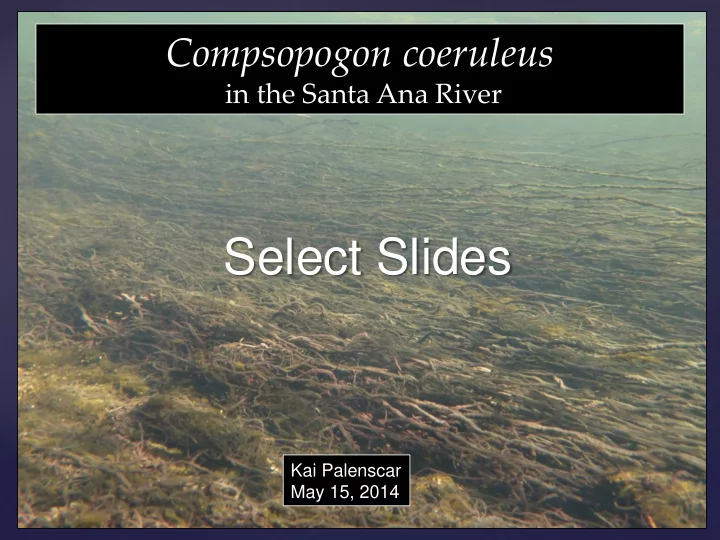
Select Slides

slide-2
SLIDE 2

Algae first noted as potentially problematic during non-native fish removal at the RIX discharge pool.

In attendance USFWS, USFS, CDFW, RCRCD, SBVMWD, RIX personnel February 13, 2014 17 Non-native fish removed: 2 largemouth bass 14 black bullhead catfish 1 green sunfish

slide-3
SLIDE 3

Algae collected from RIX discharge pool

  • Feb. 13, 2014 – dark brown/black and filamentous

Downstream of discharge pool Feb. 25, 2014

slide-4
SLIDE 4

Preferred Habitat (Necchi et al 2013)

Aquarium

  • Epiphytic Pest

Wildland

  • Clear Water
  • Rapid Velocity
  • Hard Substrate
  • Water Temp.
  • Mean 70°F (20°C)
  • Min. 56°F (12°C)
  • pH
  • usually alkaline >7.5
  • Specific

Conductivity

  • Wide Range:

fresh to brackish water

Rialto Channel RIX* Discharge *RIX – Rapid Infiltration and Extraction

Algae Habitat = Sucker Habitat

Algae Present Algae Not Present

slide-5
SLIDE 5

80-100 % ___ 50-80% ___ <10% ___

Preliminary survey of algae distribution conducted by Riverside-Corona Resource Conservation District Algae coverage lower in sandy areas.

Rialto Channel RIX Outfall Pool Riverside Ave. Mission Ave.

slide-6
SLIDE 6

Pre-invasion – fall 2011 Post-invasion – Feb. 25, 2014

slide-7
SLIDE 7

Santa Ana River Population of Santa Ana Sucker

slide-8
SLIDE 8

Potential Range of the Santa Ana Sucker in the Santa Ana River (32 river miles)

Prado Dam La Cadena Bridge Weir Canyon Drop Structure

Riverside Chino Hills Colton

Current distribution much more limited.

slide-9
SLIDE 9
  • Snorkel Survey
  • Riverside Ave. to RIX discharge pool
  • Data
  • Underwater video/photos
  • Location of sucker and algae presence
  • Results
  • Algae cover is 75-100 percent of river bottom
  • 135 Santa Ana sucker observed (80-150 mm)
  • Arroyo chub more common (adults and juveniles)

Survey for Santa Ana Sucker February 25, 2014

slide-10
SLIDE 10

Survey Points for Snorkel Survey (Feb. 25, 2014): Red = sucker occurrences Blue = Riverwalk data point locations

slide-11
SLIDE 11

Long-term viability is precarious due to the limited extent of suitable habitat

  • Habitat is limited by
  • barriers, water availability and rocky substrate (cobble/gravel)
  • Other threats
  • non-native aquatic species, off-road vehicles, water quality,

hydrologic regime, water temperature (?), algae (?)

  • Amount of suitable habitat
  • At time of listing - 32 mi. (defined by river barriers)
  • Actual - <7 mi. (defined by presence of rocky substrate)
  • Without algae - <½ mi. (majority = Rialto Channel)
  • Algae is a new potential threat to Santa Ana sucker and its

habitat that we need to further evaluate.

Threats to the sucker in the Santa Ana River

slide-12
SLIDE 12

Current Conditions

  • Since February, three

precipitation events have

  • ccurred
  • Algae density decreased with

each rain event

  • Regrowth estimated at 1-2 cm

per day

At RIX Discharge Location

May 2, 2014

Between RIX and Riverside Ave. Santa Ana River after rain event at Rialto Confluence March 1, 2014

slide-13
SLIDE 13

Next Steps -What do we do now?

  • Determine nativity and range in CA
  • Few occurrence records (northern and southern CA, all recent)
  • Determine threat to the sucker
  • Survey river for presence and measure regrowth
  • Conduct trials at RCRCD – feeding/spawning
  • Management
  • Containment to Santa Ana River
  • Control
  • Chemically (copper sulfate, chlorine, barley extract?)
  • Drying - Realign upper portion of the river and allow to dry
  • Partners
  • USFWS, USDA, USACE, CDFW, RWQCB, MWD, local cities, flood

control, local water agencies (SBVMWD, SBVWCD, OCWD, SBMWD, etc.), CSU San Marcos – Sheath Lab.