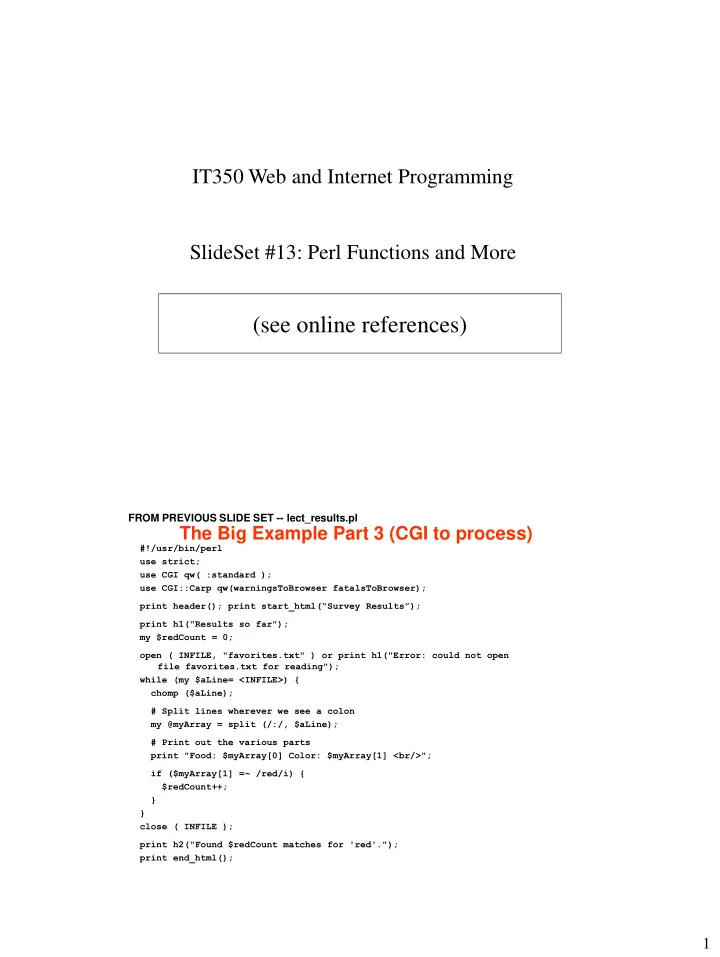
(see online references) FROM PREVIOUS SLIDE SET -- lect_results.pl - - PDF document

see online references
SMART_READER_LITE
LIVE PREVIEW

(see online references) FROM PREVIOUS SLIDE SET -- lect_results.pl - - PDF document

IT350 Web and Internet Programming SlideSet #13: Perl Functions and More (see online references) FROM PREVIOUS SLIDE SET -- lect_results.pl The Big Example Part 3 (CGI to process) #!/usr/bin/perl use strict; use CGI qw( :standard ); use


slide-1
SLIDE 1

1

(see online references)

IT350 Web and Internet Programming SlideSet #13: Perl Functions and More

The Big Example Part 3 (CGI to process)

#!/usr/bin/perl use strict; use CGI qw( :standard ); use CGI::Carp qw(warningsToBrowser fatalsToBrowser); print header(); print start_html(“Survey Results”); print h1("Results so far"); my $redCount = 0;

  • pen ( INFILE, "favorites.txt" ) or print h1("Error: could not open

file favorites.txt for reading"); while (my $aLine= <INFILE>) { chomp ($aLine); # Split lines wherever we see a colon my @myArray = split (/:/, $aLine); # Print out the various parts print "Food: $myArray[0] Color: $myArray[1] <br/>"; if ($myArray[1] =~ /red/i) { $redCount++; } } close ( INFILE ); print h2("Found $redCount matches for 'red'."); print end_html();

FROM PREVIOUS SLIDE SET -- lect_results.pl

slide-2
SLIDE 2

2

Perl Stuff 2

  • Arithmetic operators and comparisons

– +, -, *, /, % – ==, !=, <, >, <=, >=

  • String operators and comparisons

– . – eq, ne, lt, gt, le, ge

  • Literal strings and interpolated strings

– ‘dog’ – “$dog is a dog”

  • Strings and numbers

Perl Basics

#!/usr/bin/perl use strict; use CGI qw( :standard ); use CGI::Carp qw(warningsToBrowser fatalsToBrowser); print header(); print start_html(‘Perl basics’); print ('<p>'); my $x = 2 + 3; my $y = $x * 4; if ($x == 5.0) { print ("x is five"); } for (my $i = 0; $i < 3; $i++) { my $squared = $i * $i; print ("<br/> \$i = $i, squared is $squared"); } my $pet1 = "dog"; my $pet2 = "ll" . "ama"; # Single quotes vs. double quotes print ("<br/>I have a $pet1 and a $pet2."); print ('<br/>I have a $pet1 and a $pet2.'); my $comp1 = ($pet1 eq "dog"); print ("<br/> comp1: $comp1"); print ('</p>'); print end_html();

FROM PREVIOUS SLIDE SET -- lect_basics.pl

slide-3
SLIDE 3

3

Exercise: What is the output (1st time, 2nd … )?

#!/usr/bin/perl use strict; use CGI qw( :standard ); use CGI::Carp qw(warningsToBrowser fatalsToBrowser); print header(); print start_html(); my $index = 0; my $sum = 0; my @myArray = (); my $filename = "numbers.txt";

  • pen ( MYFILE, $filename ) or print h1("Error: could not open file $filename for

reading"); while (my $aNum = <MYFILE>) { chomp $aNum; if ($aNum > 0) { $myArray[$index] = $aNum; $sum += $aNum; $index++; } } close ( MYFILE ); # Add the sum to the array $myArray[$index] = $sum; my $size = @myArray;

  • pen ( MYFILE, ">$filename") or print h1("Error: could not open file $filename for

writing"); for (my $i = 0; $i < $size; $i++) { print br() . $myArray[$i]; print MYFILE $myArray[$i] . "\n"; } close (MYFILE); print end_html();

FROM PREVIOUS SLIDE SET lect_io_array.pl

numbers.txt: 1 2

use strict AND my

  • With “use strict”, variables must be declared with “my”
  • More work at first, but saves pain later!

#!/usr/bin/perl use strict; use CGI qw( :standard ); use CGI::Carp qw(warningsToBrowser fatalsToBrowser); print header(); print start_html(“Example”); my $x = 89; my ($y, $z) = (91, 93); my @arr = (1, 2, 3); my($d1, $d2, $d3) = @arr; my($f1, @f2, $f3) = @arr; print p("x is $x"); print p("y is $y"); print p("z is $z"); print p("d1: $d1 d2: $d2 d3: $d3"); print p("f1: $f1 f2: @f2 f3: $f3"); my $details = "John--rabbit7"; my($name,$password) = split ( /--/, $details); print p("name: '$name' password: '$password'"); print end_html();

slide-4
SLIDE 4

4

Perl Function Calls (“subroutines”)

#!/usr/bin/perl use strict; use CGI qw( :standard ); use CGI::Carp qw(warningsToBrowser fatalsToBrowser); print header(); print start_html(-title => "Test Subs“, -style => “styles.css”); print '<p>'; # Prints "hello", takes no arguments sub hello { print "\n<br/> Hello."; } # Takes two arguments, returns their product sub multiply { my($valA, $valB) = @_; return $valA * $valB; } my $x = 2; print "\n<br/> $x * 7 = " . multiply($x,7); hello; hello(); hello(72145); print '</p>'; print end_html();

Function Calls and Arrays

… #usual prelude here # Takes an array as argument, returns minimum value sub findMin { my @arr = @_; my $min = $arr[0]; for (my $ii=1; $ii < @arr; $ii++) { if ($arr[$ii] < $min) { $min = $arr[$ii]; } } return $min; } # Defines new global array, @array1 # AND returns a new array with 4 elements. my @array1; sub makeArray{ @array1 = (89, 23, 90); my @array2 = (34, 5.4, 123, 2.01); return @array2; } my @test1 = makeArray(); my @test2 = (89, 23, 40, -17); print "\n<br />Min1 is: " . findMin(@test1); print "\n<br />Min2 is: " . findMin(@test2); print "\n<br />Min3 is: " . findMin(@array1); print "\n<br />Min4 is: " . findMin(@array2);

slide-5
SLIDE 5

5

Exercise #1

  • Write a Perl function checkNum that takes three arguments, num,

min, and max, and returns 1 if num is in the range [min,max] (inclusive), or 0 otherwise.

Exercise #2

  • Write a function dup that takes two arguments, ch and

count, and prints the value of ‘ch’ out ‘count’ times.

  • Then write code to produce the following output:

12 12 12 12 12

slide-6
SLIDE 6

6

Exercise #3

  • Write a function, makeArray, that takes one argument,

count, and returns returns an array of size count with the numbers from [1..count]. So makeArray(4) should return (1, 2, 3, 4)

Exercise #4

  • Write a Perl function, reverse, that takes one argument,

an array, and returns that array in reverse order. So (1, 2, 3) becomes (3, 2, 1).

slide-7
SLIDE 7

7

String  number conversions (and back)

  • Perl will convert to number where needed , or to a string where needed

my $str1 = "27"; my $str2 = "dog"; my $str3 = "cat"; my $result1 = $str1 + 10; my $result2 = $str1 - 10; my $result3 = $str2 + 10; print p("result1: $result1 result2: $result2"); print p("result3: $result3"); my $val1 = 13; my $val2 = 27; print p("Combine these: " . $val1 . $val2); if ($str2 == $str3) { print h2("Dogs and cats unite!"); }

elsif if ($x > 0) { print “Hello”; } elsif ($x == -5) { print “Goodbye”; } else { print “Bye”; }

slide-8
SLIDE 8

8

Gotchas, References, and Multiple Files

my @array = @_; not the same as my @array = $_; my ($valA, $valB) = @_; not the same as my $valA, $valB = @_;

References:

@array = (1, 2, 3); $ref_array = \@array; @array2 = @$ref_array; print "\nfrom ref: " . $$ref_array[1]; print "\nfrom array: " . $array[1];

Multiple Perl Files:

require "question_struct.pl";

Be sure not to use same names (e.g., function names) in different files! The file to include needs 1; on the last line