Securing Internet Routing Securing Internet Routing $ Local ISP - - PowerPoint PPT Presentation

securing internet routing securing internet routing
SMART_READER_LITE
LIVE PREVIEW

Securing Internet Routing Securing Internet Routing $ Local ISP - - PowerPoint PPT Presentation

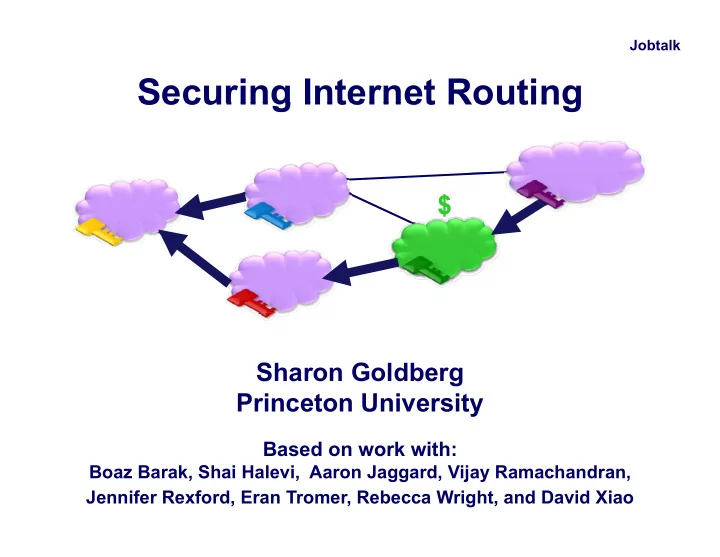
Jobtalk Securing Internet Routing Securing Internet Routing $ Local ISP Sharon Goldberg g Princeton University Based on work with: Based on work with: Boaz Barak, Shai Halevi, Aaron Jaggard, Vijay Ramachandran, Jennifer Rexford, Eran


slide-1
SLIDE 1

Securing Internet Routing

Jobtalk

Securing Internet Routing

Local

$

ISP

Sharon Goldberg g Princeton University

Based on work with:

Princeton University

Based on work with:

Boaz Barak, Shai Halevi, Aaron Jaggard, Vijay Ramachandran, Jennifer Rexford, Eran Tromer, Rebecca Wright, and David Xiao

slide-2
SLIDE 2

Th I t t i ll ti f A t S t (AS)

The Internet (1)

The Internet is a collection of Autonomous Systems (AS).

Princeton IBM AT&T Local Princeton Comcast Local ISP

Connectivity requires competing ASes to cooperate Connectivity requires competing ASes to cooperate.

slide-3
SLIDE 3

The Internet (2)

E h A t S t (AS) i ll ti f t Each Autonomous System (AS) is a collection of routers.

Princeton IBM AT&T Local Princeton Comcast Local ISP Local ISP

slide-4
SLIDE 4

Different Failure Models & Formal Techniques

Honest

  • Follows the protocol

The Internet Benign / Fail-Stop

  • Stops responding

The Internet was designed for this.

  • Stops responding

$

Rational (Selfish)

  • Deviates from protocol for personal gain

$

Game Theory

g

Cryptography Adversarial

  • Actively tries to “break” the protocol
slide-5
SLIDE 5

Research Approach

System (Goal) engineering & economic limitations Prove this protocol satisfies security for Define Security Property failure model.

erate erate

$

Choose Failure Model

Ite Ite

Evaluate Protocol Ch t i Any protocol with security property X Characterize Security vs Efficiency security property X needs resource Y

slide-6
SLIDE 6

Research Approach

System (Goal) Define Security Property

erate erate

Choose Failure Model Standards, Prototypes

Ite Ite

Evaluate Protocol Ch t i Implement / Characterize Security vs Efficiency Implement / Tech transfer

slide-7
SLIDE 7

Secure Routing on the Internet

Goal: Ensure packets arrive at their destination.

Princeton IBM AT&T Local Princeton Comcast Local ISP

Years of security research devoted to solving this problem. y g p

slide-8
SLIDE 8

Overview of Previous Work on Secure Routing

AT&T IBM

IBM AT&T Princeton

AT&T, IBM

IBM Comcast Local ISP Comcast

Local, Comcast, IBM

Control Plane (Routing protocols):

S h b d Secure BGP

[Kent Lynn Seo 00]

soBGP, IRV, SPV, pgBGP, psBGP, Listen Whisper etc

  • Set up paths between nodes

[Kent Lynn Seo 00]

Listen-Whisper, etc.,

Data Plane:

  • Given the paths, how should packets be forwarded?

p p NPBR [Perlman 88], Secure Msg Transmission [DDWY92], Secure/Efficient Routing [AKWK04], Secure TR [PS03], etc!

slide-9
SLIDE 9

Overview of Previous Work on Secure Routing

AT&T IBM

IBM AT&T Princeton

AT&T, IBM

To inform deployment efforts, my research focuses on: 1 Are we securing the right part of the system?

IBM Comcast Local ISP

  • 1. Are we securing the right part of the system?
  • 2. Characterizing the tradeoffs between security & efficiency

Comcast

Local, Comcast, IBM

Control Plane (Routing protocols):

S h b d Secure BGP

[Kent Lynn Seo 00]

soBGP, IRV, SPV, pgBGP, psBGP, Listen Whisper etc

  • Set up paths between nodes

[Kent Lynn Seo 00]

Listen-Whisper, etc.,

Data Plane:

  • Given the paths, how should packets be forwarded?

p p NPBR [Perlman 88], Secure Msg Transmission [DDWY92], Secure/Efficient Routing [AKWK04], Secure TR [PS03], etc!

slide-10
SLIDE 10

Overview of the Results in this Talk

Internet Routing (Ensuring packets arrive at their destination) Ensure packets actually Detect packet loss follow announced paths. & localize bad router.

$

Rational ASes Adversarial routers [GHJRW, SIGCOMM’08] Known control Known control-

  • plane

plane [GXTBR, SIGMETRICS’08] [BGX, EUROCRYPT’08] New data New data-plane plane protocols, like Secure BGP New data New data plane plane protocols & characterization

slide-11
SLIDE 11

Part I : The Control Plane Part I : The Control Plane

two counterexamples & a theorem

slide-12
SLIDE 12

BGP: The Internet Routing Protocol (1)

P th b t A t S t (AS ) Paths between Autonomous Systems (ASes) are set up via the Border Gateway Protocol (BGP). AT&T Princeton

IBM AT&T, IBM

$

IBM AT&T Local ISP

Local Val ation

$

$

Comcast ISP

IBM Local Valuation: Comcast, IBM AT&T, IBM

Forwarding: Node use single outgoing link for all traffic to destination.

Comcast, IBM IBM

Valuations: Usually based on economic relationships. Here, we assume they are fixed at “beginning of game”

slide-13
SLIDE 13

BGP: The Internet Routing Protocol (2)

P th b t A t S t (AS )

AT&T, IBM

$

Paths between Autonomous Systems (ASes) are set up via the Border Gateway Protocol (BGP). AT&T Princeton

AT&T, IBM

$

$

IBM AT&T Local ISP

Princeton Valuat’n: Local AT&T IBM

$

Comcast ISP

Local, AT&T, IBM AT&T, IBM Local, Comcast, IBM Local, Comcast, IBM

Forwarding: Node use single outgoing link for all traffic to destination. Valuations: Usually based on economic relationships. Here, we assume they are fixed at “beginning of game”

slide-14
SLIDE 14

Our desired security goal…

BGP announcements match actual paths in the data plane.

AT&T Princeton IBM AT&T Local ISP

Princeton Valuat’n: Local AT&T IBM

Comcast ISP

Local, AT&T, IBM AT&T, IBM Local, Comcast, IBM

Then, can use BGP messages as input to security schemes! 1. Chose paths that avoid ASes known to drop packets 2. Protocols that localize an adversarial router on path. 3. Contractual frameworks that penalize nodes that drop packets.

slide-15
SLIDE 15

Our desired security goal…

BGP announcements match actual paths in the data plane.

AT&T Princeton

Local, AT&T, IBM

IBM AT&T Local ISP Local ISP

$

Princeton Valuat’n: Local AT&T IBM

Comcast ISP ISP

Local, AT&T, IBM AT&T, IBM Local, Comcast, IBM

Then, can use BGP messages as input to security schemes! 1. Chose paths that avoid ASes known to drop packets 2. Protocols that localize an adversarial router on path. 3. Contractual frameworks that penalize nodes that drop packets.

slide-16
SLIDE 16

The “Secure BGP” Internet Routing Protocol

Public Key If AS a announced path abP then b announced bP to a

Comcast: (IBM)

Public Key Infrastructure

AT&T Princeton

Comcast: (IBM) Local: (Comcast, IBM) Princeton: (Local, Comcast, IBM)

IBM AT&T Local ISP

( , , )

Comcast ISP

Comcast: (IBM) Comcast: (IBM) Comcast: (IBM) Local: (Comcast, IBM)

Public Key Signature: Anyone who knows IBM’s public key can verify the message was sent by IBM.

slide-17
SLIDE 17

The “Secure BGP” Internet Routing Protocol

Public Key If AS a announced path abP then b announced bP to a

Comcast: (IBM)

Public Key Infrastructure

AT&T Princeton

Comcast: (IBM) Local: (Comcast, IBM) Princeton: (Local, Comcast, IBM)

IBM AT&T Local ISP

( , , )

Comcast ISP

Comcast: (IBM) Comcast: (IBM) Comcast: (IBM) Local: (Comcast, IBM)

If we assume nodes are rational, do we get security from “Secure BGP”?

Y

F t i tilit d l ( i k) Public Key Signature: Anyone who knows IBM’s public key can verify the message was sent by IBM.

Yes Yes - For certain utility models (prior work)

No No - For more realistic ones (our work)

slide-18
SLIDE 18

Model of utility in prior work:

The “No Attractions” model of utility…

. Utility of outgoing (data-plane) path Utility of attracted incoming traffic Utility of AS =

+

Model of utility in prior work:

( p ) p g IBM AT&T Princeton

Local Valuatio’n: Comcast, IBM AT&T IBM

Comcast Local ISP Local ISP

AT&T, IBM

In all prior work: Utility i d t i d b th is determined by the valuation function

slide-19
SLIDE 19

Utility Secure

Do control plane & data plane match?

y Model BGP No Attractions [LSZ] No Attractions [LSZ]

Corollary: If _________, rational rational ASes have no incentive to send dishonest BGP announcements!

to se d d s o est

G a

  • u ce

e ts

  • [Feigenbaum-Ramachandran-Schapria-06],

[Feigenbaum-Schapria-Shenker-07] [Levin-Schapira-Zohar-08]

  • These results build on
  • [Nisan-Ronen-01]

[Feigenbaum-Papadimitriou-Shenker-01], [Parkes-Shneidman-04], [Feigenbaum-Karger-Mirrokni-Sami-05] Feigenbaum-Papadimitriou-Sami-Shenker-05],

slide-20
SLIDE 20

Model of utility in prior work:

The “Attractions” model of utility…

Our model of utility:

. Utility of outgoing (data-plane) path Utility of attracted incoming traffic Utility of AS =

+

Model of utility in prior work:

. Utility of outgoing (data-plane) path Utility of attracted incoming traffic Utility of AS =

+

Our model of utility:

( p ) p g ( p ) p g IBM AT&T Princeton

$

$

Comcast Local ISP Local ISP

$ $

Local Valuat’n: Comcast IBM Attract: Princeton

More realistically models

Comcast, IBM AT&T, IBM Valuat’n: Comcast, IBM AT&T, IBM

payment structure.

slide-21
SLIDE 21

Utility Secure

Do control plane & data plane match?

y Model BGP No Attractions [LSZ]

?

No Attractions Attractions [LSZ]

X ?

Attractions

X

Negative result is network where a node has incentive to lie.

slide-22
SLIDE 22

Counterexample: “Secure BGP” is not sufficient!

Comcast: (IBM) Local: (Comcast, IBM) Princeton: (Local Comcast IBM) AT&T: (IBM) Local: (AT&T, IBM) Princeton: (Local AT&T IBM) AT&T: (IBM) Local: (AT&T, IBM) Princeton: (Local, Comcast, IBM) Princeton: (Local, AT&T, IBM)

IBM AT&T Princeton

$

Comcast Local ISP Local ISP

Princeton Valuat’n: Local, AT&T, IBM AT&T, IBM

Attract: Princeton Valuation: Local, Comcast, IBM

Comcast: (IBM) Comcast, IBM AT&T, IBM Comcast: (IBM) Local: (Comcast, IBM)

slide-23
SLIDE 23

Utility Secure Next-hop

Do control plane & data plane match?

y Model BGP p Policy No Attractions [LSZ] [FRS]

OR

?

No Attractions Attractions [LSZ] [FRS]

OR

X ? ?

Attractions

X ?

Next-hop policy: Valuations depend only on 1st AS to receive traffic.

slide-24
SLIDE 24

What if everyone used next-hop policy?

N t h li V l ti d d l 1 t Next-hop policy: Valuations depend only on 1st AS to receive traffic. The bad example goes away.

IBM AT&T Princeton

$

Comcast Local ISP Local ISP

Princeton Valuat’n: Local, AT&T, IBM AT&T, IBM Princeton Valuat’n: Local, *

* , IBM

AT&T * IBM Attract: Princeton Valuation: Local, Comcast, IBM AT&T, , IBM Comcast, IBM AT&T, IBM

slide-25
SLIDE 25

Att ti Secure Next-hop

Do control plane & data plane match?

Attractions BGP p Policy No Attractions [LSZ] [FRS]

OR

?

No Attractions Attractions [LSZ] [FRS]

OR

X X ?

Attractions

X X

N t h li ( ï ) i t iti Next-hop policy, (naïve) intuition: If a uses a next-hop policy, nothing m says affects a. S i i l

m, *, dest Blah blah blah Blah

Surprisingly, intuition fails (again). m a

…. ….

(aga )

slide-26
SLIDE 26

Counterexample: Next-hop policy is not sufficient! (1)

Attract Princeton (on direct link only) Value: IBM Sprint, *, IBM

IBM AT&T

$ $

Greedy ISP

$

IBM Princeton ISP

$

Sprint, *, IBM Greedy, *, IBM

Sprint

$

$

Greedy, *, IBM IBM

slide-27
SLIDE 27

Counterexample: Next-hop policy is not sufficient! (2)

Attract Princeton (on direct link only) Value: IBM Sprint, *, IBM Greedy, IBM

  • IBM

AT&T Greedy ISP

Greedy, IBM

  • IBM

Princeton ISP

Sprint, *, IBM Greedy, *, IBM

Sprint

IBM Greedy, *, IBM IBM Sprint, Greedy, IBM Export

slide-28
SLIDE 28

Counterexample: Next-hop policy is not sufficient! (3)

Attract Princeton (on direct link only) Value: IBM Sprint, *, IBM Greedy, IBM

IBM AT&T Greedy ISP

Greedy, Princeton, IBM

IBM Princeton ISP

Sprint, *, IBM Greedy, *, IBM

Sprint

IBM Greedy, *, IBM IBM Sprint, Greedy, Princeton, IBM

This is a false loop!

slide-29
SLIDE 29

Counterexample: Next-hop policy is not sufficient! (3)

Observation: Manipulation not possible with Secure BGP Observation: Manipulation not possible with Secure BGP. (Also not possible if nodes use clever loop detection.)

IBM AT&T Greedy ISP

Greedy, Princeton, IBM

IBM Princeton ISP

Sprint, *, IBM Greedy, *, IBM

Sprint

Greedy, *, IBM IBM

slide-30
SLIDE 30

Att ti Secure Next-hop

Do control plane & data plane match?

Attractions BGP p Policy No Attractions [LSZ] [FRS]

X X

No Attractions Attractions [LSZ] [FRS]

*

X X

Attractions

*

slide-31
SLIDE 31

For a network with traffic attraction where all nodes have

Our Main Theorem

For a network with traffic attraction where all nodes have

1. Next-hop valuations, and 2 Secure BGP; 2. Secure BGP;

and there is no dispute wheel in the valuations

There is a set H of “honest strategies” such that for every node m, if all nodes except m use a strategy in H, then m has an optimal strategy in H Then no node has an incentive to lie. has an optimal strategy in H. Proof Idea: Proof Idea:

  • 1. Assume some node gets higher utility by lying
  • 2. Show some node must have announced a false loop.

p

  • 3. Contradiction if nodes use Secure BGP.
slide-32
SLIDE 32

For a network with traffic attraction where all nodes have

Our Main Theorem

For a network with traffic attraction where all nodes have

1. Next-hop valuations, and 2 Secure BGP; 2. Secure BGP;

and there is no dispute wheel in the valuations

There is a set H of “honest strategies” such that for every node m, if all nodes except m use a strategy in H, then m has an optimal strategy in H has an optimal strategy in H. Proof Idea: “ex-post set set Nash”

[Lavi-Nisan 05]

Proof Idea:

  • 1. Assume some node gets higher utility by lying
  • 2. Show some node must have announced a false loop.

p

  • 3. Contradiction if nodes use Secure BGP.
slide-33
SLIDE 33

Securing the Control Plane: Conclusions

Secure Next-hop BGP p Policy No Attractions [LSZ] [FRS]

X X

No Attractions Attractions [LSZ] [FRS]

*

X X

Attractions

*

These routing policies are not realistic. Incentives to announce false paths even Incentives to announce false paths, even if ASes are rational and use “Secure BGP” Motivates more work on data plane security Motivates more work on data plane security

slide-34
SLIDE 34

Part II : The Data Plane Part II : The Data Plane

two theorems & a protocol

slide-35
SLIDE 35

Securing the Data Plane (1)

How is path performing? performing? Alice Bob

Detection:

Does packet loss / corruption rate exceed 1% ?

Localization: If so, which router is responsible?

slide-36
SLIDE 36

Securing the Data Plane (2)

How is path performing? performing? Alice Eve

ping ack ping ack

Alice Bob Eve Knows monitoring protocol Add / drop / modify / reorder packets Wants to hide packet loss from Alice

Detection:

Does packet loss / corruption rate exceed 1% ?

Localization: If so, which router is responsible? Today’s approaches cannot withstand active attack Today s approaches cannot withstand active attack (ping, traceroute, active probing, marked diagnostic packets)

slide-37
SLIDE 37

Data Plane: Security vs Efficiency

How is path performing? performing? Alice Bob Eve Eve

[GXTBR SIGMETRIC’08] Any protocol detecting loss on a path Argued by reduction to one-way functions. y g (with an adversary) needs keys and crypto at Alice and Bob. g y y [BGX, EUROCRYPT’08] Any protocol localizing the adversary

  • n a path needs keys and crypto at every node on the path

Argued with Impagliazzo-Rudich style black box separation.

  • n a path, needs keys and crypto at every node on the path.
slide-38
SLIDE 38

Data Plane: Security vs Efficiency

How is path performing? performing? Alice Bob Eve Eve

[GXTBR SIGMETRIC’08] Any protocol detecting loss on a path y g (with an adversary) needs keys and crypto at Alice and Bob. [BGX, EUROCRYPT’08] Any protocol localizing the adversary

  • n a path needs keys and crypto at every node on the path

Argued with Impagliazzo-Rudich style black box separation. Limited incentives to deploy these protocols in the Internet.

  • n a path, needs keys and crypto at every node on the path.
slide-39
SLIDE 39

key k , key k ,

Efficient & Secure Detection : Protocol

key k , key k ,

Bob Alice

+1

2 1 1 3 1 1 1 3

A B

1 1 1 4

  • 2

1 1 3

  • 1

1

  • 1

3

A B

1 1 1 4

Hash each packet fk(d) = index Update sketch A[index] += 1 Hash each packet fk(d) = index Update sketch B[index] += 1 Send authenticated (MAC’d) sketch Take difference sketch X = A-B C Decide btwn > 1% and < 0.5% loss:

  • Compute the ℓ2-norm

ΣXi

2

MAC and send Refresh hash key & Repeat Refresh hash key & Repeat

i

  • Raise an alarm iff norm > 0.66%
slide-40
SLIDE 40

key k key k

Efficient & Secure Detection : Summary

key k key k

Bob Alice

+1

2 1 1 3 1 1 1 3

A B

  • 2

1 1 3

  • 1

1

  • 1

3

A B

Our protocol requires: O(l (# k t )) t t Ali & B b Pkts Sketch

6

  • O(log(# packets)) storage at Alice & Bob
  • compute one hash / packet at Alice & Bob
  • no traffic modification

106 170 Bytes 107 200 Bytes 108 235

  • 2 extra packets (communication)
  • pairwise keys at Alice & Bob

108 235 Bytes 109 270 Bytes This was prototyped at Cisco in summer 2008.

slide-41
SLIDE 41

Securing the control plane is not a panacea

Conclusions

Securing the control plane is not a panacea.

  • Even if we assume ASes are rational and use “Secure BGP”

Availability schemes that require knowledge of paths?

  • Control-plane protocols don’t guarantee that
  • we know the paths packets actually take
  • … we know the paths packets actually take.
  • Data-plane protocols that localize an adversary are
  • expensive; each node on the path has to participate

…expensive; each node on the path has to participate. Availability schemes that involve only the end points? y y p

  • Efficient protocols are possible, even in the data-plane
  • … but with weaker security guarantees
slide-42
SLIDE 42

Thanks! Thanks!

Local ISP

Full versions of all papers available: www.princeton.edu/~goldbe/

Princeton University