Section 382 Limits on NOL Usage Following an Ownership Change - - PowerPoint PPT Presentation

section 382 limits on nol usage following an ownership
SMART_READER_LITE
LIVE PREVIEW

Section 382 Limits on NOL Usage Following an Ownership Change - - PowerPoint PPT Presentation

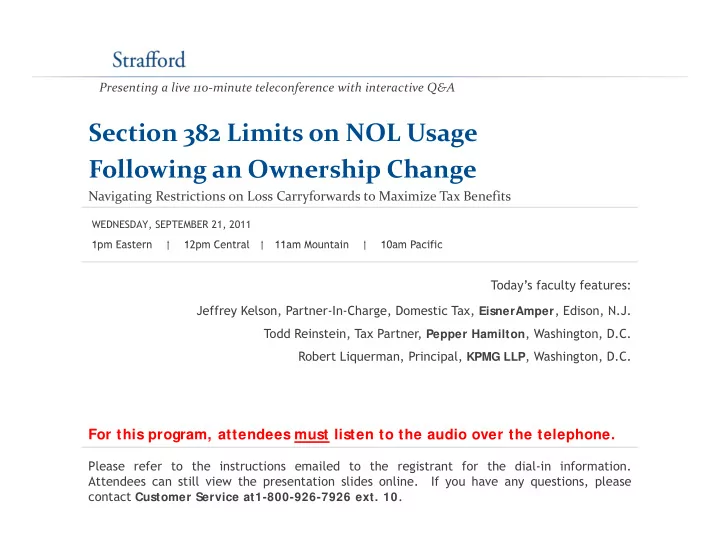
Presenting a live 110 minute teleconference with interactive Q&A Section 382 Limits on NOL Usage Following an Ownership Change Following an Ownership Change Navigating Restrictions on Loss Carryforwards to Maximize Tax Benefits WEDNESDAY,


slide-1
SLIDE 1

Presenting a live 110‐minute teleconference with interactive Q&A

Section 382 Limits on NOL Usage Following an Ownership Change Following an Ownership Change

Navigating Restrictions on Loss Carryforwards to Maximize Tax Benefits

1pm Eastern | 12pm Central | 11am Mountain | 10am Pacific WEDNESDAY, SEPTEMBER 21, 2011

Today’s faculty features:

1pm Eastern | 12pm Central | 11am Mountain | 10am Pacific

Jeffrey Kelson Partner-In-Charge Domestic Tax EisnerAmper Edison N J Jeffrey Kelson, Partner In Charge, Domestic Tax, EisnerAmper, Edison, N.J. Todd Reinstein, Tax Partner, Pepper Hamilton, Washington, D.C. Robert Liquerman, Principal, KPMG LLP, Washington, D.C.

For this program, attendees must listen to the audio over the telephone.

Please refer to the instructions emailed to the registrant for the dial-in information. Attendees can still view the presentation slides online. If you have any questions, please contact Customer Service at1-800-926-7926 ext. 10.

slide-2
SLIDE 2

Conference Materials

If you have not printed the conference materials for this program, please complete the following steps:

  • Click on the + sign next to “Conference Materials” in the middle of the left-

hand column on your screen hand column on your screen.

  • Click on the tab labeled “Handouts” that appears, and there you will see a

PDF of the slides for today's program.

  • Double click on the PDF and a separate page will open.

Double click on the PDF and a separate page will open.

  • Print the slides by clicking on the printer icon.
slide-3
SLIDE 3

Continuing Education Credits

FOR LIVE EVENT ONLY

Attendees must listen to the audio over the telephone. Attendees can still view

the presentation slides online but there is no online audio for this program. Please refer to the instructions emailed to the registrant for additional

  • information. If you have any questions, please contact Customer Service

at 1-800-926-7926 ext. 10. at 1 800 926 7926 ext. 10.

slide-4
SLIDE 4

Tips for Optimal Quality

S d Q lit S

  • und Qualit y

For this program, you must listen via the telephone by dialing 1-866-873-1442 and entering your PIN when prompted. There will be no sound over the web connection. co ect o . If you dialed in and have any difficulties during the call, press *0 for assistance. You may also send us a chat or e-mail sound@

straffordpub.com immediately so

we can address the problem.

Viewing Qualit y

To maximize your screen, press the F11 key on your keyboard. To exit full screen, press the F11 key again press the F11 key again.

slide-5
SLIDE 5

Section 382 Limits on NOL Usage F ll i O hi Ch Following an Ownership Change Seminar

  • Sept. 21, 2011

Robert Liquerman, KPMG

rliquerman@ kpmg.com

Todd Reinstein, Pepper Hamilton

reinsteint@ pepperlaw.com

Jeffrey Kelson, EisnerAmper

jeffrey.kelson@ eisneramper.com

slide-6
SLIDE 6

Today’s Program

What Causes An Ownership Change

[T dd R i t i ]

Slide 7 – Slide 14

[Todd Reinst ein]

Calculating The Limitation

[Robert Liquerman]

Slide 15 – Slide 23 Notice 2003-65 And Built-in Gains

[Jeffrey Kelson]

Notice 2010-50 And Fluctuations In Value Slide 34 – Slide 39 Slide 24 – Slide 33

[Todd Reinst ein]

Notice 2010-49 And Treatment Of Non-5% Shareholders

[Robert Liquerman]

Slide 40 – Slide 45 Investment Advisors

[Jeffrey Kelson]

Slide 46 – Slide 48

slide-7
SLIDE 7

WHAT CAUSES AN

Todd Reinstein, Pepper Hamilton

WHAT CAUSES AN OWNERSHIP CHANGE

slide-8
SLIDE 8

Wh S 8 M Why Sec. 382 Matters

  • Purchase price modeling should account for limits on NOLs.
  • Equity transactions should be monitored to make sure
  • wnership changes do not inadvertently trip Sec. 382.
  • Cumulative annual limitations may be less than the NOL

carryforward. y ― Deferred tax asset

8

slide-9
SLIDE 9

S 8 B i

  • Sec. 382 Basics
  • Limits a “loss corporation”
  • Limits a loss corporation
  • That undergoes an “ownership change”

― An ownership change occurs if immediately after an

  • wner shift or an equity structure shift; the percentage

by value of stock of the loss corporation owned by one or more 5 % shareholders has increased by more than 50 y percentage points over the lowest percentage ownership

  • f such shareholders.
  • During a three-year “testing period”

During a three year testing period

  • From utilizing “pre-change losses” or other tax attributes
  • Against “post-change” income

9

slide-10
SLIDE 10

S 8 D fi i i

  • Sec. 382 Definitions
  • Loss corporation

― NOL, tax credit, capital loss or other attribute carryforward Net unrealized built in loss ― Net unrealized built-in loss

  • 5% shareholders

― Any person holding 5% or more during the testing period

  • Testing period

― Begins on the first day of the tax year in which carryforward begins carryforward begins ― Three-year “rolling” period, unless change occurs ― Shorter period when an ownership change occurs

10

slide-11
SLIDE 11

E i Equity

  • Common stock
  • Common stock
  • Convertible preferred stock
  • Voting preferred stock

11

slide-12
SLIDE 12

N E i Not Equity

  • Plain vanilla preferred stock [Sec 1504(a)(4) stock]
  • Plain vanilla preferred stock [Sec. 1504(a)(4) stock]

― Not entitled to vote ― Not convertible ― Limited and preferred as to dividends ― Does not participate in corporate growth Redemption and liquidation rights do not exceed issue ― Redemption and liquidation rights do not exceed issue price

  • Most stock options

― But, must test under the option attribution rules

  • Debt, including most convertible debt

The convertibility feature creates an option to acquire

12

― The convertibility feature creates an option to acquire stock.

slide-13
SLIDE 13

D t i i % Sh h ld Determining 5% Shareholders

  • Any individual who owns directly or indirectly an amount of the loss corporation

stock that aggregates to a 5% ownership interest by value

  • Include indirect 5% shareholders

― Trying to get to “arms and legs”

A is indirect 5% shareholder of LossCo A sells 30% of X stock to C 24% shift in LossCo (30% multiplied by

A C 30%

( p y 80%) even though shareholder X still

  • wns 80%

80% X B 80%

LossCo

20%

13

slide-14
SLIDE 14

SEC Fil SEC Filers

  • “Reliance” on the existence or absence of Schedules 13D &

13G ― What about Schedule 13F? No obligation to inquire or to determine whether actual facts

  • No obligation to inquire or to determine whether actual facts

are consistent with the ownership ― IRS has moved away from this view in recent PLRs and is now requiring more inquiry.

  • “Actual knowledge” can always be taken into account.
  • Other SEC information:

Other SEC information: ― Forms 3 and 4 ― DEF 14A – Proxy Statement

14

― 10-Qs ― 10-Ks

slide-15
SLIDE 15

CALCULATION THE

Robert Liquerman, KPMG

CALCULATION THE LIMITATION

slide-16
SLIDE 16

A l Li i i Annual Limitation

In general,

Equity value immediately before ownership change (Special adjustments) (Special adjustments) Adjusted equity value x AFR for ownership changes in given month x AFR for ownership changes in given month Basic annual limitation

Direct adjustments to annual Sec. 382 limitation under certain conditions

16

slide-17
SLIDE 17

Determining Value Of Loss Corporation

  • Value of loss corporation is the value of the stock of such

corporation immediately before the ownership change. Sec. 382(e)(1)

  • TAM 200513027

TAM 200513027

  • Taxpayer hired an accounting firm to value P and T in

lieu of using a market capitalization approach.

  • Average high/low trading prices on the ownership

change date (market capitalization)

  • An adjustment for control premium may be appropriate.

An adjustment for control premium may be appropriate.

  • No control premium was added to the market

capitalization approach for acquisition of T .

  • A control premium for the P market capitalization

approach may be appropriate.

17

slide-18
SLIDE 18

S 8 Li i i

  • Sec. 382 Limitation
  • Redemptions or other corporation contractions

[Sec 382(e)(2)] [Sec. 382(e)(2)]

  • Certain capital contributions [Sec. 382(l)(1)]

p [ ( )( )]

  • Extent of non-business assets [Sec. 382(l)(4)]
  • Continuity of business enterprise [Sec. 382(c)]

18

slide-19
SLIDE 19

C i l C ib i Capital Contributions

C it l t ib ti ithi t [S 382(l)(1)]

  • Capital contributions within two years [Sec. 382(l)(1)]
  • Part of a plan a principal purpose of which is to avoid or
  • Part of a plan, a principal purpose of which is to avoid or

increase a Sec. 382 limitation

19

slide-20
SLIDE 20

C i l C ib i (C ) Capital Contributions (Cont.)

  • Received by LossCo within two years of ownership change
  • “Irrebutably” presumed to be part of a plan to increase

LossCo value for computing limitation p g

  • Relief from “irrebutable presumption” under certain

conditions, based on committee reports and private letter rulings

20

slide-21
SLIDE 21

C i l C ib i (C ) Capital Contributions (Cont.)

“Exceptions” to irrebutable presumption

  • Contributions in connection with LossCo formation
  • Contributions prior to LossCo becoming a loss corporation

p g p

  • Working capital expenditures

― Meeting daily operating expenditures If t ib ti i th lt f it li d d bt t i ― If a contribution is the result of capitalized debt, certain PLRs have supported treating debt under the working capital exception, based on (i) debt proceeds used for working capital, (ii) proximity of incurring debt and working capital, (ii) proximity of incurring debt and capitalizing debt, and (iii) intent to convert debt to equity

  • r to raise equity to repay debt.

21

slide-22
SLIDE 22

Capital Contributions (Notice 2008‐78)

  • Turns off the irrebutable presumption of Sec. 382(l)(1)(B)

― Facts-and-circumstances test ― Effective date: Ownership changes in tax years ending on or after Sept. 26, 2008 , ― Safe harbors – A capital contribution will not be considered part of a plan if: ― Made by person that is not a controlling shareholder or related Made by person that is not a controlling shareholder or related party; no more than 20% of the value of the stock issued; no contemplated ownership change transaction; no ownership change within six months ― Made by a related party or other person; no more than 10% of the value of the stock issued; no contemplated ownership change transaction; no ownership change within one year ― Made in exchange for services ― Received on formation or before it becomes a loss corporation

22

slide-23
SLIDE 23

S b i l N B i A Substantial Non‐Business Assets

  • Substantial non-business assets [Sec 382(l)(4)]
  • Substantial non-business assets [Sec. 382(l)(4)]
  • Value of old LossCo is reduced by the value of its non-business

assets (adjusted for their indebtedness), but only if the new LossCo has substantial non-business assets immediately after the ownership change.

  • Substantial non-business assets threshold is met if

Substantial non business assets threshold is met if at least one-third of the value of the total assets of the new LossCo are non-business assets.

  • Berry Pet roleum
  • Notice 2008-78: No double-reduction under Sec. 382(l)(1) and
  • Sec. 382(l)(4)
  • Sec. 382(l)(4)

23

slide-24
SLIDE 24

NOTICE 2003 65 AND BUILT IN

Jeffrey Kelson, EisnerAmper

NOTICE 2003‐65 AND BUILT‐IN GAINS

slide-25
SLIDE 25

O h Si ifi Adj Other Significant Adjustments

NUBIG/RBIG

  • NUBIG/RBIG
  • NUBIL/RBIL
  • NUBIL/RBIL

25

slide-26
SLIDE 26

B il I G i /L Built‐In Gains/Losses

  • After ownership change
  • Must determine whether it has net unrealized built-in gain

(NUBIG) or net unrealized built-in-loss (NUBIL) (NU G) o et u eal ed bu lt loss (NU )

  • Stand-alone loss corporation either has NUBIG or NUBIL, but

not both. Th h ld t

  • Threshold amount
  • $10 Million or, if less than $10 Million, 15% of the value of the

assets

26

slide-27
SLIDE 27

B il I G i /L (C ) Built‐In Gains/Losses (Cont.)

  • FMV of assets minus tax basis = NUBIG/NUBIL (subject to de

minimis rules) s ules)

Recognition period

  • Recognized built-in losses (RBILs) or recognized built-in gains

(RBIGs) during the five-year recognition, period beginning on the change date

27

slide-28
SLIDE 28

I Of RBIG /RBIL Impact Of RBIGs/RBILs

  • Increase or decrease Annual 382 Limit for recognition period

(beyond, in certain cases)

  • If NUBIG-RBILs are ignored

NU G s a e g o ed If NUBIL-RBIGs are ignored Different than S corporation treatment

  • Items of income and items of deduction are treated as RBIGs
  • r RBILs if the item is “properly taken into account during the

recognition period” and is attributable to periods before the change date.

  • Deduction items: Depreciation, amortization
  • Income items: Sec 481 adjustments COD income
  • Income items: Sec. 481 adjustments, COD income

28

slide-29
SLIDE 29

Oth I t Of B ilt i G i Other Impacts Of Built‐in Gains

  • AMT taxpayers need to take into account NUBIL rules in

calculating ACE.

  • Pre-paid income is not RBIG; any amounts received prior to

Pre paid income is not RBIG; any amounts received prior to change date that are attributable to performance occurring on

  • r after change - final regulations.
  • Planning: Reduce NUBIL (built-in income items)
  • Sec. 384

Appraisals

  • Appraisals

29

slide-30
SLIDE 30

N i 6 Notice 2003‐65

  • Much confusion regarding calculating NUBIL/RBIL, NUBIG/RBIG
  • IRS issued notice as stopgap and safe harbor.
  • Notice is effective until temporary or final regulations are issued
  • Notice is effective until temporary or final regulations are issued.
  • Adopt one of two possible alternatives in determining RBIGs/RBILs

338 approach: RBIGs take into account “deemed” amortization and depreciation deduction, based on a deemed 338 election.

  • Best for NUBIGs

Sec 1374 approach

  • Sec. 1374 approach

COD and bad debts reduced to 12-month recognition period

  • Best for NUBILs

30

slide-31
SLIDE 31

N i 6 E l Notice 2003‐65: Example

  • Hypothetical Sec. 338 purchase of the company

under IRS Notice 2003-65

― Company value $1,820 p y $ , ― Company liabilities $600 ― Hypothetical ADSP $2,420 E t t b i i t $2 270 ― Est. tax basis in assets $2,270 ― NUBIG $150

31

slide-32
SLIDE 32

N i 6 E l (C ) Notice 2003‐65: Example (Cont.)

H th ti l S 338 h f th d IRS

  • Hypothetical Sec. 338 purchase of the company under IRS

Notice 2003-65 (Cont.) ― NUBIG (from prior slide): $150 ( p ) $ ― RBIG attributable to Asset 1: $30 ― RBIG attributable to goodwill: $120 ― Hypothetical amortization on goodwill ― RBIG attributable to goodwill: $120 ― Amortization period: 15 years ― Hypothetical amortization: $8 per year

32

slide-33
SLIDE 33

N i 6 E l (C ) Notice 2003‐65: Example (Cont.)

Adjustments to Section 382 Limitation in 5 Year Recognition Period

Year 1 Year 2 Year 3 Year 4 Year 5 Year 6

Gain on Disposition of Asset 1

  • 30
  • Hypothetical Amortization (5 years)

8 8 8 8 8

  • T t l R

i d B ilt I G i

8 38 8 8 8

Total Recognized Built-In Gain

8 38 8 8 8

PLUS: Annual NOL Limitation

81 81 81 81 81 81

EQUALS: Adjusted Limitation

89 119 89 89 89 81

j

33

slide-34
SLIDE 34

NOTICE 2010 50 AND

Todd Reinstein, Pepper Hamilton

NOTICE 2010‐50 AND FLUCTUATIONS IN VALUE

slide-35
SLIDE 35

M i Shif Measuring Shifts

  • The determination of the percentage of stock owned by a

The determination of the percentage of stock owned by a person shall be made on the basis of the relat ive fair market

value of the stock owned by such person to the total fair

market value of the corporation’s outstanding stock market value of the corporation s outstanding stock.

35

slide-36
SLIDE 36

Fl i I V l Fluctuations In Value

  • Any change in proportionate ownership that is attributable

solely to fluctuations in relative FMV of different classes of stock is not taken into account [Sec. 382(l)(3)(C)]

36

slide-37
SLIDE 37

Fl i I V l E l Fluctuations In Value: Example

A

P f $20 ( t 1504) C $80

B C

Year 2 common sale $5 At LossCo formation A has 20% of FMV and B has 80% FMV Pref $20 (not 1504) Common $80

LossCo

At LossCo formation, A has 20% of FMV and B has 80% FMV. Year 1: LossCo has NOL Year 2: LossCo overall value drops to $25; A still has 80% of FMV, and B drops to 20% FMV Year 2: B sells all LossCo stock to unrelated C for $5 Is the sale treated as an 80% shift [A increases from 20% to 80% (60% difference) + C increases from 0% to 20% (20% difference)]? Or

37

difference) + C increases from 0% to 20% (20% difference)]? Or, Is the sale treated as a 20% shift (C’s increase to 20%)?

slide-38
SLIDE 38

N i Notice 2010‐50

  • Issued June 11, 2010
  • Full-value methodology

― Mark-to-market shares H ld i i l

  • Hold-constant principle

― The equity shift is calculated by factoring out fluctuations in the relative values of classes. ― Alternative 1 ― Look-back method Al i 2 b li d i ― Alternative 2 can be applied in two separate ways: ― Proportionate reduction method ― Purchase reduction method

38

slide-39
SLIDE 39

Issues To Resolve Under Notice 2010‐50

  • Designation of 5% percent shareholders (FMV% or HCP%)
  • Issuances and redemptions could have different results under

all three.

  • Application to small and cash-issuance exceptions
  • Applies to closed years

― Can’t change tax liability

39

slide-40
SLIDE 40

NOTICE 2010 49 AND

Robert Liquerman, KPMG

NOTICE 2010‐49 AND TREATMENT OF NON‐5% SHAREHOLDERS

slide-41
SLIDE 41

N i S Notice 2010‐49: Summary

  • IRS invites comments relating to potential modifications to

the treatment of “small shareholders,” for Sec. 382 purposes ― “Small shareholders” are defined as those who are not 5% shareholders (very generally, shareholders that do not own directly or indirectly 5% or more of the loss corporation).

  • The notice sets forth two approaches to the proper treatment
  • f small shareholders, both of which recognize that one of the

primary abuses Sec. 382 seeks to prevent is the acquisition of l ti t k f ll d b t ib ti f i loss corporation stock, followed by contribution of income- producing assets or diversion of income-producing

  • pportunities.

41

slide-42
SLIDE 42

N i T A h Notice 2010‐49: Two Approaches

  • Ownership tracking approach

p g pp ― Approach primarily taken by the current regulations ― Public tracking exception: Temp. Treasury Reg. 1.382-2T(e)(1)(ii) ― It is generally of no significance whether the shareholders who increase their ownership (to count toward the 50% threshold) are small or 5% shareholders, when they purchase from a 5% shareholder. ― For example, if a 5% shareholder sells stock to small shareholders, such small shareholders are segregated into a separate public group, resulting in a shift in ownership counted toward the 50% threshold

  • Temp. Treasury Reg. 1.352-2T(j)(3)

p y g (j)( )

42

slide-43
SLIDE 43

Notice 2010‐49: Two Approaches (Cont.)

  • Ownership tracking approach

Public Group

4% L Stock

Public Public Group 2

  • Mr. A

$ 20% 80%

L

43

slide-44
SLIDE 44

Notice 2010‐49: Two Approaches (Cont.)

  • Purposive approach

Purposive approach ― Seeks to indentify more specifically the circumstances in which abuses of Sec. 382’s underlying purpose are likely to i arise ― Reflects the view that it is unnecessary to take into account all acquisitions of stock by small shareholders, q y , because they generally are not in a position to abuse Sec. 382 by acquiring loss corporation stock and then contributing income-producing assets (or diverting contributing income producing assets (or diverting income-producing opportunities) ― Typically would result in fewer owner shifts, because hif b i many shifts are not abusive

44

slide-45
SLIDE 45

Notice 2010‐49: Two Approaches (Cont.)

  • Original public group (OPG) owns 100% of LossCo (L).

― New investor 1 (NI1) buys 10% of L stock and sells to small shareholders.

C t bli 1 (NPG1) ― Creates new public group 1 (NPG1)

― New investor 2 (NI2) buys 10% of L stock and then sells to small shareholders.

Purchase deemed made from OPG and NPG1 ― Purchase deemed made from OPG and NPG1 ― Creates NPG2

― New investor 3 (NI3) buys 10% of L stock and then sells to small shareholders shareholders.

― Purchase deemed made from OPG, NPG1 and NPG2

― Ownership tracking approach: 27.1% shift Purpose approach: 10% or possibly 0% shift ― Purpose approach: 10%, or possibly 0%, shift

45

slide-46
SLIDE 46

INVESTMENT ADVISORS

Jeffrey Kelson, EisnerAmper

INVESTMENT ADVISORS

slide-47
SLIDE 47

I Ad i Investment Advisors

  • Investment advisors may not count at 5% shareholders.

― PLRs distinguish between a person who has the right to the dividends and proceeds from the sale of a loss corporation’s t k (th “ i ”) d th i t t d i stock (the “economic owner”); and the investment advisor, who holds the power to vote and/or dispose of such stock (the “reporting owner”). Right to dividends ― Right to dividends ― Right to proceeds upon the sale of stock ― PLR 9533024, PLR 9725039, PLR 200806008 and PLR 200902007 200902007 ― If not a separate 5% shareholder, the stock is treated as held by the public group

47

slide-48
SLIDE 48

I Ad i (C ) Investment Advisors (Cont.)

PLR 200747016 provides guidance on how to interpret information

  • n Schedules 13D and 13G.
  • SEC filers who do not provide additional information and

SEC filers who do not provide additional information, and taxpayer has no actual knowledge

  • SEC filers who provide additional information
  • SEC filers who do not provide additional information, but

taxpayer has actual knowledge PLR20110006

  • PLR20110006
  • Actual knowledge
  • Not obligated to pursue for all shareholders
  • Not obligated to pursue for all shareholders

48