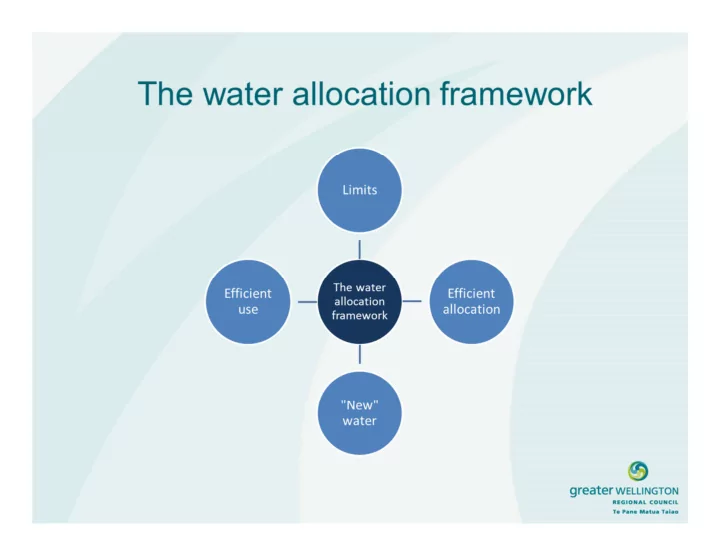
Limits (the size of the pie) allocation limits minimum - - PowerPoint PPT Presentation
Limits (the size of the pie) allocation limits minimum reliability flow of supply Limits Implement climate minimum change flows multiple bands/ blocks Multiple bands/block How and where to set the limits? Reliability of supply
Limits
(the size of the pie)
Limits
allocation limits reliability
- f supply
climate change
multiple bands/ blocks Implement minimum flows
minimum flow
Multiple bands/block
How and where to set the limits?
Minimum Flows Allocation Limit Reliability
- f supply
Minimum flows
Actual minimum flow
Allocation limit
Reliability of supply
Water available for 9 days Water not available for 20 days
0% 20% 40% 60% 80% 100% 120% 140% 160%
Minimum flow as % of 7dMALF
Lower Ruamahanga River
- Minimum flow 8.5
m3/s at Waihenga
- Instream values and
IFIM studies in 2007
- Adult brown trout
identified as primary flow value
- 90% habitat retention
level selected. DO and water temp considered as well as boating and fish passage
Mangatarere River
- Minimum flow 0.24
(upper) and 0.20 m3/s (lower)
- IFIM & WAIORA late
- 1990s. CAP 2003
- Trout habitat &
spawning an important feature
- Dilution of CDC
discharge also considered
Papawai Stream
- Minimum flow 0.160 m3/s
- Issues and flow
assessment in 2008
- Objectives: longfin eels,
DO levels, swimming
Lower Ruamahanga
- Existing average reliability = 93%
- Min Flow 50%, Reliability 10%
0% 20% 40% 60% 80% 100% 120% 1990 1995 2000 2005 2010 2015 Reliability during summer
Lower Ruamahanga River - Reliability of supply
% Existing Minimum Flow (8.5) 0% 20% 40% 60% 80% 100% 120% 1990 1995 2000 2005 2010 2015 Reliability during summer
Lower Ruamahanga River - Reliability of supply
% Existing Minimum Flow (8.5) % Min Flow 50% higher (12.5)
10 Feb 2015 ~12 cumecs 08 March 2015 ~50 cumecs 19 Feb 2015 ~4 cumecs 07 March 2015 ~3.2 cumecs
How do outcomes change with different combinations of limits?
Testing limit scenarios
Objective 1a. Loss of long fin eel habitat is <15% of that available at MALF
Minimum Flow (% of MALF) Habitat Change (%) Allocation Limit (% of MALF)
Testing limit scenarios
Objective 1b. Loss of torrent fish habitat is <15% of that available at MALF
Minimum Flow (% of MALF) Allocation Limit (% of MALF) Habitat Change (%)
Testing limit scenarios
Objective 2. Reliability of full supply of >90%
Minimum Flow (% of MALF) Reliability
- f
Supply (%) Allocation Limit (% of MALF)
Testing limit scenarios
Objective 3. Reliability of partial supply of >95%
Minimum Flow (% of MALF) Reliability
- f
Supply (%) Allocation Limit (% of MALF)
Testing limit scenarios
Allocation efficiency
(the framework – dividing up the pie)
How is water allocated when it becomes available
- n common expiry dates for resource consents
No water available to new users when resource consents expire because:
- existing users can retain their water
- the sinking lid
Current water availability at full allocation
The maximum amount of water available for allocation (core allocation) shall not exceed whichever is the greater of:
- The total amount allocated by resource consents
- The limit identified in the Plan
Potential policy direction
When considering an application [for renewal of resource consent] … a consent authority must have regard to the value of the investment of the existing consent holder (RMA s104 (2A))
How will the Committee address allocation on expiry of resource consents?
- Potential allocation approaches:
- status quo
- market e.g. auction, tender
- administrative e.g. priority allocation system,
user groups, ballot, transfer
- Equity vs existing investment?