
110311 Bibliotheca Alexandrina Compiled by: Claudia Nessim & Salsabeel Kassem
Noël Coward
(1899 – 1973)
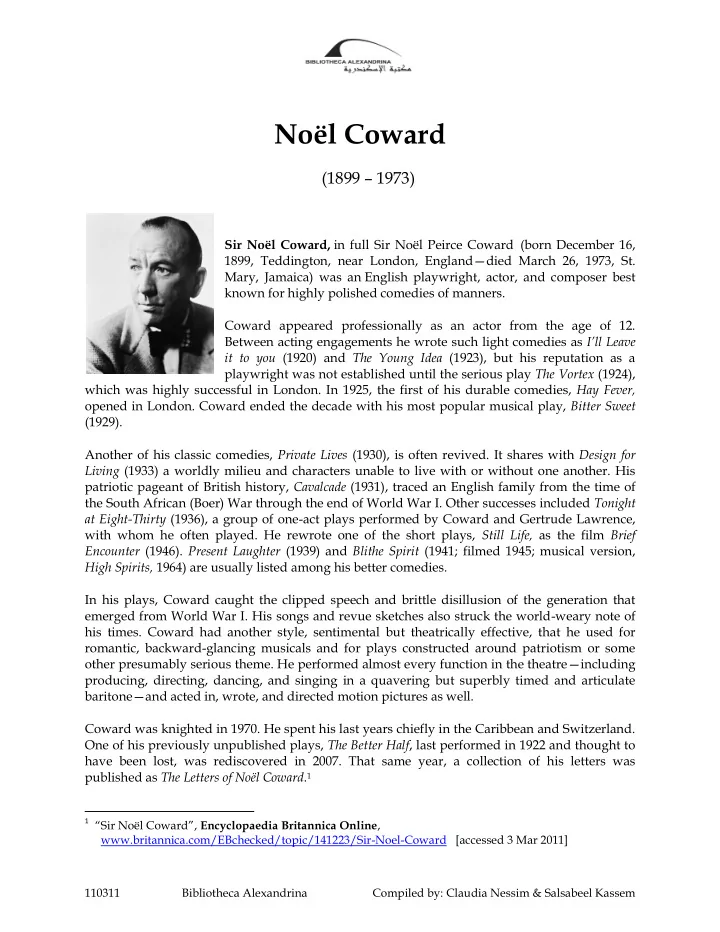
Sir Noël Coward, in full Sir Noël Peirce Coward (born December 16, 1899, Teddington, near London, England—died March 26, 1973, St. Mary, Jamaica) was an English playwright, actor, and composer best known for highly polished comedies of manners. Coward appeared professionally as an actor from the age of 12. Between acting engagements he wrote such light comedies as I’ll Leave it to you (1920) and The Young Idea (1923), but his reputation as a playwright was not established until the serious play The Vortex (1924), which was highly successful in London. In 1925, the first of his durable comedies, Hay Fever,
- pened in London. Coward ended the decade with his most popular musical play, Bitter Sweet
(1929). Another of his classic comedies, Private Lives (1930), is often revived. It shares with Design for Living (1933) a worldly milieu and characters unable to live with or without one another. His patriotic pageant of British history, Cavalcade (1931), traced an English family from the time of the South African (Boer) War through the end of World War I. Other successes included Tonight at Eight-Thirty (1936), a group of one-act plays performed by Coward and Gertrude Lawrence, with whom he often played. He rewrote one of the short plays, Still Life, as the film Brief Encounter (1946). Present Laughter (1939) and Blithe Spirit (1941; filmed 1945; musical version, High Spirits, 1964) are usually listed among his better comedies. In his plays, Coward caught the clipped speech and brittle disillusion of the generation that emerged from World War I. His songs and revue sketches also struck the world-weary note of his times. Coward had another style, sentimental but theatrically effective, that he used for romantic, backward-glancing musicals and for plays constructed around patriotism or some
- ther presumably serious theme. He performed almost every function in the theatre—including
producing, directing, dancing, and singing in a quavering but superbly timed and articulate baritone—and acted in, wrote, and directed motion pictures as well. Coward was knighted in 1970. He spent his last years chiefly in the Caribbean and Switzerland. One of his previously unpublished plays, The Better Half, last performed in 1922 and thought to have been lost, was rediscovered in 2007. That same year, a collection of his letters was published as The Letters of Noël Coward.1
1 “Sir Noël Coward”, Encyclopaedia Britannica Online,
www.britannica.com/EBchecked/topic/141223/Sir-Noel-Coward [accessed 3 Mar 2011]