Encouraging Effective Contract Specifications Todd Schiller , Kellen - - PowerPoint PPT Presentation

encouraging effective contract specifications
SMART_READER_LITE
LIVE PREVIEW

Encouraging Effective Contract Specifications Todd Schiller , Kellen - - PowerPoint PPT Presentation

Contract.Requires (amount > 0.0); Contract.Ensures (Balance == Contract.OldValue (Balance) + amount); Contract.Invariant (Balance > 0.0); Encouraging Effective Contract Specifications Todd Schiller , Kellen Donohue, Forrest Coward, Michael


slide-1
SLIDE 1

Encouraging Effective Contract Specifications

Todd Schiller, Kellen Donohue, Forrest Coward, Michael Ernst University of Washington

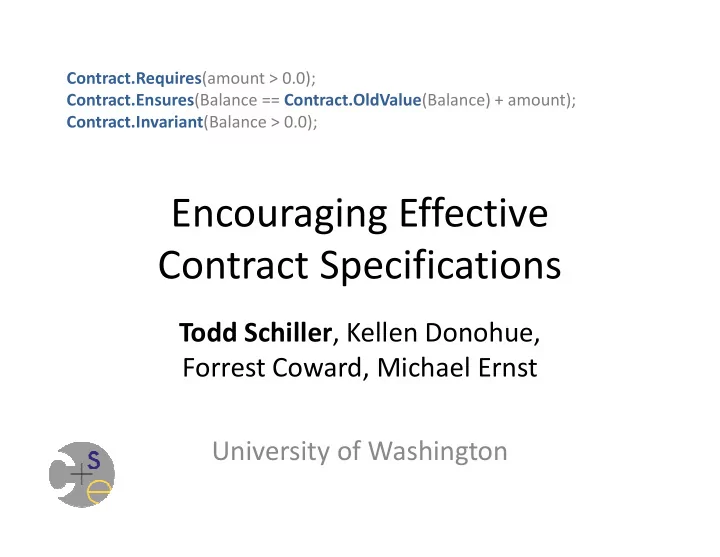
Contract.Requires(amount > 0.0); Contract.Ensures(Balance == Contract.OldValue(Balance) + amount); Contract.Invariant(Balance > 0.0);

slide-2
SLIDE 2

Microsoft Code Contracts

public class BankAccount { public void Deposit(decimal amount){ Contract.Requires(amount > 0.0); Contract.Ensures(Balance == Contract.OldValue(Balance) + amount); . . . } . . . }

2

  • C# Syntax and Typing
  • Run-time Checking
  • Static Checking

Precondition Postcondition

slide-3
SLIDE 3

What contracts do developers write? What contracts could developers write? How do developers react when they are shown the difference? How can we use this information to make developers more effective?

3

slide-4
SLIDE 4

Developers use contracts ineffectively

  • Most contracts check for

missing values, e.g. != null

  • Miss aspects of program

behavior

  • Don’t (effectively) use

powerful features, e.g.,

  • bject invariants

4

Introduce tooling to reduce annotation burden Make suggestions key part

  • f tool ecosystem

Curate best practices. It’s OK to be normative

slide-5
SLIDE 5

5

Contracts as Functional Specifications Contracts as Assertions

Goal: Move Developers Toward Using Contracts as Specifications

  • What program should do
  • Object Invariants
  • Contracts on Interfaces
  • Assumption Violations
slide-6
SLIDE 6

Effective Contracts Have Many Benefits

6

Development

  • Static Checking

[Fahndrich10]

  • Refactoring

[Cousot12]

Design

  • Design by Contract

[Meyer86]

Testing

  • Test Generation

[Barnett09]

  • Runtime Checking

Debugging

  • Runtime Checking
  • Fault Localization

Maintenance

  • Refactoring
  • Documentation
slide-7
SLIDE 7

Talk Outline

  • 1. The contracts that developers write
  • 2. The contracts that developers could write
  • 3. How developers react when shown the

difference

7

slide-8
SLIDE 8

Most Contracts Just Check for Missing Values

8

Written Contracts Missing-Value Checks

  • Subjects: The 90 C#

projects with Code Contracts on Ohloh

  • Missing-Value: Null,

Empty String, Empty Collection

slide-9
SLIDE 9

Many Postconditions are Trivially Redundant with the Code

  • 25% of contracts are

postconditions

  • 15% of postconditions

specify:

– The value a method returns – The value a property is set to

9

Missing-Value Checks Redundant with Code Written Postconditions

slide-10
SLIDE 10

Smart Defaults Reduce Annotation Burden

Nullness: Checker Framework [Papi08] for Java assumes parameters and return values are non-null

10

Tool Annotations per 1K LOC Checker Framework w/ Defaults 1-2 annos. Code Contracts 2-5 annos.

Awkward to override restrictions using Contracts: x != null || x == null

Defaults cut # of annotations needed in half

slide-11
SLIDE 11

Microsoft Code Contracts

public class BankAccount { public void Deposit(decimal amount){ Contract.Requires(amount > 0.0); Contract.Ensures(Balance == Contract.OldValue(Balance) + amount); . . . } . . . }

11

  • C# Syntax and Typing
  • Run-time Checking
  • Static Checking
slide-12
SLIDE 12

Why Don’t Developers Use Functional Specifications? They are Expensive

  • Verbose, especially involving return / pre-state

expressions

– Contract.Result<IEnumerable<TEdge>>()

  • High runtime cost

– Contract.ForAll(collection, elt => elt > 0)

  • No static checking

– dictionary[key] < array.Length

12

slide-13
SLIDE 13

Talk Outline

  • 1. The contracts that developers write
  • 2. The contracts that developers could write
  • 3. How developers react when shown the

difference

13

slide-14
SLIDE 14

Inferring Contracts From Runtime Traces with Daikon

Value Trace Contracts Daikon

14

Celeriac: code.google.com/p/daikon-dot-net-front-end

.NET Binary Celeriac Instrumented Binary

Introduced in our paper

Run

[Ernst99]

+ Celeriac

slide-15
SLIDE 15

There’s a Gap Between Written Contracts and Program Behavior

15

Written Contracts Inferred Contracts Functional Specifications Good candidates for smart defaults

slide-16
SLIDE 16

Developer-Written Contracts Miss Aspects of Program Behavior

Object State:

  • this.IsUsable == (this.Reader.GetRefCount != 0)

Relations:

  • this.programElement.ColumnNumber >= 0

State update:

  • this.Reader.GetRefCount() >=

Contract.OldValue(this.Reader.GetRefCount())

16

slide-17
SLIDE 17

Talk Outline

  • 1. The contracts that developers write
  • 2. The contracts that developers could write
  • 3. How developers react when shown the

difference

17

slide-18
SLIDE 18

Case Study Research Question

How do developers decide which contracts to add if contracts can be added with a single click?

18

slide-19
SLIDE 19

Case Study Methodology

Subjects: two developers and their projects

  • Sando Code Search: document indexer component
  • Mishra RSS Reader: model component

Existing Contracts:

  • 28 contracts across 482 methods
  • All but 3 were checks for missing values

Task: Developer used interface to insert inferred contracts

19

slide-20
SLIDE 20

20

slide-21
SLIDE 21

Case Study Research Question

How do developers decide which contracts to add if contracts can be added with a single click?

21

slide-22
SLIDE 22

Differing Viewpoints to Inserting Contracts

  • Sando: in favor of automatically inserting all

contracts above some confidence threshold

  • Mishra Reader: chose not to insert many valid

contracts

– Avoiding code bloat – Fear of runtime overhead – Belief that contracts should only be written at module boundaries (public methods)

22

slide-23
SLIDE 23

Suggestions are Beneficial (Up to a Point)

  • Tool suggested types of contracts developers

would not have thought of

– e.g.: Contract.ForAll(collection, elt => elt > 0)

  • Not a perfect substitute for training

– Sando developer, unaware of object invariant and interface contracts, overlooked tool’s suggestions

23

slide-24
SLIDE 24

Training Affects How Contracts Are Used

Opportunities to train developers via the tooling itself

  • Identifying features that developer is under-

utilizing

  • Can supplement sound static-checker inference

with more expressive inference

24

Contracts as Functional Specifications Contracts as Assertions

slide-25
SLIDE 25

UI Grouping Schemes to Encourage Functional Specifications

25

FieldX: PropertyX: Nullness: Comparison: Always: PropertyX: this.PropertyX > 3: FieldX: By variable By kind By antecedent / var Always: Nullness: this.PropertyX > 3: Nullness: Comparison: By antecedent / kind ① (this.PropertyX > 3) implies (this.FieldX != null) ① ① ① ①

Led developers to discover kinds of contracts they had not considered before Grouping by condition did not help the developers reason about implications

slide-26
SLIDE 26

Related Work

  • Contracts in the Wild:

– Chalin06: Eiffel programs have a lower proportion of non-null checks, higher proportion of postconditions – Estler14: Eiffel, JML, and C# contracts are stable over time; preconditions are larger than postconditions

  • Human Factors:

– Polikarpova09: Daikon finds contracts that developers missed – Johnson13: false positives and inadequate presentation prevent uptake of static analysis tools

26

slide-27
SLIDE 27

Conclusion: Both Tooling and Training are Required for Usability

  • Most check missing values,

e.g. != null

  • Miss aspects of program

behavior

  • Don’t (effectively) use

powerful features, e.g.,

  • bject invariants

27

Introduce tooling to reduce annotation burden Make suggestions key part

  • f tool ecosystem

Curate best practices. It’s OK to be normative Tools and Data: http://bit.ly/code-contracts

slide-28
SLIDE 28

28

slide-29
SLIDE 29

29

Increased build time is a big problem!

The visual studio editor extension is buggy […] Seeing contracts easily from the call site would be a huge factor in convincing less enthusiastic developers about the benefits. I am not yet totally convinced that [Code Contracts] are ready for prime-time [The static checker is] too slow, complicated and not expressive enough. Annotations are too heavy especially the Result/Old syntax is horrid.

Lifecycle Not Ideal in Practice

slide-30
SLIDE 30

Subject Projects

30

Subject Program Domain Code Contract Use Other Quality Tools Used Labs Framework (11K SLOC) API exploration framework Static checking StyleCop Mishra Reader (19K SLOC) RSS reader Debugging concurrent code Jetbrains R# Sando (24K SLOC) Code search Early runtime error detection Quick Graph (32K SLOC) Algorithms and data structures Pex / Testing Pex

slide-31
SLIDE 31

Contract Inserter Interface

Four possible actions:

– Add as contract – Add as documentation – Mark as false – Ignore as implementation detail

31

slide-32
SLIDE 32

Null-checks Can be Expressive

public ComplicatedType Foo(. . .){ Contract.Ensures(Contract.Result<ComplicatedType>() != null); . . . }

32

Types + Contracts Guarantee:

  • Methods Signatures + Method Contracts
  • Object Invariants
slide-33
SLIDE 33

Tool Information

Celeriac: Contract Inference via Runtime Tracing https://code.google.com/p/daikon-dot-net-front-end Contract Inserter: Visual Studio Add-in https://bitbucket.org/fmc3/scout

33

slide-34
SLIDE 34

Type-State Example: Degenerate Behavior Encoding

public class Subscription{ public SubscriptionsList SubscriptionsList { get; private set; } public void AddItem(Item item) { Contract.Requires(SubscriptionsList != null, "Call Initialize first"); . . . } [InvariantMethod] public void ObjectInvariant(){ . . . } }

34

Can’t write an invariant All contracts use != null

slide-35
SLIDE 35

Type-State Example: Application- Specific Property Encoding

public class Subscription { public SubscriptionsList SubscriptionsList { get; private set; } public boolean IsInitialized { get; private set; } public void AddItem(Item item) { Contract.Requires(IsInitialized, "Call Initialize first"); . . . } [InvariantMethod] public void ObjectInvariant(){ Contract.Invariant(!IsInitialized || SubscriptionsList != null); . . . } }

35

Implications can be tricky for multiple states

slide-36
SLIDE 36

Mishra Reader: Concurrent Debugging via Nullness Checks

Model subcomponent (of MVC architecture) contained just 11 contracts across 80 classes and 360 methods:

  • 10 argument non-null preconditions
  • 1 invariant: UnreadCount >= 0

36

slide-37
SLIDE 37

Pattern Example: Encoding Type-State with Contracts

Basic Idea:

  • Expose Properties indicating state, e.g., IsOpen
  • Contracts contain implications based on state
  • Postconditions encode transitions

Observation: only see this pattern in projects that use the static checker

37

slide-38
SLIDE 38

Case Study: Mishra News Reader

Lead developer introduced Contracts to help debug concurrent code

38

slide-39
SLIDE 39

Mishra Reader: Concurrent Debugging via Nullness Checks

Model subcomponent (of MVC architecture) contained just 11 contracts across 80 classes and 360 methods:

  • 10 argument non-null preconditions
  • 1 invariant: UnreadCount >= 0

39

slide-40
SLIDE 40

Case Study: Sando

Introduced Code Contracts after major contributor saw a webinar

40

slide-41
SLIDE 41

Sando: Used Contracts like Assertions

Indexer component contained 17 contracts across 34 classes and 182 methods:

  • 12 non-null checks
  • 4 non-empty checks
  • 1 implication:

41

!criteria.SearchByUsageType || criteria.UsageTypes.Count > 0