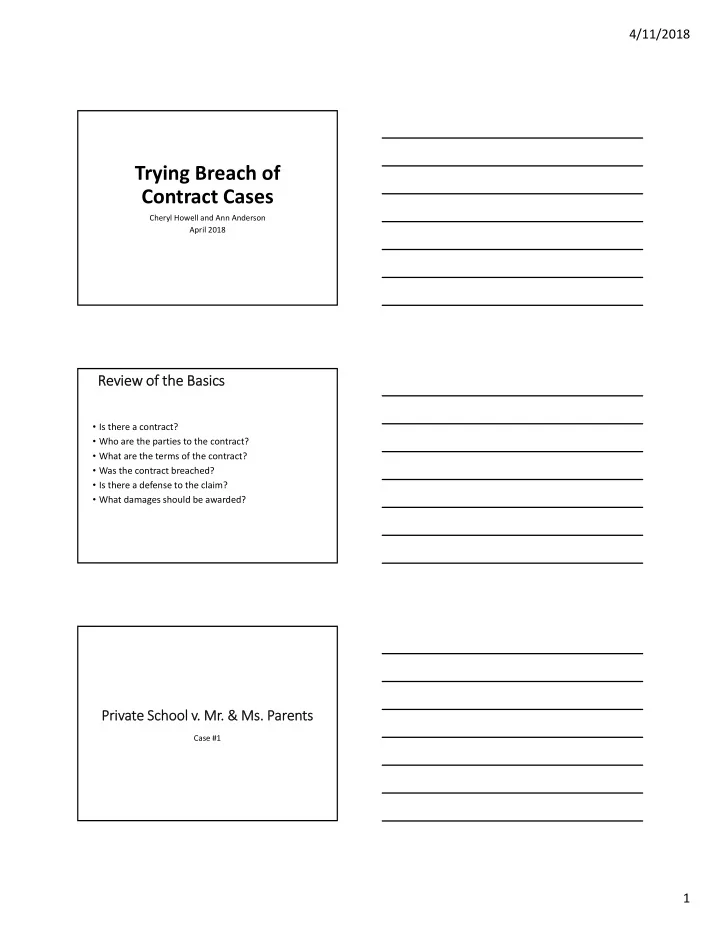
Trying Breach of Contract Cases Cheryl Howell and Ann Anderson April - - PDF document

trying breach of contract cases
SMART_READER_LITE
LIVE PREVIEW

Trying Breach of Contract Cases Cheryl Howell and Ann Anderson April - - PDF document

4/11/2018 Trying Breach of Contract Cases Cheryl Howell and Ann Anderson April 2018 Re Review of of th the Basic Basics Is there a contract? Who are the parties to the contract? What are the terms of the contract? Was the contract


slide-1
SLIDE 1

4/11/2018 1

Trying Breach of Contract Cases

Cheryl Howell and Ann Anderson April 2018

Re Review of

  • f th

the Basic Basics

  • Is there a contract?
  • Who are the parties to the contract?
  • What are the terms of the contract?
  • Was the contract breached?
  • Is there a defense to the claim?
  • What damages should be awarded?

Pr Private ate School hool v.

  • v. Mr
  • Mr. & Ms
  • Ms. Pa

Parents

Case #1

slide-2
SLIDE 2

4/11/2018 2

Mo Moti tion

  • n to

to Di Dism smiss iss Mo Moti tion

  • n fo

for Judgm udgment on

  • n Pleadi

eading ngs Motions Motions to to Di Dism smis iss – 12(b 12(b)

(1) Lack of subject matter jurisdiction (2) Lack of personal jurisdiction (3) Improper venue (4) Insufficiency of process (5) Insufficiency of service of process (6) Failure to state a claim upon which relief can be granted. (7) Failure to join a necessary party.

12(b 12(b)(6) (6)

  • Only tests whether complaint states a

claim “upon which relief can be granted”

  • Assumes allegations of complaint are true;

does not look beyond complaint (and incorporated attachments)

Motion to Dismiss for Failure to State a Claim (12(b)(6))

slide-3
SLIDE 3

4/11/2018 3 12(b 12(b)(6) (6)

  • Only tests whether complaint states a

claim “upon which relief can be granted”

  • Assumes allegations of complaint are true;

does not look beyond complaint (and incorporated attachments)

Motion to Dismiss for Failure to State a Claim (12(b)(6))

Narrow exception: Court may consider an unattached copy of an “instrument [contract] upon which plaintiffs are suing” if referenced in the

  • complaint. ‐Coley, 41 N.C. App. 121 (1979); Oberlin, 147 N.C.
  • App. 52 (2001).

12(b 12(b)(6) (6) and and 12(c) 12(c)

  • Only tests whether complaint states a

claim “upon which relief can be granted”

  • Assumes allegations of complaint are true;

does not look beyond complaint (and incorporated attachments)

Motion to Dismiss for Failure to State a Claim (12(b)(6))

  • Like 12(b)(6), but after

pleadings are closed. So court considers all the pleadings, not just the complaint.

Motion for judgment “on the pleadings” (12(c))

El Elem emen ents ts fo for Br Breac each of

  • f Con

Contract ct Claim Claim

  • Existence of a valid contract with defendants, and
  • Material breach of the contract
slide-4
SLIDE 4

4/11/2018 4

Plain Plaintif iff’s br breach each a de defense? e?

  • “The general rule is that if either party to a bilateral

contract commits a material breach of the contract, the non‐breaching party is excused from the obligation to perform further.”

  • Lake Mary Ltd. Part. v. Johnston, 145 N.C. App. 525 (2001)
  • However, the failure to perform an independent

promise does not excuse nonperformance on the part of the other party.

  • Id., Coleman v. Shirlen, 53 N.C. App. 573 (1981)

To To ex excuse br breach… each………

  • Plaintiff’s breach must be:
  • A material breach
  • Of a term that was dependent on the term breached by

defendant

Ma Material rial br breach each

  • One that “substantially defeat[s] the purpose of the

contract or [can] be characterized as a substantial failure to perform.”

  • Long v. Long, 160 NC App 664 (2003)
  • Breach must “go to the very heart of the agreement”
  • Fletcher v. Fletcher, 123 NC App 744 (1996)
  • A breach of a term “that is essential to the transaction,

that is, a term which, if omitted or modified, would cause one of the parties to withhold consent or to bargain for a substantially different term.”

  • N.C.P.I.‐Civil 502.00
slide-5
SLIDE 5

4/11/2018 5

N. N.C.P C.P.I.

  • I. – C

– Civil 502 502.00 00.

  • “In determining whether a term is material, you may

consider the following factors:

  • The subject matter and purpose of the contract;
  • The intentions of the parties;
  • The scope of performance reasonably expected by each

party;

  • The prior dealings of the parties;
  • Any custom, practice or usage so commonly known to other

reasonable persons, in similar situations, that the parties knew or should have known of its existence; and

  • Any other factors established by the evidence.”

Pr Private ate Schoo School vs

  • vs. Mr
  • Mr. And

And Ms

  • Ms. Pa

Parents

  • Material term??
  • Class size no more than

20

  • Actual class size 23

Interdep epend endent te terms

  • “Whether covenants are dependent or independent, and

whether they are concurrent on the one hand or precedent and subsequent on the other, depends entirely upon the intention

  • f the parties shown by the entire contract as construed in the

light of the circumstances of the case, the nature of the contract, the relation of the parties thereto, and other evidence which is admissible to aid the court in determining the intention

  • f the parties.”
  • Harris & Harris Const. Co. v. Crain & Denbo, Inc., 256 N.C.

110, 117, 123 S.E.2d 590, 595 (1962)

slide-6
SLIDE 6

4/11/2018 6

Dependen pendent vs vs Independen dependent

  • Independent:
  • Williams v. Habul, 219 NC App 281 (2012)(terms of settlement

not dependent upon dismissal of case with prejudice).

  • Smith v. Smith, 225 NC 189 (1945)(husband’s obligation to pay

alimony was not dependent on wife’s agreement not to molest or interfere with husband)

  • Dependent:
  • Wheeler v. Wheeler, 299 N.C. 633 (1980)(agreement stated

husband would pay “as long as” wife performed her part)

  • McClure Lumber v. Helmsman Construction, 160 NC App

190 (2003)(parties testified that they would not have entered into settlement agreement without provision that was breached)

Pr Private ate Schoo School vs

  • vs. Mr
  • Mr. and

and Ms

  • Ms. Pa

Parents

  • Independent or

dependent?

  • Class size
  • Obligation to pay

tuition

Di Did pla plaintif iff pr promise 20 20 mem member cl class? ass?

  • What are the terms of the contact?
  • “[T]he purport of a written instrument is to be gathered

from its four corners.”

  • Ussery v. Branch Banking & Trust Co., 368 N.C. 325, 336, 777

S.E.2d 272, 279 (2015)

  • “When the language of the contract is clear and

unambiguous, construction of the agreement is a matter

  • f law for the court and the court cannot look beyond

the terms of the contract to determine the intentions of the parties.”

  • Lynn v. Lynn, 202 N.C.App. 423, 431, 689 S.E.2d 198, 205

(2010).

slide-7
SLIDE 7

4/11/2018 7

Can Can the the co court co consider th the ad ads/ we website?

Te Terms ca can be be in incorporated…….

  • Montessori Children’s House of Durham v. Blizzard,

244 NC App 633 (2016)(family handbook was not incorporated into contract so provisions in handbook were not a part of the contract)

  • Supplee v. Miller‐Motte Business College, 239 NC App

208 (2015)(provisions in student handbook that was incorporated into enrollment agreement were provisions of the contract).

Pa Paro rol Evidence Rule Rule

  • Prohibits the trial court from considering evidence that

varies, adds to, or contradicts a written contract.

  • Robbins v. C.W. Myers Trading Post, 253 NC 474 (1960).
  • When the parties execute a writing intended to reflect the

final agreement of the parties, the written document becomes the exclusive source of the parties’ rights and

  • bligations with respect to the transaction or agreement.
  • Rowe v. Rowe, 305 NC 177 (1982); Borden, Inc. v. Brower, 284 NC 54

(1973).

  • Evidence of conversations between the parties is admissible

to show the intent of the parties only if the court determines the agreement is ambiguous.

  • Root v. Allstate Insurance Co., 272 NC 580 (1968).
slide-8
SLIDE 8

4/11/2018 8

Mo Motion

  • n fo

for summar mmary jud judgment

Sum Summary ary Judgm udgment

  • Only tests whether complaint states a

claim “upon which relief can be granted”

  • Assumes allegations of complaint are true;

does not look beyond complaint (and incorporated attachments)

Motion to Dismiss for Failure to State a Claim (12(b)(6))

  • Looks to all the materials before the court

to determine if there “is any issue of material fact.” (Will there be anything for a jury to decide?)

  • Examines the evidence in light most

favorable to non‐movant

Motion for Summary Judgment (56)

Sum Summary ary Judgm udgment

  • Motion served at least 10 days

before hearing

  • Typically supported by affidavits
  • Adverse party allowed to serve
  • pposing affidavits 2 days before

hearing

  • If not, court may continue hearing.
slide-9
SLIDE 9

4/11/2018 9

Dam Damages

  • Injured party entitled to:
  • Recover for losses reasonably contemplated at time of

contracting

  • An amount to fully compensate loss
  • Be placed as near as possible to condition he would
  • ccupy if no breach occurred
  • Recover for losses actually incurred that were

reasonably foreseeable at time of contracting

  • An amount that is proven with sufficient certainty

Br Brea each of

  • f co

contract ct

  • Types of damages
  • Direct damages
  • Incidental damages
  • Consequential damages
  • Interest
  • Attorney fees

Spec Specific ific Pe Performance??

  • Only authorized when:
  • Remedy at law is inadequate,
  • Party seeking the remedy has complied with the

contract, and

  • Party ordered to perform has ability to comply
  • Clause in contract
  • Enforceable if a UCC contract
  • GS 25‐2‐719; Martin v. Sheffer, 102 NC App 802 (1991)
  • Not enforceable in common law contract
  • Reeder v. Carter, 226 NC App 270 (2013)
slide-10
SLIDE 10

4/11/2018 10

Sum Summary ary judgm udgment against moving moving pa party? rty?

Sum Summary ary Judgm udgment

Yes, allowed.

  • Court may grant summary

judgment against the party that moved for summary judgment when the evidence supports it.

‐Rule 56(c)

Who Who is is a party party to to a co contract ct?

  • Spouses
  • Not responsible for contacts of the other
  • No presumption of agency generally
  • Doctrine of necessaries
  • Agency
  • Actual
  • Apparent
  • Ratification
  • Business entities
  • See Contract Module 3 in class materials
slide-11
SLIDE 11

4/11/2018 11

Ho Homeo meowner ner v.

  • v. Sam

Sam’s Hea Heating ing & Ai Air

Case #2

De Default and and De Default ult Jud Judgment

De Default Jud Judgment – R – Rule 55 55

Two‐step process:

  • 1. Entry of default –
  • On motion, clerk

“enters” on the record that defendant failed to plead

  • 2. Default judgment
  • Judgment entered

by the court

Effect of “entry” of default:

  • Factual allegations are

deemed admitted

  • But, Defendant may still:
  • Show that those

allegations are insufficient to state a claim

  • Present evidence as to

damages (if complaint does not establish a “sum certain”).

slide-12
SLIDE 12

4/11/2018 12

http://benchbook.sog.unc.edu/

De Default Jud Judgment – R – Rule 55 55 Br Brea each of

  • f co

contract ct

  • Types of damages
  • Direct damages
  • Incidental damages
  • Consequential damages
  • Interest
  • Attorney fees

UCC UCC Dam Damages

  • GS 25‐2‐601, et. seq.
  • Nonconforming goods and repudiation
  • GS 25‐2‐701, et. seq.
  • Remedies
  • See NC Pattern Jury Instructions
  • Civil 504.00 through 504.54 (UCC remedies)
  • Civil 741.00 through 741.72 (breach of warranty)
slide-13
SLIDE 13

4/11/2018 13

Mo Motion

  • n to

to Dism Dismiss iss

Motions Motions to to Di Dism smis iss – 12(b 12(b)

(1) Lack of subject matter jurisdiction (2) Lack of personal jurisdiction (3) Improper venue (4) Insufficiency of process (5) Insufficiency of service of process (6) Failure to state a claim upon which relief can be granted. (7) Failure to join a necessary party.

If complaint reveals that the statute of limitations has run, dismissal under 12(b)(6) is appropriate.

St Statut ute of

  • f Lim

Limitatio tions

  • Limitation period
  • Most common law contracts have 3 years
  • Contracts under seal have 10 years
  • UCC contracts 4 years
  • May agree to shorter term but not longer
  • Begins to run at time of breach
slide-14
SLIDE 14

4/11/2018 14

Wha What ar are th the ter terms? s?

  • GS 25‐2‐202: UCC Parol Evidence Rule
  • Terms …set forth in a writing intended by the parties as a final

expression of their agreement with respect to such terms as are included therein may not be contradicted by evidence of any prior agreement or of a contemporaneous oral agreement but may be explained or supplemented

(a) by course of dealing or usage of trade (G.S. 25‐1‐205) or by course of performance (G.S. 25‐2‐208); and (b) by evidence of consistent additional terms unless the court finds the writing to have been intended also as a complete and exclusive statement

  • f the terms of the agreement.

Te Terms Im Implie lied in in UCC UCC Con Contracts

  • Warranties
  • Express
  • GS 25‐2‐313
  • Merchantability
  • GS 25‐2‐314
  • Fitness for a Particular Purpose
  • GS 25‐2‐315
  • Contract can limit warranties
  • Limit on merchantability must use word

“merchantability”

  • GS 25‐2‐316

Lim Limitatio tion on

  • n dam

damages

  • Common law contracts
  • Parties can contract to exclude certain damages unless

the limitation is unconscionable. The contract must allow “minimum adequate remedies.”

  • Stan Bowles Distributing v. Pabst Brewing Company, 69 NC App 341 (1984)
  • UCC contracts
  • Can limit or provide additional damages
  • Can limit consequential damages
  • Can limit to repair or replacement of defective parts
  • Unless remedy “fails at its essential purpose”
  • GS 25‐2‐719
slide-15
SLIDE 15

4/11/2018 15

Liqui quidat dated dam damages

  • Common Law
  • “It is well established that a

sum specified in the contract as the measure of recovery in the event of a breach will be enforced if the court determines it to be a provision for liquidated damages, but not enforced if it is determined to be a penalty.”

  • Brenner v. Little Red School

House, 302 NC 207 (1981)

  • UCC
  • “Damages for breach by

either party may be liquidated in the agreement but only at an amount which is reasonable in the light of the anticipated or actual harm caused by the breach, the difficulties of proof of loss, and the inconvenience

  • r nonfeasibility of
  • therwise obtaining an

adequate remedy. A term fixing unreasonably large liquidated damages is void as a penalty.”

  • GS 25‐2‐718