Seattles Need for Improvement of Public Safety The Seattle Police - - PowerPoint PPT Presentation

seattle s need for improvement of public safety
SMART_READER_LITE
LIVE PREVIEW

Seattles Need for Improvement of Public Safety The Seattle Police - - PowerPoint PPT Presentation

Seattles Need for Improvement of Public Safety The Seattle Police Department (SPD) has a great responsibility in this city which has a total population of 686,800 people and is spread out over 143 square miles. While they do an acceptable job


slide-1
SLIDE 1

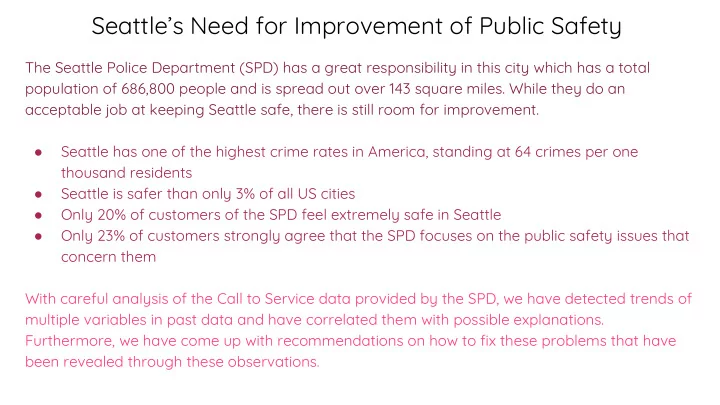
Seattle’s Need for Improvement of Public Safety

The Seattle Police Department (SPD) has a great responsibility in this city which has a total population of 686,800 people and is spread out over 143 square miles. While they do an acceptable job at keeping Seattle safe, there is still room for improvement.

  • Seattle has one of the highest crime rates in America, standing at 64 crimes per one

thousand residents

  • Seattle is safer than only 3% of all US cities
  • Only 20% of customers of the SPD feel extremely safe in Seattle
  • Only 23% of customers strongly agree that the SPD focuses on the public safety issues that

concern them With careful analysis of the Call to Service data provided by the SPD, we have detected trends of multiple variables in past data and have correlated them with possible explanations. Furthermore, we have come up with recommendations on how to fix these problems that have been revealed through these observations.

slide-2
SLIDE 2

Overall Trends:

  • The most common type of crimes are traffic related,

making up about 18% of total calls.

  • Vice calls were the least common type of crime, making

up about .001%

Data Table

slide-3
SLIDE 3

Overall Trends Con’t:

  • The top graph shows the total

number of calls for each district of Seattle

  • The bottom graph shows the

number of calls per capita annually for each district

  • In both graphs, districts K and

M have the highest amount of crime

  • District B has the lowest

amount of crime based on the number of crimes per capita annually

slide-4
SLIDE 4
  • Using Seattle’s 2017 population estimate in conjunction with the Call to Service data, the amount
  • f annual calls per capita was approximately 0.608 overall for Seattle (Assefa).
  • Districts K and M (outliers) have the two highest numbers of annual calls per capita, at 4.807 and

2.416, respectively.

The Impact of Employment on Crime

  • Forbes recently reported Seattle’s

unemployment rate to be 2.9%, while Districts K and M have respective unemployment rates of 9.1% and 11.1% (Worstall)

  • Districts K and M both have higher

amounts of crime and unemployment rates compared to Seattle as a whole. Solution:

  • Extend employment outreach programs in

these districts to curb the correlating crime rates

slide-5
SLIDE 5

The Impact of Poverty on Crime

  • The percentage of Seattle’s population that lies below the poverty line is

approximately 14.7% (Seattle).

  • Districts K and M have much higher percentages below the poverty line, at 44% and

29.1%, respectively. Solution:

  • Addressing this underlying cause by

ensuring adequate financial aid, access to affordable housing, and access to affordable meals could help to alleviate the pressures of poverty upon the community and therefore reduce the amount of crime.

(Seattle, Gongloff)

  • Furthermore, the percentage of the

population below the poverty line in districts K and M is considerably higher than the state and national percentages.

slide-6
SLIDE 6

Seattle’s Top Performing District

  • As would be expected, Seattle’s district with the least amount of annual calls per capita exhibits

the opposite qualities of the most call-dense districts.

  • District B has an unemployment rate of approximately 5.0%, and only around 15.0% of the

population living below the poverty line.

  • Social programs employed in District B should be examined and replicated in more

poorly-performing districts K and M, as the correlation between employment and poverty to amount of crime is clear.

slide-7
SLIDE 7

Distribution of Traffic Related Call

Percent of the Seattle Police Department’s calls that are traffic related: 17.9%

If they could cut down the number of traffic related calls, they would have more time to investigate more serious offenses. In this way, the number of inaccurate convictions would decrease while the

  • verall public safety of Seattle would increase.

Solutions:

  • Education/raising awareness of

road rules and safety

  • From our data, liquor violations are

the 4th most common type of call ○ Therefore, enforcing valid identification when purchasing alcohol would reduce both liquor violations and DUI problems

  • More available parking in city

Break Down of Traffic Related Calls into Subgroup:

slide-8
SLIDE 8

What do we notice and what do we do about it?

  • Liquor violations are most likely to occur in

district K while district O is the most likely to call about traffic related issues

  • Decrease the number of liquor stores and

promote more beneficial activities (service, environment, etc.) in district K

  • Add more road surveillance and station

more officers near notoriously dangerous intersections in district O

  • Burglaries are most likely to happen in district U
  • Improve home/store security systems

(intrusion sensors, remote door lock, door bell camera, etc.)

slide-9
SLIDE 9

Works Cited

Assefa, Samuel. “Population & Demographics.” Population & Demographics - OPCD, City of Seattle, 2017. Gongloff, Mark. “45 Million Americans Still Stuck Below Poverty Line: Census.” The Huffington Post, TheHuffingtonPost.com, 16 Sept. 2014. “Seattle, WA Real Estate and Demographic Data.” Neighborhood Scout, 2o17, https://www.neighborhoodscout.com/wa/seattle “Seattle, Washington (WA) Poverty Rate Data.” Seattle, Washington (WA) Poverty Rate Data - Information about Poor and Low Income Residents Living in This City. “September 2016 Service Quality Update Report.” Seattle Police Department. October 24, 2016. Accessed October 22, 2017. https://www.seattle.gov/Documents/Departments/Police/Publications/CustomerSurveyReportSep2016.pdf Worstall, Tim. “Seattle's 2.9% Unemployment Rate Tells Us Nothing About The Effects Of Seattle's Minimum Wage Rise.” Forbes, Forbes, 5 Apr. 2017.