SLIDE 1
U.S. Department of the Interior U.S. Department of the Interior Minerals Management Service Minerals Management Service
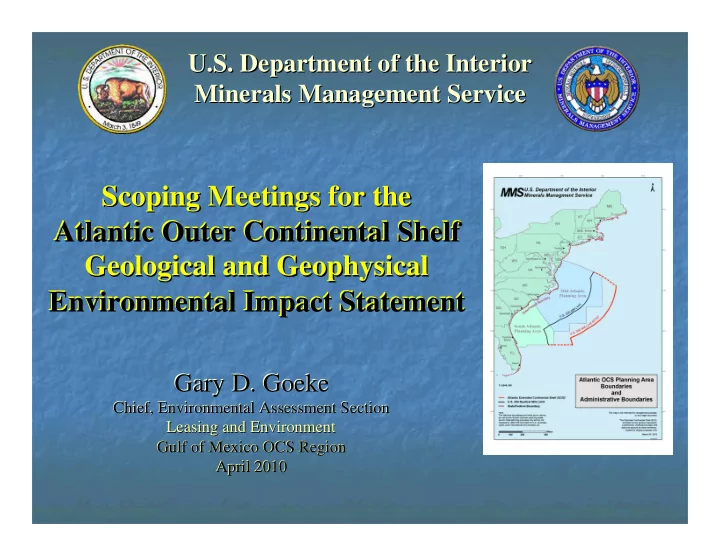
Scoping Meetings for the Scoping Meetings for the Atlantic Outer Continental Shelf Atlantic Outer Continental Shelf Geological and Geophysical Geological and Geophysical Environmental Impact Statement Environmental Impact Statement
Gary D. Goeke Gary D. Goeke
Chief, Environmental As Chief, Environmental Assessment Section sessment Section Leasing and Environment Leasing and Environment Gulf of Mexico OCS Region Gulf of Mexico OCS Region April 2010 April 2010
SLIDE 2
The Minerals Management Service (MMS) is a The Minerals Management Service (MMS) is a bureau of the Department of the Interior, whose bureau of the Department of the Interior, whose mission is to manage the mineral and renewable mission is to manage the mineral and renewable energy resources of the Outer Continental Shelf energy resources of the Outer Continental Shelf (OCS) in an environmentally sound and safe (OCS) in an environmentally sound and safe manner, under authority of the Outer Continental manner, under authority of the Outer Continental Shelf Lands Act, as amended. Shelf Lands Act, as amended.
SLIDE 3 Purpose Purpose of Today
’s Meeting s Meeting
Share information on the purpose and process for
Share information on the purpose and process for preparation of the Atlantic OCS Programmatic preparation of the Atlantic OCS Programmatic Environmental Impact Statement (PEIS) for Environmental Impact Statement (PEIS) for Geological and Geophysical (G&G) Activities Geological and Geophysical (G&G) Activities
Hear and record your views on the scope of the PEIS
Hear and record your views on the scope of the PEIS
Comply with the National Environmental Policy Act
Comply with the National Environmental Policy Act
SLIDE 4 National Environmental Policy Act National Environmental Policy Act
NEPA NEPA
Provides framework for protecting the environment
Provides framework for protecting the environment
Requires Federal agencies to consider environmental
Requires Federal agencies to consider environmental impacts of their activities impacts of their activities
Allows for public input to decisionmaking
Allows for public input to decisionmaking
Assists decisionmakers in in
Assists decisionmakers in incorporating environmental corporating environmental information into programs information into programs
SLIDE 5
Purpose of the PEIS Purpose of the PEIS
Assess potential environmental effects of multiple
Assess potential environmental effects of multiple G&G activities on the Atlantic OCS G&G activities on the Atlantic OCS
Evaluate mitigation and monitoring measures to
Evaluate mitigation and monitoring measures to reduce or eliminate the potential for impacts to the reduce or eliminate the potential for impacts to the environment environment
Provide information and analyses to MMS and other
Provide information and analyses to MMS and other agencies prior to decisions to authorize G&G agencies prior to decisions to authorize G&G activities activities
SLIDE 6 Need for the PEIS Need for the PEIS
Potential renewable energy, sand and gravel, and oil
Potential renewable energy, sand and gravel, and oil and gas activities in the Mid and gas activities in the Mid-
and South Atlantic OCS will require G&G surveys for site assessment, will require G&G surveys for site assessment, exploration, and other purposes exploration, and other purposes
MMS determined a PEIS would be required prior to
MMS determined a PEIS would be required prior to authorizing any large authorizing any large-
scale G&G surveys
Preparation of the PEIS will help ensure compliance
Preparation of the PEIS will help ensure compliance with NEPA and other applicable laws, such as the with NEPA and other applicable laws, such as the Endangered Species Act, Marine Mammal Protection Endangered Species Act, Marine Mammal Protection Act, and the Coastal Zone Management Act Act, and the Coastal Zone Management Act
SLIDE 7 OCS Activities are Subject to Numerous Laws, OCS Activities are Subject to Numerous Laws, Executive Orders, and Regulations Executive Orders, and Regulations
Marine Mammal Protection Act E.O. 12898: Environmental Justice Coastal Zone Management Act Federal Water Pollution Control Act National Historic Preservation Act
NEPA NEPA
Clean Air Act
& OCSLA & OCSLA
Magnuson-Stevens Fishery Conservation and Management Act Endangered Species Act
SLIDE 8 NMFS and MMS Consultation NMFS and MMS Consultation
NMFS has the primary responsibility for protecting marine
NMFS has the primary responsibility for protecting marine mammals and their habitat mammals and their habitat
MMS prepares a biological assessment and submits it to NMFS
MMS prepares a biological assessment and submits it to NMFS to aid in Marine Mammal Protection Act coordination to aid in Marine Mammal Protection Act coordination
NMFS prepares a decision and assists MMS in development of
NMFS prepares a decision and assists MMS in development of mitigations mitigations
MMS incorporates the mitigations
MMS incorporates the mitigationsinto the decision documents into the decision documents and relays them to the and relays them to the permittee permittee
NMFS places marine mammal observers onboard seismic
NMFS places marine mammal observers onboard seismic vessels to ensure compliance vessels to ensure compliance
The MMS also undergoes a similar The MMS also undergoes a similar consult consulta ation process for fisher tion process for fisheries and ies and essenti essentia al fish habitat l fish habitat
SLIDE 9
Environmental Impact Statements Environmental Impact Statements
Council on Environmental Quality (CEQ) regulations Council on Environmental Quality (CEQ) regulations state that an EIS state that an EIS “ “shall provide full and fair discussion of significant shall provide full and fair discussion of significant environmental impacts and shall inform decisionmakers environmental impacts and shall inform decisionmakers and the public of the reasonable alternatives which and the public of the reasonable alternatives which would avoid or minimize adverse impacts or enhance would avoid or minimize adverse impacts or enhance the quality of the human environment. the quality of the human environment.” ” And And “ “shall be analytic rather than encyclopedic. shall be analytic rather than encyclopedic.” ”
SLIDE 10 Notice of Intent to Notice of Intent to Prepare an EIS Prepare an EIS “ “Scoping Scoping” ” Public Comment Public Comment and Meetings and Meetings Draft EIS Draft EIS Final EIS Final EIS Comment Period Comment Period and and Public Hearing Public Hearing Record of Decision Record of Decision
Environmental Impact Statement Process Environmental Impact Statement Process
SLIDE 11 Development of an EIS Development of an EIS
Identify purpose, need, and alternatives for the
Identify purpose, need, and alternatives for the proposed action proposed action
Identify impact
Identify impact-
- producing factors and potentially
producing factors and potentially affected environmental and socioeconomic resources affected environmental and socioeconomic resources
Describe the existing environment
Describe the existing environment
Layout scenarios for analyses
Layout scenarios for analyses
Assess and estimate the potential impacts of the
Assess and estimate the potential impacts of the proposed action and alternatives over the life of the proposed action and alternatives over the life of the project project
Consider potential cumulative impacts
Consider potential cumulative impacts
Develop mitigations to address potential impacts
Develop mitigations to address potential impacts
SLIDE 12
Proposed Action Proposed Action
The proposed action to be The proposed action to be addressed by the PEIS will addressed by the PEIS will encompass G&G operations encompass G&G operations under MMS authority in the under MMS authority in the Atlantic OCS associated with Atlantic OCS associated with siting for renewable energy siting for renewable energy projects, marine minerals projects, marine minerals extraction, and oil and gas extraction, and oil and gas exploration that could take exploration that could take place over a period of many place over a period of many years. years.
SLIDE 13 Alternatives to be Considered in the PEIS Alternatives to be Considered in the PEIS
Alternative A Alternative A – – Analyze Analyze G&G activities G&G activities
- ut to the 200 nautical mile limit
- ut to the 200 nautical mile limit
Alternative B Alternative B – – Analyze Analyze G&G activities G&G activities
- ut to the 350 nautical mile limit
- ut to the 350 nautical mile limit
Alternative C Alternative C – – Analyze G&G activities Analyze G&G activities with appropriate mitigations to reduce with appropriate mitigations to reduce environmental impacts (e.g., ramp environmental impacts (e.g., ramp-
up procedures, and safety zones) procedures, and safety zones) Alternative D Alternative D – – A Additional alternatives dditional alternatives developed through the scoping period developed through the scoping period and early environmental analyses and early environmental analyses Alternative E Alternative E – – No Action Alternative No Action Alternative
SLIDE 14
Environmental Resources Environmental Resources to be Examined in the PEIS to be Examined in the PEIS
Coastal environments
Coastal environments
Deepwater benthic communities
Deepwater benthic communities
Fisheries (fish resources and essential fish habitat)
Fisheries (fish resources and essential fish habitat)
Coastal and marine birds
Coastal and marine birds
Endangered species (marine mammals, sea turtles)
Endangered species (marine mammals, sea turtles)
Archaeological resources (historic and prehistoric)
Archaeological resources (historic and prehistoric)
Socioeconomic issues
Socioeconomic issues Additional resources to be addressed? Additional resources to be addressed?
SLIDE 15 Potential Impacting Factors Potential Impacting Factors to be Examined in the PEIS to be Examined in the PEIS
Noise
Noise
Test drilling/coring
Test drilling/coring
Operational wastes
Operational wastes
Air emissions
Air emissions
Vessel traffic (supply vessels and helicopters)
Vessel traffic (supply vessels and helicopters)
Trash and debris
Trash and debris
Seabed
Seabed-
- impacting equipment (e.g., anchors, sensors,
impacting equipment (e.g., anchors, sensors, wire lines, cable lines, etc.) wire lines, cable lines, etc.)
Electromagnetic emissions
Electromagnetic emissions Additional impacting factors? Additional impacting factors?
SLIDE 16 Mitigation Examples Mitigation Examples
Acoustic source has to be ramped
Acoustic source has to be ramped-
up from a low-
- intensity to operational level to allow marine
intensity to operational level to allow marine mammals to leave the area mammals to leave the area
Safety zones of 500 meters established around the
Safety zones of 500 meters established around the acoustic source acoustic source
Marine Mammal Observers onboard to monitor the
Marine Mammal Observers onboard to monitor the safety zones and shut safety zones and shut-
down if marine mammals come into the zone come into the zone
Marine Mammal Observer reports submitted to
Marine Mammal Observer reports submitted to MMS every two weeks MMS every two weeks
Final Marine Mammal Observer report and digital
Final Marine Mammal Observer report and digital navigation data submitted to MMS at conclusion of navigation data submitted to MMS at conclusion of the acquisition the acquisition
SLIDE 17 Environmental Review of G&G Activities Environmental Review of G&G Activities
Large Large G G E E O O G G R R A A P P H H I I C C A A
An M An MM MPA, ES PA, ESA, o A, or rCZM CZMA A
R R
review revieww wo
uld be required be required for for ea each G& ch G&G permit application G permit application
E E
regardless of si regardless of siz ze e. .
A A Mid Mid-
and South Atlantic OCS Programmatic EIS Programmatic EIS Large Large-
Scale Seismic Surveys Supplemental EIS or EA Supplemental EIS or EA Small Small-
Scale Surveys EA EA Site Specific Site Specific EA EA Small Small
SLIDE 18 Why are G&G Activities Conducted? Why are G&G Activities Conducted?
To Survey for To Survey for
Renewable Energy Site Assessment Renewable Energy Site Assessment – – Locating sites for alternative en Locating sites for alternative energy structures associated with ergy structures associated with wind, wind,
- cean current, and wave
- cean current, and wave-
- related energy production and transmission
related energy production and transmission (e.g., seismic, coring, etc.) (e.g., seismic, coring, etc.) Marine Minerals I Marine Minerals In nvestigation vestigation – – Locating potential sand and gravel Locating potential sand and gravelsources for beach restoration sources for beach restoration and and sand and gravel mining (i.e., high sand and gravel mining (i.e., high-
- resolution seismic and coring)
resolution seismic and coring) Oil and Gas Exploration Oil and Gas Exploration – – Obtaining data for oil and gas exploration and production (i.e., Obtaining data for oil and gas exploration and production (i.e., seismic, gravity, magnetics, and controlled source electromangne seismic, gravity, magnetics, and controlled source electromangnetics) tics) – – Identifying possible seafloor or Identifying possible seafloor orshallow depth geological hazard shallow depth geological hazards s Biological Resource and Submerged Cultural Resource Biological Resource and Submerged Cultural Resource Identification Identification – – Locate or avoid sens Locate or avoid sensitive resources (i.e., high itive resources (i.e., high-
resolution seismic and coring) coring)
SLIDE 19 Types of G&G Activities Types of G&G Activities Requiring MMS Review Requiring MMS Review
Geological Geological
Shallow test drilling
Shallow test drilling
Deep
Deep stratigraphic stratigraphic test wells test wells Coring Coring
Geophysical Geophysical
2D and 3D seismic
2D and 3D seismic
Controlled source electromagnetic or CSEM
Controlled source electromagnetic or CSEM
Gravity and
Gravity and magnetics magnetics (sea and air) (sea and air)
High
High-
resolution seismic
SLIDE 20 What is a Seismic Survey? What is a Seismic Survey?
A seismic survey is a program designed for mapping A seismic survey is a program designed for mapping
- f the surface and subsurface using acoustically
- f the surface and subsurface using acoustically
generated waves that are reflected from contrasts in generated waves that are reflected from contrasts in the earth. the earth. Characteristic acoustic waves Characteristic acoustic waves are detected are detected by receivers, and the reflected travel time and by receivers, and the reflected travel time and velocity are then processed to help map geologic velocity are then processed to help map geologic structures and stratigraphic features. structures and stratigraphic features.
SLIDE 21 A 2D Marine Seismic Method A 2D Marine Seismic Method
Streamer Energy Source Vessel
Birds Eye View
SLIDE 22 Atlantic G&G PEIS Process Atlantic G&G PEIS Process Tentative Schedule Tentative Schedule
Notice of Intent Notice of Intent Federal Register Federal Register Notice Notice Reopening of Commen Reopening of Comment t Period Period Scoping Meetings Scoping Meetings Draft PEIS Published Draft PEIS Published Comment Period and Comment Period and Public Hearings Public Hearings Final PEIS Published Final PEIS Published Record of Decision January 21, 2009 January 21, 2009 April 2, 2010 April 2, 2010 April 2010 April 2010 Late 2011 Late 2011 Record of Decision Late 2011 Late 2011 Early 2012 Early 2012 Mid Mid-
2012
Comment opportunities are highlighted in red. Comment opportunities are highlighted in red.
SLIDE 23 Procedures for Submitting Comments Procedures for Submitting Comments
Two stations with a facilitator and court reporter are
Two stations with a facilitator and court reporter are set up to collect oral comments. set up to collect oral comments.
Each attendee submitting oral comments will be
Each attendee submitting oral comments will be allowed 3 minutes to speak. allowed 3 minutes to speak.
Written comments may be submitted to a facilitator
Written comments may be submitted to a facilitator
- r court reporter.
- r court reporter.
A separate station with two information officers is
A separate station with two information officers is set up to answer questions related to G&G set up to answer questions related to G&G activities, biological resources, etc. activities, biological resources, etc.
SLIDE 24 How Do I Provide Scoping Comments on the How Do I Provide Scoping Comments on the Atlantic G&G PEIS? Atlantic G&G PEIS?
Comments must be received on or before May 17,
Comments must be received on or before May 17, 2010. 2010.
Comments collected at the public scoping meeting
Comments collected at the public scoping meeting may be oral or written (may be left at registration may be oral or written (may be left at registration desk) desk)
Comments can be e
Comments can be e-
mailed to: GGEIS@mms.gov GGEIS@mms.gov
Comments can be mailed to
Comments can be mailed to Joseph Christopher, Regional Supervisor Joseph Christopher, Regional Supervisor Leasing and Environment (MS 5410) Leasing and Environment (MS 5410) Minerals Management Service Minerals Management Service Gulf of Mexico OCS Region Gulf of Mexico OCS Region 1201 Elmwood Park Boulevard 1201 Elmwood Park Boulevard New Orleans, Louisiana 70123 New Orleans, Louisiana 70123-
2394
SLIDE 25
http://www.gomr.mms.gov/homepg/offshore/atlocs/gandg.html