Science in underground laboratories The ANDES Initiative Xavier - - PowerPoint PPT Presentation

science in underground laboratories the andes initiative
SMART_READER_LITE
LIVE PREVIEW

Science in underground laboratories The ANDES Initiative Xavier - - PowerPoint PPT Presentation

Science in underground laboratories The ANDES Initiative Xavier Bertou Centro At omico Bariloche CNEA/CONICET ISAPP school 2019 @ the Pierre Auger Observatory Why would one want to go underground? HAWC/LAGO, Sierra Negra, Mexico LAGO, M

slide-1
SLIDE 1

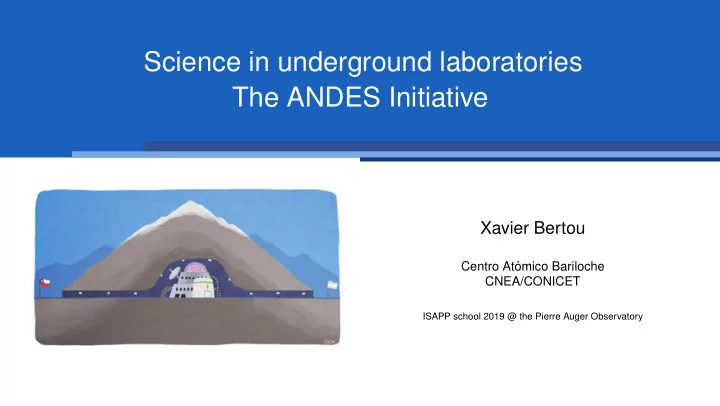
Science in underground laboratories The ANDES Initiative

Xavier Bertou

Centro At´

  • mico Bariloche

CNEA/CONICET

ISAPP school 2019 @ the Pierre Auger Observatory

slide-2
SLIDE 2

Why would one want to go underground?

HAWC/LAGO, Sierra Negra, Mexico LAGO, M´ erida, Venezuela Pierre Auger Observatory, Malarg¨ ue, Argentina 2 / 80

slide-3
SLIDE 3

Why would one want to go underground?

3 / 80

slide-4
SLIDE 4

Cosmic radiation and underground laboratories

4 / 80

slide-5
SLIDE 5

Cosmic rays

Primaries

  • Protons
  • Nuclei (Helium... Oxygen... Iron)
  • Neutrons
  • Gammas

Secondaries

  • muons
  • electrons/positrons
  • gammas
  • neutrons
  • neutrinos
  • ...

5 / 80

slide-6
SLIDE 6

Cosmic rays as noise

In a cubic meter of detector at ground level, one detects every day:

  • 108 muons
  • 108 gammas/electrons/positrons
  • 106 neutrons

. 10−3 neutrinos . 10−7 supernova neutrinos . maybe 100s of dark matter particles

6 / 80

slide-7
SLIDE 7

Cosmic rays as noise

In a cubic meter of detector at ground level, one detects every day:

  • 108 muons
  • 108 gammas/electrons/positrons
  • 106 neutrons

. 10−3 neutrinos . 10−7 supernova neutrinos . maybe 100s of dark matter particles

Weakly interacting 7 / 80

slide-8
SLIDE 8

Muon flux vs depth

Muon flux at ground level: a few 100 m−2 s−1

Muon flux at 5000 m.w.e. underground: 1 m−2 day−1

8 / 80

slide-9
SLIDE 9

Cosmic rays as noise

Malarg¨ ue: 1 particle per ms-m2 Modane UL: 1 particle per day-m2 Roger Waters at River Plate: 110 dB Patagonia (without wind): 30 dB

Hearing whispers from the Universe

9 / 80

slide-10
SLIDE 10

Scientific research in Underground Laboratories

10 / 80

slide-11
SLIDE 11

The Majorana low background low noise front-end electronics. Analytic approach to three-neutrino oscillations in the Earth. The ICARUS Experiment; latest results. The MicroBooNE and ArgoNeuT Experiments. Uncovering Multiple Mechanisms of bb0nu Decay. Investigation of double beta decay of 100Mo to excited final states of 100Ru. Kinetic Inductance Detectors as light detectors for neutrino and dark matter searches.. Final results of a Dark Matter Search with the Silicon Detectors of the CDMS II Experiment and future results SuperCDMS Soudan. The SNO+ Experiment. Latest Results of the NEMO-3 Experiment and Status of SuperNEMO. DEAP-3600 Dark Matter Search with Argon. Halo-independent tests relevant for inelastic dark matter scattering. Radon-Related Backgrounds in the LUX Dark Matter Search. Searching for Dark Matter with XENON100 and XENON1T LAGUNA-LBNO Project. Solar Neutrino Results and Future Opportunities with Borexino. Observation of the Dependence of Scintillation from Nuclear Recoils in Liquid Argon Drift Field. The new wide-band solar neutrino trigger for Super-Kamiokande. Dark matter anisotropic distribution functions and impact on WIMP direct detection. Development SiPMs for ultra low background LAr and LXe detectors. Neutrino(Antineutrino) Cross Sections in some Nuclear Targets at Supernova Neutrino Energies. DAMIC at SNOLAB:

  • DAMIC100. Future Geo-Neutrino Experiments. Search for the light WIMP captured in the Sun using contained events in Super-Kamiokande. The Status of the Search f

Mass WIMPs: 2013. Search for an annual modulation in 3.4 years of CoGeNT data. Coherent Inverse Primakoff-Bragg Conversion of Solar Axions in Single Crystal Bolometers Recent results from EXO-200. Updates from the DMTPC directional dark matter experiment. Recent Results from the KamLAND-Zen Experiment. Halo Independent Compar

  • f Direct Dark Matter Detection Data. Non-Standard Mechanisms for Double Beta Decay. ANDES: an underground laboratory in South America. Recent results from the OPERA
  • experiment. Geo-neutrinos and Earth Models. The EDELWEISS Dark Matter search. The status of the MARE experiment with 187Re and 163Ho isotpes. KamLAND-PICO

Matter Search Project. Atmospheric neutrino calculations. The Electron Capture 163Ho experiment ECHo. First results from subkeV energy threshold spherical gazeous detector light Dark Matter identification. The LUX Experiment. A Dark Matter Search with The MAJORANA Low-Background Broad Energy Germanium Detector. The Majorana Demonstr Calibration System. Dark Matter search with CUORE-0 and CUORE. The Majorana Demonstrator for 0vBB: Current Status and Future Plans. A CDMS low ionization threshold experiment and SuperCDMS SNOLAB. CUORE and beyond: bolometry techniques to explore inverted neutrino mass hierarchy. Model-Independent Analyses of Dark Matter P

  • Interactions. Physics beyond neutrinoless double-beta decay with a tonnescale germanium experiment. Status of NEXT-100. New Limits on Sterile Neutrino Mixing with Atmospher
  • Neutrinos. The Precision Tracker of the OPERA Detector. Design of low energy calibration sources for liquid xenon dark matter detectors.. Neutron detection and distinguishing

energy Anti-neutrinos in Super-Kamiokande. Searching for Dark Matter with PICASSO. The unbearable lightness of being: CDMS versus XENON. The latest results from T2K the neutrino oscillation. SNO+ experiment. Recent progress in KIMS experiment. The AMoRE project to search for neutrinoless double decay of 100Mo using cryogenic CaMoO4

  • detectors. Sterile neutrino oscillations: the global picture. Production of 51Cr neutrino and 144Ce antineutrino sources for SOXand CeLAND experiments (presented by

Cribier). Analysis of 3+ years of CoGeNT Data. GADZOOKS!. The Sanford Underground Research Facility (SURF). Limits on spin-independent couplings of WIMP dark with a p-type point- contact germanium detector. Progress and results from COUPP60. Neutrino flavor sensitivity of large scintillator detectors. Reaching higher sensitivities neutrinoloess doube beta decay with GERDA phase II. The LUX Experiment: Background Modeling and Sensitivity Projections. DarkSide-50 experiment status. Testing the Exclusion Principle for Electrons at LNGS. Development of Germanium Detectors with n/g Discrimination at 77 K for Dark Matter Experiments. DarkSide-50: a two-phase TPC for a direct WIMP search. Improving Dark Matter Searches by Measuring the Nucleon Axial Form Factor: perspectives from MicroBooNE. The DRIFT Directional Dark

  • Detector. NEST, the Noble Element Simulation Technique. Status of XMASS experiment. GLACIER for LBNO: Physics motivation and R and D results. Future of Super-Kamiokande

and Hyper-Kamiokande. NEWAGE. PICOlite: A bubble chamber to search for light WIMPs. A maximum-likelihood-method search for low-mass WIMPs using the CDMS II exper Ton-scale Xenon Gas TPC Concept for Simultaneous Searches for WIMP Dark Matter with Directional Sensitivity and Neutrino-less Double Beta Decay. Solar Neutrino Prospects with the SNO+ Experiment. Atmospheric neutrino oscillation and mass hierarchy determination in Super-Kamiokande. First experimental results in High Pressure Xe + TMA mixtures towards supra-intrinsic energy resolution and sensing of Dark Matter directionality. Trigger and analysis tools for Dark Matter Search in CUORE-0. Activites at Modane Underg

  • Laboratory. Characterization of Nuclear Recoils in High-Pressure Xenon Gas: Towards a Simultaneous Search for WIMP Dark Matter and Neutrinoless Double Beta Decay. Recent

Solar Neutrino Results From Super-Kamiokande. Update on the MiniCLEAN Dark Matter Experiment. DIANA - An Underground Accelerator Facility for Nuclear Astroph Status Report. The Origin of Neutrino Masses and Neutrinoless Double Beta Decay. Measurements of low-energy nuclear recoils in liquid argon. PRELIMINARY RESUL ANAIS-25 AT THE CANFRANC UNDERGROUND LABORATORY. Results from the GERDA experiment. SABRE: A new NaI(Tl) dark matter direct detection experiment. Past present experiments of geoneutrinos. The Nuclear Matrix Elements for 0nbb-Decay: Current Status. The SNOLAB Science Programme. SOX: Short distance neutrino Oscillations with BoreXino. Systematics of Low Threshold Modulation Searches in CDMS-II. Light WIMPs And Equivalent Neutrinos. LUMINEU: a pilote scintillating bolometer exper for neutrinoless double beta decay search. Low Background Counting at the LBNL Low Background Facility. Performance of DAMIC at SNOLAB. DAEdALUS/IsoDAR: A Phased

slide-12
SLIDE 12

Scientific research in Underground Laboratories

Out of these many topics, I will focus on:

  • Neutrino physics
  • Dark Matter search
  • Low radiation and multidisciplinary experiments

12 / 80

slide-13
SLIDE 13

Neutrino physics

13 / 80

slide-14
SLIDE 14

Neutrino underground experiments

Sources

  • neutrinos from nuclear reactors
  • neutrinos from particle accelerators
  • atmospheric neutrinos
  • solar neutrinos
  • astrophysical neutrinos
  • geoneutrinos

Physics

  • neutrino oscillation
  • neutrino masses
  • neutrino nature
  • astrophysics
  • geophysics

14 / 80

slide-15
SLIDE 15

Main recent result in neutrino from Underground Labs

2015 Nobel Prize: Kajita (SuperKamiokande) and McDonald (SNO) . Neutrino oscillations . K2K, MINOS, OPERA, T2K

15 / 80

slide-16
SLIDE 16

Current state of the art neutrino detector: Borexino

Low energy neutrino detector @ Gran Sasso

16 / 80

slide-17
SLIDE 17

Future major experiment: DUNE

17 / 80

slide-18
SLIDE 18

Neutrino nature via neutrinoless double beta decay

18 / 80

slide-19
SLIDE 19

Neutrinoless double beta decay search

Kamland-Zen SNO+ CUORE Majorana GERDA CUPID nEXO SuperNEMO NEXT ...

19 / 80

slide-20
SLIDE 20

Dark Matter search

20 / 80

slide-21
SLIDE 21

Dark matter in the Universe

“There are known knowns; there are things we know we know. We also know there are known unknowns; that is to say, we know there are some things we do not know. But there are also unknown unknowns - the ones we don’t know we don’t know.”

Donald Rumsfeld

21 / 80

slide-22
SLIDE 22

The bullet cluster

22 / 80

slide-23
SLIDE 23

Dark matter in the Universe

23 / 80

slide-24
SLIDE 24

Direct searches detection techniques

24 / 80

slide-25
SLIDE 25

Direct searches (spin independent current limits - PDG2018)

25 / 80

slide-26
SLIDE 26

Direct searches (spin independent current limits - PDG2018)

26 / 80

slide-27
SLIDE 27

Going down: Xenon/Argon dual phase TPC

27 / 80

slide-28
SLIDE 28

Going left: Low threshold detectors

CRESST, SuperCDMS, DAMIC, SENSEI (NEWS-G...)

28 / 80

slide-29
SLIDE 29

Many experiments and new ideas

29 / 80

slide-30
SLIDE 30

Signal in DAMA/LIBRA at Gran Sasso?

DAMA/LIBRA:

250 kg crystals of ultra-pure sodium iodide (Thallium doped)

Gran Sasso Laboratory:

The largest underground laboratory in the world

30 / 80

slide-31
SLIDE 31

Modulation results from DAMA/LIBRA

31 / 80

slide-32
SLIDE 32

Modulation from DAMA/LIBRA and atmospheric effects

32 / 80

slide-33
SLIDE 33

The Big Bang Theory

Season 2, chapter 15

  • Leonard: I think you’ll find my work pretty interesting. I’m attempting to replicate the

dark matter signal found in sodium iodide crystals by the Italians.

  • Mother:

So, no original research?

  • Leonard:

No.

  • Mother:

Well, what’s the point of my seeing it? I could just read the paper the Italians wrote.

Season 4, chapter 4

  • Raj (to Sheldon): I’m telling you, if xenon emits ultraviolet light, then those dark matter

discoveries must be wrong.

33 / 80

slide-34
SLIDE 34

Low radiation and multidisciplinary experiments

34 / 80

slide-35
SLIDE 35

Multidisciplinary underground experiments

  • Geoscience
  • Radiation impact on Biology
  • Low radiation measurements...

material selection climatology, environment microelectronics, wine

35 / 80

slide-36
SLIDE 36

Geo science in Underground sites

36 / 80

slide-37
SLIDE 37

Cosmic radiation impact on cells

”Underground laboratories provide a novel environment in which to conduct biological experiments, by

  • ffering a setting where the cosmic radiation flux is vastly reduced. Growing organisms inside this

environment allows the contribution of the normal sea-level background dose received by cells to be suppressed, providing a means of exploring the impact of the natural radiative background on biological

  • systems. Surprisingly, experiments led thus far in underground labs show that a reduction in

background radiation has a stressful impact on cells, reducing the growth rate of bacteria when cells were grown in the Waste Isolation Pilot Plant in New Mexico, and reducing the ability of yeast cells grown in the Gran Sasso underground laboratory to withstand exposure to DNA damaging chemicals. [...] Low background experiments in Gran Sasso have been extended to study the impact of radiation on V79 Chinese hamster cells, and human lymphoblastoid TK6 cells. Across the vast range of organisms considered, these experiments in underground laboratories all support the hypothesis that background radiation acts as a conditioning agent for the cellular response to DNA damage.”

(Introduction of EPJ Web of Conferences 124, 00006 (2016)) 37 / 80

slide-38
SLIDE 38

Heavy metals in plants

Some plants uptake heavy metals and process them. Real time analysis of the process would be possible in an underground laboratory.

38 / 80

slide-39
SLIDE 39

Sardine in Peru and lead contamination in alpine lakes

Sardine vs anchovy evolution in Peruvian coasts

  • Populations of sardines and anchovy are anti-correlated in peruvian coasts
  • Data only available for last tens of years

! Expand the data set by low radiation measurements

Lead contamination in alpine lakes

  • Can be traced by 210Pb
  • Usually resolution of tens of years

! Can be measured on a yearly timescale in an underground laboratory ! Look at leadless gasoline impact

39 / 80

slide-40
SLIDE 40

Microelectronics and wine

IBM test of microchips

  • Study bit error rate

Wine datation for fraud

  • Check century old bottles with Cs

40 / 80

slide-41
SLIDE 41

Underground laboratories

41 / 80

slide-42
SLIDE 42

World map of underground laboratories

42 / 80

slide-43
SLIDE 43

Gran Sasso, Italy

43 / 80

slide-44
SLIDE 44

SNOLAB, Canada

44 / 80

slide-45
SLIDE 45

Updated world map of underground laboratories

45 / 80

slide-46
SLIDE 46

The Big Bang Theory

Season 4, chapter 4

  • Raj (to Sheldon): I’m telling you, if xenon emits ultraviolet light, then those dark matter

discoveries must be wrong.

Season 2, chapter 15

  • Leonard: I think you’ll find my work pretty interesting. I’m attempting to replicate the

dark matter signal found in sodium iodide crystals by the Italians.

  • Mother:

So, no original research?

  • Leonard:

No.

  • Mother:

Well, what’s the point of my seeing it? I could just read the paper the Italians wrote.

46 / 80

slide-47
SLIDE 47

The ANDES laboratory

47 / 80

slide-48
SLIDE 48

The Agua Negra tunnel (Coquimbo - San Juan)

  • Crossing the Andes is of strategic importance for the region to link productive

areas to the Asian market

  • 2 tunnels, 12 m each, 60 m one from another, ⇡ 14 km
  • Deepest point at ⇡ 1750 m depth
  • International tender started in January 2013, construction 2019-2027

48 / 80

slide-49
SLIDE 49

The Agua Negra tunnel recent history

  • Pre-feasibility study done in 2005, feasibility in 2008
  • Presidents signed a Bi-National Integration treaty, including the San Juan - Coquimbo
  • ption, in October 2009, voted later on by both countries
  • August 2010 MERCOSUR meeting in San Juan with strong support for Agua Negra
  • Since 2011 the Argentine congress votes every year a 800 MU$D guarantee fund
  • In March 2012, Presidents signed an agreement to start the international tender
  • 2013: new conceptual design and budget review
  • 2014: detailed engineering design completed and construction protocol agreed upon
  • In 2015, the IDB accepted to finance the project
  • In December 2016, the first 40M$ from IDB were received
  • In October 2017, 280M$ more from IDB were received
  • Total cost estimated to about 1.25 BU$D

49 / 80

slide-50
SLIDE 50

A scientific opportunity in the south?

  • Opportunity for a big AND deep laboratory
  • Located in the south
  • pposite weather modulation (dark matter)

complementary for supernovae neutrinos

  • Geoneutrinos

(Low neutrino flux from nuclear power plants)

  • Geoactive region

! Underground geophysics laboratory Manage it from an international consortium

  • Opportunity to have not only international experiments but an international laboratory
  • The consortium would be the seed of a “CERN” focused on underground science (high

energies, geology, biology, technology...)

50 / 80

slide-51
SLIDE 51

Expected Muon Flux (Aldo Ianni - TAUP 2017)

51 / 80

slide-52
SLIDE 52

ANDES size (Aldo Ianni, TAUP 2017)

52 / 80

slide-53
SLIDE 53

Original scientific programme for ANDES

  • Neutrino

host a double beta decay experiment build a large neutrino detector as a flagship experiment

  • similar to KamLAND/Borexino?
  • focused on low energies
  • solar/supernovae/geo-neutrinos
  • Dark Matter

modulation measurements 4th generation new technologies

  • Geophysics

Natural link of seismograph networks “flat slab” study

  • Biology
  • Low radiation measurements
  • Accelerator

Nuclear astrophysics DAR neutrino beam?

53 / 80

slide-54
SLIDE 54

SuperNEMO: double beta decay experiment

  • based on NEMO-NEMO3 expertise (LSM)
  • 100 200 kg of 82Se
  • sensitive to a neutrino mass of

⇡ 0.05 0.1 eV

  • modular design:

⇡ 20 modules

  • Status in 2027?

54 / 80

slide-55
SLIDE 55

NEXT: double beta decay Xenon TPC

  • NEXT at Canfranc
  • Xenon TPC
  • Background rejection by

looking at blobs at both ends on trace

  • Timescale ANDES

compatible

  • Discussed at 5th ANDES

Workshop (June 2017)

55 / 80

slide-56
SLIDE 56

Large Neutrino Detector

  • design similar to Borexino and KamLAND?

3 10 kton of scintillator

  • interesting site for geoneutrinos
  • complementary for supernovae neutrino

measurements: arXiv:1027.5454 ! Have a large pit foreseen for the detector

56 / 80

slide-57
SLIDE 57

Dark Matter in ANDES

  • host a copy of an experiment observing a modulation
  • host a 4th generation experiment
  • work on new technologies (actively evolving area)

ex: DAMIC (Dark Matter In CCD)

57 / 80

slide-58
SLIDE 58

Dark Side: Argon TPC

  • Argon community joined
  • n Dark Side
  • Timescale ANDES

compatible

  • Discussed at 5th ANDES

Workshop (June 2017)

58 / 80

slide-59
SLIDE 59

Nuclear astrophysics

LUNA: Laboratory for Underground Nuclear Astrophysics

  • installed at LNGS (Gran Sasso)
  • 50 kV accelerator
  • 400 kV (LUNA II)

study nuclear reactions at low energies, relevant in astrophysics (Gamow peak) ex: 3He(3He,2p)4He below 21 keV Proposal for a 300 kV high intensity platform for ANDES

59 / 80

slide-60
SLIDE 60

First proposal for the ANDES laboratory (2011)

60 / 80

slide-61
SLIDE 61

Conceptual design for the ANDES laboratory (2015-2016)

  • main hall:

(21⇥23⇥50) m3

  • secondary hall:

(16⇥14⇥40) m3

  • small halls (office, workshop, clean room, ...):

total 340 m2

  • ultra-low radiation pit: 9 m, 9 m depth
  • single experiment pit: 30 m, 30 m depth

Total civil work cost: 38.1M$ < 2.5 % of tunnel cost

61 / 80

slide-62
SLIDE 62

Detailed engineering under way (2018-)

  • Add GEO portion

(inspired by BFO, Germany)

  • Add BIO independent

laboratory

  • Reorder small rooms
  • Add Accelerator room
  • Keep cost close to 40M$

while adding multidisciplinarity platforms

62 / 80

slide-63
SLIDE 63

Background studies for ANDES

  • 600 m deep rock samples measured for natural radioactivity (LAAN, M. Arribere)

(Bq/kg) Basalt Andesite Rhyolite 1 Rhyolite 2 Canfranc

238U

2.6 ± 0.5 9.2 ± 0.9 14.7 ± 2.0 11.5 ± 1.3 4.5 30

232Th

0.94 ± 0.09 5.2 ± 0.5 4.5 ± 0.4 4.8 ± 0.5 8.5 76

40K

50 ± 3 47 ± 3 57 ± 3 52 ± 3 37 880

  • Depth, muon flux and neutron activation calculations

63 / 80

slide-64
SLIDE 64

Two support laboratories

  • At La Serena (Chile) and Rodeo (Argentina)
  • Workshops for the underground activities
  • Integration with local universities (academic activity)
  • Visitor centres

64 / 80

slide-65
SLIDE 65

International and institutional support

  • Memorandum of Understanding signed during the first

ANDES workshop (includes the signaturs of the director

  • f Modane, the emeritus director of Homestake, the

spokespersons of SuperNEMO and Edelweiss II).

  • EBITAN (Entidad Binacional T´

unel Agua Negra), supported the ANDES laboratory in its Xth meeting and agreed on including it in the Agua Negra tunnel project in its XXXVth meeting

  • Support and interest by latin american institutions:
  • CONICET, Argentina
  • MinCyT, Argentina
  • Universidad de La Plata, Argentina
  • Universidad de San Juan, Argentina
  • ANDES Unit in CLAF
  • Universidad La Serena, Chile
  • Gobierno de la provincia de San Juan, Argentina
  • CONICYT, Chile
  • Gobierno de la provincia de Elqui, Chile
  • Gobierno de la regi´
  • n de Coquimbo, Chile
  • CCHEN, Chile
  • MinRel, Chile
  • Support and interest by representatives of latin american scientists

and institutions:

  • Claudio Dib, representing groups from 4 Chilean universities
  • Juan Carlos D’Olivo, High Energy Physics Network, Mexico
  • Ronald Shellard, CBPF and SBF vice director, Brazil
  • Eduardo Charreau, ANCEFN president, Argentina
  • Francisco Tamarit, AFA president, Argentina
  • Support from scientists and international experiments:
  • Stephen Adler, Princeton
  • M. Miller, A. Garcia, University of Washington
  • Bob Svoboda, LNBE Spokesperson
  • Nigel Smith, SNOLAB Director
  • Kunio Inoue, KamLAND Spokesperson
  • Hiro Ejiri, Former RCNP Director
  • Yoichiro Suzuki, Kamioka Director, Super Kamiokande

Spokesperson

  • Takaaki Kajita, ICRR Director
  • P

. Brink et al., DM modulation

  • D.A. Harris, K. McFarland, MINERvA Spokespersons
  • A.B. McDonald, Nobel Physics Laureate

65 / 80

slide-66
SLIDE 66

Manifested interest in contributing to ANDES

  • interest for collaboration and instrument installation in ANDES:
  • Jennifer Thomas, SuperNEMO CB Chair
  • Daniel Santos, MIMAC Spokesperson
  • Kai Zuber, COBRA Spokesperson
  • J. Conrad, M. Shaevitz, DAEDALUS Spokespersons
  • A. Galindo-Uribarri et al., ORNL

Interest in collaborating to the construction and operantion of the ANDES laboratory by latin american groups:

  • Argentina:
  • IFLP

, UNLP

  • Neutrones y Reactores, CAB
  • Part´

ıculas y Campos, CAB

  • Bajas Temperaturas, CAB
  • Instituto Geof´

ısico Sismol´

  • gico Volponi, San Juan
  • ITeDA, CNEA-CAC
  • I&D - PNGRR, CNEA-CAC

ısica Experimental Altas Energ´ ıas, UBA

  • Instituto de Matem´

atica Aplicada, San Luis

  • Empresa SOLYDES
  • Brasil:
  • Rede Nacional de F´

ısica de Altas Energias

  • ICE, UFRJ
  • IFRW, UNICAMP
  • ICRA, CBPF
  • Neutrino Physics group, UFABC
  • HEP

, PUC Rio

  • Instituto de F´

ısica, USP

  • Chile:
  • CCTVAL, UTFSM
  • Pontificia Universidad Cat´
  • lica de Chile
  • Universidad de Santiago de Chile
  • Dpto Ciencias de la Tierra, Universidad de Concepci´
  • n
  • ICFM, Universidad Austral
  • Mexico:
  • Instituto de Biotecnolog´

ıa, UNAM

  • Instituto de Ciencias Nucleares, UNAM
  • Grupo Astropart´

ıculas, UMSNH

  • FCFM, BUAP

66 / 80

slide-67
SLIDE 67

ANDES timeline

  • Project started in July 2010
  • First 3 ANDES workshops in Buenos Aires, Argentina, April 2011, Rio de

Janeiro, Brazil, June 2011, Valpara´ ıso, Chile, January 2012

  • approved by the Argentine MinCyT (CAGICyT) and EBITAN, March 2012
  • Fourth workshop in Mexico City, Mexico, January 2014
  • ANDES Unit in CLAF created, January 2014
  • Laboratory New Conceptual Design ready, January 2016
  • Fifth ANDES workshop in Buenos Aires, Argentina, June 2017
  • ANDES proposed for the TAN civil work by EBITAN, July 2017

. Detailed engineering (0.5 M$) started in August 2018 . Construction together with tunnel 2019-2027 (2021-2025)

67 / 80

slide-68
SLIDE 68

Meanwhile...

68 / 80

slide-69
SLIDE 69

Introducing Sierra Grande

  • Underground Laboratory operated in

the 1990s

  • Experiment from F

. Avignone et al.

Sideral day dark matter signal modulation

  • located 400 m deep, 1000 m.w.e.
  • See for example:

Astroparticle Physics 6, 63 (1996) arXiv:astro-ph/9809018 arXiv:astro-ph/9712308 arXiv:astro-ph/9708008 arXiv:astro-ph/9311049

69 / 80

slide-70
SLIDE 70

70 / 80

slide-71
SLIDE 71

Sideral day modulation in the South

  • WIMP wind coming from ⇡ 40 deg

North (Cygnus)

  • Maximum modulation if WIMP flux

modified by in Earth interactions (strong energy loss, self-interaction...)

  • Sideral modulation: can be seen in
  • ne day, checked after a few (6?)

months

71 / 80

slide-72
SLIDE 72

Sierra Grande from San Carlos de Bariloche

72 / 80

slide-73
SLIDE 73

Sierra Grande, the entrance

73 / 80

slide-74
SLIDE 74

Sierra Grande, reaching the cave (by car!)

74 / 80

slide-75
SLIDE 75

Sierra Grande, we were there

75 / 80

slide-76
SLIDE 76

Muon flux vs depth

Muon flux at ground level: a few 100 m−2 s−1

Muon flux at Sierra Grande: ⇡ 2 m−2 min−1

76 / 80

slide-77
SLIDE 77

Sierra Grande, schedule

  • First trip and contact

July 19, 2018

  • Signed interest letter from MCC Sierra Grande president

Aug 15, 2018

  • Signed agreement between CNEA and MCC

Mid 2019

  • First measurements: muon flux, radon

April 2019(?)

  • First experiment: CCD daily modulation experiment

End 2019(?) . Site available for 5 years . After that may need to move 100 m up for permanent site . Develop new skills underground (copper electroforming?) . Start multidisciplinary underground activities?

. Need agreement from MCC for extra activities

77 / 80

slide-78
SLIDE 78

Conclusions

78 / 80

slide-79
SLIDE 79

Underground Laboratory science is at the frontier. There is a unique opportunity to build ANDES, a world class deep underground laboratory,

  • ne of a kind in the southern hemisphere,
  • perated by an international consortium

http://andeslab.org/

79 / 80

slide-80
SLIDE 80

Thank you!

Neutrino search (Kay Quattrocchi, 2012)

80 / 80