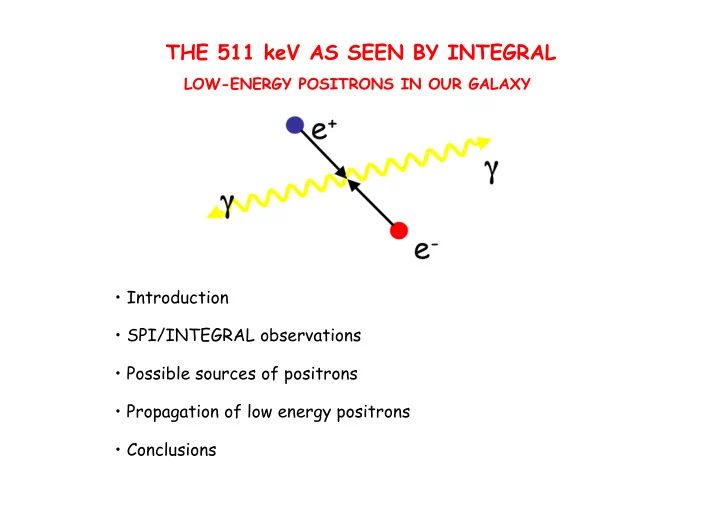
THE 511 keV AS SEEN BY INTEGRAL LOW-ENERGY POSITRONS IN OUR GALAXY - - PowerPoint PPT Presentation

the 511 kev as seen by integral
SMART_READER_LITE
LIVE PREVIEW

THE 511 keV AS SEEN BY INTEGRAL LOW-ENERGY POSITRONS IN OUR GALAXY - - PowerPoint PPT Presentation

THE 511 keV AS SEEN BY INTEGRAL LOW-ENERGY POSITRONS IN OUR GALAXY Introduction SPI/INTEGRAL observations Possible sources of positrons Propagation of low energy positrons Conclusions Production of e + in the Galaxy - +


slide-1
SLIDE 1

THE 511 keV AS SEEN BY INTEGRAL

LOW-ENERGY POSITRONS IN OUR GALAXY

  • Introduction
  • SPI/INTEGRAL observations
  • Possible sources of positrons
  • Propagation of low energy positrons
  • Conclusions
slide-2
SLIDE 2

Production of e+ in the Galaxy

  • β+ isotopes
  • > SNe, novae …
  • > Ee+ ~ 1 MeV

Xp -> Xn + e+ + νe

  • π+ decay
  • > CR interactions with ISM
  • > Ee+ ~ 10-100 MeV

p + p -> p + n + π+ and π+ -> µ+ -> e+

  • e+e- pair production
  • > accretion disks & jets
  • > Ee+ ≤ 1 MeV

γ + γ -> e+ + e-

  • > pulsar magnetosphere
  • > Ee+ ~ 1-1000 GeV

γ + γ -> e+ + e-

  • exotic processes
  • > e.g. dark matter, …
  • > Ee+ ~ ? MeV

dm + dm -> e+ + e-

Origin of galactic e+ is yet unknown

slide-3
SLIDE 3

Annihilation of low energy e+

  • Direct annihilation
  • Positronium formation

e+ + e- -> Ps + γ or e+ + H -> Ps + H+

e-

γ γ

e+

1/4

e- e+

Eγ=511keV

γ γ

line

e- e+

γ γ γ

3/4 Eγ<511keV continuum Ps

slide-4
SLIDE 4

History of observations prior to INTEGRAL History of observations prior to INTEGRAL

  • 1970-1974

balloon borne NaI spectrometer (Rice)

  • 1977-1989

balloon borne Ge spectrometers

  • > correlation between measured flux

and FOV (Albernhe et al., 1981)

  • 1979-1980

HEAO3

  • 1981-1985

SMM

  • 1991-1997

OSSE

  • > First maps
  • 1995-1997

TGRS

GC flux ~ 10-3 γ s-1 cm-2 fPs = (93 ± 4)% Bulge to disk flux ratio: B/D ~ 0.2-3.3

Kinzer et al., 2001 Milne et al., 2000 & 2002

slide-5
SLIDE 5

INTEGRAL INTEGRAL

ESA’s INTErnational Gamma-Ray Astrophysics Laboratory

Observation with SPI/INTEGRAL

Scientific objectives of SPI : nucleosynthesis, diffuse emissions, origin of positrons

  • Imaging the annihilation emission

=> spatial distribution of the sources

  • Spectroscopy (fPs = NPs/Nann and line shape)

=> conditions of ISM where e+ annihilate

Launch : 17 october 2002

19 germanium detectors Energy range : 20 keV - 8 MeV ΔE ≈ 2 keV at 1 MeV Field of view ≈ 20° Angular resolution ≈2°

slide-6
SLIDE 6

Weidenspointer et al., 2008

Imaging: the all-sky distribution of the 511 keV line emission

Morphological analysis by model fitting :

  • Bulge :

2 Gaussians : 3o & 11o FWHM, Flux ~ 10-3 γ/s/cm2

  • Galactic disk :

Asymmetric, F(l<0°) = 1.7 × F(l>0°), Flux ~ 7 × 10⁻⁴ γ/s/cm2

  • > no point sources
  • > B/D flux ratio ~ 0.8-2.9 : old star population favored if e+ annihilate close to their sources
  • > Similar asymmetry in the spatial distribution of LMXBs emitting at high energy

MREM image

Observation with SPI/INTEGRAL

slide-7
SLIDE 7

Hard LMXBs in the 3rd IBIS catalogue (Bird et al. 2007) A MREM image of the 511 keV emission

Imaging: the all-sky distribution of the 511 keV line emission

Observation with SPI/INTEGRAL

slide-8
SLIDE 8

Spectral analysis: fit the phase fractions in the bulge

Positrons annihilate at energies < 10 eV, in warm phases (Jean et al. 2006) or in a warm slightly ionized phase (Churazov et al. 2005). fi : contribution of phase i

Jean et al. 2006

Ps fraction : (97±2) %

Observation with SPI/INTEGRAL

slide-9
SLIDE 9

Spectral analysis: annihilation in flight of relativistic positrons

If positrons are produced in a steady state in the GC then their initial kinetic energy should be < 8 MeV else the intensity of the inflight annihilation emission would be detected at high energy (Aharonian & Atoyan 1981, Beacom & Yuksel 2006, Sizun et al. 2007)

« COMPTEL measurement »

Observation with SPI/INTEGRAL

Injection rate : 1043 e+/s

slide-10
SLIDE 10

Possible sources of positrons

Observational facts

  • Annihilation rates:

(1.1 - 3.0) x 1043 s-1 in the bulge (0.8 - 0.5) x 1043 s-1 in the disk

  • Morphology:

B/D ~ 1.4 - 6 (luminosity ratio) Possible asymmetry of the emission from the disk

  • Spectral analysis:

Initial kinetic energy of e+ (steady state) < 8 MeV Positrons annihilate in warm phases

How to produce ~ 2-3 x 1043 e+/s ?

  • β+ isotopes produced in stars
  • > 26Al : SNII, WR
  • > 44Ti : SNII
  • > 56Co : SNe
  • > 22Na : O-Ne Novae
  • Compact sources
  • > Black-holes
  • > Pulsars
  • Cosmic-rays
  • > p + p → p + n + π+ and π+ → µ+ → e+
  • Dark matter

  E+ > 10 MeV 

Not enough e+ (Hernanz et al. 1999) Not enough e+ (Harding & Ramaty 1987)

slide-11
SLIDE 11

Sky-map of the 1.8 MeV line (COMPTEL )

26Al produced in SNII/Ib & WR 26Al -> 26Mg + β+ + γ1.8MeV

T1/2 ~ 0.7 Myr

  • > Contribution of 26Al :

F1.8MeV => M26 ~ 2 - 3 M* => Re+ ~ 3 x 1042 s-1

Knödlseder et al., 1999

Decay of 26Al Decay of 44Ti

44Ti produced in SNs 44Ti -> 44Sc -> 44Ca + β+

(T1/2 ~ 60 yr)

  • > Contribution of 44Ti (Milne et al., 2002)

Solar abundance of 44Ca => M44 ~ (3±1) 10-6 M* (Timmes et al., 1996) => Re+ ~ 2 x 1042 s-1

26Al & 44Ti could explain

all or a fraction of the disk emission

Possible sources of positrons

slide-12
SLIDE 12
  • SNII -> e+ from 56Co do not escape the ejecta (Chan & Lingenfelter, 1993)
  • SNIa -> a fraction f of e+ from 56Co escape the ejecta

Galactic Rate : Re+ ∝ f x νSNIa x M56 M56~ 0.6 M* & νSNIa~ 0.003 yr-1

  • > f < 15% (Chan & Lingenfelter, 1993)

=> Re+ < 4 x 1043 s-1.

  • > f ~ 5% (Milne, The & Leising, 2001)

=> Re+ ~ 1043 s-1.

Supernovae

  • Recent observation of bolometric light curves suggested f ≈ 0 (Sollerman et al. 2004)
  • Although SNeIa belong to the old population their distribution seems to give (B/D)SNeIa < 1

Milne, The & Leising (2001)

Possible sources of positrons

slide-13
SLIDE 13

e+ produced in the inner regions of accretion disks through γ + γ -> e+ + e- (T ~ 109 K). Positrons could be ejected through jets or winds.

  • Positron yield from jets/winds not clearly known :
  • > R+ ~ 1041 s-1 with a large uncertainty
  • > E ≤ 1 MeV
  • Number of microquasars : NµQ ~ 100 (Paredes 2005)
  • (B/D)LMXB ~ 0.9 (Grimm et al. 2002)
  • Rbulge = NµQ(Bulge) x R+

=> Rbulge ~ 5 x 1042 e+/s

  • Rdisk = NµQ(Disk) x R+

=> Rdisk ~ 6 x 1042 e+/s LMXBs could explain e+ from the disk, but :

  • Nature of jet (leptonic, hadronic) is not known
  • Do e+ escape the inner regions of the accretion disk?

LMXB/Microquasars

(Guessoum, Jean & Prantzos, 2006)

Possible sources of positrons

Bandyopadhyay et al. (2008): ~300-3000 faint LMXBs could explain emission from the bulge

slide-14
SLIDE 14

Sgr A*

Disruption of stars in the vincinity of the supermassive black hole

  • > a massive star ~107 yrs ago (Cheng et al. 2006)
  • > stars at a rate of 10-5 yr-1 (Cheng et al. 2007)

Positrons are produced via the decay of π+ which are produced in pp collisions Protons would be accelerated in shocks in the accretion disk. => Production of high energy positrons but not in a steady state.

now 511 keV line γ-rays from π0 decays Cheng et al. 2006

Possible sources of positrons

slide-15
SLIDE 15

Summary

============================================================================== Sources Yield Morph. Comments

  • SNIa (56Co)

0-100% B/D<1 Difficulty for e+ to escape the ejecta SNII, WR (26Al) ~15% D Could explain a fraction of the disk emission SNII (44Ti) ~10% D Could explain a fraction of the disk emission LMXBs (γγ) 0-50% B/D~1 Could explain the disk emission & its asymmetry Sgr A* burst (π+) 0-100% B Could explain the bulge emission Novae (22Na) ~1% B/D<1 Not enough positrons Pulsars (γγB) ~0.1% D High energy positrons & not enough positrons Cosmic-rays (π+) ~5% D High energy positrons & not enough positrons Dark matter (χχ) ?% B High energy positrons SNII (56Co) 0% D Positrons cannot escape the ejecta ==============================================================================

Do the spatial distribution of the annihilation emission trace the spatial distribution of the sources?

Possible sources of positrons

slide-16
SLIDE 16

Propagation of low energy positrons in the ISM

  • Jean et al. (2006): point out uncertainties about the propagation of positrons in ISM

and found difficulty for a single positron source to fill the bulge

  • Prantzos (2006): suggested that SNIa positrons from the disk might be transported

toward the bulge where they annihilate (see also Higdon et al., 2009)

  • Jean, Gillard, Marcowith & Ferrière, in prep.: study the propagation of E<10 MeV positrons
  • Positrons do not scatter with MHD waves in neutral media
  • Positrons would scatter with MHD waves in WIM & hot when E>Emin ~ 0.01-1MeV
  • Positrons that do not scatter with MHD waves, propagate along the turbulent

magnetic field lines (collisional transport)

  • Low energy e+ could propagate far from their creation sites: dmax(1MeV)~20 kpc/nH
  • The spatial distribution of the 511 keV emission should trace the magnetic field lines
  • Positrons escape the hot ionized medium before annihilating.

=> Filling factors of CNM & MM being low, e+ annihilate mostly in warm phases

slide-17
SLIDE 17
  • Collisional transport
  • > propagation along turbulent magnetic field lines with a ballistic motion
  • > pitch-angle slightly scattered in collisions with gas particles

Ek,init = 100 keV , ΔB/<B> = 1, λmax = 10 pc z90 ~2 kpc

<B>

Spatial distribution of e+ at the end

  • f their life in WIM

<B> Blocal

Propagation of low energy positrons in the ISM

slide-18
SLIDE 18

Conclusions

  • Observations
  • Asymmetry of the disk emission (has to be confirmed, observations in progress)
  • Positrons annihilate in the warm phases
  • Most popular solutions to explain the 511 keV emission
  • In the galactic disk: 26Al & 44Ti from massive stars, LMXBs
  • Origin of positrons in the bulge: Sgr A* ? Hidden LMXBs ?
  • Disk & bulge: 56Co from SN Ia & propagation (Prantzos 2006, Higdon et al. 2009)
  • How low energy positrons propagate in the ISM?
  • Low energy positrons propagate along magnetic field lines
  • Need for simulations of the transport at Galactic scale (Galprop like modeling)
  • Search for the 511 keV line from e+ emitted by 26Al in the Cygnus region