Science and Technology Policy Priorities and Opportunities in the - - PDF document

science and technology policy priorities and
SMART_READER_LITE
LIVE PREVIEW

Science and Technology Policy Priorities and Opportunities in the - - PDF document

3/23/2010 Science and Technology Policy Priorities and Opportunities in the Obama Administration John P Holdren John P. Holdren Assistant to the President for Science and Technology and Director, Office of Science and Technology Policy Executive


slide-1
SLIDE 1

3/23/2010 1

John P Holdren

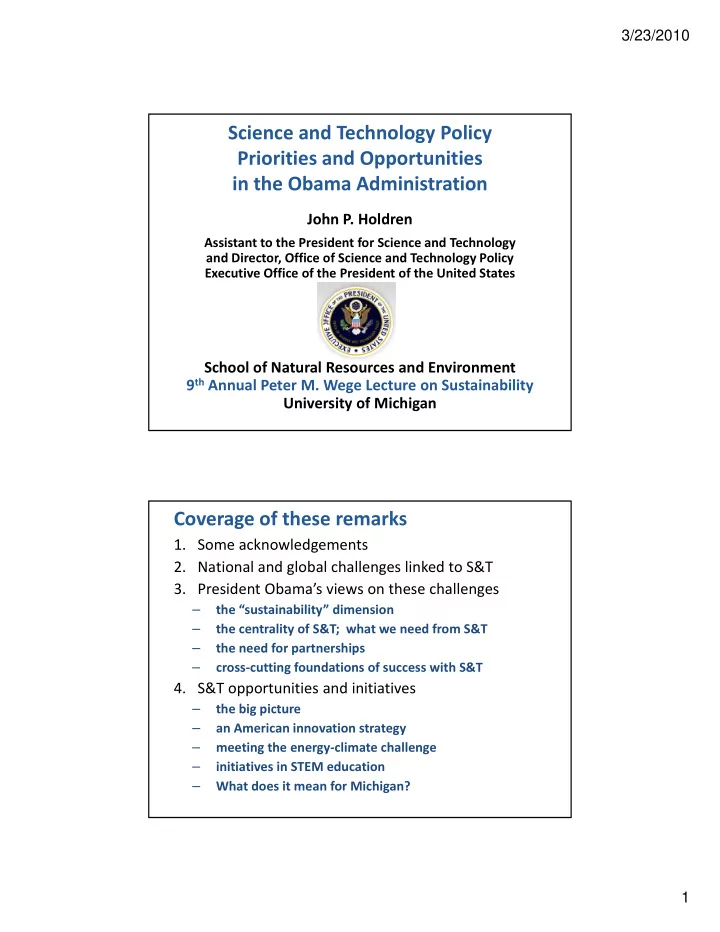
Science and Technology Policy Priorities and Opportunities in the Obama Administration

John P. Holdren

Assistant to the President for Science and Technology and Director, Office of Science and Technology Policy Executive Office of the President of the United States

School of Natural Resources and Environment 9th Annual Peter M. Wege Lecture on Sustainability University of Michigan

Coverage of these remarks

  • 1. Some acknowledgements
  • 2. National and global challenges linked to S&T
  • 3. President Obama’s views on these challenges

th “ t i bilit ” di i – the “sustainability” dimension – the centrality of S&T; what we need from S&T – the need for partnerships – cross‐cutting foundations of success with S&T

  • 4. S&T opportunities and initiatives

– the big picture the big picture – an American innovation strategy – meeting the energy‐climate challenge – initiatives in STEM education – What does it mean for Michigan?

slide-2
SLIDE 2

3/23/2010 2

Peter M. Wege

Environmentalist Businessman Businessman Philanthropist Author Thank you for all that you’ve done and do! Jerome B Wiesner Jerome B. Wiesner

1915-1994 U of Mich College of Engineering: BS 37, MS 38, PhD 50 Science Advisor to President John F. Kennedy President of MIT Mentor in science & technology policy to me & many more

slide-3
SLIDE 3

3/23/2010 3

Michigan grads among my colleagues in the Obama Administration

Valerie Jarrett

Senior Advisor to the President

Raj Shah

Administrator, USAID

Ken Salazar

Secretary of Interior

Melody Barnes

Director, Domestic Policy Council

Cecilia Muñoz

Director, Intergovernmental Affairs

More Michigan grads in the Obama Administration: a sustainable flow of leaders

Jocelyn Frye

Deputy Assistant to the President and

Roberto Rodriguez

Special Assistant to the President for Education Policy

t e es de t a d Director of Policy & Projects for the First Lady

Rand Beers

Undersecretary, Dept of Homeland Security

Zach Lemnios

Director, Defense Research and Engineering, DoD

slide-4
SLIDE 4

3/23/2010 4

Wolverines in the White House Office of Science and Technology Policy (OSTP)

Dr Sridhar Kota Dr Jag Pamulapati Dr Sridhar Kota

Professor of Mechanical Engineering, on leave as OSTP Assistant Director of Advanced Manufacturing and ASME Fellow

Dr Rosina M Bierbaum

Professor and Dean, SNRE, Member of President Obama’s Council of Advisors on Science and Technology, Former OSTP Associate Director for Environment, Former Acting Director of OSTP

Dr Jag Pamulapati

3 UM degrees, Senior Policy Analyst, National Security and International Affairs

Challenges linked to S&T: US national

  • economic recovery & growth: S&T as drivers

(infotech, biotech, nanotech, greentech...?)

  • health care: better outcomes for all at lower cost
  • health care: better outcomes for all at lower cost
  • energy: reduced oil imports and conventional &

heat‐trapping pollution

  • other resources & environment: water, agricul‐

ture toxics climate‐change adaptation ture, toxics, climate change adaptation

  • national & homeland security: scientific intelli‐

gence, cyber‐ & power‐grid security, reducing risks from nuclear & biological weapons

slide-5
SLIDE 5

3/23/2010 5

Challenges linked to S&T: Global

  • deploying S&T to help with poverty eradication

and development

  • combating preventable and pandemic disease
  • combating preventable and pandemic disease
  • transforming the global energy system and land‐

use practices to avoid catastrophic climate change

  • maintaining the ecological integrity and

productivity of the oceans productivity of the oceans

  • reducing risks from nuclear & biological weapons

President Obama’s views on these challenges

  • They are all about aspects of “sustainability”.
  • The challenges are interdisciplinary and interlinked.
  • S&T are not just germane to success but central.

S&T are not just germane to success but central.

  • Success requires attention not just to “applied” goals but

also to cross‐cutting foundations of strength in S&T.

  • Centrality means moving S&T back to the center of what

the federal government thinks, says, and does about these challenges “Science in its rightful place ” these challenges – “Science in its rightful place.”

  • Interdisciplinarity & interconnectedness mean solutions

require partnerships – across federal agencies; branches & levels of government; public, private, & philanthropic sectors; and nations – “All hands on deck.”

slide-6
SLIDE 6

3/23/2010 6

The sustainability dimension

Foundations of sustainable well-being

Human well-being rests on three pillars, the care & sustain- ment of which are the core responsibilities of society:

  • economic conditions and processes

such as employment income wealth markets trade such as employment, income, wealth, markets, trade, productive technologies…

  • sociopolitical conditions and processes

such as law & order, national & homeland security, governance, justice, education, health care, science, culture & the arts, liberty, privacy…

  • environmental conditions and processes

such as air, water, soils, mineral resources, the biota, nutrient cycles, climatic processes… Government must provide for some of these & establish the rules under which other sectors provide for the rest.

slide-7
SLIDE 7

3/23/2010 7

Sustainable well-being (continued)

  • All of the pillars are indispensable, and they inter-

act both for good & for ill.

The economic system cannot function without inputs from th i t l t it f ti ith t the environmental system, nor can it function without elements of societal stability provided by the sociopolitical

  • system. Societal stability itself cannot be maintained in

the face of environmental disaster (Haiti, Katrina).

  • Sustainability requires improvements in human well-

being be sought by means and to end-points being be sought by means and to end points consistent with maintaining the improvements indefinitely.

Satisfying this criterion requires taking into account the interactions among the pillars.

The centrality of S&T: What do we need?

  • The Economy: innovation that yields better

manufacturing techniques, new and better products & services for high-quality, sustainable jobs…

  • Health: new IT tools for medical records, doctor-

doctor & doctor-patient interaction; better, cheaper diagnostics; faster vaccine development & production; cancer therapies that target only cancer cells cancer cells…

  • Energy: better batteries, cheaper photovoltaic

cells, lower-impact biofuels, CO2 capture & sequestration, safer nuclear fuel cycles, fusion…

slide-8
SLIDE 8

3/23/2010 8

What we need from S&T (continued)

  • Climate Change: better monitoring in-situ & from

space; better models on faster computers; regional disaggregation of impacts to support adaptation, better scientific communication for public understanding…

  • National & Homeland Security: better defenses

against cyber-threats; better detection of conventional & nuclear explosives and of conventional & nuclear explosives and of clandestine weapons facilities; faster identification

  • f and response to bio-threats…

The need for partnerships

Pres Obama meeting with his Council of Advisors on Science & Technology 3-12-10

slide-9
SLIDE 9

3/23/2010 9

Cross‐cutting S&T foundations of success

  • the institutions that do most of our basic research

(research universities, national & private labs)

  • other key infrastructure: IT/broadband, energy,
  • ther key infrastructure: IT/broadband, energy,

transportation

  • science, technology, engineering, & math (STEM)

education: pre‐ to grad‐school and lifelong

  • capabilities in space: communications, Earth

capabilities in space: communications, arth

  • bservation, geopositioning, science, exploration
  • effective institutional processes & guidelines

(IP, export controls, integrity, openness, visas)

Overview of President Obama’s Initiatives

Putting S&T in the center with appointments

  • A Nobel Laureate in physics as Energy Secretary
  • A world‐class marine biologist as NOAA head

g

  • 30+ appointees are members of the NAS, NAE, Institute
  • f Medicine, or American Academy of Arts and Sciences

Highlighting S&T with speeches & ceremonies

  • Speeches: campaign, inauguration, NAS Annual Meeting,

Cairo, Troy (American Innovation Strategy), MIT, SOTU… Cairo, Troy (American Innovation Strategy), MIT, SOTU…

  • Ceremonies: National Medals of ST&I, middle school

math & science winners, Presidential Awards for Science Teaching and Mentoring, Presidential Early Career Awards in Science and Engineering…

slide-10
SLIDE 10

3/23/2010 10

The President with the PECASE winners

U of Michigan Ass’t Prof of ECE Anthony Grbic is 4th from left in 2nd row

Overview of Initiatives (continued)

Investments in S&T

  • Science got a huge boost in the stimulus/recovery pkg

(ARRA) and the FY2009 / FY2010 budgets (NIH, NIST, NOAA, DoD basic research, DOE‐science,...), giving 2009‐10 the highest federal research spending ever.

  • Total ARRA funds for S&T, including IT & transportation

infrastructure, applied energy technology, space exploration, approach $100 billion.

  • Investment goals announced last year: double budgets
  • f NSF, DOE science, NIST labs in 10 yr; make Research

& Experimentation Tax Credit permanent: lift public + private investment in R&D to ≥ 3% of GDP.

slide-11
SLIDE 11

3/23/2010 11

Overview of Initiatives (continued)

The President’s FY2011 S&T budget proposals

  • All federal R&D reaches $147.7 billion.
  • Nondefense R&D = $66 0 billion up 4 8% in real terms

Nondefense R&D = $66.0 billion, up 4.8% in real terms.

  • All research (basic + applied) grows 4.5% real.
  • Basic research = $33.0 billion, up 3.3% real.
  • DOD basic research reaches $2.0 billion, up 8.0% real.
  • NSF, DOE Office of Science, and NIST labs, with a total
  • f $13.3 billion, on track to double by 2017.
  • NASA R&D =$11.0 billion, up 17% real.

The President’s American Innovation Strategy

  • Invest in the building blocks of innovation

– restore leadership in fundamental research boost STEM education – boost STEM education – strengthen physical infrastructure – develop an advanced IT “ecosystem”

  • Promote competitive markets to spur innovation

l k h f d – support capital markets that fund innovation – encourage innovation‐based entrepreneurship – boost public‐sector & community innovation – promote American exports

slide-12
SLIDE 12

3/23/2010 12

The American Innovation Strategy (continued)

  • Catalyze breakthroughs for national priorities

– unleash a clean‐energy revolution support advanced vehicle technology – support advanced‐vehicle technology – drive breakthroughs in health IT – address other “grand challenges” of the 21st century

Initiatives on principles & procedures

  • Stem‐cell guidelines

– expanding stem‐cell lines that can be used with federal support while respecting ethical boundaries

  • Scientific integrity principles

– ensuring openness, transparency, reliance on peer‐ reviewed science across Federal agencies

  • Visa MANTIS procedures

t li i d f th MANTIS t th t – streamlining procedures for the MANTIS system that applies to visas for scientist & technologists, reducing backlogs and delays while preserving security

slide-13
SLIDE 13

3/23/2010 13

A new initiative on “procedures”: streamlining reporting on Federal research grants

  • Progress reports on grants rank as the top

administrative burden on faculty researchers.

  • The National Science and Technology Council,

managed by OSTP, has been pursuing remedies.

  • We’ve got one: OSTP and OMB have just agreed on a

simplified uniform grant progress‐report form – following posting of a draft version in the Federal Register and receiving extensive comments from the academic community – which will be finalized and communicated to all Federal agencies by April 15.

Meeting the energy‐climate challenge

  • The Administration remains committed to comprehen‐

sive energy‐climate legislation to help us:

– reduce dependence on foreign oil; – improve air & water quality; – cut back the carbon pollution that is changing the climate; – create new American jobs around the clean, domestic energy sources that will get all this done.

  • The climate‐change component of this challenge is real

and urgent and urgent.

– This is a fact‐based Administration; we’re not fooled by the campaign to inflate a few mistakes & missteps by climate scientists into doubt about the core findings of decades of peer‐reviewed climate science. You shouldn’t be, either.

slide-14
SLIDE 14

3/23/2010 14

The energy‐climate challenge (continued)

THE ADMINISTRATION’S ACTIONS TO DATE

  • $80 billion for clean & efficient energy in ARRA
  • creation of ARPA‐E ($400M in 2009‐10, $300M

creation of ARPA E ($400M in 2009 10, $300M proposed for 2011), energy‐innovation hubs

  • first‐ever fuel‐economy/CO2 tailpipe standards
  • strengthened bilateral partnerships on energy &

climate change w China, India, Brazil, Russia…

  • US Global Change Research Program increased to

$2.56 billion for FY2011 (19.4% real increase).

  • FY11 budget also restructures NPOESS for success,

funds Orbiting Carbon Observatory replacement.

The energy‐climate challenge (continued)

MORE ADMINISTRATION ACTIONS

  • Restructuring of NOAA to consolidate “climate

services” germane to climate‐change adaptation

  • Inter‐agency task force led by OSTP, CEQ, NOAA on

coordination of government’s adaptation activities; “Adaptation Summit” in late May will be co‐chaired by Dean Bierbaum

  • PCAST review of the effectiveness of the US energy‐

PCAST review of the effectiveness of the US energy innovation system (Moniz‐Savitz)

slide-15
SLIDE 15

3/23/2010 15

The STEM‐education initiative

  • Joint effort of the White House (Domestic Policy Council,

OSTP) and Dept of Education

  • New national goals: moving American kids from middle

t t f i t ti l ki i & th t t to top of international rankings on science & math tests, increasing American proportion of college graduates to first in the world by 2020.

  • $4.4 billion “Race to the Top” in the stimulus includes

priority for STEM education. “Ed t t I t ’t b i hil th i

  • “Educate to Innovate: gov’t‐business‐philanthropic

partnerships to improve K‐12 education in and out of school ($510M so far in non‐gov’t in‐kind & monetary contributions from Time Warner Cable, Discovery Channel, IBM, Gates & MacArthur foundations, & more)

Respecting achievement in STEM‐education: middle‐school math champs in the Oval Office

slide-16
SLIDE 16

3/23/2010 16

What do these priorities & projects mean for Michigan?

ENERGY:

  • $243 million to support the weatherization of homes
  • $82 million more to the State Energy Program
  • $77 million more for block grants for energy

efficiency

  • $18.5 million for UM Solar & Thermal Energy

Conversion program

  • $2.4 million for Delphi Corp to develop & test fuel‐cell

technology

  • A123 Systems using ARRA funds to expand capacity

to make advanced lithium‐ion batteries in MI.

Projects in Michigan (continued)

EDUCATION & RESEARCH:

  • $1.1 billion (including Title I funds, Pell grants)
  • $239 million for UM research

$239 million for UM research

  • Woodrow Wilson Michigan Teaching Fellowship Program

(UM + 5 other MI universities, Kellogg Foundation) under “Educate to Innovate” – training and placing middle‐ and high‐school teachers

  • 8 000+ new MI jobs from federal funding for expanded

8,000+ new MI jobs from federal funding for expanded stem‐cell research (including in U of Mich consortium)

  • 2 new Great Lakes research vessels from Stimulus funds

(Lake Ontario & Lake Erie)

slide-17
SLIDE 17

3/23/2010 17

Projects in Michigan (continued)

TRANSPORTION & COMMUNICATION INFRASTRUCTURE:

  • $847 million in highway funds to help build & repair

roads and bridges g

  • $135 million to build & repair public transportation

infrastructure

  • Merit Network, led by MI public universities, using ARRA

funds to build 955‐mi fiber‐optic network providing broadband to rural and underserved communities in 32 counties.

The best news for the future of S&T and sustain‐ ability: We have a President with vision.

“Astronomy for Kids on the White House Lawn”, October 7, 2009