School of Health Professions Institute of Nursing A Community-Based - - PDF document

school of health professions institute of nursing
SMART_READER_LITE
LIVE PREVIEW

School of Health Professions Institute of Nursing A Community-Based - - PDF document

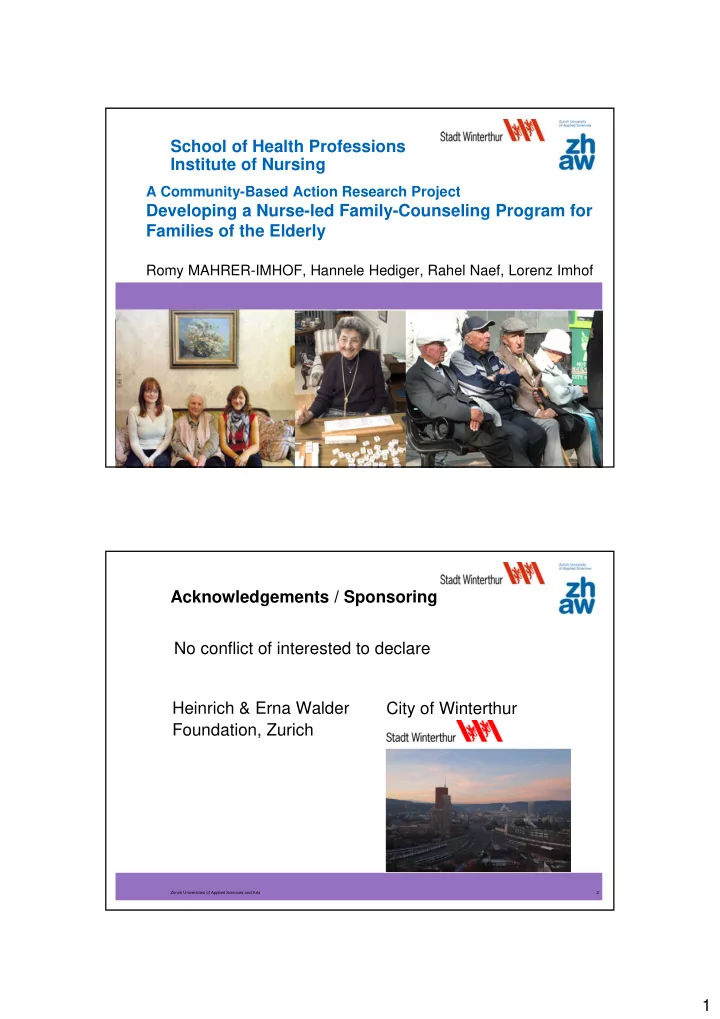
School of Health Professions Institute of Nursing A Community-Based Action Research Project Developing a Nurse-led Family-Counseling Program for Families of the Elderly Romy MAHRER-IMHOF, Hannele Hediger, Rahel Naef, Lorenz Imhof Bild 28.4 cm


slide-1
SLIDE 1

1

Zurich Universities of Applied Sciences and Arts

Bild 28.4 cm x 8 cm School of Health Professions Institute of Nursing

A Community-Based Action Research Project

Developing a Nurse-led Family-Counseling Program for Families of the Elderly

Romy MAHRER-IMHOF, Hannele Hediger, Rahel Naef, Lorenz Imhof

Acknowledgements / Sponsoring City of Winterthur Heinrich & Erna Walder Foundation, Zurich

2 Zurich Universities of Applied Sciences and Arts

No conflict of interested to declare

slide-2
SLIDE 2

2

3 Zurich Universities of Applied Sciences and Arts

  • Never before such high life expectancy
  • 20-25 years after retirement - more time than childhood and

adolescents

  • Different health status in the elderly
  • More generations live together over longer periods of time

4 Zurich Universities of Applied Sciences and Arts

Truth about age New challenges for all generations

Höpfliger et al,2012;Imhof et al,2012

slide-3
SLIDE 3

3 Families conquer the challenge

5

Family support for elderly people 80+ years

(N=459) N Mean ±SD sum

hours / week 459 22.3 48.3 10‘235 Intensive support (7/24) 40 168.0 6‘719 support (not 7/24) 419 8.4 18.3 3‘526

Imhof et al, 2012

slide-4
SLIDE 4

4 Methode: Community-Based Participatory Action Research (CBPR)

7 Zurich Universities of Applied Sciences and Arts

Glason et al, 2008

  • 2. Plan : Concept
  • Individual counseling for single family members and/or

family as a group

  • Peer group for family members
  • Public events for family caregivers

8 Zurich Universities of Applied Sciences and Arts

slide-5
SLIDE 5

5

  • 3. Reflect: Benefits of Counseling

Telling the story

  • Taking time

to open up with the nurse

  • Being

understood Realizing own situation

  • Accepting
  • wn needs
  • Overcoming

feelings of guilt Planning next steps

  • Asking for

help

  • Evaluating
  • ther

services Practicing

  • Addressing

need with relative

  • Organizing

free time

  • Trusting in
  • wn abilities

9 Zurich Universities of Applied Sciences and Arts

Start next CBPR - Cycle

  • Announcing the counseling program
  • Including more family members in research group
  • Adapting questionnaires
  • Proactive follow-up by counseling team

10 Zurich Universities of Applied Sciences and Arts

slide-6
SLIDE 6

6

Plan

Evaluation

  • Individual counseling sessions

– Preparedness for care (Family Care Inventory, Archbold et al,2001) – Caregiver Burden (Cargiver Burden Scale, Barkas 2004) – Ecomap and Genogram – Satisfaction with counseling (ANP-IQ, Imhof et al, 2010) – Benefit of counseling (semi-structured interviews)

11 Zurich Universities of Applied Sciences and Arts

Implement

Caregiver Characteristics

Caregivers (n=16)

Gender, n (%) female 12 (75) Age in years, M ± SD (range), n=12 52.5 ± 15.4 (24-87) Marital status, n (%1) Married/partnered 9 (75) widowed 1 (8) unmarried / single 1 (8) divorced 1 (8) no data 4 Relation to care recipient, n (%) partner 2 (13) children 11 (69)

  • thers

3 (19)

12 Zurich Universities of Applied Sciences and Arts

slide-7
SLIDE 7

7

Implement

Caregiver Characteristics II

Same household no 14 (88) Main Caregiver yes 8 (50) Caregiving time (n=8) In years, M ±SD (range) 5.8 ± 5.7 (0-16) In hours/week, M ±SD (range) 58 ± 85 (0-168)

13 Zurich Universities of Applied Sciences and Arts

Implement

Care recipients Characteristics

Care recipients (n=13) gender, n (%) female 7 (54) Age in years, M ± SD (range), n=12 82.3 ± 9.1 (64-92) Marital status, n (%1) Married / partnered 3 (25) widowed 7 (58) single divorced 2 (17) No data 1 Number of Children, M ± SD (range), n=12 2 ± 1.5 (0-5) Lives alone, n (%1) yes 9 (69)

14 Zurich Universities of Applied Sciences and Arts

slide-8
SLIDE 8

8 Support Services

Services Care recipients (n=13) Community nursing 4 Household aid 1 Cleaning lady 2 Day care 2 Healer 1 Alarm system 1 Visiting service 1 Meals on wheals 1 No services 6

15 Zurich Universities of Applied Sciences and Arts

Topics

Use of ressources Auxilliary materials at home, maintance of flat, living situation at home 18 Respite Care Nursing home, Day resp. Night care, Community nursing, 18 Health of care recipient Dementia, cognitive deline, depression 10 Challenging behavior of care recipient Aggression, refusal , decline of communication skills, personality changes 9 Caregiver Guilt, shame, own health, relief of strains 9 Legal issues Will, inheritance, pension claim 7 Family conflicts Demarcation disputes, relationship among family members 5 Helth care system Conflict with nursing staff, transportation 3

16 Zurich Universities of Applied Sciences and Arts

slide-9
SLIDE 9

9

Reflecting

Caregiver Burden

pre (n=6) post (n=6) p-value1 Burden2, M ± SD (range), 65.6 ± 30 (12-100) 50.6 ± 33.1 (17-100) .23

17 Zurich Universities of Applied Sciences and Arts

1 Wilcoxon-Test, Z-value=-1.214; 2Scale: 0=no burden to100=very high burden

Reflecting

Preparedness

18 Zurich Universities of Applied Sciences and Arts

pre (n=8) post (n=8) p- value1 Preparedness, M ± SD (range), 2.0 ± .62 (.63-2.5) 2.4 ± .58 (1.4-3.0) .067

1 Wilcoxon-Test, Z-value=-1.832; 2Scale: 0= not at all prepared to 4=very well prepared

slide-10
SLIDE 10

10

Reflecting

Feedback

  • a very competent, and warm hearted person with a lot of

empathy allowed an open and informative exchange of ideas.

  • The conversation was without any stress. The high amount of

sympathy eased the situation.

  • I could distance myself from the situation of my mother which

made it possible to consider new interventions. I felt very well supported and understood. We focused on core problems. Thanks a lot.

19 Zurich Universities of Applied Sciences and Arts

Conclusions Family Counseling

  • Counseling families at home
  • Nurses as liason person to existing networks and services
  • Educated Advanced Practice Nurses
  • Principles of empowerment and self management
  • Focus on skill building and well-being

20 Zurich Universities of Applied Sciences and Arts

slide-11
SLIDE 11

11 Conclusions CBPR

  • Stamina is needed for CBPR
  • New skills in advertising and marketing are necessary
  • Needs time

21 Zurich Universities of Applied Sciences and Arts

Questions?

22 Zurich Universities of Applied Sciences and Arts

slide-12
SLIDE 12

12

23 Zurich Universities of Applied Sciences and Arts

Thank you

Romy Mahrer Imhof, PhD, RN Professor family-centered nursing University of Applied Sciences

  • Technikumstr. 71

8401 Winterthur romy.mahrer@zhaw.ch

Bild 13.2 cm x 13.2 cm bitte Feld löschen Acknowledgement Team

  • Jutta Dreizler, Brigitte Benkert, Michelle Bruylands, Eva Geiser,

Mrs Hablützel, Mrs. Kolb, Mrs Gubler

  • City Council for the elders, Andreas Paintner, Jeannette

Höfliger, Roland Wellauer, Brigitte Trechsel

  • Family members of the Alzheimer Support Group
  • Families in the city of Winterthur
  • Nurses from the community service
  • Member of the City Council and Ministry of Social Affairs:

Barbara Günthard, Nicolas Galladé

24 Zurich Universities of Applied Sciences and Arts