' School Finance Hot Topics - October 11, 2017 Upcoming WVDE Training - - PDF document

school finance hot topics october 11 2017 upcoming wvde
SMART_READER_LITE
LIVE PREVIEW

' School Finance Hot Topics - October 11, 2017 Upcoming WVDE Training - - PDF document

' School Finance Hot Topics - October 11, 2017 Upcoming WVDE Training Sessions - Save the Dates Winter WVEIS- December 8, 2017 at Embassy Suites in Charleston OSF Summer Conference -July 17 -19, 2018- Location TBD Certified List of


slide-1
SLIDE 1

'

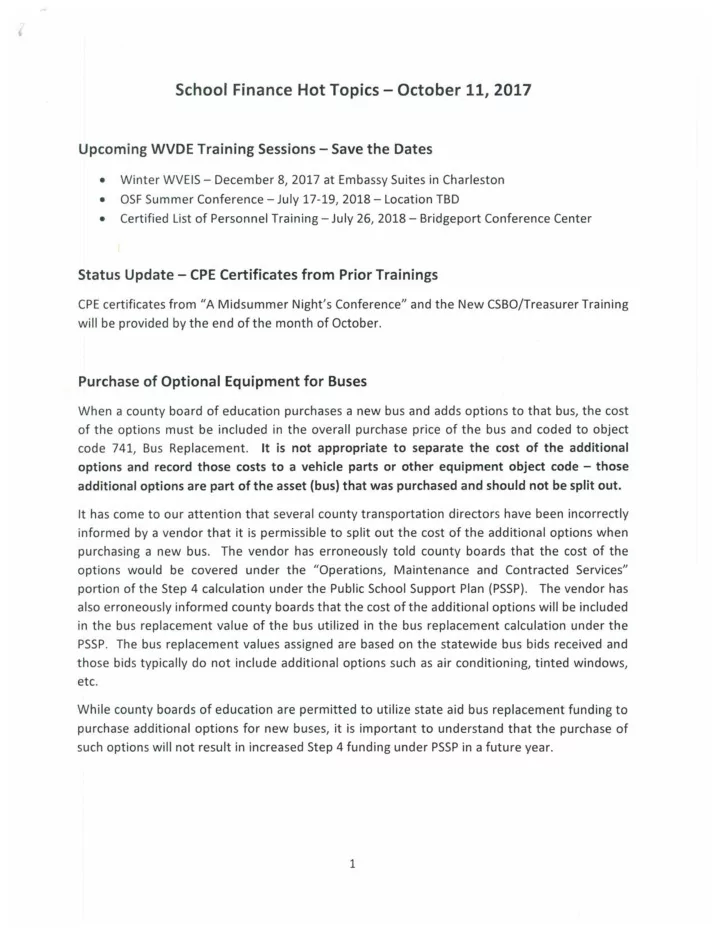
School Finance Hot Topics - October 11, 2017

Upcoming WVDE Training Sessions - Save the Dates

  • Winter WVEIS- December 8, 2017 at Embassy Suites in Charleston
  • OSF Summer Conference -July 17-19, 2018- Location TBD
  • Certified List of Personnel Training -July 26, 2018 - Bridgeport Conference Center

Status Update - CPE Certificates from Prior Trainings

CPE certificates from "A Midsummer Night's Conference" and the New CSBO/Treasurer Training

will be provided by the end of the month of October.

Purchase of Optional Equipment for Buses

When a county board of education purchases a new bus and adds options to that bus, the cost

  • f the options must be included in the overall purchase price of the bus and coded to object

code 741, Bus Replacement. It is not appropriate to separate the cost of the additional

  • ptions and record those costs to a vehicle parts or other equipment object code - those

additional options are part of the asset (bus) that was purchased and should not be split out. It has come to our attention that several county transportation directors have been incorrectly informed by a vendor that it is permissible to split out the cost of the additional options when purchasing a new bus. The vendor has erroneously told county boards that the cost of the

  • ptions would be covered under the "Operations, Maintenance and Contracted Services"

portion of the Step 4 calculation under the Public School Support Plan (PSSP). The vendor has also erroneously informed county boards that the cost of the additional options will be included in the bus replacement value of the bus utilized in the bus replacement calculation under the

  • PSSP. The bus replacement values assigned are based on the statewide bus bids received and

those bids typically do not include additional options such as air conditioning, tinted windows, etc. While county boards of education are permitted to utilize state aid bus replacement funding to purchase additional options for new buses, it is important to understand that the purchase of such options will not result in increased Step 4 funding under PSSP in a future year. 1

slide-2
SLIDE 2

Medicaid - SB 231 and Related Implications

As mentioned previously, SB 231 passed during the 2017 Legislative Session and provided county boards of education flexibility in regards to Medicaid billing. The legislation states the

following under WVC §18-2-Sb: (b) The state board may delegate this provider status and subsequent reimbursement to regional education service agencies, county boards or both: Provided, That a county board is not required to seek reimbursement if it determines there is not a net benefit after consideration of costs and time involved with seeking the reimbursement for eligible services and that the billing process detracts from the educational program. Before a county board of education makes a determination that they will discontinue Medicaid billing, a cost benefit analysis must be performed in order to ascertain that there is no net benefit to the county. Several counties have asked if the cost benefit analysis required by SB 231 must be submitted to the WVDE Office of School Finance (OSF) for review. While that is not required by the Legislation, county boards of education are encouraged to share the file with OSF to help review for completeness and accuracy and to confirm the conclusion reached by the county. County boards must retain a copy of the cost benefit analysis for their records in the event that the county's determination to stop billing is questioned in the future by the Legislature, CMS, etc. Please note that if a county board performs the cost benefit analysis and determines that they will stop billing for a particular service, changes cannot be made to the quarterly RMTS roster if the deadline has already passed for a particular quarter. The employees originally included on the roster will be expected to continue their participation in the RMTS for that quarter, responding to all moments received from PCG. Failure to respond to the moments will impact the overall response rate for the State as a whole for the cost pool in which the employee was included, which could unfairly penalize other county boards of education. Please be sure to inform employees that their continued response to moments is required until the employee can appropriately be removed from the roster. If the county stops billing on the fee-for-service side for particular services, no costs should be claimed on the quarterly or annual costs reports even if employees must continue to respond to moments due to a timing difference. However, because the individuals are still participating in the RMTS, county boards could also choose to continue billing fee-for-service for the remainder of the quarter and claim those costs on the cost reports. The simple rule of thumb is if you stop the fee-for-service billing for a service type, you also must not claim any costs for those individuals on the cost report. An unintended consequence of dropping out of the Medicaid billing process is that the employees of county boards who remain in the RMTS each quarter will receive more random

  • moments. There are a set number of moments required statewide in order to have a valid

2

slide-3
SLIDE 3

(

sample size, so having fewer participants in the RMTS pool means that each remaining employee will receive more moments. While there is no requirement under SB 231 for a county to take the other county boards into consideration when making the Medicaid billing determination for their county, it is important for all county boards of education to fully understand the implications of the decision to stop billing.

Medicaid MOUs

A copy of the fully-executed Medicaid MOUs were mailed to county CSBOs approximately 1.5 weeks ago. If you didn't receive your copy, please email Amy Willard at awillard@k12.wv.us.

PEIA Reallocation - County Tools

As a reminder, there is a tool on the WVDE website for county boards of education to estimate

their final PEIA funding for the current year using data from their recently submitted certified list of personnel. The tool can be found at the link below under "Forms-Checklists- Templates

> PEIA Reallocation Estimate." The Excel file includes instructions on how to obtain the data, fill

  • ut the excel spreadsheet, etc.

http://wvde.state.wv.us/finance/

CSBOs are strongly encouraged to complete the PEIA reallocation tool so that the budgetary impact on your county can be identified earlier in the fiscal year. It is normally mid-Spring each year before the Office of School Finance obtains the retiree premium amounts and finalizes the reallocation calculation, but county boards can perform their own estimates as early as late October or early November.

FAQ: Can county boards of education trade in county-owned vehicles towards the purchase of a new or used vehicle?

Yes, county-owned vehicles can be traded-in towards the purchase of a new or used vehicle. State Board Policy 8200, Section 31.2 discusses the trade-in of surplus personal property towards the purchase of a replacement item. See applicable section below.

31.2. Disposal of Personal Property:

31 .2.1. At any time a LEA determines that any personal property, including

equipment, portable building, or motor vehicle, including school bus, school furniture, computers, or other personal property is no longer needed for school purposes, the purchasing director, in

3

slide-4
SLIDE 4

cooperation with the Chief School Business Official may declare the property surplus and dispose of the property in the most economical method for the benefit of the LEA 31.2.2. The property may be disposed of in several ways: discarded or junked if it is determined not to have any salvageable value, traded in towards the purchase of a replacement item, sold at public auction, by competitive bid to the highest bidder, by fixed price, or contributed to:

  • a. The state or political subdivisions, including county commissions
  • r agencies thereof;
  • b. A private, nonprofit, tax-exempt organization having been

granted tax-exempt status by IRS Code 501 (c) 3 through (8) inclusive, (19) or (23) for nominal consideration, provided that the property is for charitable, economic development or other community use. Certified List of Personnel FAQ: What is the appropriate education bonus/extra pay level for a service personnel who holds a Master's Degree?

Based on the statutory language contained in WVC § 18A-4-8a{c) through WVC §18A-4-8a(e), the appropriate education bonus/extra pay level for a service personnel holding a Master's Degree is BA+lS. To qualify for the additional $11 per month, the statute refers to a specific numbers of hours up through 120 college hours and then lists BA+lS, MA+lS, MA+30, MA+45, and MA+60 as additional options to qualify for the additional pay. A service person holding a Master's Degree exceeds the BA+lS level but has not reached the MA+lS level. It is important to also note that the Education Level of Master's Degree will also qualify the service person for an additional $40 per month for holding the higher degree level.

Cooperative Agreement FAQ: If two or more county boards of education enter into direct cooperative arrangements with each other to share personnel, how will this impact the state aid funding calculations?

In situations where two county boards enter into agreements directly with each other, the county that hires the employee will report the portion of the employee's salary that is being paid by the other county(s) as funding source 8 (other sources) on the certified list of

  • personnel. Therefore, only the portion of the employee that is being paid directly by the hiring

county would potentially count as a funding source 1 (state aid) on the certified list of personnel (assuming the position is a state aid eligible position). Only that portion of the

4

slide-5
SLIDE 5

(

position would be included in the FTE count in the state aid funding calculations, and depending

  • n the other staffing in the county, could be reflected as being "over formula."

For example, Wirt County and Calhoun County are sharing a Child Nutrition Director this

  • year. Wirt County has employed the individual. Assuming a 50/50 split of the salary between

the two county boards, the individual will be listed on the Wirt County certified list of personnel

as 0.50 FTE under funding source 8 (other sources) and 0.50 FTE as funding source 4

(county). The Child Nutrition Director is not a state aid eligible position. If this was a state aid eligible position, the second 0.50 FTE would be funding source 1 (state aid) and be counted in the state aid funding calculations. With the funding formula changes under HB2561, state aid funding is no longer reduced if a county employs less personnel than would be funded based on the enrollment limits. Therefore, there is currently no funding formula disincentive to enter into a direct cooperative arrangement with other county boards of education to share resources.

5