School education in Scotland Pupil numbers by stage: 70,000 - - PowerPoint PPT Presentation

school education in scotland
SMART_READER_LITE
LIVE PREVIEW

School education in Scotland Pupil numbers by stage: 70,000 - - PowerPoint PPT Presentation

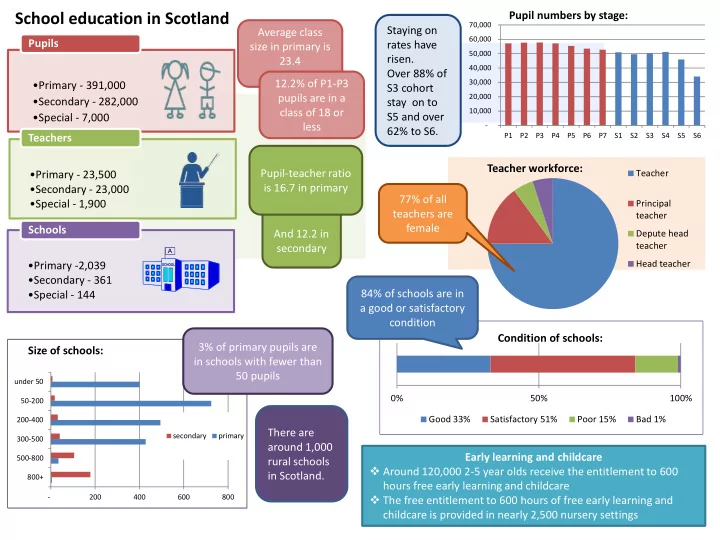
School education in Scotland Pupil numbers by stage: 70,000 Staying on Average class Pupils 60,000 rates have size in primary is 50,000 risen. 23.4 40,000 Over 88% of 12.2% of P1-P3 30,000 Primary - 391,000 S3 cohort pupils are


slide-1
SLIDE 1

Average class size in primary is 23.4 Staying on rates have risen. Over 88% of S3 cohort stay on to S5 and over 62% to S6. There are around 1,000 rural schools in Scotland.

  • Primary - 391,000
  • Secondary - 282,000
  • Special - 7,000

Pupils

  • Primary - 23,500
  • Secondary - 23,000
  • Special - 1,900

Teachers

  • Primary -2,039
  • Secondary - 361
  • Special - 144

Schools

  • 10,000

20,000 30,000 40,000 50,000 60,000 70,000 P1 P2 P3 P4 P5 P6 P7 S1 S2 S3 S4 S5 S6

Pupil numbers by stage:

  • 200

400 600 800 800+ 500-800 300-500 200-400 50-200 under 50 secondary primary

Size of schools:

School education in Scotland

3% of primary pupils are in schools with fewer than 50 pupils

0% 50% 100% Good 33% Satisfactory 51% Poor 15% Bad 1%

84% of schools are in a good or satisfactory condition 12.2% of P1-P3 pupils are in a class of 18 or less And 12.2 in secondary

Teacher Principal teacher Depute head teacher Head teacher

Teacher workforce: 77% of all teachers are female Pupil-teacher ratio is 16.7 in primary Condition of schools: Early learning and childcare  Around 120,000 2-5 year olds receive the entitlement to 600 hours free early learning and childcare  The free entitlement to 600 hours of free early learning and childcare is provided in nearly 2,500 nursery settings

slide-2
SLIDE 2

No matter what data we use,

  • r which aspect of attainment

we look at, there is a clear gap between children from more deprived and less deprived backgrounds.

“There is significant variation in attainment between individual councils, schools and groups of pupils.”

Attainment

The majority of P4 and P7 pupils are performing well or very well in literacy and numeracy... ...However there were small decreases in performance in reading and writing between 2012 and 2014 at the majority

  • f stages.

...And a decreased numeracy performance between 2011 and 2015 There are signs that the attainment gap is reducing on some measures. There is an improving picture for those leaving school with low or no levels or qualification. The difference in the proportions from the most and least deprived areas achieving at least one SCQF 5 qualification or better has reduced (33 percentage points in 09/10 to 21 points in 14/15.) But the gap in terms of those achieving 5 or more awards at SCQF5

  • r better has decreased at a much

slower rate (down 5.6 percentage points since 09/10). Attainment is rising:

  • Very few young people leave school with

no or very low levels of qualifications (2.1% in 14/15)

  • 152,701 Higher passes in 2016, up more

than 40,000 since 2006 Positive destinations for our young people are rising - 92% of 2014/15 school leavers were in a positive follow up destination in March 2016.

92%

The Scottish Survey of Literacy and Numeracy shows that:

slide-3
SLIDE 3

Education Expenditure Secondary £1,929 m (40%) Primary £1,852 m (38%) Special schools £533m (11%) Early Years and Childcare £346 m (7%) Other £156 m (3%)

Education is the largest service area – The 32 councils plan to spend 41% of service expenditure

  • n education in 2016-17

Teachers 54% Other Employees 14% Support Services 4% All Other Expenditure 28% All teachers in schools and those centrally employed by LAs All non-teaching staff employed in schools and non- teaching staff employed by LA education services Running school buildings, school meals, school transport, textbooks etc, some elements of unitary charge payments Services purchased to support delivery (e.g. IT or finance bought within an LA) Average spend per pupil of £4,814 Average spend per pupil of £6,790

£- £2,000 £4,000 £6,000 £8,000 £10,000 Scotland average

Average spend per pupil in primary, by local authority

Island authorities

Spending on education by local authorities

Councils spent £4.8 bn on education in 2014-15 Over half of spend on primary, secondary and special education is on teachers There is wide variation between councils in spend per pupil

Average spend per child of around £2,900 a year

slide-4
SLIDE 4

Others A range of other partners support children’s learning including private and third sector providers; local community organisations and charities as well as other local services such as social work, the police, employers, colleges and universities

Parents School Local National

How is Education in Scotland run now?

The Scottish Government, local government, national agencies and other bodies each play different roles in governing, leading and supporting the delivery of education

Scottish Government

  • Develops national policy and sets overall direction
  • Gives majority of funding to local authorities for

education

  • Legal duty to improve education and powers to

raise standards

  • Legal duty to promote involvement of parents in

education

Child

Education Scotland

  • Supports quality and improvement
  • Responsible for supporting schools to deliver

Curriculum for Excellence and for school inspection. 8 Universities

  • Provide

teacher education 32 Local Authorities (as Education Authority)

  • Duty to provide “adequate and efficient” school

education and early years provision

  • Employment of school and some early years staff
  • Decide how much money to give to schools
  • Number of other duties, for example; providing for

additional support needs; consulting on school estate, arranging school transport, school opening, closing and holiday dates Scottish Qualifications Authority

  • Develops school examinations

and awards school qualifications

  • Also has responsibility for other

qualifications (such as HNC’s) General Teaching Council for Scotland

  • Sets teaching standards
  • Accredits teacher training
  • Oversees induction, professional learning

and student placement programmes Headteachers

  • Day to day running of school
  • Share responsibility with local

authority for management and delivery of curriculum

  • Some funding decisions

Early Years staff & Teachers

  • Deliver day to day care and

learning to children in early years settings and schools Care Inspectorate

  • Regulates and inspects the standard of

care services, including in early years, and residential schools Parents have a range of rights and responsibilities, including

  • Responsibilities to ensure their children: are properly educated at

school age; attend school; obey school rules.

  • Rights to: children being educated in line with their

religious/philosophical beliefs; to choose school; to be consulted and appeal against decisions on additional support needs.

  • Parent Councils represent the voice of parents in their school

Scottish College for Educational Leadership

  • Responsible for developing

leadership and programmes Children and Young People

  • Children have

rights to be heard and involved in decisions about their education Scottish Social Services Council

  • Regulator for the social

service workforce Scottish Qualifications Authority

  • Develops school

examinations and awards qualifications