
SLIDE 1
Key environmental problems facing Scotland Flooding In Scotland - - PowerPoint PPT Presentation
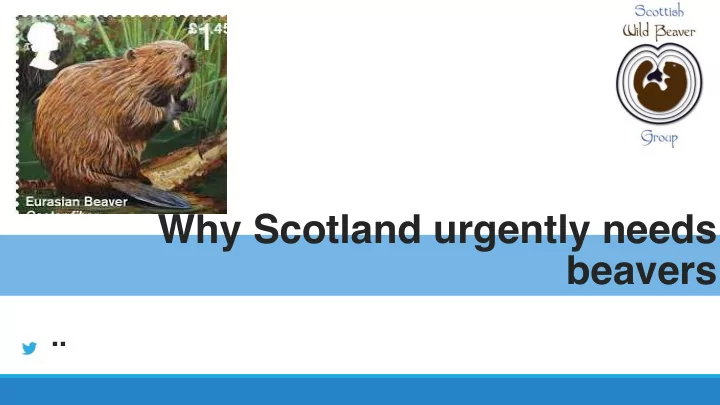
Why Scotland urgently needs beavers .. Key environmental problems facing Scotland Flooding In Scotland around 108,000 properties are at risk of flooding Estimated annual flood costs are in the region of 252 million Flood Risk Management
In Scotland around 108,000 properties are at risk of flooding Estimated annual flood costs are in the region of £252 million
Flood Risk Management Strategy NE, SEPA 2015. Photos by ki
Annualized cost of loss of organic soil from arable land and associated loss of CO2 in Scotland - £60.5 million (2009)
(Dobbie et al, 2011) ; Photos: W
Red areas = subject to rural diffuse pollution.
… where nutrients, pesticides, faecal bacteria, chemicals are lost from the land into local burns, rivers, lochs and groundwater as a result of surface runoff.
Watchlist Indicator showing the average population trend for 77 moths, 19 butterflies, 8 mammals and 51 birds listed as UK Biodiversity Action Plan priorities, 1968-2010.
(Graph
There is one small thing that we can do in Scotland to make a really significant difference …
Why wetlands?
pesticides) and prevent eutrophication.
(Scallen, 2008)
… encourage beavers to build them.
Beavers are nature’s hydro engineers - extremely efficient builders
(Halley et al. 2012; Photo: Derek Gow)
plants
now present in Knapdale (RZSS/SWT trial) and Tayside
countries of their former range.
(cf. France 10,000; Germany 15,000, Poland 41,000, Norway 80,000)
Beavers dams can reduce floods, moderate flow velocity and effects
Flow in and out of a Beaver site during a storm event
During storm events, beaver dams reduced peak discharges by 34%.
(Nyssen et al., 2011; Puttock et al., 2016)
Eurasian Beaver have now been reintroduced specifically to combat floods at sites in Cornwall, Essex and Yorkshire
Studies have found beaver ponds can...
blooms
(Wohl, E 2013; Bason et al., 2017; Bledzki et al., 20
Cleaner rivers not only benefit invertebrates and fish, but humans too
Stirling University research found "a massive (148%) increase" in local plant life where beaver dams are present Who else benefits?
(Law et al., 2017; Gaywood, 2018;)
“a very positive influence on biodiversity” SNH’s Martin Gaywood
drought
valuable source of environmental education and wildlife tourism
(Law et al., 2017; Johnston, 2014; Vowles N 2018; Scottish Wildlife Trust, 2016;)
Photos : SWT ; trip adviser / Outdoor Explore (Blairgowrie)
Pre-emptive engagement is key to build awareness of wide range of mitigation techniques
Pond Leveller Culvert protection Tree Wrapping Exclusion fence
solutions)
management plan
(Kemp et al., 2012; Bouwes et al., 2016, Bukaty and Leighton, 200
salmon specialists have become convinced that beavers will be a problem for Scottish salmon.
in Scandinavia in rivers very similar to Scottish ones, but the majority of evidence seems to point to more advantages than disadvantages. (Kemp Report). We don’t find this surprising.
Eurasian beaver is the first mammalian species reintroduction in UK. Beavers became a protected species in Scotland on 1 May 2019.
(Gaywood, 2018, Photo: Dory 2018, )
Current Management Framework is deeply flawed and raised several critical animal welfare and conservation issues. “Natural Expansion only” policy delays other parts of Scotland receiving beaver benefits in short term and limits translocation as a means of mitigation It effectively creates “no go zones” for beavers in large parts of Tayside – often where there benefits are most required.
have already been issued by Scottish Natural Heritage to landowners.
65% of beaver territory in Tayside) are not required to try alternative mitigation before applying for a lethal control licence.
period” (April - August ), any unweaned kits left in the beaver lodge will die of starvation.
(Campbell-Palmer, R., Puttock, A., Graham, H., Wilson, K., Schwab, G., Gaywood, M.J. & Brazier, R.E. 2018. Survey of the Tayside area beaver population 2017-2018. Scottish Natural Heritage Commissioned Report No. 1013. Photo: Featurepics)
Beaver wetlands will help towards improving our environment.
The Scottish environment is under threat in many ways, some of which are critically important for our economy. Beavers are not trouble free, but the modest cost of management will be repaid generously in environmental benefits
(Photo: Brightsea Print Group)
Bason, C. W., Kroes, D. E., & Brinson, M. M. (2017). The Effect of Beaver Ponds on Water Quality in Rural Coastal Plain Streams. Southeastern Naturalist, 16 (4), 584-602. Błȩdzki, L. A., Bubier, J. L., Moulton, L. A., & Kyker‐Snowman, T. D. (2011). Downstream effects of beaver ponds on the water quality of New England first‐and second‐order streams. Ecohydrology, 4(5), 698-707 Bouwes, N., Weber, N., Jordan, C. E., Saunders, W. C., Tattam, I. A., Volk, C., ... & Pollock, M. M. (2016). Ecosystem experiment reveals benefits of natural and simulated beaver dams to a threatened population of steelhead (Oncorhynchus mykiss). Scientific reports, 6, 28581. Boyles, S. L., & Savitzky, B. A. (2008). An analysis of the effjcacy and comparative costs of using flow devices to resolve conflicts with North American beavers along roadways in the coastal plain of Virginia. Proceedings 23rd Vertebrate Pest Conference, 23, 47-52. BTO/JNCC/RSPB (2016) Breeding Bird Survey, obtained from https://www.bto.org/volunteer-surveys/bbs/latest-results/trend-graphs Bukaty, R. F., & Leighton J. (2008) Photograph of Atlantic Salmon, obtained from https://www.ctvnews.ca/canada/atlantic-salmon-decline-getting- worse-conservationists-say-1.3464864 Campbell-Palmer, R. (2016). The Eurasian Beaver Handbook: Ecology and Management of Castor fiber. Pelagic Publishing Ltd. Campbell-Palmer, R., Puttock, A., Graham, H., Wilson, K., Schwab, G., Gaywood, M.J. & Brazier, R.E. 2018. Survey of the Tayside area beaver population 2017-2018. Scottish Natural Heritage Commissioned Report No. 1013. Carrington, D (2018) Oceans suffocating as huge dead zones quadruple since 1950, scientists warn, obtained from https://www.theguardian.com/ environment/2018/jan/04/oceans-suffocating-dead-zones-oxygen-starved Diaz, R. J., & Rosenberg, R. (2008). Spreading dead zones and consequences for marine ecosystems. science, 321(5891), 926-929.
Dobbie, K.E., Bruneau, P.M.C., Towers, W. The state of Scotland’s Soil 22 March 2011 Dory, N (2018) Photograph of beaver, obtained from http://resources4rethinking.ca/en/step-outside/nature-guides-archive/spring-2017/mid-june-2017 Gaywood, M. J. (2018). Reintroducing the Eurasian beaver Castor fiber to Scotland. Mammal Review, 48(1), 48-61. Halley D, Rosell F, savaljev A, 2012 Population and distribution of the Eurasian Beaver. Baltic Forestry 18 (1) Hood, G. A., & Larson, D. G. (2015). Ecological engineering and aquatic connectivity: a new perspective from beaver‐modified wetlands. Freshwater Biology, 60(1), 198-208. Hood, G. A., Manaloor, V., & Dzioba, B. (2017). Mitigating infrastructure loss from beaver flooding: A cost–benefit analysis. Human Dimensions of Wildlife, 1-14. Johnston, C. A. (2014). Beaver pond effects on carbon storage in soils. Geoderma, 213, 371-378. Kemp, P. S., Worthington, T. A., Langford, T. E., Tree, A. R., & Gaywood, M. J. (2012). Qualitative and quantitative effects of reintroduced beavers on stream fish. Fish and Fisheries, 13(2), 158-181. Law, A., Gaywood, M. J., Jones, K. C., Ramsay, P., & Willby, N. J. (2017). Using ecosystem engineers as tools in habitat restoration and rewilding: beaver and
Nyssen, J., Pontzeele, J., & Billi, P. (2011). Effect of beaver dams on the hydrology of small mountain streams: example from the Chevral in the Ourthe Orientale basin, Ardennes, Belgium. Journal of hydrology, 402(1-2), 92-102.
Pollock, M. M., Beechie, T. J., Wheaton, J. M., Jordan, C. E., Bouwes, N., Weber, N., & Volk, C. (2014). Using beaver dams to restore incised stream ecosystems. Bioscience, 64(4), 279-290 Priestley, S. (2017) Flood risk management and funding, House of Commons Library, briefing paper number CBP07514 Puttock, A., Graham, H. A., Cunliffe, A. M., Elliott, M., & Brazier, R. E. (2017). Eurasian beaver activity increases water storage, attenuates flow and mitigates diffuse pollution from intensively-managed grasslands. Science of the Total Environment, 576, 430-443. Scallen, D. (2008) Wetland Restoration? Leave it to Beaver, In the Hills, obtained from https://www.inthehills.ca/2008/03/wetland-restoration-leave-it-to-beaver/ Scottish Government (2018) Climate change, obtained from http://www.gov.scot/Topics/Environment/climatechange Scottish Wildlife Trust (2016) Beavers back for good – partners welcome return of the Eurasian beaver, obtained from https://scottishwildlifetrust.org.uk/news/beavers-back-for-good/ Scottish Beaver Trial (2018) Help secure protection for Scotland’s beavers, obtained from https://scottishwildlifetrust.org.uk/2018/03/help-secure-protection-scotlands-beavers/ SEPA (2018) National Water Scarcity Plan obtained from https://www.sepa.org.uk/environment/water/water-scarcity/ Stringer, A. P., & Gaywood, M. J. (2016). The impacts of beavers Castor spp. on biodiversity and the ecological basis for their reintroduction to Scotland, UK. Mammal review, 46(4), 270-283. Vowles, N. (2018) Universtiy of Sussex March Press Release: Post-Brexit farming subsidies could be used to pay farmers to host dam-building beavers, obtained from http:// www.sussex.ac.uk/broadcast/read/44311 Wohl, E. (2013) Landscape –scale carbon storage associated with Beaver dams. Geophysical Research Letters. Vol 40, Issue 14 pp 3631-3636 Wright, J. P., Jones, C. G., & Flecker, A. S. (2002). An ecosystem engineer, the beaver, increases species richness at the landscape scale. Oecologia, 132(1), 96-101. Wurzbacher, J. (2011) Ocean Dead Zones, obtained from https://www.sailorsforthesea.org/programs/ocean-watch/ocean-dead-zones.