Outpatient Systems Background Analyses: An Interprofessional 4.5 - - PowerPoint PPT Presentation

outpatient systems background analyses
SMART_READER_LITE
LIVE PREVIEW

Outpatient Systems Background Analyses: An Interprofessional 4.5 - - PowerPoint PPT Presentation

Outpatient Systems Background Analyses: An Interprofessional 4.5 million ambulatory care visits occur every year due to adverse drug events 1 Curriculum to Teach Patient Safety 5% of adults in the United States experience a missed or


slide-1
SLIDE 1

[ADD PRESENTATION TITLE: INSERT TAB > HEADER & FOOTER > NOTES AND HANDOUTS] 3/30/2016 1

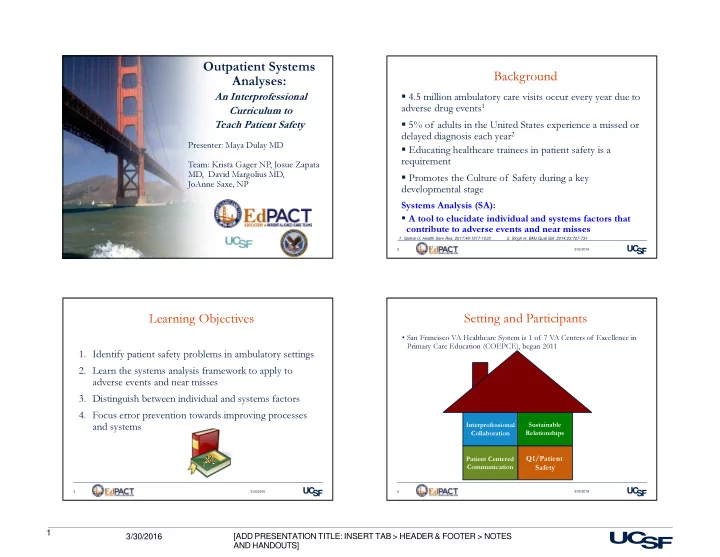
Outpatient Systems Analyses:

An Interprofessional Curriculum to Teach Patient Safety

Presenter: Maya Dulay MD Team: Krista Gager NP, Josue Zapata MD, David Margolius MD, JoAnne Saxe, NP

Background

4.5 million ambulatory care visits occur every year due to adverse drug events1 5% of adults in the United States experience a missed or delayed diagnosis each year2

3/30/2016 2

  • 1. Sarkar U, Health Serv Res. 2011;46:1517-1533
  • 2. Singh H, BMJ Qual Saf. 2014;23:727-731

Educating healthcare trainees in patient safety is a requirement Promotes the Culture of Safety during a key developmental stage

Systems Analysis (SA): A tool to elucidate individual and systems factors that contribute to adverse events and near misses

Learning Objectives

  • 1. Identify patient safety problems in ambulatory settings
  • 2. Learn the systems analysis framework to apply to

adverse events and near misses

  • 3. Distinguish between individual and systems factors
  • 4. Focus error prevention towards improving processes

and systems

3/30/2016 3

Setting and Participants

  • San Francisco VA Healthcare System is 1 of 7 VA Centers of Excellence in

Primary Care Education (COEPCE), began 2011

3/30/2016 4

Interprofessional Collaboration Sustainable Relationships Patient Centered Communication

QI/Patient Safety

slide-2
SLIDE 2

[ADD PRESENTATION TITLE: INSERT TAB > HEADER & FOOTER > NOTES AND HANDOUTS] 3/30/2016 2

Setting and Participants

  • Participants 2011-2015:
  • 69 medicine residents
  • 20 NP students
  • pharmacy resident
  • Each learner attends 2-3 one-hour SA sessions in 1yr and

presents 1 case as part of a pair

  • Patient Safety Faculty:
  • 1 MD, 2 NP, Quality & Safety Chief Residents

3/30/2016 5

Outpatient SA Curriculum Design Prep

  • Faculty emails trainee pairs intro and

expectations (at least 2 weeks prior)

  • Trainees choose personal case with near

miss/adverse event

  • Mini case review: Trainee pairs prepare SA

worksheet

3/30/2016 6

  • 1. Collect

information

  • 2. Construct

timeline

  • 3. Identify

key events

  • 4. Classify

contributing factors

  • 5. Propose

solutions

Outpatient SA Curriculum Design Conference

  • 2-3 Trainee teams present cases during one hour

conference

  • Review timeline, key events, identify adverse

event(s), sources of error

  • Small group discussion focuses on sources of

error and potential solutions

  • Faculty guides discussion and highlights learning

points

3/30/2016 7

Outpatient SA Curriculum Design Wrap-up

  • Trainee teams submit final worksheet with

updated recommendations

  • Recommendations communicated to key

stakeholders by faculty

  • Clinic Leadership, Clinic QI Huddle Board,

Office of Systems Improvement

  • Idea generating for future Trainee QI projects

3/30/2016 8

slide-3
SLIDE 3

[ADD PRESENTATION TITLE: INSERT TAB > HEADER & FOOTER > NOTES AND HANDOUTS] 3/30/2016 3

Results: Curriculum Evaluation

3/30/2016 9

4.6 4.4 4.6 4.6 1 2 3 4 5

Overall quality of session Estimated likelihood of making changes in practice as a result of the session Usefulness of activities/exercises during the session Usefulness of discussion during the session

Ratings Scale 1= Poor, 2=Fair, 3=Good, 4=Very Good, 5=Excellent

2011-15 SA session ratings by learners (n=160)

3/30/2016 10

SA Evaluation Conclusions and Lessons Learned

  • Highly rated, case-based approach to patient safety

education for interprofessional trainees in outpatient settings

  • Experiential learning an ideal medium to teach QI and PS
  • Communication errors were key contributing factors in our

SAs -> helps inform and reinforce the importance of our COEPCE patient and IP communication curriculum

3/30/2016 11

Conclusions and Lessons Learned

  • SAs can be a springboard for trainee-led QI projects and a

source of recommendations for clinic/facility leadership.

3/30/2016 12

slide-4
SLIDE 4

[ADD PRESENTATION TITLE: INSERT TAB > HEADER & FOOTER > NOTES AND HANDOUTS] 3/30/2016 4

Acknowledgements

  • QI & PS Team:
  • JoAnne Saxe, Krista Gager
  • Quality & Safety Chief Residents:

‒Krishan Soni ‒Aparna Goel ‒Emily Gottenborg ‒David Margolius ‒Josue Zapata

  • Jessica Chen, Christine Generans, Gillian Earnest

3/30/2016 13

Questions?

14