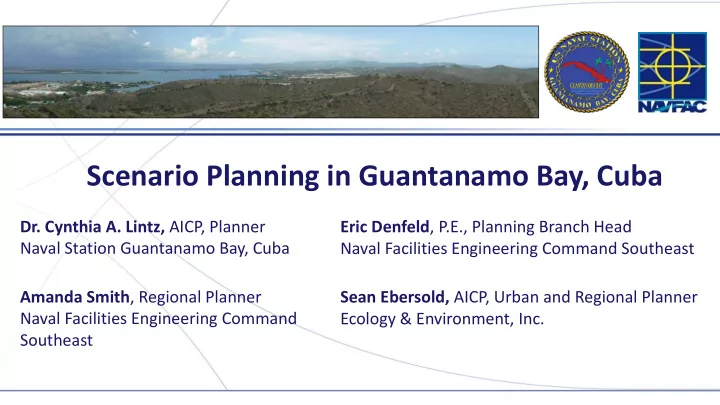
Scenario Planning in Guantanamo Bay, Cuba Dr. Cynthia A. Lintz, AICP, - - PowerPoint PPT Presentation

scenario planning in guantanamo bay cuba
SMART_READER_LITE
LIVE PREVIEW

Scenario Planning in Guantanamo Bay, Cuba Dr. Cynthia A. Lintz, AICP, - - PowerPoint PPT Presentation

Scenario Planning in Guantanamo Bay, Cuba Dr. Cynthia A. Lintz, AICP, Planner Eric Denfeld , P.E., Planning Branch Head Naval Station Guantanamo Bay, Cuba Naval Facilities Engineering Command Southeast Amanda Smith , Regional Planner Sean Ebersold,


slide-1
SLIDE 1

1

Scenario Planning in Guantanamo Bay, Cuba

  • Dr. Cynthia A. Lintz, AICP, Planner

Naval Station Guantanamo Bay, Cuba Eric Denfeld, P.E., Planning Branch Head Naval Facilities Engineering Command Southeast Amanda Smith, Regional Planner Naval Facilities Engineering Command Southeast Sean Ebersold, AICP, Urban and Regional Planner Ecology & Environment, Inc.

slide-2
SLIDE 2

2

Session Objectives

  • Provide background information about Naval Station Guantanamo Bay,

Cuba (NSGB)

  • Scenario planning overview
  • Discuss scenarios
  • Comparison with Guam

Photo: Michael C. Woods

slide-3
SLIDE 3

3

Location

Photo: Michael C. Woods

slide-4
SLIDE 4

4

Location

slide-5
SLIDE 5

5

Location

Photo: Michael C. Woods

slide-6
SLIDE 6

6

Climate

slide-7
SLIDE 7

7

Timeline

1903 US leases 45 square miles of land - 2,000 gold coins a year ($4,085). 1959 Castro’s communist revolutionaries take control. 1991 45,000 Cubans and Haitians are held in tent cities across the base. 2002 JTF Guantanamo activated to manage detention facility. 2009 President Obama takes office, vowing to close the detention facility. 2015 Cuba and the United States restore diplomatic relations.

Photo: Michael C. Woods

slide-8
SLIDE 8

8

Command Areas

Photo: Michael C. Woods

slide-9
SLIDE 9

9

Navy Master Planning

slide-10
SLIDE 10

10

Constraints

slide-11
SLIDE 11

11

Constraints

slide-12
SLIDE 12

12

Existing Conditions

Photo: Michael C. Woods

slide-13
SLIDE 13

13

Scenario Planning Overview “This present moment used to be the unimaginable future.”

Stewart Brand

Photo: Michael C. Woods

slide-14
SLIDE 14

14

Scenario Planning Overview

  • Scenario planning helps make sense and plan for an uncertain
  • future. It doesn’t predict the future.
  • Scenarios allow a shared view of the future to be developed, and

then…

  • Provide the opportunity for an organization to consider how it wants

to position itself in that future.

Maree Conway

slide-15
SLIDE 15

15

Scenario Planning Overview

  • Scenario planning helps make sense and plan for an uncertain
  • future. It doesn’t predict the future.
  • Scenarios allow a shared view of the future to be developed, and

then…

  • Provide the opportunity for an organization to consider how it wants

to position itself in that future.

Maree Conway

slide-16
SLIDE 16

16

Scenario Planning Overview

  • Scenario planning helps make sense and plan for an uncertain
  • future. It doesn’t predict the future.
  • Scenarios allow a shared view of the future to be developed, and

then…

  • Provide the opportunity for an organization to consider how it wants

to position itself in that future.

Maree Conway

slide-17
SLIDE 17

17

Scenario Planning – Types of Futures

  • Possible
  • “might” happen (future knowledge)
  • Plausible
  • “could” happen (current knowledge)
  • Probable
  • “likely” to happen (current trends)
  • Preferable - “want” to happen (value judgements)

Maree Conway

slide-18
SLIDE 18

18

Scenario Planning – Types of Futures

  • Possible
  • “might” happen (future knowledge)
  • Plausible
  • “could” happen (current knowledge)
  • Probable
  • “likely” to happen (current trends)
  • Preferable - “want” to happen (value judgements)

Maree Conway

slide-19
SLIDE 19

19

Scenario Planning – Types of Futures

  • Possible
  • “might” happen (future knowledge)
  • Plausible
  • “could” happen (current knowledge)
  • Probable
  • “likely” to happen (current trends)
  • Preferable - “want” to happen (value judgements)

Maree Conway

slide-20
SLIDE 20

20

Scenario Planning – Types of Futures

  • Possible
  • “might” happen (future knowledge)
  • Plausible
  • “could” happen (current knowledge)
  • Probable
  • “likely” to happen (current trends)
  • Preferable - “want” to happen (value judgements)

Guantanamo Bay’s scenario planning considers what’s plausible.

Maree Conway

slide-21
SLIDE 21

21

Guantanamo Bay Scenarios

Scenario 1. Hurricane or Earthquake Scenario 2. New Mission Requirements Scenario 3. Migrant Surge

Photo: Michael C. Woods

slide-22
SLIDE 22

22

Scenario 1. Hurricane or Earthquake

What’s the shared view?

Possible

  • “might” happen (future knowledge)

Plausible

  • “could” happen (current knowledge)

Probable

  • “likely” to happen (current trends)

Preferable

  • “want” to happen (value judgements)
  • 1. A major hurricane or earthquake causes

significant damage and disruption to carrying out mission requirements.

  • 2. Critical water supply and treatment, and

power generation infrastructure are damaged leaving no water or electricity.

slide-23
SLIDE 23

23

Scenario 1. Hurricane or Earthquake

slide-24
SLIDE 24

24

Scenario 2. New Mission Requirements

  • 1. With increased funding for the military, there is a new need for the base to

support larger ships.

  • 2. Increased infrastructure demands and base support requirements could
  • ccur.

What’s the shared view?

Possible

  • “might” happen (future knowledge)

Plausible

  • “could” happen (current knowledge)

Probable

  • “likely” to happen (current trends)

Preferable

  • “want” to happen (value judgements)

Photo: Michael C. Woods

slide-25
SLIDE 25

25

Scenario 2. New Mission Requirements

slide-26
SLIDE 26

26

Scenario 2. New Mission Requirements

slide-27
SLIDE 27

27

Scenario 3. Migrant Surge

  • 1. Similar to 1994, a flood of refugees from

Venezuela, Haiti, and/or Cuba come to the base. Within the first week, 13,000 refugees arrive and more are expected.

  • 2. Knowing past trends, we can expect

that this population will be here at least a year before the refugees are resettled.

Photo: Dvidshub.net

What’s the shared view?

Possible

  • “might” happen (future knowledge)

Plausible

  • “could” happen (current knowledge)

Probable

  • “likely” to happen (current trends)

Preferable

  • “want” to happen (value judgements)
slide-28
SLIDE 28

28

Scenario 3. Migrant Surge

slide-29
SLIDE 29

29

Using a Comparison (Guam)

slide-30
SLIDE 30

30

Using a Comparison (Guam)

slide-31
SLIDE 31

31

Thank You!

  • Dr. Cynthia A. Lintz, AICP,

Community Planner Naval Station Guantanamo Bay, Cuba Cynthia.Lintz@gtmo.navy.mil

Eric Denfeld, P.E.

Planning Branch Head Naval Facilities Engineering Command - Southeast eric.denfeld@navy.mil

Amanda Smith,

Regional Planner Naval Facilities Engineering Command - Southeast amanda.e.smith@navy.mil

Sean Ebersold, AICP,

Urban and Regional Planner Ecology & Environment, Inc. sebersold@ene.com

Photo: Michael C. Woods