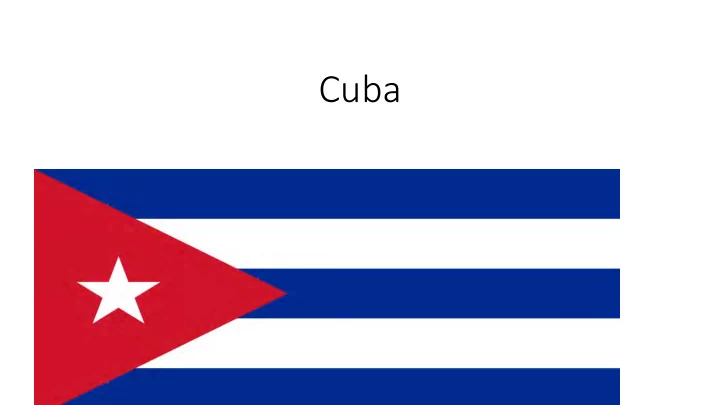
SLIDE 1
Cuba
SLIDE 2 Warning
- It is impossible to discuss Cuba without getting political!
SLIDE 3
Map of Cuba
SLIDE 4
Topographical Map of Cuba
SLIDE 5 Cuba
- Population: 11.2 million
- Area 42,426 square miles (size of Tennessee or Virginia)
- Official language: Spanish
- First Secretary of Cuban Communist Party: Miguel Díaz-Canel (since
19 April 2018)
- Climate: tropical
- 64.1% white, 27.6 % mulato, 9.3% black
SLIDE 6 Cuban History
- 4th millennium BC – 15th Century Cuba occupied by indigenous
Ciboney, Guanahatabey, and Taino people.
- 1492 Columbus lands in Cuba, claims for Spain
- 1511 Diego Velazquez first settlement at Baracoa (Eastern tip near
Guantanamo)
- Indigenous peoples wiped out due to small pox and measles
- 1548 Havana becomes capital
- Cuba urbanized society with diverse agriculture
- 1762 Seven Year’s War
- Brits take over Havana, western Cuba
SLIDE 7 Cuban History (2)
- 1790-1820 325,000 Africans imported as slaves (Haitian rebellion)
- 1868 Cuban rebellion begins
- 1892 José Marti, national hero, founds Cuban independence party
- 1895 killed
- Late 1890’s Spanish concentration camps killed 200,000 to 400,000
- 1898 Treaty of Paris
- Cuba protectorate of US
- Americans entitled to intervene
- Guantanamo Bay leased
SLIDE 8 Cuban History (3)
- 1906 U.S. occupies Cuba, names its governor
- 1924 Geraldo Machado President
- Tourist business expanded
- Many American-owned hotels, restaurants
- 1933 Fulgencio Batista, head of army, repressed revolts
- 1940-44 social reforms under Batista
- 1952 Batista returns
- Military coup
- Suspended political liberties
SLIDE 9 Cuban History (4)
- 1958 Major unemployment: Middle class withdraws support from Batista
- 1959 Batista flees, Fidel Castro takes over
- 1,000s of Batista officials executed
- Farmlands expropriated
- 1961 Bay of Pigs invasion
- 1991 Soviet empire falls
- Cuba severe economic need “Special period”
- 1996 Helms –Burton
- U.S. embargo codified into law
- Sanctions against companies trading with Cuba
SLIDE 10 Cuban History (5)
- 2000 Hugo Chavez becomes Cuba’s new benefactor
- 2008 Fidel resigns due to ill health, brother Raúl takes over
- 2014 Thawing of relations
- Embargo relaxed but not eliminated
- 2016 Fidel Castro dies
- 2018 Miguel Díaz-Canel takes over
- First President born after the revolution
- little known to the public before he became president
- Is in favor of same sex marriage
- Raúl Castro’s daughter Mariela favored liberalization
- Claims to have nothing to do with hearing problems of U.S. diplomats
- 2019 New constitution will recognize private property
SLIDE 11 Cuban Economy
- Planned economy
- Most people work for state-owned industries
- Sugar cane is the main crop
- Tobacco and cigars
- Tourism traditional industry
- All but banned until 1997 (Castro didn’t want foreigners influencing Cuba)
- Regime restored many old hotels
- Tourism occurred in enclaves like beach resorts (Varadero)
- Once again became Cuba’s number one industry
SLIDE 12 Heath Care in Cuba
- National health system takes care of all Cuban citizens
- No private facilities, all government run
- Average life expectancy reported 77 years for males, 81 females
- Nearly half of doctors left after the Revolution, leaving only 3,000
- 58.6 doctors per 10,000 inhabitants by 1999
- Universal vaccination eradicated polio, tetanus, diphtheria, rubella
- U.S. embargo prevented Cuban purchase of medicine from U.S.
- More medical care to the developing world than all G8 countries combined
- Better health care in rural areas
SLIDE 13 Education in Cuba
- Literacy rate is 99.8%
- Education free and mandatory through the ninth grade
- Less than 1% drop out of primary education
- 98% of Cuban children attend preschool
- Maximum of 25 children per primary school class
- Free after-school care for children
- 425 schools for special-needs children
- 7% of gross national product spent on education
SLIDE 14 Religion in Cuba
- Restricted after the revolution
- Priests said communism was incompatible with Catholicism
- 1991 fall of the Soviet Union
- Government more conciliatory toward religion
- Protestant churches start to flourish
- 1998 Pope John Paul II visits Cuba
- Government allows construction of new church, first since 1959
- 2012 Pope Benedict XVI visits
- 2015 Pope Francis visits
- Syncretic religions of African origin
- https://cruxnow.com/church-in-the-americas/2019/01/27/cubans-
inaugurate-first-new-catholic-church-in-decades/
SLIDE 15 “We Pretend to work and they pretend to pay us”
- The government announces the minimum salary will be nearly $17 a
month.
- The average salary will rise from $32/month to $44/month
- Two currency
- Convertible peso is worth nearly $1 (CUC)
- The Cuban peso (Moneda nacional) is worth about $.04
- Plans are to convert to a single currency
SLIDE 16 Guantanamo Naval Base
- Where the freedoms and rule of law that thousands of American
soldiers died for are ignored
- Visible symbol of “El Imperialismo Norte Americano”
accused 9/11 terrorists have yet to be tried
- Cases of torture of prisoners and their denial of protection under the
Geneva Convention (Became detention center in 2002)
- Millions and millions of taxpayer dollars wasted
- Leased as a naval base and fueling station in 1903
- Why doesn’t the Cuban government expel the Americans?
SLIDE 17
Sign in Cuba Protesting American embargo
SLIDE 18 U.S. Embargo against Cuba
- Imposed October 19, 1960 in response to Cuban nationalization of American oil
refineries without compensation
- Eisenhower government refused to export oil to Cuba
- 1996 Helms-Burton Act restricts U.S. citizens from doing business in or with Cuba
(March 12, 1996)
- Also prohibits companies doing business in Cuba from doing business in the U.S.
- Most enduring trade embargo in modern history
- Violations of embargo can result in up to 10 years in prison.
- After the fall of Russia, Congress considered lifting it
- Castro deliberately inflamed Congress by shooting down the Brothers to the Rescue Aircraft
- n February 24, 1996
- Embargo helps Castro blame the U.S. for the train wreck Cuban economy
- For more research “The Economic War Against Cuba”
SLIDE 19 Premise of the embargo
- If we make the Cuban people suffer enough, they will rise up and
- verthrow their government, replacing it with one more amenable to
the U.S.
- When in school, did the teacher ever threaten to punish the whole
class until they ratted the perp? Did it work?
- Imagine if you give the perp the only gun in the room!
SLIDE 20 2000 Election Result in Florida
- In 2017, 1.53 Million Cubans lived in Florida
- In June 2000, the Clinton administration returned Elián González to
his father in Cuba on orders of an appeals court.
- Many Cuban-Americans were angered by Al Gore’s support of the
administration
- The votes of angry Cuban-American exiles far outweighed the impact
- f “hanging chads” and may have given the election to George W.
Bush.
SLIDE 21
“Cuba: Lost and Found” by Edward J. Neyra
SLIDE 22 Che Guavara
- Argentine Marxist revolutionary
- Traveled through South America, shocked by poverty
- Movie “The Motorcycle Diaries” describes his experiences
- “Che” is a term given to Argentinians
- Central figure in the Cuban revolution
- Went abroad to foster revolution
- CIA-assisted Bolivian forces captured and executed him
- Very popular figure in Cuba
- More popular than Fidel Castro (based on images I saw)]
- Did the CIA do Castro’s bidding? (apparently the Russians didn’t like him either)
- https://newrepublic.com/article/70855/the-death-che-guevara
SLIDE 23 Cuban Ballet
- https://www.youtube.com/watch?v=gWLiyJ5C03g
- Fidel Castro pledged to make the arts available to everyone
- National Ballet School supported by the government and those
accepted are supported by the government
- International tours to countries in Europe, Asia, and America
- Cervilio Amador and Gema Díaz defected in 2004 and joined
Cincinnati Ballet
- International students learn ballet in Cuba
SLIDE 24 Music of Cuba
- One of the richest and most influential in the world
- Son Cubano merges Spanish guitar with Afro-Cuban percussion
- Contributed to rhumba, Afro-Cuban jazz, salsa, soukous
- https://www.youtube.com/watch?v=rublV5LQ5Ds
- https://www.youtube.com/watch?v=lPQhlCsjG0w
SLIDE 25
Our wonderful hostess in Havana
SLIDE 26
Impressions of Cuba?
SLIDE 27
Quirky Sculptures
SLIDE 28
The Malecon
SLIDE 29
Baseball Field What’s missing?
SLIDE 30
U.S. Capitol?
SLIDE 31
Near Santa Clara Baptista supply train attacked by Revolutionaries
SLIDE 32
Monument to the Revolution
SLIDE 33
The “Yellow Submarine”: Our Tour bus in Cuba
SLIDE 34
Man selling cheese in Cuban countryside
SLIDE 35
Paladar Restaurant
SLIDE 36
Source of food On Premises
SLIDE 37
Stop for Refreshments
SLIDE 38 57th anniversary
SLIDE 39
Beautiful town square
SLIDE 40
Che’s image common in Cuba
SLIDE 41
Fidel’s picture
SLIDE 42
Ice cream parlor
SLIDE 43
Cuban Jazz band in Camagüey
SLIDE 44
Dancing to the music of the band
SLIDE 45
Street in Camaguëy
SLIDE 46
Celia Cruz CD
SLIDE 47
Beautiful church
SLIDE 48
Brewery near Camagüey
SLIDE 49
George our leader
SLIDE 50
Varadero Tourist Resort
SLIDE 51
Varadero Hotel Lobby
SLIDE 52
Onions on sale in Havana
SLIDE 53
School: uniforms
SLIDE 54
Socialism or death
SLIDE 55
Humorous Sign
SLIDE 56
View from a religious seminary
SLIDE 57
Cemetery near Havana
SLIDE 58 The nightly firing of the cannon
- Every night at 9 pm a ceremony is held to commemorate the closing
- f Havana harbor to keep pirates out.
- http://www.havana-guide.com/cannon-ceremony.html
SLIDE 59
A town square in Havana
SLIDE 60
Afro-Cuban artifacts
SLIDE 61
Afro-Cuban Dancing
SLIDE 62 Travel to Cuba?
- Permitted under 11 categories
- Family visits, official government business, journalism, professional research,
religious activities, public performances, support for the Cuban people (most common), humanitarian projects, private foundations, export or transmitting
- f information, some export transactions
- American cruise lines can no longer dock in Cuba
- People to people eliminated
- Trump administration is considering tightening restrictions on
Americans traveling to Cuba to retaliate for its support of Maduro
SLIDE 63