Santa Fe River Basin Sam B. Upchurch, Ph.D., P.G. Jian Chen, P.G. - - PowerPoint PPT Presentation

santa fe river basin
SMART_READER_LITE
LIVE PREVIEW

Santa Fe River Basin Sam B. Upchurch, Ph.D., P.G. Jian Chen, P.G. - - PowerPoint PPT Presentation

Springsheds of the Santa Fe River Basin Sam B. Upchurch, Ph.D., P.G. Jian Chen, P.G. Crystal R. Cain SDII Global Corporation Tampa, Florida May 9, 2008 Springshed Area contributing water to the discharge of a spring. Includes


slide-1
SLIDE 1

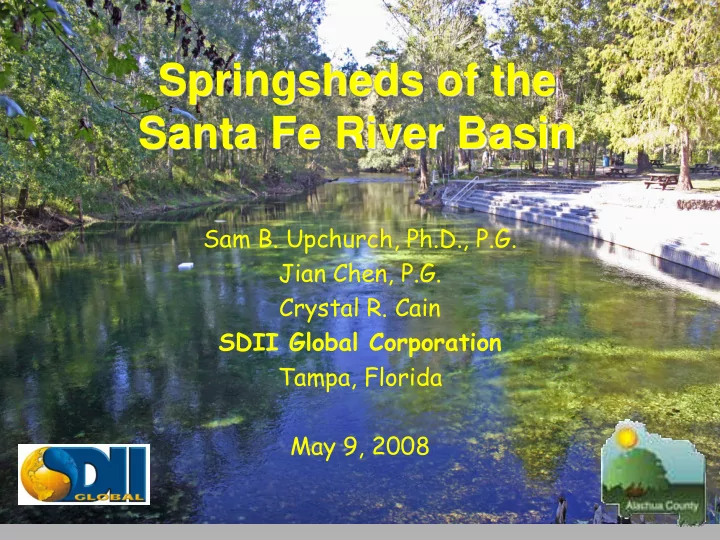
Springsheds of the Santa Fe River Basin

Sam B. Upchurch, Ph.D., P.G. Jian Chen, P.G. Crystal R. Cain SDII Global Corporation Tampa, Florida May 9, 2008
slide-2
SLIDE 2

Springshed

  • Area contributing

water to the discharge of a spring.

  • Includes

– Groundwater basin and – Surface water basin

slide-3
SLIDE 3

Sample Map – Ichetucknee Springs

  • Based on high

resolution data

  • 1-foot contour

interval

  • Note that basin

appears to pass under the Northern Highlands

Upchurch and Champion (2005)

slide-4
SLIDE 4

Project Expanded to Two Phases

  • Phase I

– Literature review – Springshed delineation using existing upper Floridan potentiometric surface data from 2000 – Capture zones modeled using USGS and SRWMD groundwater flow models – Reported on in June 2007 – Comments by Alachua County and FDEP

slide-5
SLIDE 5

Project Expanded to Two Phases

  • Phase II

– Alachua County developed

  • High-resolution

monitoring network

  • “Newberry Plain”
  • f the Western

Valley

– Sites located and surveyed – Water levels measured in September 2007

slide-6
SLIDE 6

Project Expanded to Two Phases

– Phase II Continued

  • Geostatistical analysis to evaluate adequacy
  • f monitoring network
  • Delineation of springsheds using high-

resolution monitoring network and 1 foot contours

  • Revision of report
slide-7
SLIDE 7

Area Overview

LEGEND

County Boundaries Hydrography Springs

µ

2 4 1 Miles

STUDY AREA

WORTHINGTON SPRINGS SANTA FE SPRINGS SANTA FE RISE DARBY SPRINGS HORNSBY SPRING COLUMBIA SPRINGS POE SPRINGS BLUE SPRING DEVIL'S EYE DEVIL'S EAR JULY SPRING SIPHON CREEK RISE WILSON SPRINGS BETTY SPRINGS OASIS SPRINGS JAMISON SPRINGS COFFEE SPRINGS DEVIL'S EYE SPRING VENT GRASSY HOLE MISSION SPRING VENT ICHETUCKNEE HEAD SPRING CEDAR HEAD SPRING SUNBEAM SPRINGS GINNIE SPRINGS

ALACHUA GILCHRIST LAFAYETTE SUWANNEE COLUMBIA UNION

BRADFORD TREEHOUSE

slide-8
SLIDE 8

Spring Clusters

! ( ! ( ! ( ! ( ! ( ! ( ! ( ! ( ! ( ! ( ! ( ! ( ! ( ! ( ! ( ! ( ! ( ! ( ! ( ! ( ! ( ! ( ! ( ! ( ! ( ! (! ( ! ( ! ( ! ( ! ( ! ( ! ( ! ( ! ( ! ( ! ( ! ( ! ( ! ( ! ( ! ( ! ( ! ( ! ( ! ( ! ( ! ( ! ( ! ( ! ( ! ( ! ( ! ( ! ( ! ( ! ( ! ( ! ( ! ( ! ( ! ( ! ( ! ( ! ( ! ( ! ( ! ( ! ( ! ( ! ( ! ( ! ( ! ( ! ( ! ( ! ( ! ( ! ( ! ( ! ( ! ( ! ( ! ( ! ( ! ( ! ( ! ( ! ( ! ( ! ( ! ( ! (

Ichetucknee Cluster Sunbeam Cluster Betty Spring Cluster Wilson Spring Cluster Siphon Creek Cluster Ginnie Springs Cluster Poe-July Cluster Hornsby-Columbia Cluster Santa Fe Rise Santa Fe Springs Cluster Worthington Spring ALACHUA UNION COLUMBIA GILCHRIST SUWANNEE DIXIE LAFAYETTE BRADFORD BAKER

SPRING CLUSTERS

County Boundaries Hydrography

! (

Springs

µ

5 10 2.5 Miles

slide-9
SLIDE 9

Physiographic Provinces

DIXIE ALACHUA COLUMBIA LAFAYETTE SUWANNEE UNION BAKER CLAY GILCHRIST BRADFORD LEVY PUTNAM DUVAL MADISON TAYLOR NASSAU

Northern Highlands Gulf Coastal Lowlands Western Valley Central Valley Trail Ridge Brooksville Ridge Duval Upland Bell Ridge High Springs Gap Alachua Lake Cross Valley Coastal Swamps Kenwood Gap

LEGEND

County Boundaries Hydrography

µ

5 10 2.5 Miles

slide-10
SLIDE 10

Aquifer Confinement

ALACHUA DIXIE UNION GILCHRIST LAFAYETTE COLUMBIA SUWANNEE BRADFORD LEVY BAKER

County Boundaries Hydrography Springs

HYDROGEOLOGIC CONDITONS

CONFINED SEMICONFINED UNCONFINED

µ

4 8 2 Miles

slide-11
SLIDE 11

2000 Potentiometric Surface

! ! ! ! ! ! ! ! ! ! ! ! ! ! ! ! ! ! ! ! ! ! ! ! ! ! ! ! ! ! !! ! ! ! ! ! ! ! ! ! ! ! ! ! ! ! ! ! ! ! ! ! ! ! ! ! ! ! ! ! ! ! ! ! ! ! ! ! ! ! ! ! ! ! ! ! ! ! ! ! ! ! ! ! ! ! ! ! ! ! ! ! ! ! ! ! ! ! ! ! ! ! ! ! ! ! ! ! ! ! ! ! ! ! ! ! ! ! ! ! ! ! !

ALACHUA DIXIE UNION GILCHRIST LAFAYETTE COLUMBIA SUWANNEE BRADFORD LEVY BAKER

50 3 40 1 2 60 70 50 7 4 40 5 40 60 50 30 60 70 LEGEND

County Boundaries Hydrography Potentiometric Surface

!

Springs

µ

4 8 2 Miles

slide-12
SLIDE 12

Why Index Period of 2000?

  • The District’s groundwater flow model was

calibrated to conditions in 2000 (Schneider and others, 2008),

  • 2000 was a dry year, so the potentiometric

surface should have maximum relief and enhance ability to identify springsheds, and

  • Potentiometric

data were relatively abundant.

slide-13
SLIDE 13

Springshed Delineation from Potentiometric Surface Data

  • Well density is low in many critical areas
  • Available data contoured at 1-foot interval
  • Contour map reconciled with known geology

and USGS 2000 potentiometric surface

slide-14
SLIDE 14

Results

ALACHUA DIXIE UNION GILCHRIST LAFAYETTE COLUMBIA SUWANNEE BRADFORD LEVY BAKER

County Boundaries Hydrography Springs Springshed Boundaries

HYDROGEOLOGIC CONDITONS

CONFINED SEMICONFINED UNCONFINED

µ

4 8 2 Miles

A B C D E F G H

B = Betty Spring cluster (north) A = Ichetucknee cluster H = Santa Fe Rise G = Hornsby-Columbia Spring cluster F = Poe-July Springs cluster E = Ginnie Springs cluster D = Sunbeam and Wilson Spring clusters C = Betty Spring cluster (south)

slide-15
SLIDE 15

Phase I Delineation Evaluation

  • Individual springsheds could not be

identified because of

– Low monitoring well density – High hydraulic conductivities and/or conduit flow results in relatively flat potentiometric surfaces near springs

  • Springsheds could be identified for

spring clusters

slide-16
SLIDE 16

Phase II, High-Resolution Springshed Delineation

  • Mix of domestic

wells, monitoring wells and piezometers

  • Includes

– Alachua County network, – SRWMD WARN data, – Danone/Coca-Cola wells

1 2 3 4 5 6 7 8 9 10 11 12 13 14 15 16 17 18 19 20 21 22 23 24 25 26 27 28 29 30 31 32 33 34 35 36 37 38 39 40 41 42 43 44 45 46 47 48 49 50 51 52 53 54 55 56 57 58 59 60 61 62 63 64 65 66 67 68 69 70 71 72 73 74 75 76 77 78 79 80 81 82 83 84 85 86 87 88 89 90 91 92 93 94 95 96 97 98 99 100 101 102 103 104 105 106 107 108 109 110 111 112 113 114 115 116 117 118 119 120 121 122 123 124 125 126 127 128 129 130 131 132 133 134 135 136 137 138 139 140 141 142 143 144 145 146 147 148 149 150 151 152 153 154 155 156 157158 159 160 161 162 163 164 165 166 167 168 169 170 171 172 173 174 175 176 177 178 179 180 181 182 183 184 185 186 187 188 189 190 191 192 193 194 195 196 197 198 199 200 201 202 203 204 205
slide-17
SLIDE 17

Regional Potentiometric Surface

  • Distal wells

provide boundary conditions

  • Reproduces

potentials in Newberry Plain well

slide-18
SLIDE 18

Local Potentiometric Surface

  • Focus on

Newberry Plain area

  • Note cone-
  • f-

depression near Gainesville

slide-19
SLIDE 19

Geostatistical Analysis

  • Used to evaluate monitoring network

in terms of

– Spacing of sampling points – Need for additional sampling points – Level of uncertainty associated with contour maps (I.e., potentiometric surface maps) – Identification of anomalous data points

slide-20
SLIDE 20

Geostatistical Analysis

  • Two steps

– Structural analysis

  • “Rules” of contouring
  • Detection of local variability
  • Uncertainty related to distance between sampling

points

– Kriging

  • Map showing property distribution
  • Map showing uncertainty distribution
  • Map that identifies “outliers”
slide-21
SLIDE 21

Variogram

  • Reflects model

developed to characterize variability between sample pairs as a function of sample point spacing

Nugget = 15 ft.2 Range =350,000 ft. Sill =800 ft.2

Nugget Range Sill

slide-22
SLIDE 22

Nugget Effect

  • Caused by

local variability

– Short term – Transient – Caused, in part, by sampling

  • ver a

month period

5 10 15 20 25 Jan-76 Dec-80 Dec-85 Dec-90 Jan-96 Dec-00 Dec-05 Date Water Level (feet, NGVD)

Gilchrist County Well

slide-23
SLIDE 23

Kriged Potentiometric Surface

2500000 2600000 2700000

Easting (Feet)

200000 250000 300000 350000

Contours

  • 45 -

Wells Springs

Legend Kriged Potentiometric Surface Elevation (feet NGVD) 10 25 40 55 70

slide-24
SLIDE 24

Kriged Standard Deviation

  • Shows the

distribution

  • f

uncertainty

  • Units of

feet based

  • n KSD

(kriged standard deviations)

2500000 2600000 2700000

Easting (Feet)

200000 250000 300000 350000

Northing (Feet)

Contours
  • 45 -
Wells Springs

Legend Kriged Standard Deviation (KSD; feet) 2 6 10

slide-25
SLIDE 25

Residuals

  • Observed

water level – kriged water level

  • Helps

identify

  • utliers

2500000 2600000 2700000

Easting (Feet)

200000 250000 300000 350000

Northing (Feet)

Contours

  • 45 -

Wells Springs Legend

Residuals (feet)

  • 20
  • 16
  • 12
  • 8
  • 4

4 8 12 16 20

slide-26
SLIDE 26

Network Evaluation

  • Network is good within the Newberry

Plain and vicinity

  • There is no need for additional wells

in the Newberry Plain area

  • There is an uncertainty (the nugget)

when contouring between wells of up to ±10 feet because of local variability

slide-27
SLIDE 27

High-Resolution Springshed Delineation

slide-28
SLIDE 28

Springshed Evaluation

  • High-resolution monitoring allows for

resolution of springsheds with much more confidence than with the typical regional potentiometric surface map

  • Confidence in springsheds of major

spring clusters ranges from moderate to high

  • There is still a problem with where

the water in the southern part of the Newberry Plain discharges

slide-29
SLIDE 29

Modeling Capture Zones

  • Identify spring contribution areas

through groundwater flow modeling

  • USGS Megamodel by Sepúlveda (2002)
  • Suwannee River WMD Model by

Schneider and others (2008)

  • 5, 10, 100 year capture zones

attempted

  • Utilized inverse particle tracking to

model capture zones

slide-30
SLIDE 30

Why Use Two Models?

  • Models rarely

agree

  • Conservative to

include results

  • f all models
  • Models differ

in features and construction

Rainbow Springs 10-year travel times

slide-31
SLIDE 31

USGS Megamodel

  • Regional model
  • 3-D model
  • 5,000 x 5,000 ft. cells
  • Layers

– 1, Surficial Aquifer, is a constant head boundary – 2, Intermediate Aquifer System – 3, upper Floridan Aquifer

  • Does not account for most springs
  • Cannot deal with conduit flow
slide-32
SLIDE 32

USGS Megamodel

COLUMBIA SUWANNEE BAKER UNION LAFAYETTE ALACHUA BRADFORD DIXIE GILCHRIST HAMILTON MADISON

Mega-Model

County Boundaries Hydrography 5 year 10 year 25 year 100 year Steady-State

µ

5 10 2.5 Miles

slide-33
SLIDE 33

Megamodel Conclusions

  • Could not accurately reproduce

capture zones of springs not explicitly in model

– Steady state run produced spatially and temporally unrealistic results – Absence of many springs and of siphons that capture river water in model a limitation – Constant head in Layer 1 apparently prevents accurate representation of dispersed recharge

slide-34
SLIDE 34

District Model

  • Regional model
  • 3-D model
  • 5,000 x 5,000 ft. cells
  • Active Layers

– 1, Surficial Aquifer – 2, Intermediate Aquifer System – 3, upper Floridan Aquifer – 4, middle confining unit – 5, lower Floridan aquifer

slide-35
SLIDE 35

District Model (cont.)

  • Accounts for

– All 1st and 2nd magnitude springs, – Many 3rd magnitude springs, and – All major siphons and swallets

  • Cannot deal with conduit flow
slide-36
SLIDE 36

District Model

ALACHUA DIXIE GILCHRIST UNION COLUMBIA LAFAYETTE SUWANNEE BRADFORD LEVY

SDII Model

County Boundaries Hydrography 5 year 10 year 25 year 100 year Steady-state

µ

4 8 2 Miles

Rose Creek Sink Siphon Creek Worthington, Santa Fe Hornsby, Treehouse, Columbia Ginnie to Poe

slide-37
SLIDE 37

District Model Conclusions

  • Appears reasonable with respect to

many springsheds in steady-state mode

  • This is important because the

District uses steady-state modeling to evaluate permit applications

  • Model cannot accurately model

capture zones based on travel time because it cannot account for conduit flow

slide-38
SLIDE 38

District Model Conclusions

  • Model provides insight into flow

systems

– When aquifer approximates flow through homogeneous aquifer, travel times can be approximated – When flow is dominated by conduit transport, the model may approximate springshed in steady-state mode but not short-term capture zones

slide-39
SLIDE 39

Evaluations of Springsheds

  • Springsheds from potentiometric surface

and model are consistent within limitations

  • Addition of swallets and siphons is critical

to capture zone modeling

  • Rum Island – Gilchrist Blue springshed

remains large for magnitude of spring discharge

  • Flow to springs is limited from Bell

Ridge/Waccasassa Flats area and Northern Highlands

slide-40
SLIDE 40

Evaluations of Springsheds

  • Many springs are dominated by

swallets that capture water from Northern Highlands

  • Springs are dominated by conduit

flow

  • Worthington and Santa Fe Springs

are not consistent with Floridan aquifer potentials

slide-41
SLIDE 41

Recommendations

  • It is not appropriate to set up protection

zones based on model-based travel times

– Models do not deal with conduit flow – karst flow is too complex – Dye tracing proves that basins are larger than model predictions and that travel times in conduits are shorter

  • Spring protection zones should consist of

all areas within the springshed and streams that discharge to swallets

slide-42
SLIDE 42

Recommendations

  • Siphon-spring systems have been identified

by Butt et al. (2007), do they need special protection strategies?

  • The entire Newberry Plain should be

considered a springshed and subject to primary protection measures

  • Areas north of the river in Columbia

County are as important as those areas of Alachua and Gilchrist counties in the Newberry Plain

slide-43
SLIDE 43

Recommendations

  • Sub-regional model

– Needed because of growth in Lake City and Gainesville/Alachua areas – Allow refinement of karst system – Transient model – Integrated surfacewater/groundwater model

slide-44
SLIDE 44

Recommendations

  • Model being developed privately

for Western Valley may better refine knowledge

  • Dye tracing

– Robinson Sinks – Western Valley – Poe Springs

slide-45
SLIDE 45

Thank You, Any Questions?