SAM Portable Haptic Arm Exoskeleton Upgrade Technologies And New - - PowerPoint PPT Presentation

sam portable haptic arm exoskeleton upgrade technologies
SMART_READER_LITE
LIVE PREVIEW

SAM Portable Haptic Arm Exoskeleton Upgrade Technologies And New - - PowerPoint PPT Presentation

SAM Portable Haptic Arm Exoskeleton Upgrade Technologies And New Application Fields Pierre Letier , Elvina Motard, Michel Ilzkovitz Andr Preumont Jean-Philippe Verschueren Astra 2011, ESA/ESTEC, Noordwijk, 12-14 April 2011 1 A Few Words of


slide-1
SLIDE 1

Astra 2011, ESA/ESTEC, Noordwijk, 12-14 April 2011 1
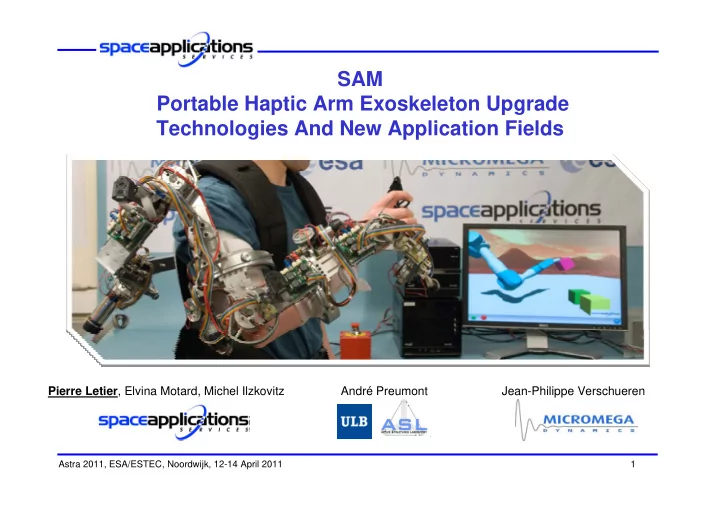
SAM Portable Haptic Arm Exoskeleton Upgrade Technologies And New Application Fields

Pierre Letier, Elvina Motard, Michel Ilzkovitz André Preumont Jean-Philippe Verschueren

slide-2
SLIDE 2

Astra 2011, ESA/ESTEC, Noordwijk, 12-14 April 2011 2

A Few Words of Acknowledgement…

SAM is a derived product from the EXOSTATION project, an ESA project funded in the framework of the Technology Research Program entitled : Control Stations for new Space A & R Applications, in which cooperated the following partners...

Prime Contractor : Sub Contractors :

slide-3
SLIDE 3

Astra 2011, ESA/ESTEC, Noordwijk, 12-14 April 2011 3

Space Technology Trends: Anthropomorphic Slave Robots

EUROBOT Wet model and EGP (ESA) JUSTIN (DLR) ROBONAUT(R2 and Centaur) (NASA)

  • EVA support or replacement
  • Costly, risky, resources demanding (on-ground and on-board)
  • Stressing and tiring for crew
slide-4
SLIDE 4

Astra 2011, ESA/ESTEC, Noordwijk, 12-14 April 2011 4

System Overview: EXOSTATION’s goal

Building a complete haptic control station which allows the operator wearing an exoskeleton- based haptic interface for the human arm to remotely control a virtual slave robot.

slide-5
SLIDE 5

Astra 2011, ESA/ESTEC, Noordwijk, 12-14 April 2011 5

System Overview

slide-6
SLIDE 6

Astra 2011, ESA/ESTEC, Noordwijk, 12-14 April 2011 6

System Overview

  • Power amplification
  • Sensors conditioning
  • Communications between boards and main controller
  • Haptic control loops
  • Haptic rate and synchronisation
slide-7
SLIDE 7

Astra 2011, ESA/ESTEC, Noordwijk, 12-14 April 2011 7

System Overview

  • Simulates

a 7-DOF anthropomorphic robot cinematically equivalent to the master and its interaction with a virtual environment

  • Based on ODE
  • Scripting

technology to quickly design virtual environments and modify control strategies

slide-8
SLIDE 8

Astra 2011, ESA/ESTEC, Noordwijk, 12-14 April 2011 8

System Overview

  • Visualisation of the virtual world
  • Supports various states of the system
slide-9
SLIDE 9

Astra 2011, ESA/ESTEC, Noordwijk, 12-14 April 2011 9

State Machine and Control

Error Error Unpowered Unpowered Calibration Calibration No Simulation No Simulation Inactive Inactive Active Active In Control In Control

Power on End of calibration Start/send control parameters Dead Man + State button Dead Man + State button HAPTIC LOOP RUNNING (500 Hz) Emergency stop Dead Man released Stop

slide-10
SLIDE 10

Astra 2011, ESA/ESTEC, Noordwijk, 12-14 April 2011 10

EXOSTATION Scenarios

Wall Tapping Shape Screening Constraint motion on the robot

(screwing, sliding)

Manipulation tasks

slide-11
SLIDE 11

Astra 2011, ESA/ESTEC, Noordwijk, 12-14 April 2011 11

Video

slide-12
SLIDE 12

Astra 2011, ESA/ESTEC, Noordwijk, 12-14 April 2011 12

SAM Exoskeleton

  • 7 actuated DOF, 6 adjustments sliders
  • Compact on-joint actuation with integrated position and torque

sensor

  • 1/20th of the human torque capabilities (10 to 1 Nm, shoulder

to wrist)

  • Aluminum structure with ergonomic fixations
  • On board electronics (conditioning and amplification)
  • Weight of 7 kg
slide-13
SLIDE 13

Astra 2011, ESA/ESTEC, Noordwijk, 12-14 April 2011 13

Improvements : Workspace

Large diameter roller bearings

  • Redesign of the backplate fixation
  • Open-circular guides

Human Workspace SAM Workspace Ratio SAM/Human Total Volume [m³] 0.65 0.38 58 Front Volume (x>0) [m³] 0.48 0.35 73

  • Investigations:
slide-14
SLIDE 14

Astra 2011, ESA/ESTEC, Noordwijk, 12-14 April 2011 14

Improvements : Weight - Ergonomy

  • Total current weight: 7.4 kg
  • Mechanical Structure : 3.9kg
  • Actuation: 3 kg
  • 4.5kg worn by the arm
  • Internal gravity compensation
  • Mechanical Structure optimization with

more advanced materials and shapes (composite, polymers):

  • Rigidity
  • Manufacturing processes, assembly
  • Costs
slide-15
SLIDE 15

Astra 2011, ESA/ESTEC, Noordwijk, 12-14 April 2011 15

Improvements : Robustness

Capstan Cable

  • Simultaneous use of capstan and gearbox for high enough

torque combined with high compactness, low friction and low backlash transmission.

  • Limited use for higher torque and sensible to wear
  • Deeper analysis of the capstan type reducer (cable material,

wheel/shaft diameters,…)

  • Other reducer technologies : e.g. Harmonic drive
  • More compact and higher output torque
  • Higher intrinsic friction, not backdrivable
  • Other control strategies : e.g. admittance control (already

tested)

  • Electrical robustness : data and power bus in “open-air”
  • Sensors casing protection
  • Lightweight protection shells along the structure
slide-16
SLIDE 16

Astra 2011, ESA/ESTEC, Noordwijk, 12-14 April 2011 16

Terrestrial Applications: Future exoskeletons perspectives

  • The advantages of a portable anthropomorphic force-feedback exoskeletons are:
  • Intuitive control of anthropomorphic robotic arms
  • Great workspace, similar to the human arm workspace
  • Multi-point contacts
  • Free body motion / transportable
  • No reaction-forces under 0G
  • Potential terrestrial applications:
  • Teleoperation
  • Virtual Reality
  • Rehabilitation
slide-17
SLIDE 17

Astra 2011, ESA/ESTEC, Noordwijk, 12-14 April 2011 17

Terrestrial Applications: Teleoperation

  • Support of Haptic Control is very useful when one has to perform very precise
  • manipulations. The feeling of force-feedback increases the operator’s awareness of

the situation (objects weight, pulling connectors, …)

  • The main criteria that favour a haptic teleoperation system deployment are :

 Operations requiring human skills and expertise  An hostile environment (operation field that is very dangerous for an

  • perator to risk his life in and therefore requires to be preferably operated at

distance.)  Very precise interventions and manipulations that do not tolerate errors as otherwise may lead to dramatic consequences.  Emergency intervention in a de/un/structured environment (for which intervention means and operations cannot be easily planned and deployed in advance.)

slide-18
SLIDE 18

Astra 2011, ESA/ESTEC, Noordwijk, 12-14 April 2011 18

Teleoperation Application Fields

(credits: Teodor, telRob)

Monirobo

  • Intervention on CBRN (Chemical, bacteriological, Radiological and Nuclear) crisis site
  • IEDD (Improvised Explosive Devices Disposal) and de-mining operations
  • Support to rescue operations after an earthquake
  • Sub-sea operations (e.g. offshore oil rig well sealing)
  • Hazardous materials manipulations (chemical, nuclear)
  • Nuclear Infrastructure dismantling, decontamination and waste treatment operations

SCRIPPS Institution of Oceanography (credits: CEA)

slide-19
SLIDE 19

Astra 2011, ESA/ESTEC, Noordwijk, 12-14 April 2011 19

Terrestrial Applications: Virtual Reality

(credits: VRLab, Nasa) (credits: Dassault System, haption)

  • Virtual Training: free body motion, multi-points contacts for better immersion
  • FITS ESA project to evaluate how VR and force-feedback can improve

current astronaut training program

  • Virtual Assembly and Design: virtual manikin control
  • Entertainment (Long Term)
slide-20
SLIDE 20

Astra 2011, ESA/ESTEC, Noordwijk, 12-14 April 2011 20

Terrestrial Applications: Rehabilitation

  • The patient performs repetitive task-oriented medical exercises wearing the

exoskeleton:

  • User motion guidance
  • Resistive force
  • Greater output torque than pure haptic needs, depending on the type of

rehabilitation

  • Generally associated to a set of joints
slide-21
SLIDE 21

Astra 2011, ESA/ESTEC, Noordwijk, 12-14 April 2011 21

Conclusions

  • EXOSTATION: demonstrator of a complete haptic control chain that shows the

advantages of haptic feedback information in space teleoperation activities.

  • Derived product SAM as portable haptic arm exoskeleton for terrestrial application
  • Industrialisation phase for teleoperation, VR and rehabilitation terrestrial

applications

  • Addition of Virtual reality, augmented reality technologies
slide-22
SLIDE 22

Astra 2011, ESA/ESTEC, Noordwijk, 12-14 April 2011 22

Thank you