Sainsburys Waltham Point Road Safety Team We would like to talk to - - PowerPoint PPT Presentation

sainsbury s
SMART_READER_LITE
LIVE PREVIEW

Sainsburys Waltham Point Road Safety Team We would like to talk to - - PowerPoint PPT Presentation

Sainsburys Waltham Point Road Safety Team We would like to talk to you today about Road Safety. And the dangers of being around large goods vehicles. 19 32 Waltham Points fleet of vehicles cover around 8.3 million kilometres per


slide-1
SLIDE 1

Sainsbury’s

Waltham Point Road Safety Team

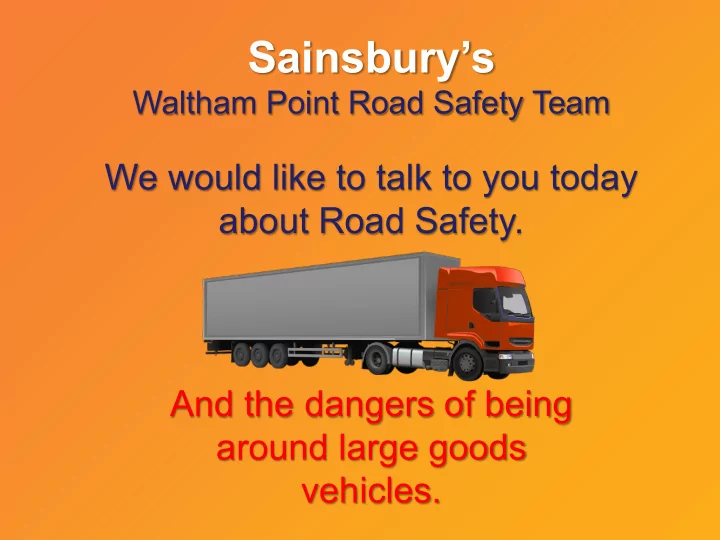
We would like to talk to you today about Road Safety. And the dangers of being around large goods vehicles.

slide-2
SLIDE 2
slide-3
SLIDE 3

19

slide-4
SLIDE 4
slide-5
SLIDE 5

32

slide-6
SLIDE 6
slide-7
SLIDE 7

Waltham Point’s fleet of vehicles cover around 8.3 million kilometres per year delivering to our stores, which is roughly the same as driving 206 times around the world

  • r 23 times to the moon.
slide-8
SLIDE 8

Or you could walk around the outside

  • f our depot which

is 1.6 km. However, this would take you roughly 196 years to complete the 8.3 million kilometres.

slide-9
SLIDE 9

Cyclists & Lorries should be able to use the same roads as each other. However, both MUST understand each

  • ther’s needs.

Cycle Safety

slide-10
SLIDE 10

All new lorries now come with 6 mirrors But please remember, like you the driver only has one pair of eyes and can only look in one mirror at a time.

slide-11
SLIDE 11

Does anybody know what we call the areas around a vehicle where you can’t be seen?

Blind Spots

All vehicles have blind spots

slide-12
SLIDE 12

Blind Spots

slide-13
SLIDE 13

From the moment the driver gets behind the wheel in a normal steering position, he can NOT see any of the red carpet!

slide-14
SLIDE 14

Undertaking at Junctions can be fatal

  • As the lorry starts

to make it’s turn so the blind spot area changes.

  • That is12 Cyclists

in the drivers blind spot!

slide-15
SLIDE 15

Our new rigid vehicles come with 4 cameras, 1 on each side, 1 at the front and 1 at the rear. These give the driver a 360 degree view around the vehicle, which is displayed on a small screen mounted in the cab. But remember the driver still only has

  • ne pair of eyes
slide-16
SLIDE 16

Some stickers that you may see on a Sainsbury’s vehicle.

slide-17
SLIDE 17
  • Riding a cycle that is too big, too small or

badly adjusted for you can affect your balance.

  • Make sure your cycle is safe to ride.

Cycle Safety Tips

  • Always wear a cycle helmet – it will help to

protect you if you have an accident.

  • At night or in poor visibility always use your

lights and wear something bright or luminous.

slide-18
SLIDE 18

Pedestrian Safety

  • The blind spots around

vehicles apply to pedestrians the same as cyclists. REMEMBER

  • What colour are the

reversing lights?

  • How do you know if a vehicle

is about to reverse? WHITE

slide-19
SLIDE 19

Crossing the Road

The Green Cross Code.

  • A - First find a safe place to cross.
  • B - Stop just before you get to the kerb.
  • C - Look all around for traffic and listen.
  • D - If traffic is coming, let it pass.
  • E - When it is safe, go straight across the road – do not run.
slide-20
SLIDE 20
  • When crossing the road always use a

marked crossing whenever possible. When using any type of crossing you should:

  • Always check that the traffic has stopped before you start to

cross.

  • Always cross between the studs or over the zebra markings.

Do not cross at the side of the crossing or on the zig-zag lines, as it can be dangerous. Try and cross to the side of the crossing furthest from the traffic.

  • Before crossing try and make eye contact with the driver(s).

Zebra crossings have flashing beacons

  • When out walking at night always wear something bright
  • r luminous
slide-21
SLIDE 21

When using signal controlled crossings (Traffic Lights. Pelican

  • r Puffin) you should:
  • only start to cross the road when the green figure shows. If

you have started to cross the road and the green figure goes

  • ut, you should still have time to reach the other side, but do

not delay. If no pedestrian signals have been provided, watch carefully and do not cross until the traffic lights are red and the traffic has stopped.

  • keep looking and check for traffic that may be turning the

corner.

  • remember that traffic lights may let traffic move in some

lanes while traffic in other lanes has stopped. At traffic lights, puffin and pelican crossings. *At pelican crossings only.

slide-22
SLIDE 22

One vehicle you are more likely to see outside your home or on the way to school are the Sainsbury’s and other home delivery vans. These are smaller in size and weight but still have blind spots and have less mirrors, so be extra careful around them.

slide-23
SLIDE 23

So why is road safety important

  • Around 5,000 children under the age of 16 die or are

seriously injured on Britain’s roads each year.

  • Nearly two in three road accidents happen when

children are walking or playing.

  • Most serious road accidents involving children

walking and cycling happen close to home.

  • Almost two-thirds of child accident victims are boys.
  • As a child gets older the risk of a road accident

increases.

?

slide-24
SLIDE 24

One final thing If you are ever in a broken down car at the side of a road or motorway then you always need to get out of the car and wait in a safe place behind the car and behind the barrier if there is one.

slide-25
SLIDE 25

SO PLEASE REMEMBER! BE AWARE! BE SAFE!!