s XP A list of the - - PowerPoint PPT Presentation

s xp
SMART_READER_LITE
LIVE PREVIEW

s XP A list of the - - PowerPoint PPT Presentation

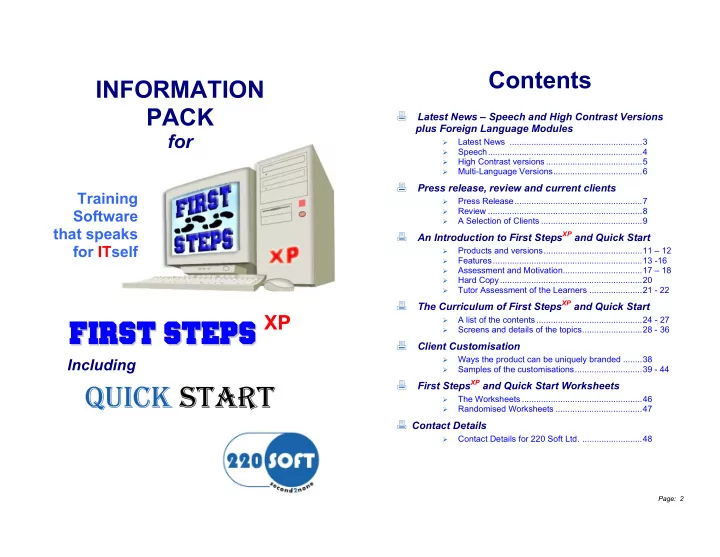
Contents INFORMATION PACK Latest News Speech and High Contrast Versions plus Foreign Language Modules for Latest News .......................................................3


slide-1
SLIDE 1

INFORMATION PACK

for

F Fi ir rs st t S St te ep ps s XP

Including

QUICK QUICK START START

Training Software that speaks for ITself

Page: 2

Contents

Latest News – Speech and High Contrast Versions

plus Foreign Language Modules

  • Latest News .......................................................3
  • Speech................................................................4
  • High Contrast versions........................................5
  • Multi-Language Versions.....................................6

Press release, review and current clients

  • Press Release.....................................................7
  • Review ................................................................8
  • A Selection of Clients ..........................................9

An Introduction to First StepsXP and Quick Start

  • Products and versions.........................................11 – 12
  • Features..............................................................13 -16
  • Assessment and Motivation.................................17 – 18
  • Hard Copy...........................................................20
  • Tutor Assessment of the Learners ......................21 - 22

The Curriculum of First StepsXP and Quick Start

  • A list of the contents............................................24 - 27
  • Screens and details of the topics.........................28 - 36

Client Customisation

  • Ways the product can be uniquely branded ........38
  • Samples of the customisations............................39 - 44

First StepsXP and Quick Start Worksheets

  • The Worksheets ..................................................46
  • Randomised Worksheets ....................................47

Contact Details

  • Contact Details for 220 Soft Ltd. .........................48
slide-2
SLIDE 2

Page: 3

Latest News

220 Soft have launched new, enhanced versions of Quick Start and First StepsXP. There are THREE major additions:

  • Speech is included with all versions. There

are two modes of operation:

  • 1. Auto Speech
  • 2. Learner controlled speech

All text, including menus, glossary, tests and help screens will be read to the learner, making this a unique training program ideal for learners with reading

  • r

viewing difficulties.

  • High Contrast Versions, ideal for visually

impaired learners are supplied. Four styles are available using different, high-contrasting colours and font sizes.

  • Progress Reporting is now available to

Learners themselves as well as tutors (in addition to certificate printing) Upgrades will be supplied FREE to all existing clients. Multiple Language capabilities are built into the software. During 2004, 220 Soft will be releasing several foreign language modules allowing FOUR modes of operation: English text/English speech Foreign text/Foreign speech English text/Foreign Speech Foreign text/English speech Any paragraph can be spoken in English, no matter which language combination is chosen. The first language – Urdu – will be supplied FREE with the software and also dispatched to all existing clients.

More details of language modules are on Page 6.

Page: 4

Speech

The two modes of operation

Auto Speech

Auto speech is the default (as it is assumed the learner may not know how to click the mouse to control it himself). Everything is read automatically for the learner. Clicking a paragraph puts the current page under learner control.

Learner controlled speech

Clicking a paragraph or menu item causes it to be read. This feature can be turned on from the program customise menu or is automatically entered for a single page if the learner clicks

  • n a paragraph to hear it read again.

Each paragraph Is read (Auto Speech) or can be read by clicking on it (Learner Controlled). The speech pauses to wait for the interactive challenges to be performed.

slide-3
SLIDE 3

Page: 5

High Contrast Versions

Ideal for visually impaired learners

Four new versions of First StepsXP and Quick Start are available with a high contrast between the colours used for text and backgrounds. These are simply selected the first time a learner uses the product. The selected preference will remain the preference for that learner every time he or she re-enters their name. The standard versions of First StepsXP and Quick Start have blue scrolling clouds on the background and an overall blue appearance to give a relaxed and enjoyable learning environment. While the text of this version is larger than many other training products, four even clearer versions have been developed to suit a variety of preferences and visual requirements. The first has a black background and predominantly yellow font with white highlights. The font is Arial as it is clearer to read than serif or fancy fonts. The second uses the same colours as above, but a bold font. This means the font has to be slightly smaller to fit the screen. The final two versions use the same fonts and sizes as above but the colours have been changed to be predominantly blue on white with black highlights.

Samples from the High Contrast Versions Page: 6

Foreign Language Modules

The content can viewed

  • r read in many languages

Foreign language modules of First StepsXP and Quick Start will be available during 2004. The first, Urdu, is expected in August and will be supplied free to all new and existing clients. By the end of 2004, several languages will be available including Urdu, Punjabi, Bengali, and a selection of Eastern European languages. Various demonstrations are available (Spanish and Russian text, Urdu speech). Note these demos were created for testing purposes

  • nly (using a web translation service) and only intended to show the

product in action. They do not reflect the authenticity of the actual foreign modules. Some of the screens displayed in the “Spanish” version are shown here. Foreign language modules are available as a demos – for details contact John

  • n 0161 474 8234.

The multi-language version will allow the user to select text in any of the available languages and speech in the same or one of the other languages. English speech is also available when foreign speech is selected (right-click the mouse).

slide-4
SLIDE 4

Page: 7 220 Soft Ltd. Unit 5 Mansion House Chambers 22 High Street Stockport SK1 1EG Tel: 0161 474 8235

Press Release 15 September 2003 First StepsXP and Quick Start help people to become computer literate 220Soft announce the launch of two revolutionary training products. Illustrating a completely new concept in educating the community to use their computers, First StepsXP and Quick Start guides novices into the world of computing while remaining a useful complete reference source once the user has mastered the skills. First StepsXP and Quick Start are designed by teachers to lead new computer users into an understanding of their system. Even more experienced learners will benefit from the wealth

  • f information contained in the packages and Student versions are also supplied for those

people with learning difficulties and younger pupils. With their practical content and comprehensive glossaries, First StepsXP and Quick Start build strong foundations for learners to start further courses such as ECDL and CLAIT. First StepsXP is designed to introduce the XP operating system, while Quick Start covers the earlier versions from Windows 95 onwards. All versions run on all the operation systems for complete flexibility in the training rooms. The programs start by showing users how to use the mouse, including clicking and drag and

  • drop. They will soon understand that the mouse controls the pointer and be able to use a

mouse with a degree of eye and hand co-ordination. The keyboard is also introduced ensuring that pupils will be able to recognise the keys and the functions of keys like Shift. “Nothing has been taken for granted in the design of this package,” says Chris Price, project leader for Quick Start, “The problem with other beginners’ packages is that you need to click

  • n something to learn to use the mouse. In Quick Start the keyboard is used until the user has

mastered the basics of mouse control. We even avoid the Enter key, as it is not clearly marked on some keyboards. “The software starts in full screen mode, but later on the windows environment with maximise and minimise etc. is introduced. Users can customise many features of the package, including having it always in a window, to suit their preferences.” For more information contact 220 Soft: Telephone 0161 474 8234.

  • ends -

_____________________________________________________________ Enquiries John Snowden, 220 Soft Ltd Telephone: 0161 474 8234

Page: 8

Review

Taken from http://search.ngfl.gov.uk/senit/senit.archive.0307/msg00007.html. Note that this review contains original pricing structure. For updates contact John on 0161 474 8234.

SENIT New progs for basic ICT skills

  • Subject: SENIT New progs for basic ICT skills
  • From: "Judith Stansfield" <stass@xxxxxxxxxxxxx>
  • Date: Tue, 8 Jul 2003 11:46:36 +0100

Through some community work I am involved with I have been made aware

  • f a new product that could be useful in school - especially if your

ICT facilities are used for community learning. It comes in 2 versions - First Steps XP for XP systems and Quick Start for older operating systems. It starts as a very basic intro to getting going on computers and introduces the language and basic IT skills that will take a complete (and scared) beginner from turning the machine on, closing it down to finding out how to use a mouse, menus etc, organising the desktop, accessing the internet and upgrading the computer. There is a helpful glossary available and certificates can be printed out for each unit. There is a natural progression, but it is possible to skip a unit or do them in a different order. Real speech support is available for all the on-screen text and a large print version for those with visual differences. In the autumn there will be a dual language version, so that English screen text is backed with Urdu(or another language) or vice versa - this will be a very motivating way of combining the development of ICT and language skills, either in ESOL

  • r MFL contexts.

The front end can be designed to reflect the school or community

  • wnership and a several learning centres and charities are using it

now. The site licence for any number of users and to include updates is now £1250+VAT, but will be £1500 +VAT in the Autumn when the speech and language facilities are included. There is also a home version for 4-users (£9.99) which will be really useful for parents of SEN children with their own equipment, who want to acquire the basic IT skills so they can support the child. For further details contact John Snowden at john@220soft.co.uk Cheers Judith PS I have no commercial interest in these products ~~~~~~~~~~~~~~~~~~~~~~~~~~~~ Judith Stansfield SEN ICT Consultant NASEN ICT Group BDACC Reviews and Literature Editor NAACE SEN Reference Point http://web.onyxnet.co.uk/Stass-onyxnet.co.uk

slide-5
SLIDE 5

Page: 9

A Selection of Clients

The ever-growing list of Councils and other organisations using First StepsXP to train the community and/or staff include the following. For a more up-to date list look at: www.220soft.co.uk/clients. People’s Networks

Newcastle City Council Gateshead City Council Wolverhampton City Council Bradford City Council Gloucester County Council Oldham Metropolitan Borough Council

Colleges

Bradford College Castle Point and Rochford Adult Community College Keighley College Selby College Northumberland College

City Learning Centres

Kirkby CLC Knowsley CLC Whiston & Prescot CLC Rochdale CLC Oldham CLC Middleton CLC Pleckgate CLC Witton Park CLC

Others

7 Leeds Family Learning Centres Quantica Training Age Concern Leeds Age Concern Liverpool Northumberland Training Agency Sunderland City Council – Youth Development Training Impetus4 Ambition James Kimber Training Northumberland Council – Deal Us In Page: 10

AN INTRODUCTION

to

F Fi ir rs st t S St te ep ps s XP

Including

QUICK QUICK START START

Training Software that speaks for ITself

slide-6
SLIDE 6

Page: 11

Two Products:

To suit all needs

First StepsXP on your computer is designed to introduce

learners to the latest operating system. Quick Start is a guide to the previous operating systems. NOTE: Both products work on any computer from Windows 95 upwards, giving complete flexibility. For example, training establishments with older machines can use

First StepsXP to train learners to use their new XP home or work

  • computer. Also, establishments with XP systems themselves can still

use Quick Start to teach the fundamentals of the old operating system.

Page: 12

Two Versions:

To suit all ages and abilities

First StepsXP and Quick Start have large, clear text and are

broken down into very small, palatable pieces. It is aimed at less able and younger people. The large fonts and speech add to the learning experience and also make the products ideal for visually impaired learners.

First StepsXP and Quick Start Advanced versions have a more

mature look, for educated adults who are new to computing. It also covers topics in more depth. All are fully customisable by clients and users. For example: Client User Branded Intro/Exit Screens Auto-Speech on/off Branded Certificates Speech On/Off Branded Worksheets In window or full-screen Hyperlinks Prompts on/off There are many other custom features detailed later in this pack.

slide-7
SLIDE 7

Page: 13

The Ethos:

Nothing is taken for granted

Until the mouse is mastered, it is not needed. Only keys that can be found easily are used. “Type your name and press 1” is an example – New users will not know where to find “Enter” (but it is accepted if it is pressed). As the learner progresses, control is moved to the mouse with buttons (not present on earlier screens), scrollbars and the other usual Windows controls.

Page: 14

Early Warning:

Learn to Shut Down

The first three times any user runs the program, a message warning about how to turn it off is given. This is to ensure new users don’t just turn off their computer as they would a TV or video recorder. The intro screen that is shown the first three times a user runs the standard version

  • f First StepsXP.

The intro screen that is shown the first three times a user runs the advanced version

  • f First StepsXP.
slide-8
SLIDE 8

Page: 15

Friendly Interface:

Move round by clear menus

Until the mouse exercises are done, all navigation is by numbers. Moving forward is by “Press any letter key”. Learners are not expected to use the mouse until the concept is explained and practised. Once the mouse is mastered, buttons appear for the learner to click. On the Main Menu, “Help” and “Exit” move

  • nto

buttons making room for two extra menu items including the choice

  • f

“More”, to display options including “Print Certificate”. Topics covered are shown in a different colour so learners know where you’re up to. Tutors can also monitor progress remotely from their computer (see later in the pack).

Page: 16

Interactive Exercises:

Learn by experience

The keyboard is progressively covered from simple presses to combinations of alt, control and shift. Once Control is introduced, learners are told how to produce a printout of the course. Interactive exercises help users to master the mouse – clicking, drag and drop, scrollbars etc. The learner cannot progress until each skill is mastered.

slide-9
SLIDE 9

Page: 17

Assessment:

Take the Test on each topic

Each of the nine sections has a test that is different each time the learner takes it. The answers are also randomised. These two randomisation processes ensure learners have to know and understand the topics rather than learn patterns of answers. Success in the test means the topic will be entered on the certificate and the learner progresses to the next lesson. The tutor can also view and print all the learners test results from any computer on the network.

Page: 18

Motivation:

Print certificates of achievements

Certificates of achievement can be printed at any stage of the training. These provide a constant record of progress for any learner. As soon as a learner is in a position to print a certificate, a note on the display explains how this is done.

slide-10
SLIDE 10

Page: 19

Hard Copy:

Print out any section to study

Any sections of the lessons can be printed. Once the learner has mastered use of the Control key, an explanation of how to do this is given. These can be built up into a useful reference guide containing over 50,000 words. The glossary can also be printed.

Page: 20

Help:

Available at any time

Clicking on the on-screen help button or pressing F1 at any time displays useful information about the current screen. In earlier stages of the course, pressing a number key for help is encouraged to ensure the learner gets full benefit from the lessons.

slide-11
SLIDE 11

Page: 21

On-Screen Assessment

Allows tutors to monitor learner’s progress and test results

The Assessment Module interrogates the databases that store where the learners are up to in the packages and their test results. The full details of progress can be displayed on screen and/or printed out. The learner’s details for each of the sections are given in the rows, which are sorted alphabetically. The maximum number of topics covered in each section is shown (there are 3 topics in Section 8 and 5 test questions). The number of topics covered by the students is shown - a bold A indicates all the section is complete.

Page: 22

Printed Assessment

Allows tutors to monitor learner’s progress and test results

The printout contains exactly the same information: Scores of 4 or 5 in the test are shown in bold. Students can print certificates showing these “passed” sections. Each printed report contains the date so an

  • ngoing record

can be kept. The names are always printed alphabetically by surname

slide-12
SLIDE 12

Page: 23

THE CURRICULUM

  • f

F Fi ir rs st t S St te ep ps s XP

Including

QUICK START

Training Software that speaks for ITself

Page: 24

First StepsXP Advanced: Contents

The following four pages outline the contents of First StepsXP and Quick Start Advanced. The content of the standard versions is basically the same, but the language used is simplified. The section “Optimising your workspace” has been left out of the standard versions as it is not relevant to the intended audience. Following the list of contents are examples from the various sections. The program starts with an introduction and small menu that is shown on the first 3 occasions the program is run only. It explains how to use the program and how to switch it off – a very important concept for new users. The items on the small introductory menu are:

  • 1. Main Menu
  • 2. How to switch off
  • 3. Exit
  • 4. Help

The topics on the Main Menu are:

  • 1. Getting started
  • 2. What's inside your computer?
  • 3. Talking to your computer
  • 4. Running your computer
  • 5. Using the Internet
  • 6. Optimising your workspace
  • 7. Taking care of your computer
  • 8. Customising and upgrading your computer
  • 9. How to get the most from your PC

Note that item 9 does not show until buttons have been taught, so that items 9 and 0 are Help and Exit. These move onto buttons after that section has been covered. Also, once a topic is covered, its reference on the Menu changes colour. Each selection on the Main Menu takes you to a sub-menu. The following pages show the contents of each sub-menu:

slide-13
SLIDE 13

Page: 25

The contents have been signposted to the OCR Level 1 Certificate for IT Users (New CLAIT) qualification. The core unit is well covered and some others are touched on. The numbers following the topics indicate the OCR reference. Getting Started

  • 1. Using the mouse........................ Units 1.1a,b, 1.2a
  • 2. The Desktop............................... Unit 12.8
  • 3. Shutdown procedure.................. Units 1.1f, 12.8
  • 4. Who's in charge?
  • 5. Test
  • 6. Help
  • 7. Return to Main Menu

What's Inside Your Computer

  • 1. Hardware ................................... Units 12.1, 12.2, 12.3
  • 2. Data storage .............................. Unit 12.2
  • 3. Software..................................... Units 12.5, 12.6, 12.7
  • 4. Test

Talking To Your Computer

  • 1. Mouse ........................................ Unit 12.2
  • 2. Keyboard.................................... Units 1.3a,b,c, Unit 12.2
  • 3. Cursor control ............................ Units 1.3a,b,c,d
  • 4. Mouse alternatives..................... Unit 12.2
  • 5. Audiovisual input........................ Unit 12.2
  • 6. Test

Running Your Computer

  • 1. Working with the Desktop .............Units 1.1c, 1.2b, 1.5, 12.1,

12.8, 12.9, 12.10, 13.1, 13.2

  • 2. Window controls............................Units 12.8, 13.2
  • 3. Creating shortcuts.........................Unit 12.8
  • 4. Managing folders and files............Units 1.1, 1.2b,c, 1.5, 13.3
  • 5. Getting Help..................................Unit 12.8
  • 6. More commands and techniques .. Unit 12.8
  • 7. Test

Page: 26

Using the Internet

  • 1. What is the Internet?
  • 2. Making the connection..................Units 3.1, 12.4
  • 3. Finding things on the Internet .......Units 3.1, 3.3, 14.6, 14.7
  • 4. Communicating on the Internet.....Unit 1.1a,b
  • 5. Electronic commerce
  • 6. Security and filtering .....................Units 14.10, 14.11
  • 7. Constructing your own Web page
  • 8. Test

Optimising your workspace

  • 1. Workstation................................ Unit 1.1
  • 2. Lighting ..................................... Unit 1.1
  • 3. Working position ....................... Unit 1.1
  • 4. Display ...................................... Unit 1.1
  • 5. Other equipment and wiring ...... Unit 1.1
  • 6. Information materials
  • 7. Test

Taking care of your computer

  • 1. Keeping your computer safe ........... Unit 14.7
  • 2. Hardware maintenance................... Unit 14.7
  • 3. Looking after your hard disk ........... Unit 14.7
  • 4. Computer viruses and antivirus ...... Unit 14.7
  • 5. Backing up your files ...................... Unit 14.7
  • 6. Test

Customising and upgrading your computer

  • 1. Customising your Desktop...............Unit 1.1c
  • 2. Control settings
  • 3. Customising programs
  • 4. Enhancing the Operating System ....Unit 12.9
  • 5. Installing new software.....................Unit 1.1d
  • 6. Adding and upgrading hardware
  • 7. Test
slide-14
SLIDE 14

Page: 27

How to get the most from your PC

  • 1. Recreation.................................. Unit 14.9
  • 2. Education and career ................ Unit 14.9
  • 3. Help with paperwork ................. Unit 14.9
  • 4. Running a business .................. Unit 14.9
  • 5. Test

There is also another sub-menu accessed from the main menu (once buttons are explained) or by pressing Ctrl+V

  • 1. Glossary (glossary words can also accessed by clicking

highlighted words in the text).

  • 2. Print glossary
  • 3. Print certificate
  • 4. Customise program
  • 5. Additional information

The following may be customised:

  • 1. Turn sound effects on/off
  • 2. Turn speech on/off
  • 3. Turn auto-speech on/off
  • 4. Display in full screen/window
  • 5. Turn "do earlier sections first" prompts on/off
  • 6. Hide buttons until "using mouse" completed/Always show

buttons

  • 7. Clear current scores and progress record

The following pages of this section show some examples of the screens within the various sections:

Page: 28

Topic 1: Getting Started

Learners will discover how to control the mouse and confidently navigate around the Windows environment. Along with terminology etc. they will learn sufficient to embark confidently on other courses such as ECDL etc. Getting Started will lead any

  • ne new to the world of

computing – even with no knowledge of how to use a mouse – through a series of interactive exercises to become competent in the basic skills.

slide-15
SLIDE 15

Page: 29

Topic 2: What’s Inside Your

Computer?

Learners will be able to confidently converse about their equipment and know the meaning of words used in areas like adverts and instruction manuals. What’s Inside Your Computer? Describes the important components and explains the necessary technical words that computer users’ meet.

Page: 30

Topic 3: Talking to Your

Computer

Talking to Your Computer shows how to use the keyboard for entering and editing text and describes

  • ther input devices that are

available. Learners will master the keyboard and discover other ways to input data.

slide-16
SLIDE 16

Page: 31

Topic 4: Running Your

Computer

Running Your Computer guides learners around the Windows environment giving useful tips

  • n

controlling Windows and file handling. On completion of this topic, learners will be at a level where they can competently use software and manage files.

Page: 32

Topic 5: Using the Internet

Using the Internet describes the web, shows how to connect to it and then use it safely for a whole variety of applications. The amazing world

  • f

electronic communications and discovery will be accessible to learners completing this topic.

slide-17
SLIDE 17

Page: 33

Topic 6: Optimising your

Workspace

The advice will allow learners to spend more time at their computer without discomfort. Optimising your workspace shows how you should set-up your equipment for the most comfortable and safe use.

Page: 34

Topic 7: Taking Care of Your

Computer

Learners will discover the importance of backing up work, defragging drives and looking after equipment in many other ways. Taking Care

  • f

Your Computer details how you should take care of your equipment – both hardware and software.

slide-18
SLIDE 18

Page: 35

Topic 8: Customising and

Upgrading Your Computer

Learners discover how easy it is to give their computer a personal feel and add new peripherals to the system. Customising and Upgrading Your Computer gives learners an insight into the many ways their equipment can be personalised and improved.

Page: 36

Topic 9: How to get the most

from your PC

This topic supplies students with ideas for uses of their PC so, with the knowledge gained from First StepsXP or Quick Start, they can make the most

  • f the technology available.

How to get the most from your PC explains how you can use your computer effectively for work or leisure.

slide-19
SLIDE 19

Page: 37

THE CUSTOMISING

for clients of

F Fi ir rs st t S St te ep ps s XP

Including

QUICK QUICK START START

Training Software that speaks for ITself

Page: 38

Client Customisation:

A unique branded product

First StepsXP and Quick Start can both be branded for clients in many ways including: Branded introductory logo page (animations etc. are possible) Corporate logo can be inserted on scrolling backgrounds Corporate logo, contacts etc. can be on the certificate The number of users allowed can be limited as required Installed, CD or Network versions (or combinations) can be supplied The fonts can be changed (size, face and colour) The background can be completely changed to suit corporate image Hyperlinks can be added anywhere to take learners to other areas.

slide-20
SLIDE 20

Page: 39

Client Customisation:

A unique branded product

Branded introductory logo page (animations

  • etc. are possible)

Any product name Any product logo Any company logo

Page: 40

Client Customisation:

A unique branded product

Corporate logo can be inserted on scrolling backgrounds Phone numbers, web details or messages can scroll Logos can scroll too!

slide-21
SLIDE 21

Page: 41

Client Customisation:

A unique branded product

Corporate logo, contacts etc. can be on the certificate Any logos or messages can go in this space Frame can be customised to corporate colours or changed completely

Page: 42

Client Customisation:

A unique branded product

The number of users allowed can be limited as required This version has been limited to 4 users. Anything from one user to an unlimited number is possible.

slide-22
SLIDE 22

Page: 43

Client Customisation:

A unique branded product

The fonts can be changed (size, face and colour)

Page: 44

Client Customisation:

A unique branded product

The background can be completely changed to suit corporate image Any colour or background image can be used (providing the text colours clearly show on it). Hyperlinks can be added anywhere to take learners to other areas.

For example, a link to a client’s own word-processing course could be inserted when the learner understands the basics, or a complete list of courses could be linked from the end.

slide-23
SLIDE 23

Page: 45

THE WORKSHEETS

for

F Fi ir rs st t S St te ep ps s XP

Including

QUICK QUICK START START

Training Software that speaks for ITself

Page: 46

Worksheets

Supplied with First StepsXP and Quick Start

First StepsXP and Quick Start are supplied with 32 worksheets to test the learner’s understanding of computer basics. For learners, the answers to all the questions can all be found in the software and, for tutor convenience, answers are supplied. The first 16 (18 Advanced) worksheets are based on the various sections of the courses (two each section) and for help you can select, from the program menu, the area corresponding to the title of the sheet. Sheets 17 to 32 (19 to 36 Advanced) have mixed questions that come from anywhere in the course.

The first 16 sheets correspond to the First StepsXP topics From sheet 17 onwards, the questions are from anywhere in the course

slide-24
SLIDE 24

Page: 47

Worksheets

First StepsXP RANDOM worksheets

The worksheets can be printed in four random layouts and with an infinite number of variations of arrangement of the questions and answers. It is possible to randomise just the answers, just the questions or to have complete randomisation. This means the “same” sheet can be given to a learner after a few days to ensure the knowledge has been retained.

New questions are selected Answers are randomised for repeated questions

Page: 48

For licensing details

Please contact: John Snowden 220 Soft Ltd. Unit 2 Mansion House Chambers 22 High Street Stockport SK1 1EG Telephone: +44 (0) 161 474 8234 e-mail: info@220soft.co.uk http://www.220soft.co.uk