S N element and should be in the Gaussian surface region - - PowerPoint PPT Presentation

s n
SMART_READER_LITE
LIVE PREVIEW

S N element and should be in the Gaussian surface region - - PowerPoint PPT Presentation

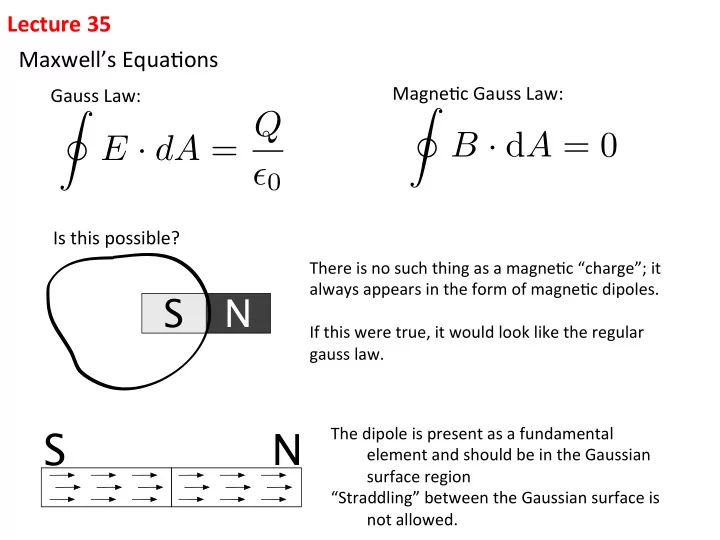
Lecture 35 Maxwells Equa-ons Magne-c Gauss Law: Gauss Law: I E dA = Q I B d A = 0 0 Is this possible? There is no such thing as a magne-c


slide-1
SLIDE 1

Maxwell’s ¡Equa-ons ¡

I E · dA = Q ✏0

Gauss ¡Law: ¡ Magne-c ¡Gauss ¡Law: ¡

I B · dA = 0

There ¡is ¡no ¡such ¡thing ¡as ¡a ¡magne-c ¡“charge”; ¡it ¡ always ¡appears ¡in ¡the ¡form ¡of ¡magne-c ¡dipoles. ¡ ¡ If ¡this ¡were ¡true, ¡it ¡would ¡look ¡like ¡the ¡regular ¡ gauss ¡law. ¡

Is ¡this ¡possible? ¡

N S

N S

The ¡dipole ¡is ¡present ¡as ¡a ¡fundamental ¡ ¡element ¡and ¡should ¡be ¡in ¡the ¡Gaussian ¡ ¡surface ¡region ¡ “Straddling” ¡between ¡the ¡Gaussian ¡surface ¡is ¡ ¡not ¡allowed. ¡

Lecture ¡35 ¡

slide-2
SLIDE 2

Maxwell’s ¡Equa-ons ¡– ¡con-nued... ¡

Ampere’s ¡Law ¡

Z B · dl = µ0I

I

Current ¡running ¡through ¡ the ¡surface ¡where ¡the ¡rim ¡

  • f ¡the ¡surface ¡= ¡path ¡

(think ¡of ¡the ¡surface ¡as ¡a ¡soap ¡bubble ¡filament) ¡

E

Mathema-cally, ¡the ¡film ¡ doesn’t ¡need ¡to ¡be ¡flat ¡

E = Q/A ✏0 Q = ✏0EA

dQ dt = ✏0 dΦE dt

, ¡

Charge ¡build-­‑up ¡on ¡the ¡plate ¡generates ¡an ¡electric ¡flux ¡ (Virtual ¡current, ¡or ¡the ¡displacement ¡current ¡ID, ¡to ¡be ¡ added ¡to ¡“I” ¡in ¡Amp-­‑Maxwell ¡Law) ¡ Responsible ¡for ¡piercing ¡the ¡surface ¡defined ¡by ¡the ¡rim ¡ (For ¡par-al ¡piercing, ¡refer ¡to ¡Fig(mi) ¡24.5) ¡

slide-3
SLIDE 3

R I I

Discussion ¡of ¡Ch24.Hw1.001 ¡

Set-­‑up: ¡

Eext = uniform

, ¡increasing ¡ Apply ¡Ampere-­‑Maxwell ¡Law: ¡

✏0 dΦE dt

(2) ¡ (1) ¡ Cau-on, ¡check ¡contribu-ons ¡of: ¡ ¡

(1) ⇢ CW CCW (2) ⇢ CW CCW

  • Contrib. ¡of ¡(1) ¡
  • Contrib. ¡of ¡(2) ¡

1) ¡ CW ¡ CW ¡ 2) ¡ CCW ¡ CW ¡ 3) ¡ CW ¡ CCW ¡ 4) ¡ CCW ¡ CCW ¡

Clicker ¡1: ¡

correct ¡ Exercise: ¡Check ¡various ¡cases: ¡

~ E ⊗ ⇢ CW CCW ~ E ⇢ CW CCW

3 ¡

P ¡

2πRBp = µ0 [NItoroid + IDC]

slide-4
SLIDE 4

We ¡use ¡the ¡following ¡example ¡used ¡by ¡Professor ¡Feynman ¡to ¡ illustrate ¡some ¡of ¡the ¡proper-es ¡of ¡EM ¡pulse. ¡The ¡geometry ¡of ¡the ¡ setup ¡is ¡shown ¡in ¡fig ¡35.2 ¡and ¡fig ¡35.3 ¡ A ¡warm ¡up. ¡There ¡is ¡the ¡presence ¡of ¡a ¡current ¡sheet ¡at ¡x ¡= ¡0 ¡in ¡the ¡ yz-­‑plane. ¡If ¡the ¡current ¡I ¡is ¡constant, ¡it ¡generates ¡a ¡familiar ¡B ¡pabern ¡ shown ¡in ¡fig ¡35.4 ¡ One ¡Dimensional ¡EM ¡Pulse ¡ For ¡x ¡> ¡0, ¡B-­‑lines ¡are ¡poin-ng ¡in ¡the ¡–z ¡direc-on. ¡For ¡x ¡< ¡0, ¡B ¡lines ¡are ¡ in ¡the ¡+z ¡direc-on. ¡ Now ¡we ¡proceed ¡to ¡discuss ¡the ¡genera-on ¡of ¡1D-­‑EM ¡pulse ¡in ¡steps. ¡

X

I

⊗ ⊗ ⊗ ⊗

  • y

z

slide-5
SLIDE 5

Step ¡1: ¡Instead ¡of ¡having ¡a ¡steady ¡current, ¡we ¡turn ¡on ¡the ¡current ¡at ¡t ¡= ¡0. ¡ ¡Here ¡ there ¡is ¡no ¡B-­‑pabern ¡before ¡t ¡= ¡0. ¡The ¡pabern ¡immediately ¡setups ¡when ¡t ¡> ¡0. ¡First, ¡ the ¡B ¡pabern ¡is ¡created ¡in ¡the ¡proximity ¡of ¡x ¡= ¡0. ¡As ¡t ¡increases ¡there ¡is ¡the ¡spread ¡ both ¡in ¡x ¡> ¡0 ¡and ¡in ¡x ¡< ¡0 ¡direc-on ¡with ¡a ¡speed ¡of ¡v. ¡The ¡goal ¡of ¡this ¡exercise ¡is ¡to ¡ use ¡fig ¡35.2 ¡and ¡fig ¡35.3 ¡determine ¡v. ¡ ¡ Step ¡2: ¡In ¡fig ¡35.21 ¡and ¡fig ¡35.2b ¡define ¡the ¡closed ¡path ¡12341. ¡The ¡loop ¡is ¡in ¡the ¡xy ¡ plane ¡at ¡some ¡z ¡value. ¡We ¡view ¡how ¡the ¡flux ¡grows ¡within ¡the ¡window. ¡As ¡shown ¡ in ¡Fig ¡35.2b, ¡the ¡B-­‑flux ¡in ¡the ¡window ¡increases, ¡as ¡the ¡flux ¡expands ¡to ¡the ¡right. ¡ The ¡flux ¡is ¡defined ¡by ¡

φB = Bhx = Bhvt

slide-6
SLIDE 6

Lenz ¡rule ¡states ¡as ¡the ¡B ¡flux ¡into ¡the ¡window ¡increases, ¡there ¡must ¡ be ¡Bind, ¡the ¡induced ¡B, ¡poin-ng ¡out ¡of ¡the ¡loop, ¡which ¡opposes ¡the ¡ increase ¡of ¡the ¡ingoing ¡flux. ¡Bind ¡is ¡caused ¡by ¡CCW ¡emf ¡induced. ¡ ¡ The ¡Faraday’s ¡Law ¡using ¡the ¡closed ¡path ¡12341 ¡gives: ¡ ¡ ¡ Step ¡3: ¡Eind ¡in ¡step ¡2 ¡is ¡the ¡E ¡field ¡of ¡the ¡EM ¡pulse ¡discussed ¡in ¡Sec. ¡ 24.2 ¡in ¡the ¡text. ¡One ¡sees ¡that ¡E ¡x ¡B ¡for ¡the ¡present ¡case ¡is ¡along ¡to ¡ the ¡right. ¡We ¡proceed ¡to ¡shown ¡that ¡Ampere-­‑Maxwell ¡law ¡(AM-­‑law) ¡ leads ¡to ¡an ¡addi-onal ¡rela-onship ¡between ¡E ¡and ¡B ¡which ¡will ¡enable ¡ us ¡to ¡determine ¡v. ¡

Eind = Eindh = dφB dt = Bhv,

  • r Eind = Bv

(1) ¡

slide-7
SLIDE 7

Consider ¡the ¡AM-­‑loop ¡12561 ¡shown ¡in ¡(a) ¡and ¡(b) ¡of ¡Fig35.3. ¡Fig35.3a ¡ shows ¡the ¡front ¡view ¡where ¡the ¡loop ¡is ¡at ¡the ¡top. ¡Fig35.3b ¡shows ¡the ¡ top ¡view ¡of ¡the ¡loop. ¡AM-­‑law ¡states: ¡ ¡ ¡ ¡ ¡ ¡ ¡ ¡ ¡ ¡ ¡ ¡ ¡ ¡or ¡ ¡ ¡ This ¡combined ¡with ¡(1) ¡E ¡= ¡Bv ¡leads ¡to ¡ ¡ ¡ ¡ Thus ¡EM ¡pulse ¡travels ¡in ¡free ¡space ¡with ¡an ¡universal ¡speed, ¡the ¡speed ¡

  • f ¡light. ¡
  • I

path

B · dl

  • = ✏0µ0
  • dE

dt

  • Bb = ✏0µ0

dEbx dt , or B = ✏0µ0Ev

B = ✏0µ0(Bv)v,

  • r v =

1 √✏0µ0 ≈ 3 × 10⁸ m/s

slide-8
SLIDE 8

Propaga-on ¡of ¡EM ¡waves: ¡

  • 1. ¡ ¡ E ⊥ B

E × B

E = vB

, ¡

gives ¡the ¡direc-on ¡of ¡propaga-on ¡

  • 2. ¡ ¡Universal ¡Speed ¡ v =

1 √µ0✏0

(in ¡a ¡vacuum) ¡ All ¡light ¡is ¡an ¡EM ¡wave, ¡and ¡travels ¡with ¡the ¡same ¡speed ¡

  • 3. ¡ ¡E = cB

Reflec-on: ¡c ¡is ¡the ¡speed ¡of ¡the ¡“wavefront” ¡ Field ¡has ¡a ¡boundary. ¡ ¡This ¡boundary ¡travels ¡ with ¡v ¡= ¡c ¡in ¡vacuum. ¡ The ¡wave ¡shape ¡is ¡ini-ated ¡by ¡the ¡t-­‑dependence ¡of ¡the ¡source. ¡

Recap: ¡

E B E B

For ¡sinusoidal ¡current: ¡ The ¡squares ¡are ¡ rounded ¡off ¡