Local vs. Global Page Replacement Local: Select victim only among - - PowerPoint PPT Presentation

local vs global page replacement
SMART_READER_LITE
LIVE PREVIEW

Local vs. Global Page Replacement Local: Select victim only among - - PowerPoint PPT Presentation

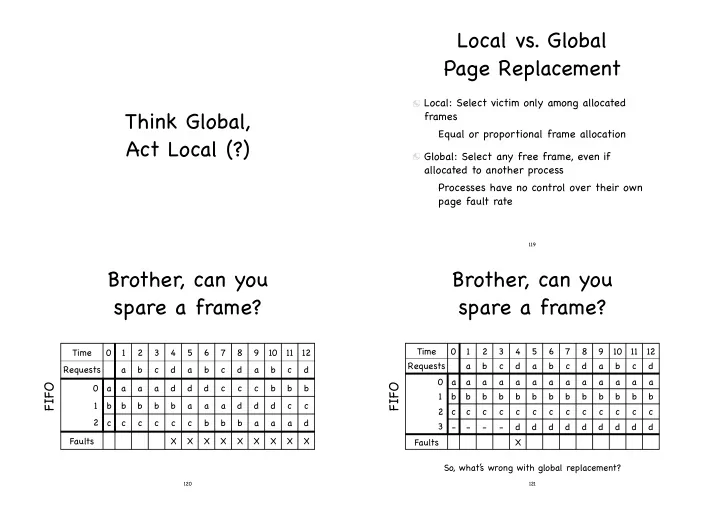
Local vs. Global Page Replacement Local: Select victim only among allocated Think Global, frames Equal or proportional frame allocation Act Local (?) Global: Select any free frame, even if allocated to another process Processes have no control


slide-1
SLIDE 1

Think Global, Act Local (?) Local vs. Global Page Replacement

Local: Select victim only among allocated frames Equal or proportional frame allocation Global: Select any free frame, even if allocated to another process Processes have no control over their own page fault rate

119

Brother, can you spare a frame?

Time 1 2 3 4 5 6 7 8 9 10 11 12 Requests a b c d a b c d a b c d a a a a d d d c c c b b b 1 b b b b b a a a d d d c c 2 c c c c c c b b b a a a d Faults X X X X X X X X X

FIFO

120

Brother, can you spare a frame?

Time 1 2 3 4 5 6 7 8 9 10 11 12 Requests a b c d a b c d a b c d a a a a a a a a a a a a a 1 b b b b b b b b b b b b b 2 c c c c c c c c c c c c c 3

  • d

d d d d d d d d Faults X So, what’ s wrong with global replacement?

FIFO

121

slide-2
SLIDE 2

Demand May Exceed Resources

Demand paging enables frames to cache the currently used part of a process VA space If the cache is large enough, hit ratio is high

few page faults

What if not enough frames to go around?

should decrease degree of multiprogramming

release frames of swapped out processes reduce contention over limited resources

122

What May Happen Instead

When not enough frames... high page fault rate low CPU utilization OS may increase degree of multiprogramming!

123

What May Happen Instead

When not enough frames... high page fault rate low CPU utilization OS may increase degree of multiprogramming! Thrashing process spends all its time swapping pages in and out

Degree of Multiprogramming CPU Utilization 124

Locality of Reference

If a process access a memory location, then it is likely that

the same memory location is going to be accessed again in the near future (temporal locality) nearby memory locations are going to be accessed in the future (spatial locality)

90% of the execution of a program is sequential Most iterative constructs consist of a relatively small number of instructions

125

slide-3
SLIDE 3

Tracking Locality

When a process executes it moves from locality (set of pages used together) to locality the size of the process’ locality (a.k.a. its working set) can change over time Goal: track the size of the process’ working set, dynamically acquiring and releasing frames as necessary

126

The Working Set Model

Define a WS window of references Goal: Keep in memory a process’ W S WSi = distinct pages referenced in latest

too small does not cover locality too large covers many localities

Thrashing if WSi > # frames

if so, swap out one of the processes

If enough free frames, increase degree of multiprogramming Σi pi

<latexit sha1_base64="ZHG+RkPq35frN/qTOCNhAC+vQ8=">AB3icdVDLSgMxFL1TX7W+qi7dBIvgapix4gMUC25cVnRsoS0lk6ZtaGYmJHeEUrp3o7hS3Pk5/oK/4ReYtrqojwMXDuecS+5JqKQw6HnvTmZmdm5+IbuYW1peWV3Lr2/cmCTVjAcskYmuhtRwKWIeoEDJq0pzGoWSV8Le+civ3HJtRBJfY1/xRkQ7sWgLRtFKV6opmvmC73pjkP9J4ezjVL0CQLmZf6u3EpZGPEYmqTE131PYGFCNgk+zNVTwxVlPdrhg/GBQ7JjpRZpJ9pOjGSsTuVoZEw/Cm0yotg1P72R+JdXS7F91BiIWKXIYzZ5qJ1KgkZtSUtoTlD2beEMi3shYR1qaYM7Z/kbHXPLR7s+0WP/Cbf1YM9j1L/1C6QmyMIWbMu+HAIJbiAMgTAoAP38ATPTujcOQ/O4ySacb52NmEKzsnDGaL9w=</latexit><latexit sha1_base64="1/VW9mlyb6fVGRlOAzoBG5h9tNU=">AB3icdVDLSgMxFL1TX3V8V26CRbB1TBjxQdYLhxWdGxhbaUTJpQzMzIckIpXTvRnGluPZn/APxN/wCM60u6uPAhcM5J7EgjOlHbdys3Mzs3v5BftJeWV1bXCusb1ypJaE+SXgi6wFWlLOY+pTutCUhwFnNaC/lnm126oVCyJr/RA0FaEuzELGcHaSJeizdqFoue4Y6D/SfH0oyxe3uxytV14bXYSkY01oRjpRqeK3RriKVmhNOR3UwVFZj0cZcOxweO0I6ROihMpJlYo7E6lcORUoMoMkI6576WXiX14j1eFRa8hikWoak8lDYcqRTlDWFnWYpETzgSGYSGYuRKSHJSba/IltqrtO6WDfK7noN/mu7u85x4534RUrJzBHrZgG3bBg0OowDlUwQcCXbiDR3iyAuvWurceJtGc9bWzCVOwnj8BgsCNGA=</latexit><latexit sha1_base64="1/VW9mlyb6fVGRlOAzoBG5h9tNU=">AB3icdVDLSgMxFL1TX3V8V26CRbB1TBjxQdYLhxWdGxhbaUTJpQzMzIckIpXTvRnGluPZn/APxN/wCM60u6uPAhcM5J7EgjOlHbdys3Mzs3v5BftJeWV1bXCusb1ypJaE+SXgi6wFWlLOY+pTutCUhwFnNaC/lnm126oVCyJr/RA0FaEuzELGcHaSJeizdqFoue4Y6D/SfH0oyxe3uxytV14bXYSkY01oRjpRqeK3RriKVmhNOR3UwVFZj0cZcOxweO0I6ROihMpJlYo7E6lcORUoMoMkI6576WXiX14j1eFRa8hikWoak8lDYcqRTlDWFnWYpETzgSGYSGYuRKSHJSba/IltqrtO6WDfK7noN/mu7u85x4534RUrJzBHrZgG3bBg0OowDlUwQcCXbiDR3iyAuvWurceJtGc9bWzCVOwnj8BgsCNGA=</latexit><latexit sha1_base64="1/VW9mlyb6fVGRlOAzoBG5h9tNU=">AB3icdVDLSgMxFL1TX3V8V26CRbB1TBjxQdYLhxWdGxhbaUTJpQzMzIckIpXTvRnGluPZn/APxN/wCM60u6uPAhcM5J7EgjOlHbdys3Mzs3v5BftJeWV1bXCusb1ypJaE+SXgi6wFWlLOY+pTutCUhwFnNaC/lnm126oVCyJr/RA0FaEuzELGcHaSJeizdqFoue4Y6D/SfH0oyxe3uxytV14bXYSkY01oRjpRqeK3RriKVmhNOR3UwVFZj0cZcOxweO0I6ROihMpJlYo7E6lcORUoMoMkI6576WXiX14j1eFRa8hikWoak8lDYcqRTlDWFnWYpETzgSGYSGYuRKSHJSba/IltqrtO6WDfK7noN/mu7u85x4534RUrJzBHrZgG3bBg0OowDlUwQcCXbiDR3iyAuvWurceJtGc9bWzCVOwnj8BgsCNGA=</latexit><latexit sha1_base64="1/VW9mlyb6fVGRlOAzoBG5h9tNU=">AB3icdVDLSgMxFL1TX3V8V26CRbB1TBjxQdYLhxWdGxhbaUTJpQzMzIckIpXTvRnGluPZn/APxN/wCM60u6uPAhcM5J7EgjOlHbdys3Mzs3v5BftJeWV1bXCusb1ypJaE+SXgi6wFWlLOY+pTutCUhwFnNaC/lnm126oVCyJr/RA0FaEuzELGcHaSJeizdqFoue4Y6D/SfH0oyxe3uxytV14bXYSkY01oRjpRqeK3RriKVmhNOR3UwVFZj0cZcOxweO0I6ROihMpJlYo7E6lcORUoMoMkI6576WXiX14j1eFRa8hikWoak8lDYcqRTlDWFnWYpETzgSGYSGYuRKSHJSba/IltqrtO6WDfK7noN/mu7u85x4534RUrJzBHrZgG3bBg0OowDlUwQcCXbiDR3iyAuvWurceJtGc9bWzCVOwnj8BgsCNGA=</latexit><latexit sha1_base64="r/Ss4if5ogUMD6/+QWEvGwrnzac=">AB3icdVDLSgMxFL1TX7W+qi7dBIvgapixQe4KLhxWdGxhbaUTJpQzOZIbkjlNK9G8WV4h/5C/6N6cNFfRwIHM454d5zw1QKg5736eSWldW1/LrhY3Nre2d4u7evUkyzXjAEpnoRkgNl0LxAVK3kg1p3EoeT0cXE38+gPXRiTqDocpb8e0p0QkGEUr3aYd0SmWfNebgvxPSjBHrVP8aHUTlsVcIZPUmKbvpdgeUY2CST4utDLDU8oGtMdH0wXH5MhKXRIl2j6FZKou5GhszDAObTKm2Dc/vYn4l9fMDpvj4RKM+SKzQZFmSYkElb0hWaM5RDSyjTwm5IWJ9qytDepGCre275tOKXPfKbfFcPTtwL17/xS9XL+Q3ycACHcAw+nEVrqEGATDowRO8wpsTOo/Os/Myi+ac+Z9WIDz/gXJiIl5</latexit>

127

WS Page Replacement = 4

Time 1 2 3 4 5 6 7 8 9 10 Requests c c d b c e c e a d Page a

  • Page b

Page c Page d

  • Page e
  • Faults

Pages in Memory

t=0 t=−1 t=−2 128

  • page mapped to a frame
  • page fault & page mapped to a frame
  • page referenced & mapped to a frame

WS Page Replacement = 4

Time 1 2 3 4 5 6 7 8 9 10 Requests c c d b c e c e a d Page a

  • Page b

Page c Page d

  • Page e
  • Faults

Pages in Memory

t=0 t=−1 t=−2

  • X
  • 129
  • X
  • X
  • X
  • X

page mapped to a frame page fault & page mapped to a frame page referenced & mapped to a frame

slide-4
SLIDE 4

Computing the WS

Use interval timer , the R bit, and extra bits per page Define When elapses, shift right once the bits, copy R bit in most significant bit, and reset R If one of the bits is 1, the corresponding page is in WS τ ∆=τ ×k k k τ k

130

When too many page faults, increase WS; when too few, decrease it

Keep time of last page fault On page fault: 1) add faulting page to the working set 2) if , then unmap all pages not referenced in [ ]

WS and Page Fault Frequency

tlast tcurrent − tlast > τ ∗

131

threshold

tlast, tcurrent

PFF Page Replacement

Time 1 2 3 4 5 6 7 8 9 10 Requests c c d b c e c e a d Page a

  • Page b

Page c Page d

  • Page e
  • Faults

Pages in Memory

τ ∗ = 2

tcurrent − tlast

132

PFF Page Replacement

Time 1 2 3 4 5 6 7 8 9 10 Requests c c d b c e c e a d Page a

  • Page b

Page c Page d

  • Page e
  • Faults

Pages in Memory

τ ∗ = 2

tcurrent − tlast

133

  • X

1

  • X
  • 3
slide-5
SLIDE 5

PFF Page Replacement

Time 1 2 3 4 5 6 7 8 9 10 Requests c c d b c e c e a d Page a

  • Page b
  • Page c
  • Page d
  • Page e
  • Faults

X X X 3 2 3 1 Pages in Memory

τ ∗ = 2

tcurrent − tlast

134

  • X

1

  • X
slide-6
SLIDE 6

I/O Devices You Need to Get Out More!

How does a computer connect with the outside world?

I/O Architecture

CPU MEM

Memory Bus General I/O Bus

Graph

(PCI) Peripheral I/O Bus (SCSI, SATA USB)

USB eSATA PCIe

CHIP I/O

MEM CPU

Graph

Interacting with a Device

Registers

Status Command Data

Interface

(what the OS sees)

Internals

(what is needed to implement the abstraction)

Abstraction

(what the user sees)

slide-7
SLIDE 7

Interacting with a Device

Registers

Status Command Data

Interface

(what the OS sees)

Internals

(what is needed to implement the abstraction)

Interacting with a Device

Registers

Status Command Data

Microcontroller Memory Other device specific chips

Internals

(what is needed to implement the abstraction)

Microcontroller Memory Other device specific chips

Interacting with a Device

OS controls device by reading/writing registers

Registers

Status Command Data

Internals

(what is needed to implement the abstraction)

while (STATUS == BUSY) ; / / wait until device is not busy write data to DATA register write command to COMMAND register / / starts device and executes command while (STATUS == BUSY) ; / / wait until device is done with request

Tuning It Up

CPU is polling

use interrupts run another process while device is busy what if device returns very quickly?

CPU is copying all the data to and from DATA

use Direct Memory Access (DMA)

while (STATUS == BUSY) ; / / wait until device is not busy write data to DATA register write command to COMMAND register / / starts device and executes command while (STATUS == BUSY) ; / / wait until device is done with request

slide-8
SLIDE 8

From interrupt-driven I/O to DMA

Interrupt driven I/O

Device CPU RAM

CPU issues read request device interrupts CPU with data CPU writes data to memory for (i = 1 . . . n)

Disk

From interrupt-driven I/O to DMA

Interrupt driven I/O

Device CPU RAM

CPU issues read request device interrupts CPU with data CPU writes data to memory

+ Direct Memory Access

Device RAM

CPU sets up DMA request Device puts data on bus & RAM accepts it Device interrupts CPU when done for (i = 1 . . . n)

Disk Disk

Communicating with devices

Explicit I/O instructions (privileged)

in and out instructions in x86

Memory-mapped I/O

map device registers to memory location use memory load and store instructions to read/ write to registers

How can the OS handle a multitude of devices?

Abstraction!

Encapsulate device specific interactions in a device driver Implement device neutral interfaces above device drivers

Humans are about 70% water…

…OSs are about 70% device drivers!

Application File System Block Cache Generic Block Layer Device Driver [SCSI, ATA, etc] Memory-mapped I/O, DMA, Interrupts Physical Device

File System Stack (simplified)

User Kernel POSIX API [open, read, write, close, etc] Generic Block Interface [block read/write] Protocol-specific Block Interface

slide-9
SLIDE 9

Persistent Storage Storage Devices

We focus on two types of persistent storage

magnetic disks

servers, workstations, laptops

flash memory

smart phones, tablets, cameras, laptops

Other exist(ed)

tapes drums clay tablets

The Oldest Library?

Ashurbanipal, King of Assyria (668-630 bc)

Magnetic disk

Store data magnetically on thin metallic film bonded to rotating disk of glass, ceramic, or aluminum