Respondent Mathieu Gaborit Supervisors Peter Gransson (KTH, se) - - PowerPoint PPT Presentation

respondent mathieu gaborit supervisors peter g ransson
SMART_READER_LITE
LIVE PREVIEW

Respondent Mathieu Gaborit Supervisors Peter Gransson (KTH, se) - - PowerPoint PPT Presentation

Respondent Mathieu Gaborit Supervisors Peter Gransson (KTH, se) Olivier Dazel (Le Mans Universit, fr) Faculty Opponent Lucie Rouleau (CNAM, fr) Evaluation Committees Elke Deckers (KU Leuven, be) meline Sadoulet (FEMTO ST, fr) Annie


slide-1
SLIDE 1

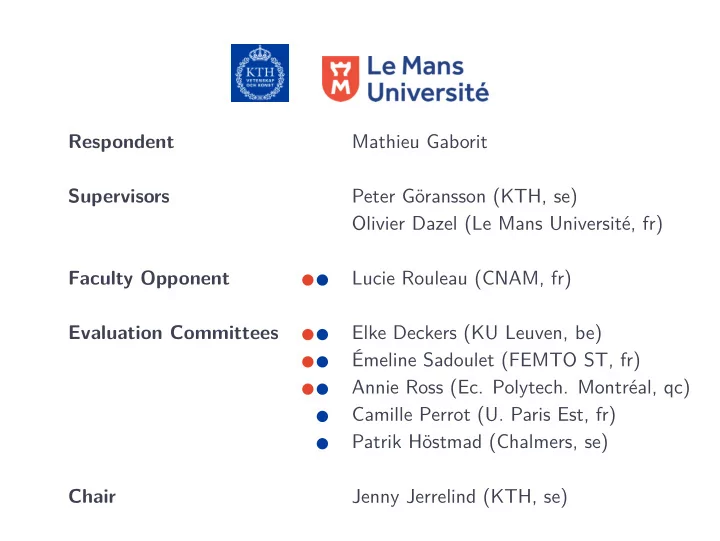
Respondent Mathieu Gaborit Supervisors Peter Göransson (KTH, se) Olivier Dazel (Le Mans Université, fr) Faculty Opponent Lucie Rouleau (CNAM, fr) Evaluation Committees Elke Deckers (KU Leuven, be) Émeline Sadoulet (FEMTO ST, fr) Annie Ross (Ec. Polytech. Montréal, qc) Camille Perrot (U. Paris Est, fr) Patrik Höstmad (Chalmers, se) Chair Jenny Jerrelind (KTH, se)

slide-2
SLIDE 2

Modelling strategies for thin imperfect interfaces and layers

Public Doctoral Thesis Defense

slide-3
SLIDE 3

Context

  • Co-tutelle agreement between

Le Mans Université and KTH

  • LAUM UMR CNRS 6613 (Olivier Dazel)
  • Marcus Wallenberg Lab. (Peter Göransson)
  • 6-months periods
  • Funding:
  • Main funder: Le Mans Acoustique
  • 4th year: AERIALIST
  • Support from MWL
  • Support from DENORMS CA15125
  • Acoustics HUB Grant
  • ÖMSE grant
  • Free software:
  • github.com/OlivierDAZEL/PLANES
  • github.com/cpplanes/pymls

1

slide-4
SLIDE 4

Efgects of noise

Efgects of noise1: stress/anxiety, heart diseases, sleep troubles Focus:

  • Better performance (especially at low frequency)
  • Multi-objectives: broadband, context adaptation, tunability
  • Multi-functional

Of course: always thinner, lighter, concealed,…

1 Babisch (2002). Noise Health, pmid: 12537836

World Health Organization (2009). OCLC: ocn475454508 World Health Organisation (2011). OCLC: 779684347 Beutel et al. (2016). PLOS ONE,. 10.1371/journal.pone.0155357 Hume et al. (2012). Noise and Health, 10.4103/1463-1741.104897. 2

slide-5
SLIDE 5

Classical design

Panels with multiple layers of foam/fjbrous media Allard and Atalla ( 2009) Pros: cheap to produce, robust, broadband Cons: ineffjcient at low frequency, hard to tune

3

slide-6
SLIDE 6

Classical design

Panels with multiple layers of foam/fjbrous media Allard and Atalla ( 2009) Pros: cheap to produce, robust, broadband Cons: ineffjcient at low frequency, hard to tune

3

slide-7
SLIDE 7

Classical design

Panels with multiple layers of foam/fjbrous media Allard and Atalla ( 2009) Pros: cheap to produce, robust, broadband Cons: ineffjcient at low frequency, hard to tune

3

slide-8
SLIDE 8

Classical design

Panels with multiple layers of foam/fjbrous media Allard and Atalla ( 2009) Pros: cheap to produce, robust, broadband Cons: ineffjcient at low frequency, hard to tune

3

slide-9
SLIDE 9

Classical design

Panels with multiple layers of foam/fjbrous media Allard and Atalla ( 2009) Pros: cheap to produce, robust, broadband Cons: ineffjcient at low frequency, hard to tune

3

slide-10
SLIDE 10

Classical design

Fibrous (1.5mm) – Carpet (3mm) – Film (0.5mm)

2000 4000 6000 8000 10000 Frequency (Hz) 0.0 0.2 0.4 0.6 0.8 1.0 Absorption coefficient

= 0 deg = 45 deg

Panels with multiple layers of foam/fjbrous media Allard and Atalla ( 2009) Pros: cheap to produce, robust, broadband Cons: ineffjcient at low frequency, hard to tune

3

slide-11
SLIDE 11

Classical design

Fibrous (1.5mm) – Carpet (3mm) – Film (0.5mm)

2000 4000 6000 8000 10000 Frequency (Hz) 0.0 0.2 0.4 0.6 0.8 1.0 Absorption coefficient

= 0 deg = 45 deg

Panels with multiple layers of foam/fjbrous media Allard and Atalla ( 2009) Pros: cheap to produce, robust, broadband Cons: ineffjcient at low frequency, hard to tune

3

slide-12
SLIDE 12

Classical design

Fibrous (1.5mm) – Carpet (3mm) – Film (0.5mm)

2000 4000 6000 8000 10000 Frequency (Hz) 0.0 0.2 0.4 0.6 0.8 1.0 Absorption coefficient

= 0 deg = 45 deg

Panels with multiple layers of foam/fjbrous media Allard and Atalla ( 2009) Pros: cheap to produce, robust, broadband Cons: ineffjcient at low frequency, hard to tune

3

slide-13
SLIDE 13

Meta(-poroelastic) materials

Idea: use networks of inclusions in a poroelastic matrix to improve performance

  • Elastic/PEM cylinders: Groby et al. (JASA 2009)
  • Elastic Shells: Weisser et al. (JASA 2016)
  • Resonators: Boutin (JASA 2013) & Groby et al. (JASA

2015)

  • Split rings: Lagarrigue et al. (JASA 2013)

Deep-subwavelength with space coiling (for ex.)

Zhou et al. (APL 2019) 4

slide-14
SLIDE 14

Meta(-poroelastic) materials

Idea: use networks of inclusions in a poroelastic matrix to improve performance

  • Elastic/PEM cylinders: Groby et al. (JASA 2009)
  • Elastic Shells: Weisser et al. (JASA 2016)
  • Resonators: Boutin (JASA 2013) & Groby et al. (JASA

2015)

  • Split rings: Lagarrigue et al. (JASA 2013)

Deep-subwavelength with space coiling (for ex.)

Zhou et al. (APL 2019)

. . . . . . . . . . . . . . . . . . . . . . . .

PEM Film Elastic/PEM inclusion

4

slide-15
SLIDE 15

Meta(-poroelastic) materials

Idea: use networks of inclusions in a poroelastic matrix to improve performance

  • Elastic/PEM cylinders: Groby et al. (JASA 2009)
  • Elastic Shells: Weisser et al. (JASA 2016)
  • Resonators: Boutin (JASA 2013) & Groby et al. (JASA

2015)

  • Split rings: Lagarrigue et al. (JASA 2013)

Deep-subwavelength with space coiling (for ex.)

Zhou et al. (APL 2019)

. . . . . . . . . . . . . . . . . . . . . . . .

PEM Film Elastic/PEM inclusion

4

slide-16
SLIDE 16

Computing the response

Transfer Matrix Method z s′ = Ts

… …

Semi-analytical approaches (eq. Multiple Scattering Theory)

  • r... Numerical methods (FEM)

Ax b Need to mesh

5

slide-17
SLIDE 17

Computing the response

Transfer Matrix Method z s′ = Ts

… …

Semi-analytical approaches (eq. Multiple Scattering Theory)

  • r... Numerical methods (FEM)

Ax = b Need to mesh

5

slide-18
SLIDE 18

Thin layers, strong efgects

On the surface...

  • Wear & tear
  • Dust
  • Porous

Acoustic Films ... but also between layers

  • bonding area
  • cluttered pores
  • stifg glue layer

Interfaces Zones Strong infmuence on the response Chevillotte (JASA 2012)

500 1000 1500 2000 2500 3000 3500 4000

Frequency (Hz)

0.0 0.2 0.4 0.6 0.8 1.0

Absorption coefficient

PEM PEM + fjlm

6

slide-19
SLIDE 19

Thin layers, strong efgects

On the surface...

  • Wear & tear
  • Dust
  • Porous

Acoustic Films ... but also between layers

  • bonding area
  • cluttered pores
  • stifg glue layer

Interfaces Zones Strong infmuence on the response Chevillotte (JASA 2012)

500 1000 1500 2000 2500 3000 3500 4000

Frequency (Hz)

0.0 0.2 0.4 0.6 0.8 1.0

Absorption coefficient

PEM PEM + fjlm

6

slide-20
SLIDE 20

Thin layers, strong efgects

On the surface...

  • Wear & tear
  • Dust
  • Porous

Acoustic Films ... but also between layers

  • bonding area
  • cluttered pores
  • stifg glue layer

Interfaces Zones Strong infmuence on the response Chevillotte (JASA 2012)

500 1000 1500 2000 2500 3000 3500 4000

Frequency (Hz)

0.0 0.2 0.4 0.6 0.8 1.0

Absorption coefficient

PEM PEM + fjlm

6

slide-21
SLIDE 21

Thin layers, strong efgects

On the surface...

  • Wear & tear
  • Dust
  • Porous

Acoustic Films ... but also between layers

  • bonding area
  • cluttered pores
  • stifg glue layer

Interfaces Zones Strong infmuence on the response Chevillotte (JASA 2012)

500 1000 1500 2000 2500 3000 3500 4000

Frequency (Hz)

0.0 0.2 0.4 0.6 0.8 1.0

Absorption coefficient

PEM PEM + fjlm

6

slide-22
SLIDE 22

Thin layers, strong efgects

On the surface...

  • Wear & tear
  • Dust
  • Porous

Acoustic Films ... but also between layers

  • bonding area
  • cluttered pores
  • stifg glue layer

Interfaces Zones Strong infmuence on the response Chevillotte (JASA 2012)

500 1000 1500 2000 2500 3000 3500 4000

Frequency (Hz)

0.0 0.2 0.4 0.6 0.8 1.0

Absorption coefficient

PEM PEM + fjlm

6

slide-23
SLIDE 23

Thin layers, strong efgects

On the surface...

  • Wear & tear
  • Dust
  • Porous

Acoustic Films ... but also between layers

  • bonding area
  • cluttered pores
  • stifg glue layer

Interfaces Zones Strong infmuence on the response Chevillotte (JASA 2012)

500 1000 1500 2000 2500 3000 3500 4000

Frequency (Hz)

0.0 0.2 0.4 0.6 0.8 1.0

Absorption coefficient

PEM PEM + fjlm

6

slide-24
SLIDE 24

Thin layers, strong efgects

On the surface...

  • Wear & tear
  • Dust
  • Porous

Acoustic Films ... but also between layers

  • bonding area
  • cluttered pores
  • stifg glue layer

Interfaces Zones Strong infmuence on the response Chevillotte (JASA 2012)

500 1000 1500 2000 2500 3000 3500 4000

Frequency (Hz)

0.0 0.2 0.4 0.6 0.8 1.0

Absorption coefficient

PEM PEM + fjlm

6

slide-25
SLIDE 25

Acoustic fjlms

Paper B

  • Woven or non-woven
  • From fmexible to stifg
  • high fmow resistivity

(105 N s m

4 and above)

  • very thin (less than 1 mm)

7

slide-26
SLIDE 26

Acoustic fjlms

Paper B

  • Woven or non-woven
  • From fmexible to stifg
  • high fmow resistivity

(105 N · s · m−4 and above)

  • very thin (less than 1 mm)

7

slide-27
SLIDE 27

Models: Equivalent fmuid — Rigid frame

Determine a ρeq and a Keq For instance Johnson-Champoux-Allard (JCA) model: σ (Flow resistivity) φ, Λ, α∞

Johnson et al. (JFM 1987)

Λ′

Champoux and Allard (JAP 1991)

α0, α′

0, k′ Lafarge et al. (JASA 1997), Lafarge ( 1993), Pride et al. (PRB 1993) 8

slide-28
SLIDE 28

Models: Biot’s theory — Elastic frame

Coupled motion & constitutive equations

Biot (JASA 1956), Biot and Willis (JAMech 1957), Allard and Atalla ( 2009), Dazel et al. (JASA 2007)

  • fmuid/skeleton interactions
  • 3 waves (2 compressional, 1 shear)
  • Fluid phase properties: JCA model

ρ1 Mass density E, ν Young’s modulus, Poisson’s ratio η Loss factor

9

slide-29
SLIDE 29

Characterisation uncertainties

Paper B 40 samples per fjlm, 2 fjlms (based on ISO 9053-1:2018)

1000 2000 3000 4000 4520

Frequency (Hz)

1 2 3 4 5 6 7 8

Static air flow resistivity 1e6

Woven

1000 2000 3000 4000 4520

Frequency (Hz)

0.0 0.2 0.4 0.6 0.8 1.0

Static air flow resistivity 1e6

Non-woven Samples Mean

10

slide-30
SLIDE 30

Characterisation uncertainties

Paper B 40 samples per fjlm, 2 fjlms (based on ISO 9053-1:2018)

′ 1

d Characterized Parameters 40 30 20 10 10 20 30 40 Deviation w.r.t. to mean (%) Non-woven film Woven film

10

slide-31
SLIDE 31

C a n w e g e t a s i m p l e r m

  • d

e l f

  • r

fj l m s ? H

  • w

t

  • a

c c

  • u

n t f

  • r

u n c e r t a i n t i e s ? H

  • w

t

  • d

e a l w i t h e x p e n s i v e m

  • d

e l s ?

slide-32
SLIDE 32

C a n w e g e t a s i m p l e r m

  • d

e l f

  • r

fj l m s ? H

  • w

t

  • a

c c

  • u

n t f

  • r

u n c e r t a i n t i e s ? H

  • w

t

  • d

e a l w i t h e x p e n s i v e m

  • d

e l s ?

slide-33
SLIDE 33

C a n w e g e t a s i m p l e r m

  • d

e l f

  • r

fj l m s ? H

  • w

t

  • a

c c

  • u

n t f

  • r

u n c e r t a i n t i e s ? H

  • w

t

  • d

e a l w i t h e x p e n s i v e m

  • d

e l s ?

slide-34
SLIDE 34

C a n w e g e t a s i m p l e r m

  • d

e l f

  • r

fj l m s ? H

  • w

t

  • a

c c

  • u

n t f

  • r

u n c e r t a i n t i e s ? H

  • w

t

  • d

e a l w i t h e x p e n s i v e m

  • d

e l s ?

slide-35
SLIDE 35

C a n w e g e t a s i m p l e r m

  • d

e l f

  • r

fj l m s ?

slide-36
SLIDE 36

Towards a simplifjcation

Paper A To represent the layer of fjlm: transfer matrix

Thomson (JAP 1950), Dazel et al. (JAP 2013) s(0) s(d)

d z s′ = T(d)s How to get T d ? d dzs z s z T d d Motion + constitutive eqs. d 1 T d I d

11

slide-37
SLIDE 37

Towards a simplifjcation

Paper A To represent the layer of fjlm: transfer matrix

Thomson (JAP 1950), Dazel et al. (JAP 2013) s(0) s(d)

d z s′ = T(d)s How to get T(d)? d dzs(z) = αs(z) ⇒ T(d) = exp(−dα) Motion + constitutive eqs. d 1 T d I d

11

slide-38
SLIDE 38

Towards a simplifjcation

Paper A To represent the layer of fjlm: transfer matrix

Thomson (JAP 1950), Dazel et al. (JAP 2013) s(0) s(d)

d z s′ = T(d)s How to get T(d)? d dzs(z) = αs(z) ⇒ T(d) = exp(−dα) Motion + constitutive eqs. d 1 T d I d

11

slide-39
SLIDE 39

Towards a simplifjcation

Paper A To represent the layer of fjlm: transfer matrix

Thomson (JAP 1950), Dazel et al. (JAP 2013) s(0) s(d)

d z s′ = T(d)s How to get T(d)? d dzs(z) = αs(z) ⇒ T(d) = exp(−dα) Motion + constitutive eqs. d ≪ 1 ⇒ T(d) ≈ I − dα

11

slide-40
SLIDE 40

Pruning the matrix

Paper A From Dazel et al. (JAP 2013) and Dazel et al. (JASA 2007) s = { ˆ σxz, us

z, ut z, ˆ

σzz, p, us

x

}T

xz xz

us

z

us

z

ut

z

ut

z zz zz

p p us

x

us

x

1 1 1 1 1 1 us 0 us d No coupling between us

x & ut z

No coupling between p &

xz 12

slide-41
SLIDE 41

Pruning the matrix

Paper A From Dazel et al. (JAP 2013) and Dazel et al. (JASA 2007) ˆ σxz ˆ σxz′ us

z

us

z ′

ut

z

ut

z ′

ˆ σzz ˆ σzz′ p p′ us

x

us

x ′

1 1 1 1 1 1 us 0 us d No coupling between us

x & ut z

No coupling between p &

xz 12

slide-42
SLIDE 42

Pruning the matrix

Paper A From Dazel et al. (JAP 2013) and Dazel et al. (JASA 2007) ˆ σxz ˆ σxz′ us

z

us

z ′

ut

z

ut

z ′

ˆ σzz ˆ σzz′ p p′ us

x

us

x ′

1 1 1 1 1 1 us 0 us d No coupling between us

x & ut z

No coupling between p &

xz 12

slide-43
SLIDE 43

Pruning the matrix

Paper A From Dazel et al. (JAP 2013) and Dazel et al. (JASA 2007) ˆ σxz ˆ σxz′ us

z

us

z ′

ut

z

ut

z ′

ˆ σzz ˆ σzz′ p p′ us

x

us

x ′

1 1 1 1 1 1 us 0 us d No coupling between us

x & ut z

No coupling between p &

xz 12

slide-44
SLIDE 44

Pruning the matrix

Paper A From Dazel et al. (JAP 2013) and Dazel et al. (JASA 2007) ˆ σxz ˆ σxz′ us

z

us

z ′

ut

z

ut

z ′

ˆ σzz ˆ σzz′ p p′ us

x

us

x ′

1 1 1 1 1 1 us(0) ≈ us(d) No coupling between us

x & ut z

No coupling between p &

xz 12

slide-45
SLIDE 45

Pruning the matrix

Paper A From Dazel et al. (JAP 2013) and Dazel et al. (JASA 2007) ˆ σxz ˆ σxz′ us

z

us

z ′

ut

z

ut

z ′

ˆ σzz ˆ σzz′ p p′ us

x

us

x ′

1 1 1 1 1 1 us(0) ≈ us(d) No coupling between us

x & ut z

No coupling between p &

xz 12

slide-46
SLIDE 46

Pruning the matrix

Paper A From Dazel et al. (JAP 2013) and Dazel et al. (JASA 2007) ˆ σxz ˆ σxz′ us

z

us

z ′

ut

z

ut

z ′

ˆ σzz ˆ σzz′ p p′ us

x

us

x ′

1 1 1 1 1 1 us(0) ≈ us(d) No coupling between us

x & ut z

No coupling between p & ˆ σxz

12

slide-47
SLIDE 47

Pruning the matrix

Paper A From Dazel et al. (JAP 2013) and Dazel et al. (JASA 2007) ˆ σxz ˆ σxz′ us

z

us

z ′

ut

z

ut

z ′

ˆ σzz ˆ σzz′ p p′ us

x

us

x ′

1 1 1 1 1 1 us(0) ≈ us(d) No coupling between us

x & ut z

No coupling between p & ˆ σxz

12

slide-48
SLIDE 48

Results

Paper A

2000 4000 6000 8000 10000 Frequency (Hz) 0.0 0.2 0.4 0.6 0.8 1.0 Absorption coefficient

Biot-JCA 13

slide-49
SLIDE 49

Results

Paper A

2000 4000 6000 8000 10000 Frequency (Hz) 0.0 0.2 0.4 0.6 0.8 1.0 Absorption coefficient

Biot-JCA JCA 13

slide-50
SLIDE 50

Results

Paper A

2000 4000 6000 8000 10000 Frequency (Hz) 0.0 0.2 0.4 0.6 0.8 1.0 Absorption coefficient

Biot-JCA JCA Proposed approach 13

slide-51
SLIDE 51

Did we reach the goal?

Paper A

  • Close to an equivalent fmuid model
  • Solid displacement on both sides equal
  • Importance of the shear term
  • Additional simplifjcation of the equivalent density and compressibility

14

slide-52
SLIDE 52

C a n w e g e t a s i m p l e r m

  • d

e l f

  • r

fj l m s ? H

  • w

t

  • a

c c

  • u

n t f

  • r

u n c e r t a i n t i e s ?

slide-53
SLIDE 53

C a n w e g e t a s i m p l e r m

  • d

e l f

  • r

fj l m s ? H

  • w

t

  • a

c c

  • u

n t f

  • r

u n c e r t a i n t i e s ?

slide-54
SLIDE 54

A (not so) naive approach

Paper B

ZB ZS

d z θ Film on backing ZB known

  • Equiv. Fluid

Impedance translation Linearisation Zs ZB j d

f

Z2

BK 1 f

Zs Zs Zs Zs f Zs f ZB

15

slide-55
SLIDE 55

A (not so) naive approach

Paper B

ZB ZS

d z θ Film on backing ZB known

  • Equiv. Fluid

Impedance translation Linearisation Zs ZB j d

f

Z2

BK 1 f

Zs Zs Zs Zs f Zs f ZB

15

slide-56
SLIDE 56

A (not so) naive approach

Paper B

ZB ZS

d z θ Film on backing ZB known

  • Equiv. Fluid

Impedance translation Linearisation Zs ≈ ZB + jωd cos θ(ρf − Z2

BK−1 f

) Zs Zs Zs Zs f Zs f ZB

15

slide-57
SLIDE 57

A (not so) naive approach

Paper B

ZB ZS

d z θ Film on backing ZB known

  • Equiv. Fluid

Impedance translation Linearisation Zs ≈ ZB + jωd cos θ(ρf − Z2

BK−1 f

) ξ = ¯ ξ + ∆ξ Zs Zs Zs Zs f Zs f ZB

15

slide-58
SLIDE 58

A (not so) naive approach

Paper B

ZB ZS

d z θ Film on backing ZB known

  • Equiv. Fluid

Impedance translation Linearisation Zs ≈ ZB + jωd cos θ(ρf − Z2

BK−1 f

) ξ = ¯ ξ + ∆ξ Zs = ¯ Zs + ∆Zs Zs f Zs f ZB

15

slide-59
SLIDE 59

A (not so) naive approach

Paper B

ZB ZS

d z θ Film on backing ZB known

  • Equiv. Fluid

Impedance translation Linearisation Zs ≈ ZB + jωd cos θ(ρf − Z2

BK−1 f

) ξ = ¯ ξ + ∆ξ Zs = ¯ Zs + ∆Zs ∆Zs = f(∆ξ) Zs f ZB

15

slide-60
SLIDE 60

A (not so) naive approach

Paper B

ZB ZS

d z θ Film on backing ZB known

  • Equiv. Fluid

Impedance translation Linearisation Zs ≈ ZB + jωd cos θ(ρf − Z2

BK−1 f

) ξ = ¯ ξ + ∆ξ Zs = ¯ Zs + ∆Zs ∆Zs = f(∆ξ) ∆Zs = f(∆ξ, ZB)

15

slide-61
SLIDE 61

Melamine backing — Woven Film

Paper B

1000 2000 3000 4000 4520 Frequency (Hz) 0.0 0.2 0.4 0.6 0.8 1.0 Absorption coefficient Naive approach - Woven facing 1000 2000 3000 4000 4520 Frequency (Hz) 0.0 0.2 0.4 0.6 0.8 1.0 Absorption coefficient Proposed approach - Woven facing

  • Exp. Responses

Standard dev. envelopes Computed envelopes 16

slide-62
SLIDE 62

Melamine backing — Woven Film

Paper B

1000 2000 3000 4000 4520 Frequency (Hz) 0.0 0.2 0.4 0.6 0.8 1.0 Absorption coefficient Naive approach - Woven facing 1000 2000 3000 4000 4520 Frequency (Hz) 0.0 0.2 0.4 0.6 0.8 1.0 Absorption coefficient Proposed approach - Woven facing

  • Exp. Responses

Standard dev. envelopes Computed envelopes 16

slide-63
SLIDE 63

Highlights

Paper B

  • Fast computation: 2 traces only
  • Merge characterisation data with system response
  • Cope with resonances
  • Reuse characterisation data
  • Sensible results

17

slide-64
SLIDE 64

C a n w e g e t a s i m p l e r m

  • d

e l f

  • r

fj l m s ? H

  • w

t

  • a

c c

  • u

n t f

  • r

u n c e r t a i n t i e s ? H

  • w

t

  • d

e a l w i t h e x p e n s i v e m

  • d

e l s ?

slide-65
SLIDE 65

C a n w e g e t a s i m p l e r m

  • d

e l f

  • r

fj l m s ? H

  • w

t

  • a

c c

  • u

n t f

  • r

u n c e r t a i n t i e s ? H

  • w

t

  • d

e a l w i t h e x p e n s i v e m

  • d

e l s ?

slide-66
SLIDE 66

Numerical methods and meta-poroelastic materials

Paper C Core

  • Porous matrix
  • Embedded structures
  • Added layers

… …

Want to design complex cores? Compute with FEM!

18

slide-67
SLIDE 67

Numerical methods and meta-poroelastic materials

Paper C } Core

  • Porous matrix
  • Embedded structures
  • Added layers

… …

Want to design complex cores? Compute with FEM!

18

slide-68
SLIDE 68

Numerical methods and meta-poroelastic materials

Paper C } Core

  • Porous matrix
  • Embedded structures
  • Added layers

… …

Want to design complex cores? Compute with FEM!

18

slide-69
SLIDE 69

Numerical methods and meta-poroelastic materials

Paper C } Core

  • Porous matrix
  • Embedded structures
  • Added layers

… …

? Want to design complex cores? Compute with FEM!

18

slide-70
SLIDE 70

Thin fjlms and FEM

Paper C FEM works best on meshes without too much distortion The problem is the same for tiny embedded elements... Previous work: coupling FEM and PW DGM Gaborit et al. (Int. J. NME 2018)

19

slide-71
SLIDE 71

Thin fjlms and FEM

Paper C FEM works best on meshes without too much distortion The problem is the same for tiny embedded elements... Previous work: coupling FEM and PW DGM Gaborit et al. (Int. J. NME 2018)

19

slide-72
SLIDE 72

Numerical methods and meta-poroelastic materials

Paper C

  • Plane wave incidence

Periodicity Bloch waves

  • Expansion of incident and coating fjelds
  • Propagation of loads and unknowns
  • Assemble the FEM domain
  • Balance the system using orthogonality

… …

?

A C C A x q f f f0

20

slide-73
SLIDE 73

Numerical methods and meta-poroelastic materials

Paper C

  • Plane wave incidence

Periodicity Bloch waves

  • Expansion of incident and coating fjelds
  • Propagation of loads and unknowns
  • Assemble the FEM domain
  • Balance the system using orthogonality

… …

?

A C C A x q f f f0

20

slide-74
SLIDE 74

Numerical methods and meta-poroelastic materials

Paper C

  • Plane wave incidence

Periodicity Bloch waves

  • Expansion of incident and coating fjelds
  • Propagation of loads and unknowns
  • Assemble the FEM domain
  • Balance the system using orthogonality

… …

?

A C C A x q f f f0

20

slide-75
SLIDE 75

Numerical methods and meta-poroelastic materials

Paper C

  • Plane wave incidence

Periodicity Bloch waves

  • Expansion of incident and coating fjelds
  • Propagation of loads and unknowns
  • Assemble the FEM domain
  • Balance the system using orthogonality

… …

?

A C C A x q f f f0

20

slide-76
SLIDE 76

Numerical methods and meta-poroelastic materials

Paper C

  • Plane wave incidence

Periodicity Bloch waves

  • Expansion of incident and coating fjelds
  • Propagation of loads and unknowns
  • Assemble the FEM domain
  • Balance the system using orthogonality

… …

?

A C C A x q f f f0

20

slide-77
SLIDE 77

Numerical methods and meta-poroelastic materials

Paper C

  • Plane wave incidence

Periodicity Bloch waves

  • Expansion of incident and coating fjelds
  • Propagation of loads and unknowns
  • Assemble the FEM domain
  • Balance the system using orthogonality

… …

?

A C C A x q f f f0

20

slide-78
SLIDE 78

Numerical methods and meta-poroelastic materials

Paper C

  • Plane wave incidence

Periodicity Bloch waves

  • Expansion of incident and coating fjelds
  • Propagation of loads and unknowns
  • Assemble the FEM domain
  • Balance the system using orthogonality

… …

?

A C C A x q f f f0

20

slide-79
SLIDE 79

Numerical methods and meta-poroelastic materials

Paper C

  • Plane wave incidence

Periodicity Bloch waves

  • Expansion of incident and coating fjelds
  • Propagation of loads and unknowns
  • Assemble the FEM domain
  • Balance the system using orthogonality

… …

?

[ A C C′ A′ ] { x q } = { f f′ } + { f0 }

20

slide-80
SLIDE 80

Results

Paper C

… …

d ≪ 1 d ≪ 1 Compare:

  • Transfer matrices
  • FEM everywhere (with mesh refjned for convergence at 1000Hz)
  • FEM in the core (same mesh) & Proposed approach

21

slide-81
SLIDE 81

Results (oblique incidence)

Paper C

1000 2000 3000 4000 5000 Frequency (Hz) 0.0 0.2 0.4 0.6 0.8 1.0 Absorpion Coefficient TMM Reference Coatings in FEM Proposed Method

Pure FEM ( ) fails before the hybrid ( ). The reference is pure TMM ( ).

22

slide-82
SLIDE 82

Key aspects

  • Simple strategy not to mesh fjlms
  • Designed for periodic systems
  • Extension of the FEM system
  • Generalised to difgerent media

23

slide-83
SLIDE 83

Conclusion

slide-84
SLIDE 84

Contributions

Achievements

  • Better understanding of the physics of fjlms
  • Statistical characterisation of fjlms
  • ... and simple approach to model uncertainties
  • Strategies to include surface layers at a reduced cost
  • Work on thin layers & applicable to interface zones

Output

  • Dataset on statistics of fjlms
  • Open, reusable source code available online
  • Extension and additional ideas presented in conferences

24

slide-85
SLIDE 85

Contributions

Achievements

  • Better understanding of the physics of fjlms
  • Statistical characterisation of fjlms
  • ... and simple approach to model uncertainties
  • Strategies to include surface layers at a reduced cost
  • Work on thin layers & applicable to interface zones

Output

  • Dataset on statistics of fjlms
  • Open, reusable source code available online
  • Extension and additional ideas presented in conferences

24

slide-86
SLIDE 86

What’s next?

  • Still lacking a proper model of a randomly mixed boundary condition
  • Refjned techniques needed to analyse the efgect of uncertainties

(constrictions)

  • Ideas from Paper B could be extended beyond surface layers
  • More to do towards engineering and making tailored absorbers
  • Unfjnished works...

25

slide-87
SLIDE 87

Thanks! — Tack! — Merci !

gaborit@kth.se

25