
SLIDE 1
Land and Water Challenge
a
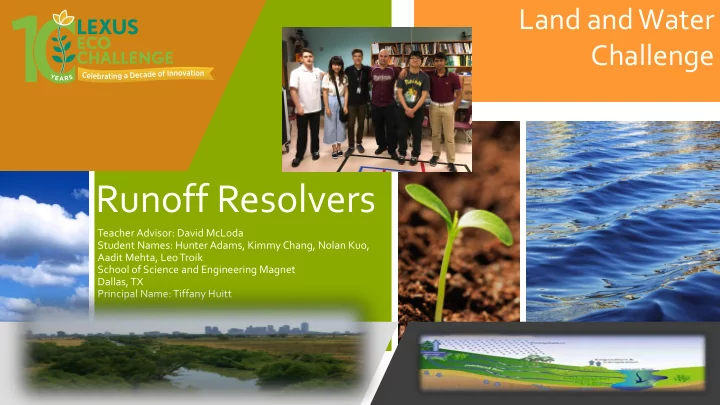
Runoff Resolvers
Teacher Advisor: David McLoda Student Names: Hunter Adams, Kimmy Chang, Nolan Kuo, Aadit Mehta, Leo Troik School of Science and Engineering Magnet Dallas, TX Principal Name: Tiffany Huitt
Runoff Resolvers Teacher Advisor: David McLoda Student Names: - - PowerPoint PPT Presentation
Land and Water Challenge a Runoff Resolvers Teacher Advisor: David McLoda Student Names: Hunter Adams, Kimmy Chang, Nolan Kuo, Aadit Mehta, Leo Troik School of Science and Engineering Magnet Dallas, TX Principal Name: Tiffany Huitt
a
Teacher Advisor: David McLoda Student Names: Hunter Adams, Kimmy Chang, Nolan Kuo, Aadit Mehta, Leo Troik School of Science and Engineering Magnet Dallas, TX Principal Name: Tiffany Huitt
What’s the environmental issue?
was the wettest year with 62.8 inches of
cumulative total precipitation of the past five years. Cumulative wastewater discharges into the river in the DFW area averaged around 450 million gallons per day.
nutrient concentrations and pollutant levels within the river including E. coli (20-30% above the state maximum), phosphate (8-75 ppm), and nitrate (10.3 ppm). These nitrogen and phosphorus concentrations put the river at risk for algae blooms and loss of
lead to contamination of much of North Texas’ drinking water source.
counter these harmful pollutants.
Our Action Plan: Step-By-Step Actions
I. Our team researched possible solutions and arrived at the conclusion to use bioswales. We then found native plants for the bioswales that could be used to target specific pollutants, and added a filtration device to improve on our design. II. Sampled the river’s composition to validate statistics we found. III. Consulted our mentor to improve our design. IV. Found key points of application for our model. V. Drew blueprint and made a digital 3D model of bioswale and filtration device. VI. Created several stages of implementation. VII. Found sponsors and spread awareness in schools and the community.
volunteers from the community. IX. Resampled the river’s composition and monitored the bioswales’ impact at the experimental site. X. Continued to expand our project to other sites of the Trinity.
Our Action Plan: Responsibilities
I. Hunter Adams
▪ Blueprint draft of bioswale and filtration device ▪ Set up appointments with sponsors
II. Kimmy Chang
▪ Design 3D Model of bioswale and filtration device ▪ Create PowerPoints (for awareness, sponsors, submission)
III. Nolan Kuo
▪ Create website ▪ Compiled initial contact list of sponsors, schools, and community groups
IV. Aadit Mehta
▪ Organize meetings and schedule ▪ Photographer
V. Leo Troik
▪ Coordinated school and community awareness events ▪ Followed up with sponsors
VI. David McLoda (Mentor)
▪ Review designs ▪ Advice on possible improvements
Each team member collected river samples, tested river’s composition, presented to sponsors, spread awareness in the community and schools, installed bioswale, and researched background information on the topic.
Hunter Adams Kimmy Chang Nolan Kuo Aadit Mehta David McLoda Leo Troik (with our principal)
Our Action Plan: Success and Impact
I. Our team has found sponsors and spread awareness in schools and the community in the DFW area. Through this, we’ve gotten the funding needed to implement stage 1 of our project (the bioswales) as well as volunteers to help install the plants. Following this, we retested contaminant levels in the implemented in
nitrogen, phosphorus, and E. coli levels decreased over time after the respective plants were introduced. II. We are continuing to get financial support from sponsors as our project expands to other sites. In a year, we hope to implement the filtration design to complete the model. III. The measure of our success involves lowering harmful pollutant levels closer to acceptable state maximums.
sponsors that could help fund and provide labor for the bioswale implementation (stage 1).
remove carbon dioxide from water, make the water less acidic, and slow water flow so suspended particles can settle), Marsh Plants (reeds to remove oil and E. coli, bulrushes to eliminate heavy metals), Submerged Plants (which remove fertilizer chemicals such as nitrogen and phosphorus), and Spikerush (for the filtration of ammonium).
contacting possible sponsors, we set up appointments to present our project. Following our presentation, we successfully got the funding and support we needed to test out our design in theTrinity.
partners and conducted tests to confirm its effectiveness.
device.
Step 1 Finalize and edit Design Step 2 Find Sponsors and other Prospects Step 3 Present the Project Step 4 Follow up and get support Step 5 Implement project
School Events ▪ Townview Magnet Center (School for the Talented and Gifted, School of Science and Engineering, School of Health Professions, School of Business and Management, ESSM, School of Law) ▪ McKinney ISD (Wolford Elementary School, Evans Middle School) At each of these schools, our team gave lessons about the Trinity River and water pollutants in classes, after-school meetings, and extracurricular activities. In these lectures, we informed students of the importance of the Trinity River for the DFW area, how we planned to reduce harmful pollutants in the Trinity River, and ways that they could help with water pollution. Some of this advice included picking up grass clippings (grass clippings – high in nitrogen and phosphorus content – are often swept into storm drains which flow into rivers), hand water or using soaker hoses (reduces runoffs), picking up pet waste (fecal matter – high in nitrogen content – leads to algae blooms), using recyclable bags (plastic bags often end up in waterways and are a threat wildlife), and to not use excess fertilizer and pesticides (contamination of waterbodies). Sponsors ▪ TODVT Inc. (Dallas, TX) We met with the partner of this corporation and presented our work. The General Manager asked our team specific questions and embraced our ideas. Upon the close of the presentation, he agreed to sponsor our work and show our project to his employees at meetings. He was glad to support us since he values the Trinity River as a drinking water resource and recreational site. Governmental Agency ▪ Dallas Park and Recreation The School of Science and Engineering principal set our team up with the Head of the Dallas’ Park and Recreation so that we could get more advice on how to improve our project. We met with the officer and gave a presentation of our model. Afterwards, we exchanged contacts and presented to other district officials. We drafted up an approximate cost and time plan and got permission to implement our project.
school principals, and creating a separate PowerPoint for
(decreased contamination levels, low-cost, high efficiency, aesthetically pleasing, easy to maintain, and versatility).
PowerPoint presentation.
Challenges One of the main challenges our team faced in this project was time
the Trinity pollutant level issue, creating a solution, finding sponsors and volunteers, and conducting experiments to test the bioswales’ effectiveness; was nearly a mission impossible to complete in the Lexus Eco Challenge time span. Furthermore, organizing meetings and setting up presentations with associations was both new and difficult. Presenting in these real-world situations forced us to learn how to control our nerves so that we could convey our message proficiently.
Success The Runoff Resolvers were able to get the funding and labor needed to implement Stage 1 of our plan (bioswales). The bioswale successfully decreased water contaminant levels in the section of the river. In addition to this, we also created a school and community movement towards reducing water pollution sources.
Evaluation of Our Plan & Results: Success and Challenges
Awareness Our team spread awareness in our school and
community and creating a website to spread our information and work to others. Through this medium, we’ve been able to see a myriad of perspectives and improve on our initial plan as people propose new ideas. As more people come to hear about our project, we hope to continue gaining enthusiastic support.
Quantifiable Results Before implementing the bioswale in the Trinity River, the respective area had noticeably high E. coli levels (approximately 20% above state maximums). However,
improvements in the contaminant level (15% above state maximums). We plan to continue reaffirming the progress
that may skew our data.
Evaluation of Our Plan & Results: Awareness and Quantifiable Results
Evaluation of Our Plan & Results: What Our Team Learned
However, thanks to our mentor’s advice, we were able to realize that some of our models wouldn’t suit this particular circumstance. Thus we learned how to refine our research tactics and better understand factors that contribute to the composition of a project.
to translate our ideas into scaled realities.
district officials. community figures, and schools. Here we gained invaluable life skills such as contacting people, following up, forming professional statements, and creating informative
anticipating questions, counterarguments, and criticism.
Teacher Advisor Funds will be used to purchase materials for an in-class bioremediation lab. We will research the use of plants, fungi, and bacteria in restoring soils contaminated with
School
winnings toward later stages of our project. Additionally, she wants to initiate a recycling program in Townview as it currently lacks one.
The majority of our winnings will go towards funding other bioswale applications. However, we will also use some of the winnings to donate to
awareness, save up for college, and fund further research.
Our Team!
Making Connections!
Spreading Awareness in Schools