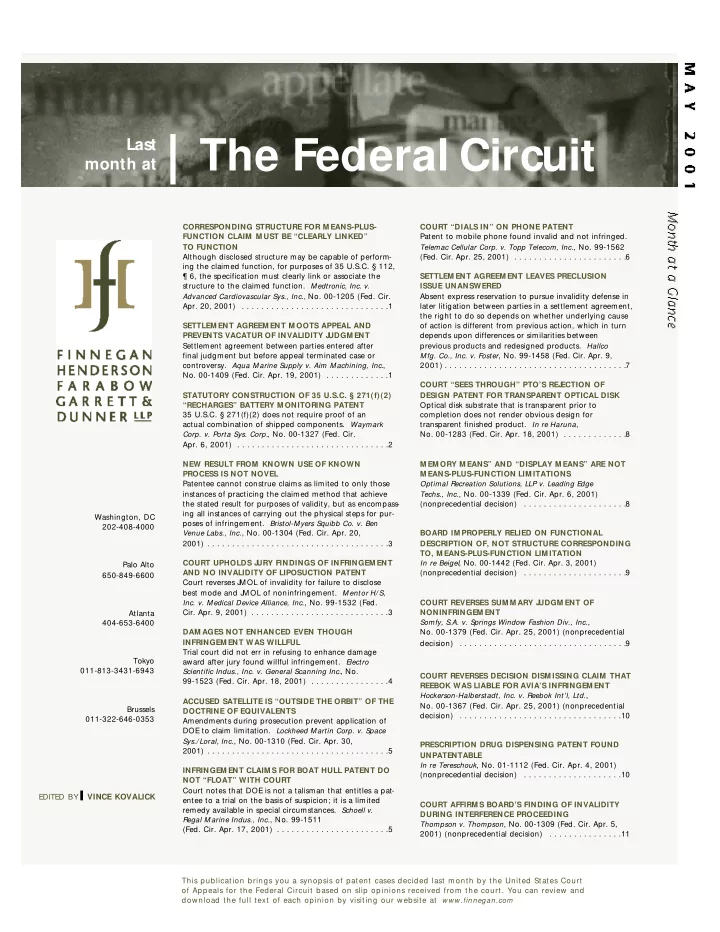
The Federal Circuit Last month at CORRESPONDING STRUCTURE FOR M - - PDF document

the federal circuit
SMART_READER_LITE
LIVE PREVIEW

The Federal Circuit Last month at CORRESPONDING STRUCTURE FOR M - - PDF document

The Federal Circuit Last month at CORRESPONDING STRUCTURE FOR M EANS-PLUS- COURT DIALS IN ON PHONE PATENT FUNCTION CLAIM M UST BE CLEARLY LINKED Patent to mobile phone found invalid and not infringed. TO FUNCTION Telemac Cellular


slide-1
SLIDE 1

E DITE D BY VINCE KOVALICK This publication brings you a synopsis of patent cases decided last m onth by the United States Court

  • f Appeals for the Federal Circuit based on slip opinions received from the court. You can review and

download the full text of each opinion by visiting our website at www.finnegan.com Washington, DC 202-408-4000 Palo Alto 650-849-6600 Atlanta 404-653-6400 Tokyo 011-813-3431-6943 Brussels 011-322-646-0353 CORRESPONDING STRUCTURE FOR M EANS-PLUS- FUNCTION CLAIM M UST BE “CLEARLY LINKED” TO FUNCTION Although disclosed structure may be capable of perform- ing the claimed function, for purposes of 35 U.S.C. § 112, ¶ 6, the specification must clearly link or associate the structure to the claimed function. Medtronic, Inc. v. Advanced Cardiovascular Sys., Inc., No. 00-1205 (Fed. Cir.

  • Apr. 20, 2001) . . . . . . . . . . . . . . . . . . . . . . . . . . . . . .1

SETTLEM ENT AGREEM ENT M OOTS APPEAL AND PREVENTS VACATUR OF INVALIDITY J UDGM ENT Settlement agreement between parties entered after final judgment but before appeal terminated case or

  • controversy. Aqua Marine Supply v. Aim Machining, Inc.,
  • No. 00-1409 (Fed. Cir. Apr. 19, 2001) . . . . . . . . . . . . .1

STATUTORY CONSTRUCTION OF 35 U.S.C. § 271(f)(2) “RECHARGES” BATTERY M ONITORING PATENT 35 U.S.C. § 271(f)(2) does not require proof of an actual combination of shipped components. Waymark

  • Corp. v. Porta Sys. Corp., No. 00-1327 (Fed. Cir.
  • Apr. 6, 2001) . . . . . . . . . . . . . . . . . . . . . . . . . . . . . . .2

NEW RESULT FROM KNOWN USE OF KNOWN PROCESS IS NOT NOVEL Patentee cannot construe claims as limited to only those instances of practicing the claimed method that achieve the stated result for purposes of validity, but as encompass

  • ing all instances of carrying out the physical steps for pur-

poses of infringement. Bristol-Myers Squibb Co. v. Ben Venue Labs., Inc., No. 00-1304 (Fed. Cir. Apr. 20, 2001) . . . . . . . . . . . . . . . . . . . . . . . . . . . . . . . . . . . . .3 COURT UPHOLDS J URY FINDINGS OF INFRINGEM ENT AND NO INVALIDITY OF LIPOSUCTION PATENT Court reverses J M OL of invalidity for failure to disclose best mode and J M OL of noninfringement. M entor H/ S,

  • Inc. v. Medical Device Alliance, Inc., No. 99-1532 (Fed.
  • Cir. Apr. 9, 2001) . . . . . . . . . . . . . . . . . . . . . . . . . . . .3

DAM AGES NOT ENHANCED EVEN THOUGH INFRINGEM ENT WAS WILLFUL Trial court did not err in refusing to enhance damage award after jury found willful infringement. Electro Scientific Indus., Inc. v. General Scanning Inc., No. 99-1523 (Fed. Cir. Apr. 18, 2001) . . . . . . . . . . . . . . . .4 ACCUSED SATELLITE IS “OUTSIDE THE ORBIT” OF THE DOCTRINE OF EQUIVALENTS Amendments during prosecution prevent application of DOE to claim limitation. Lockheed Martin Corp. v. Space Sys./ Loral, Inc., No. 00-1310 (Fed. Cir. Apr. 30, 2001) . . . . . . . . . . . . . . . . . . . . . . . . . . . . . . . . . . . . .5 INFRINGEM ENT CLAIM S FOR BOAT HULL PATENT DO NOT “FLOAT” WITH COURT Court notes that DOE is not a talisman that entitles a pat- entee to a trial on the basis of suspicion; it is a limited remedy available in special circumstances. Schoell v. Regal M arine Indus., Inc., No. 99-1511 (Fed. Cir. Apr. 17, 2001) . . . . . . . . . . . . . . . . . . . . . . .5 COURT “DIALS IN” ON PHONE PATENT Patent to mobile phone found invalid and not infringed. Telemac Cellular Corp. v. Topp Telecom, Inc., No. 99-1562 (Fed. Cir. Apr. 25, 2001) . . . . . . . . . . . . . . . . . . . . . . .6 SETTLEM ENT AGREEM ENT LEAVES PRECLUSION ISSUE UNANSWERED Absent express reservation to pursue invalidity defense in later litigation between parties in a settlement agreement, the right to do so depends on whether underlying cause

  • f action is different from previous action, which in turn

depends upon differences or similarities between previous products and redesigned products. Hallco

  • Mfg. Co., Inc. v. Foster, No. 99-1458 (Fed. Cir. Apr. 9,

2001) . . . . . . . . . . . . . . . . . . . . . . . . . . . . . . . . . . . . .7 COURT “SEES THROUGH” PTO’S REJ ECTION OF DESIGN PATENT FOR TRANSPARENT OPTICAL DISK Optical disk substrate that is transparent prior to completion does not render obvious design for transparent finished product. In re Haruna,

  • No. 00-1283 (Fed. Cir. Apr. 18, 2001) . . . . . . . . . . . . .8

M EM ORY M EANS” AND “DISPLAY M EANS” ARE NOT M EANS-PLUS-FUNCTION LIM ITATIONS Optimal Recreation Solutions, LLP v. Leading Edge Techs., Inc., No. 00-1339 (Fed. Cir. Apr. 6, 2001) (nonprecedential decision) . . . . . . . . . . . . . . . . . . . . .8 BOARD IM PROPERLY RELIED ON FUNCTIONAL DESCRIPTION OF, NOT STRUCTURE CORRESPONDING TO, M EANS-PLUS-FUNCTION LIM ITATION In re Beigel, No. 00-1442 (Fed. Cir. Apr. 3, 2001) (nonprecedential decision) . . . . . . . . . . . . . . . . . . . . .9 COURT REVERSES SUM M ARY J UDGM ENT OF NONINFRINGEM ENT Somfy, S.A. v. Springs Window Fashion Div., Inc.,

  • No. 00-1379 (Fed. Cir. Apr. 25, 2001) (nonprecedential

decision) . . . . . . . . . . . . . . . . . . . . . . . . . . . . . . . . . .9 COURT REVERSES DECISION DISM ISSING CLAIM THAT REEBOK WAS LIABLE FOR AVIA’S INFRINGEM ENT Hockerson-Halberstadt, Inc. v. Reebok Int’l, Ltd.,

  • No. 00-1367 (Fed. Cir. Apr. 25, 2001) (nonprecedential

decision) . . . . . . . . . . . . . . . . . . . . . . . . . . . . . . . . .10 PRESCRIPTION DRUG DISPENSING PATENT FOUND UNPATENTABLE In re Tereschouk, No. 01-1112 (Fed. Cir. Apr. 4, 2001) (nonprecedential decision) . . . . . . . . . . . . . . . . . . . .10 COURT AFFIRM S BOARD’S FINDING OF INVALIDITY DURING INTERFERENCE PROCEEDING Thompson v. Thompson, No. 00-1309 (Fed. Cir. Apr. 5, 2001) (nonprecedential decision) . . . . . . . . . . . . . . .11

The Federal Circuit

Last month at

slide-2
SLIDE 2

Corresponding Structure for Means-Plus-Function Claim Must Be “Clearly Linked” to Function

Christine E . Lehman

[J udges: Linn (author), M ichel, and Dyk] In Medtronic, Inc. v. Advanced Cardiovascular

Systems, Inc., No. 00-1205 (Fed. Cir. Apr. 20, 2001), the Federal Circuit affirmed a district court’s con- struction of the claim limitation “ means for con- necting adjacent elements together,” to which Medtronic, Inc. (“ Medtronic” ) had conceded no

  • infringement. The Federal Circuit found the corre-

sponding structure in the specification, a helical coil, to be the only structure that was clearly linked

  • r associated with the stated function. Additional

disclosed structure, straight wires and hooks, also performed the stated function, but was not clearly linked or associated with the claimed function and, thus, was not corresponding structure for purposes

  • f the claim construction.

U.S. Patent No. 5,653,727 (“ the ‘727 patent” ) is directed to a stent for enlarging the inside of an

  • artery. The ‘727 patent specifically discloses and

describes a helically wound, continuous-wire stent with the overall appearance of a coiled wire. The specification describes the stent as containing a series of successive 360° windings. The specification also discloses the use of straight wires and hooks to prevent longitudinal overstretch of the stent by connecting coils along the length of the stent to prevent the distance between the coils from becoming greater. The accused stent was designed with loops, and the parties agreed it was not heli- cally wound. In construing the disputed claim limitation, “ means for connecting adjacent elements togeth- er,” the Federal Circuit looked to the specification in accordance with 35 U.S.C. § 112, ¶ 6, to find the structure corresponding to the function of “ con- necting adjacent elements together.” The parties did not dispute that the helical windings of the stent were corresponding structure, in that the suc- cessive coils of the helical stent were inherently con- nected to each other by the coiled wire. However, Medtronic argued that the straight wire and hooks described in the specification were also correspon- ding structure. The Federal Circuit agreed that the straight wires and hooks were capable of performing the claimed function, but held that the straight wires and hooks were not clearly linked or associated in the specification with the function of connecting the adjacent elements together. The description in the specification about the use of wires and hooks related specifically to the function of preventing

  • verstretch of the formed helical coil, not to con-

necting separate elements. The coils of the stent were already inherently connected to each other, being formed of a continuous wire, and, therefore, the wires or hooks were not described in the speci- fication as performing the function of connecting the coils. The Court also looked to the prosecution history, but found no link or association between the function and the wires and hooks. Medtronic had conceded that under the claim construction limited to the helical coil there could be no infringement. Therefore, the Federal Circuit affirmed the district court’s judgment of non- infringement.

Settlement Agreement Moots Appeal and Prevents Vacatur of Invalidity J udgment

Roland G. McAndrews, J r.

[J udges: Dyk (author), Lourie, and Rader] In Aqua Marine Supply v. Aim Machining, Inc.,

  • No. 00-1409 (Fed. Cir. Apr. 19, 2001), the Federal

Circuit found that a settlement agreement between the parties entered into after the district court’s final judgment, but before the appeal, had terminated the case or controversy, rendering the case moot and preventing vacatur of the district court’s inva- lidity judgment. Aqua Marine Supply (“ Aqua Marine” ) filed suit against Aim Machining, Inc. and others (collectively “ Aim Machining” ) for infringement of Aqua Marine’s U.S. Patent No. 5,794,919 (“ the ‘919 patent” ) covering a compact, motorized hoist for small boat lifts. The district court held the ‘919 patent invalid on SJ based on a violation of the on- sale bar of 35 U.S.C. § 102(b). In response to a request from Aqua Marine, the district court entered final judgment and stayed the case pend- ing appeal to the Federal Circuit. Before filing a notice of appeal with the Federal Circuit, Aqua Marine and Aim Machining had entered into a settlement agreement (“ the Agreement” ) settling all claims pending between the parties. The Agreement provided that papers

page 01

L A ST M O N T H AT T H E F E D E R A L C I R C U I T

F I N N EG A N H EN D ERSO N FA RA B O W G A RRET T D U N N ER L L P

.

slide-3
SLIDE 3

2 0 0 1

M A Y 02

page F I N N EG A N H EN D ERSO N FA RA B O W G A RRET T D U N N ER LL P

. would be filed with the district court reflecting that the lawsuit had been settled and dismissed with prejudice as to all claims. In accordance with the Agreement, Aqua Marine and Aim Machining filed a joint motion, pursuant to Fed. R. Civ. P. 60(b)(6), to vacate the district court’s judgment of invalidity of the ‘919 patent. The district court denied the motion for vacatur, stating that the settlement situ- ation was not an exceptional or extraordinary cir- cumstance warranting the equitable relief of Rule 60(b)(6). After the district court’s refusal to vacate its invalidity decision, Aqua Marine appealed on the merits of the invalidity decision. Aim Machining agreed not to oppose the appeal. The Federal Circuit noted that before it could review the decision of the district court, it must first determine whether an Article III case or controversy still existed, or if the case had been mooted by the Agreement entered between the parties. While the Agreement was unclear regarding the ramifications

  • f the district court’s refusal to grant vacatur, Aim

Machining represented that, in light of the Agreement, they no longer had any interest in the

  • utcome of the validity issue on appeal. The

Federal Circuit went on to state that while under certain circumstances an opposing party’s lack of interest will not bar adjudication on the merits, when, as here, the alleged infringer has settled the infringement issue and no longer professes any interest in defending its DJ

  • f invalidity, the case

becomes moot as a result of the voluntary act of the patentee. Otherwise, patentees could simply settle the infringement question and continue to lit- igate validity unopposed by the defending party. Accordingly, the Federal Circuit concluded that the case was moot. The Federal Circuit then addressed the request for vacatur under Rule 60(b)(6), “ [w]here mootness results from settlement, . . . the losing party has vol- untarily forfeited his legal remedy by the ordinary processes of appeal or certiorari, thereby surrender- ing his claim to the equitable remedy of vacatur.” U.S. Bancorp Mortgage Co. v. Bonner Mall P’ship, 513 U.S. 18, 25 (1994). The Federal Circuit denied vacatur because to do otherwise would have effec- tively been giving Aqua Marine exactly the relief Bancorp holds inappropriate.

Statutory Construction of 35 U.S.C. § 271(f)(2) “Recharges” Battery Monitoring Patent

Anthony M. Gutowski

[J udges: Rader (author), Plager, and Dyk] In Waymark Corp. v. Porta Systems Corp., No. 00-1327 (Fed. Cir. Apr. 6, 2001), the Federal Circuit affirmed a district court’s decision granting SJ

  • f

noninfringement under 35 U.S.C. § 271(a), but reversed-in-part the decision because the district court had incorrectly interpreted 35 U.S.C. § 271(f)(2) to require proof of an actual combina- tion abroad of the shipped components. Waymark Corporation (“ Waymark” ) is the exclusive licensee of U.S. Patent No. 5,505,929 (“ the ‘929 patent” ) directed to a system including a plurality of different components for monitoring the capacity of batteries. Waymark filed suit against Porta Systems Corporation (‘Porta” ), alleging infringement of the ‘929 patent under 35 U.S.C. § 271(a). The district court granted Porta’s motion for SJ

  • f noninfringement because Porta only tested

certain individual components of a battery monitor- ing system and exported these components to Mexico without ever constructing an entire claimed system. In a petition for reconsideration, Waymark asserted that Porta infringed the ‘929 patent under 35 U.S.C. § 271(f)(2). The district court denied Waymark’s petition and concluded that Waymark’s § 271(f)(2) argument lacked merit because Waymark did not produce evidence showing a direct infringement abroad. The Federal Circuit initially considered the dis- trict court’s determination of noninfringement under 35 U.S.C. § 271(a) and concluded that Porta had not infringed under § 271(a) because Porta had

  • nly tested unpatented battery system components

in the U.S. without ever using them in the claimed combination. Turning to the issue of infringement under 35 U.S.C. § 271(f)(2), the Court determined that the district court had misconstrued this statutory section to require actual assembly of shipped com- ponents to form an infringing product.

slide-4
SLIDE 4

The Federal Circuit contrasted infringement under § 271(f)(2) with contributory infringement under § 271(c) and noted that the plain language

  • f § 271(f)(2) does not require any act of direct

infringement, nor does it speak of contributory

  • infringement. The Court also determined that the

legislative history of § 271(f)(2) does not provide any indication that this statutory provision requires an actual combination of shipped components. The Court noted that the language of § 271(f)(2) specifies that the infringer only “ intend” that a “ component” will be combined without ever requiring that the infringer actually combine or assemble components. According to the Court, such intent could occur even if the patented combi- nation is never formed from shipped components. In rejecting Porta’s argument that § 271(f)(2) impermissibly creates liability for attempted patent infringement, the Federal Circuit reasoned that shipping components of an invention abroad with-

  • ut combining them is no more an “ attempt” than

infringement under § 271(a) involving an offer to sell an invention without any actual sale. The Court explained that a requirement of actual assembly abroad would force patentees to overcome a sub- stantial hurdle of proving infringement in foreign countries, as well as providing the appearance of giving extraterritorial effect to U.S. patent protec-

  • tion. Thus, the Court vacated the SJ

under § 271(f)(2) and remanded for further proceedings.

New Result from Known Use of Known Process Is Not Novel

Lawrence F. Galvin

[J udges: Lourie (author), Gajarsa, and Dyk] In Bristol-Myers Squibb Co. v. Ben Venue

Laboratories, Inc., No. 00-1304 (Fed. Cir. Apr. 20, 2001), the Federal Circuit affirmed-in-part, vacated- in-part, and remanded a district court’s decision granting SJ that the effective claims of two issued U.S. patents were invalid for anticipation. U.S. Patent Nos. 5,641,803 (“ the ’803 patent” ) and 5,670,537 (“ the ’537 patent” ), assigned to Bristol-Myers Squibb Company (“ Bristol” ), relate to a three-hour administration of the antitumor drug paclitaxel. A number of companies, including Ben Venue Laboratories, Inc., filed Abbreviated New Drug Applications (“ ANDAs” ), seeking approval to market paclitaxel prior to the expiration of the two patents. Bristol sued those companies (collectively “ the Defendants” ) in the U.S. District Court for the District of New J ersey for infringement based on these ANDAs. In response, the Defendants moved for SJ that the two patents were invalid for anticipa- tion and obviousness. Following a Markman hear- ing, the district court granted the motion for SJ based on anticipation but denied the motion based

  • n obviousness. Subsequently, Bristol disclaimed a

total of six claims of the two patents. On appeal, the Federal Circuit first affirmed the district court’s claim construction. Specifically, the Court found preamble language in the claims non- limiting, determined that the doctrine of claim dif- ferentiation did not prevent the Court from con- cluding that two independent claims in one patent shared an identical scope, and found expressions of efficacy in the claims nonlimiting because these expressions did not distinguish over the prior art. Importantly, the Court restated that newly discov- ered results from a known use of a known process are not patentable. The Federal Circuit also found all but two of the remaining claims of the two patents invalid for

  • anticipation. Those two claims, both from the ’537

patent, recite specific classes of premedicants. Because the prior art disclosed only the general use

  • f premedicants, the Court concluded, the prior art

could not anticipate those two claims. Thus, the Court vacated the SJ with regard to those two claims and remanded this issue.

Court Upholds J ury Findings of Infringement and No Invalidity of Liposuction Patent

Gregory A. Chopskie

[J udges: Lourie (author), M ayer, and Schall] In Mentor H/S, Inc. v. Medical Device Alliance,

Inc., No. 99-1532 (Fed. Cir. Apr. 9, 2001), the Federal Circuit reversed a district court’s J MOL that the asserted claim was invalid and not infringed, but affirmed a denial of enhanced damages for will- ful infringement. Mentor H/S, Inc. (“ Mentor” ) charged Medical Device Alliance, Inc. and others (collectively “ MDA” ) with infringement of U.S. Patent No. 4,886,491 (“ the ‘491 patent” ). The ‘491 patent claims a method for ultrasonic-assisted liposuction by melting fatty tissue with heat produced by ultra- sonic vibrations.

page 03

L A ST M O N T H AT T H E F E D E R A L C I R C U I T

F I N N EG A N H EN D ERSO N FA RA B O W G A RRET T D U N N ER L L P

.

slide-5
SLIDE 5

2 0 0 1

M A Y 04

page F I N N EG A N H EN D ERSO N FA RA B O W G A RRET T D U N N ER LL P

. After a jury verdict of direct, contributory, and induced infringement of the ‘491 patent, the dis

  • trict court granted the Defendants’ motion for

J MOL that the ‘491 patent was invalid for violating the best-mode requirement and was not infringed by the Defendants. Furthermore, the district court granted a conditional new trial for anticipation,

  • bviousness, and inequitable conduct, and denied

Mentor’s motion for enhanced damages and attor - ney fees. With respect to the best-mode issue, the Defendants argued that the inventor had failed to disclose in the ‘491 patent the details of his pre- ferred circuitry. The Federal Circuit rejected that argument, holding that the invention claims a method of using ultrasonic vibrations to create heat and melt fat, but does not claim a particular circuit-

  • ry. Moreover, the Federal Circuit held that the best-

mode requirement was satisfied by the patent’s dis

  • closure of the inventor’s preferred vibration fre-

quencies, from which a person skilled in the art could have selected appropriate circuitry. The Federal Circuit also reversed the grant of a conditional new trial on anticipation, obviousness, and inequitable conduct. First, the Federal Circuit reversed the district court’s holding of anticipation,

  • bserving that the cited prior art did not teach the

melting of fat. The Federal Circuit also rejected the Defendants’ inherent anticipation argument, hold- ing that the mere possibility that the prior art devices may produce sufficient heat to melt fat was insufficient for inherent anticipation. Second, the Federal Circuit reversed the grant

  • f a new trial on obviousness, holding that the dis-

trict court had failed to articulate how the prior art references disclose the melting of fat and had failed to point to any motivation to combine the refer- ences. Third, the Federal Circuit reversed the grant of a new trial on inequitable conduct, holding that the allegedly withheld prior art was merely cumulative

  • f other prior art before the E
  • xaminer. The Court

ruled that the Defendants had failed to demon- strate deceptive intent in withholding the prior art references, noting that mere knowledge of a cumu- lative reference is not indicative of an intent to deceive. The Federal Circuit also reversed the grant of J MOL with respect to infringement, finding that substantial evidence supported the jury’s verdict that the Defendants had willfully contributed to and induced infringement. The Federal Circuit con- cluded that Mentor had offered substantial evi- dence that the accused device was not a staple arti- cle suitable for noninfringing uses and, in fact, had never been used for anything other than the patented method. Moreover, the Federal Circuit held that substantial evidence supported the jury’s finding that the Defendants had induced infringe- ment by selling the accused device with the inten- tion that doctors use it to perform the patented method. Finally, the Federal Circuit affirmed the district court’s denial of enhanced damages for willful infringement, accepting the finding that the ques- tion of willfulness was too close to merit the award.

Damages Not Enhanced Even Though Infringement Was Willful

E ric P. Raciti

[J udges: Rader (author), M ichel, and Schall] In E

lectro Scientific Industries, Inc. v. General Scanning Inc., No. 99-1523 (Fed. Cir. Apr. 18, 2001), the Federal Circuit affirmed a grant of SJ that General Scanning Inc. (“ GS” ) literally infringed two patents owned by E lectro Scientific Industries,

  • Inc. (“ ESI” ) directed to laser technology used to

sever or “ blow” links to defective memory cells dur- ing manufacture of silicon-based memory chips. In the district court, a jury had determined that ESI’s U.S. Patent No. 5,265,114 (“ the ‘114 patent” ) was not invalid, while U.S. Patent No. 5,473,624 (“ the ‘624 patent” ) was invalid as being obvious

  • ver the prior art. The jury also had found that the

infringement was willful and awarded $13.1 mil- lion. During posttrial motions, the district court denied E SI’s motions to overturn the jury’s finding that the ‘624 patent was invalid and to impose enhanced damages and attorney fees and awarded postjudgment interest at a rate lower than E SI had

  • requested. The district court also denied GS’s

motion to overturn the jury’s finding that the ‘114 patent was not invalid, to limit the finding of infringement to specific implementations, and to set aside the finding of willfulness. GS argued on appeal that the prior art con- tained the “ inherent capability” to blow links in memory and, therefore, ESI’s ‘114 patent was also

  • anticipated. The Federal Circuit dismissed this

argument, pointing to substantial evidence to the

slide-6
SLIDE 6
  • contrary. GS also argued that the district court had

erred in denying its J MOL motion for remittitur based on the noninfringing use of its products to cut nonmetallic links, which use was only covered by the invalidated ‘624 patent. The Federal Circuit found that the jury’s damage award was properly based on lost sales and that any existing noninfring- ing uses were not factually developed on the record. ESI appealed the district court’s handling of damages, arguing that a finding of willful infringe- ment entitled them to enhanced damages and attorney fees. The Federal Circuit disagreed, howev- er, concluding that a finding of willfulness does not mandate an increase in damages. The trial court had opined that the holding of willfulness was a close one, and the totality of the circumstances, including the fact that GS had received opinions of invalidity, did not justify enhanced damages.

Accused Satellite Is “Outside the Orbit” of the Doctrine of Equivalents

Bill Brogan

[J udges: Gajarsa (author), Schall, and Friedman] In Lockheed Martin Corp. v. Space Systems/Loral,

Inc., No. 00-1310 (Fed. Cir. Apr. 30, 2001), the Federal Circuit affirmed a grant of SJ

  • f noninfringe-

ment to Space Systems/Loral, Inc. (“ SSL” ) after find- ing that prosecution history estoppel prevented the application of the DOE. In 1995, a predecessor of Lockheed Martin Corporation (“ Lockheed” ), assignee of U.S. Patent

  • No. 4,084,772 (“ the ‘772 patent” ), filed suit accus-

ing SSL of building satellites that infringe the ‘772

  • patent. The ‘772 patent relates to a control system

for pointing the antennae of a geosynchronous

  • rbiting satellite at a desired target on earth. To

point its antennae, a satellite uses the angular momentum created by a spinning reaction wheel to roll about a particular axis. Rolling aims the satel- lite’s antennae in a desired direction. The primary disputed limitation of the ‘772 patent recites “ means for rotating said wheel in accordance with a predetermined rate schedule which varies sinusoidally over the orbit at the orbital frequency of the satellite.” After a Markman hear- ing, the district court had found that “ varies sinu- soidally” means “ a sine-shaped variation that passes through zero.” In terms of the motion of a reaction wheel, the wheel would have to slow, stop, and reverse direction to literally meet this limitation. Because the parties agreed that the accused SSL satellite’s wheel did not stop and reverse direction, the district court had granted SJ

  • f no literal

infringement. The district court also held that the SSL satellite did not infringe under the DOE . The district court determined that the function of the limitation was rotating the wheel by way of using a predetermined rate schedule that varies sinusoidally, with the result being that the satellite is rolled to point at a desired

  • target. Because it was undisputed that the wheel of

the accused SSL satellite did not pass through zero, the district court had ruled that the “ way” the SSL wheel operated was not substantially similar to that claimed in the ‘772 patent. On appeal, Lockheed conceded that the SSL satellite did not literally infringe the ‘772 patent

  • claims. Lockheed argued, however, that based on

the testimony of its expert, a factual dispute existed as to whether the accused satellite contains an equivalent to the disputed limitation, thus making the grant of SJ

  • f noninfringement under the DOE

improper. The Federal Circuit found no fault with the dis- trict court’s construction of the limitation “ varies sinusoidally.” Turning to Lockheed’s contention con- cerning the DOE, the Federal Circuit noted that under Festo, it must first determine whether the scope of the DOE, as applied to the disputed claim limitation, had been narrowed by prosecution histo- ry estoppel before attempting to apply the DOE. During prosecution of the ‘772 patent, the dis

  • puted limitation was amended twice, narrowing the

literal scope of the limitation in response to the E xaminer’s obviousness rejections. Noting that Festo emphasizes the need for certainty as to the scope of patent protection and that the notice function of patent claims has become paramount, the Federal Circuit held that no scope of equivalents was avail- able to Lockheed under the DOE , despite Lockheed’s arguments for a “ flexible bar” approach.

Infringement Claims for Boat Hull Patent Do Not “Float” with Court

  • P. Alan Larson

[J udges: Plager (author), Newman, and Schall] In Schoell v. Regal Marine Industries, Inc., No. 99- 1511 (Fed. Cir. Apr. 17, 2001), the Federal Circuit affirmed the district court’s grant of SJ

  • f nonin-

fringement for Regal Marine Industries, Inc. (“ Regal” ).

page 05

L A ST M O N T H AT T H E F E D E R A L C I R C U I T

F I N N EG A N H EN D ERSO N FA RA B O W G A RRET T D U N N ER L L P

.

slide-7
SLIDE 7

2 0 0 1

M A Y 06

page F I N N EG A N H EN D ERSO N FA RA B O W G A RRET T D U N N ER LL P

. Harry Schoell is the inventor of a boat hull for a planing boat patented under U.S. Patent No. 5,456,202 (“ the ‘202 patent” ). A planing boat’s hull is designed so that at speed, hydrodynamic forces lift the boat hull almost out of the water. Planing hulls generally have broad flat sections on the bottom of the hull that allow the boat to ride up and skim the top surface of the water. These flat sections take a hard pounding when the boat is driven at high speeds through rough water. A V- shaped hull has been widely adopted to help over- come this problem. Boats with V-shaped hulls per- form well when planing, but become much more difficult to maneuver at slower speeds. The ‘202 patent claims a stepped offset between forward and aft hull sections, a V-shaped forward keel, and a generally flat aft keel. Schoell claims that this configuration provides both stability and maneuver- ability. Regal manufactures a boat with a stepped-hull design referred to as the “ FasTrac” design. The aft hull of R egal’s boat contains a V-shaped aft keel. The slope of the bottom sections join at a twelve- degree angle with the horizontal. And, the forward hull of R egal’s boat also has a V-shaped keel. The forward keel has a twelve-degree V shape at the off- set that increases to a sharper angle as the keel extends toward the bow. Schoell contends that the district court did not recognize that “ generally flat” embraces configura- tions that are not perfectly flat. However, the dis

  • trict court acknowledged that a slightly concave aft

keel as claimed in independent claim 10 is not completely flat. Furthermore, during the prosecu- tion of this application, Schoell responded to the E xaminer’s rejection of his initially filed claims that the reference the Examiner had cited showed no stepped offset and no generally flat keel. The cited reference described a V-shaped aft keel with an angle between twelve and eighteen degrees. Thus, not only did Schoell differentiate between a V- shaped keel and a generally flat keel, he essentially concluded that a twelve-degree V-shaped keel can- not be a generally flat keel as claimed in the ‘202 patent by virtue of his argument to the E xaminer. Because Schoell so clearly distinguished between the two keel shapes, the Court reasoned that if Regal’s forward keel with a twelve-degree V shape satisfies the V-shape limitation, the aft keel also with a twelve-degree V shape, cannot satisfy the general- ly flat keel limitation. Thus, the Court concluded, Regal’s FasTrac hull does not literally infringe the claims of the ‘202 patent. Schoell also argued that the claims do not require the forward keel to be V shaped along the entire length from the bow to the stepped offset. Schoell argued that the twelve-degree V-shaped aft keel can satisfy the generally flat limitation and the portion of the forward keel with a deeper V shape can satisfy the V-shape limitation. However, the Court rejected this argument, concluding that if Regal’s forward portion of the bow with its twelve- degree offset was V shaped, then the aft portion of the hull with a twelve-degree offset must also be V shaped and could not be considered generally flat. Schoell also attempted to show that Regal’s boat infringed the ‘202 patent under the DOE by pointing to certain of Regal’s advertisements and sales documents, as well as alleged evidence of copying by Regal’s president. Schoell also submit- ted his own affidavit stating that testing he had performed on designs similar to those of Regal’s FasTrac hull confirmed his belief that Regal’s boat performs substantially the same function in substan- tially the same way to achieve substantially the same results as the claimed invention. The Court found this evidence to be wholly insufficient to sup- port a finding of equivalents. At most, the Court concluded, Schoell’s evidence tended to show that Regal’s boat achieved similar performance. The Court noted that the DOE does not entitle a patent- ee to a jury trial on the basis of suspicion. It is a limited remedy available in special circumstances, the evidence for which is the responsibility of the proponent.

Court “Dials In” on Phone Patent

Gregory A. Chopskie

[J udges: Gajarsa (author), Newman, and Lourie] In Telemac Cellular Corp. v. Topp Telecom, Inc.,

  • No. 99-1562 (Fed. Cir. Apr. 25, 2001), the Federal

Circuit affirmed a district court’s grant of SJ that the patent-in-suit was invalid and not infringed. Telemac Cellular Corporation (“ Telemac” ) charged Topp Telecom, Inc. (“ Topp” ) with infringe- ment of U.S. Patent No. 5,577,100 (“ the ‘100 patent” ). The ‘100 patent claims a phone system including a mobile phone that permits a user to prepay for air-time minutes that are then debited in real time from credit stored in the phone’s memory. The claimed phone is programmed by a host

slide-8
SLIDE 8

processor with “ communication means for selec- tively establishing communication to the phone” to enable operation. Charges for calls are debited at specific rates by a complex billing algorithm stored in the phone. The district court granted Topp’s motion for SJ that the ‘100 patent was invalid and not infringed. On appeal, the Federal Circuit first reviewed the district court’s claim construction. With respect to “ communication means for selectively establish- ing communication with each mobile phone,” the Federal Circuit affirmed the district court’s construc- tion that the limitation requires communications initiated by a host processor. The Federal Circuit agreed with the district court that the only struc- ture described in the specification that functioned to selectively establish communications with the cell phones was a host-processor structure that selec

  • tively and automatically established communica-

tions for performing the activation or programming

  • f the phone by an electronic link. With respect to

the “ complex billing algorithm” limitation, the Federal Circuit agreed with the district court’s con- clusion that the algorithm requires, at a minimum, storage of phone rates for local, long distance, international, and roaming calls. Turning to infringement, the Federal Circuit affirmed the district court’s finding of noninfringe- ment, either literally or under the DOE. First, the Federal Circuit agreed with the district court that the accused device lacked the claimed “ communi- cation means.” Specifically, instead of having a host processor that selectively initiates communica- tion with the phone by an electronic link, the accused device was programmed by the user’s manual input of codes into the phone. Second, the accused device lacked a “ complex billing algo- rithm” that stored phone rates for local, long dis- tance, international, and roaming calls. Rather, no international rate is stored in the accused phone and no international charges are calculated by that phone because the accused device blocks the direct placement of international calls. Finally, the Federal Circuit affirmed the district court’s conclusion that the ‘100 patent was invalid for anticipation in view of U.S. Patent No. 5,631,947 (“ the Wittstein reference” ). Telemac argued that the Wittstein reference fails to disclose the four rates used in the ‘100 patent’s complex billing algorithm. The Federal Circuit disagreed, holding that although those rates were not express

  • ly disclosed in the Wittstein reference, they are

inherently disclosed. Specifically, the Wittstein ref- erence discloses a rental mobile phone that gener- ates data normally included in a Call Detail Record. According to the Federal Circuit, the district court had correctly concluded that there was no genuine issue of material fact that Call Detail Records neces- sarily included charges categorized into the four claimed types and, thus, inherently anticipate the claimed four categories of rate charges.

Settlement Agreement Leaves Preclusion Issue Unanswered

Vince Kovalick

[J udges: Plager (author), Rader, and Schall] In Hallco Manufacturing Co., Inc. v. Foster, No. 99-1458 (Fed. Cir. Apr. 9, 2001), the Federal Circuit vacated a district court judgment which had held that the dismissal with prejudice and settlement of a previous dispute between the parties did not pre- clude Hallco Manufacturing Co., Inc. and others (collectively “ Hallco” ) from challenging the validity

  • f U.S. Reissue Patent No. Re 35,022 (“ the ‘022

patent” ) owned by Raymond Keith Foster. The Court’s vacancy also effected the district court’s judgment of invalidity and noninfringement. Hallco and Foster compete in the market for reciprocating conveyors, which are built into the floors of trucks to move large loads in and out. The key improvement of the ‘022 patent concerns mounting a drive mechanism directly below the floor members of the truck to reduce the weight of the conveyor and the amount of space it takes up. The parties have litigated various infringement actions for many years now. In particular, on a pre- vious remand from the Federal Circuit, the district court granted SJ

  • f infringement under a new claim

construction, which left Hallco with only its invalidi- ty defenses. The parties then settled, with Hallco taking a nonexclusive, royalty-bearing license. The district court then dismissed the action with preju-

  • dice. Hallco then designed its product to avoid

infringement, but Foster disagreed. Accordingly, Hallco paid royalties on the redesigned product under protest and filed a DJ action alleging nonin- fringement and invalidity. The district court deter- mined that Hallco’s invalidity defense was not pre- cluded on this issue. Foster argued on appeal that the dismissal for prejudice was as much a judgment on the merits as a consent decree and, therefore, operates the same way for preclusion purposes. Hallco argued that

page 07

L A ST M O N T H AT T H E F E D E R A L C I R C U I T

F I N N EG A N H EN D ERSO N FA RA B O W G A RRET T D U N N ER L L P

.

slide-9
SLIDE 9

2 0 0 1

M A Y 08

page F I N N EG A N H EN D ERSO N FA RA B O W G A RRET T D U N N ER LL P

. absent any admission of validity in the settlement agreement, an attack on validity is not precluded in subsequent litigation. The Federal Circuit concluded that because Hallco had not reserved the right to pursue the invalidity defense, in later litigation between the parties, its right to do so would depend upon whether the underlying cause of action is different from the one brought earlier. This question, in turn, depends on whether the redesign devices are essentially the same as the original devices or if any differences between them are merely colorable. If so, the Court concluded, claim preclusion would

  • apply. The Court found the record insufficient to

make this determination and remanded for the dis- trict court to do so.

Court “Sees Through” PTO’s Rejection of Design Patent for Transparent Optical Disk

Vince Kovalick

[J udges: Schall (author), Friedman, and Gajarsa] In In re Haruna, No. 00-1283 (Fed. Cir. Apr. 18, 2001), the Federal Circuit reversed a decision of the Board that had affirmed an Examiner’s rejection of a design patent application as being unpatentable under 35 U.S.C. § 103. The sole claim of Design Application No. 29/058,031 (“ the ‘031 application” ) filed by Tsutomu Haruna and Sado Kita (collectively “ Haruna” ) is directed to an ornamental design for a prerecorded optical disk. The design differs from conventional disks in that the metallized region of the disk stops well short of the outer rim, and the disk has a relatively wide transparent region adja- cent the outer rim. The Examiner rejected the ‘031 application as being obvious in view of a utility patent issued to Benne et al. (“ Benne” ), which describes a disk having at least three zones, where the central zone is metallized and contains informa- tion, and the outer zone may or may not be metal- lized and does not contain information. The Federal Circuit ruled that Benne’s teachings that the outer zone of its disks may not be metal- lized does not suggest the claimed invention, because it does not suggest that that portion will be transparent, even though during preparation of the Benne disk, that portion of the disk is transparent. The invention, the Court observed, is not directed to a substrate for a disk, but to the final product, i.e., a prerecorded optical disk. Thus, the Court ruled, Benne does not render the claimed design

  • bvious.

“Memory Means” and “Display Means” Are Not Means-Plus-Function Limitations

J ay A. Stelacone

[J udges: Linn (author), Schall, and Gajarsa (dis- senting-in-part)] In Optimal Recreation Solutions, LLP v. Leading

E dge Technologies, Inc., No. 00-1339 (Fed. Cir. Apr. 6, 2001) (nonprecedential decision), the Federal Circuit vacated the district court’s judgment of no literal infringement in favor of Leading E dge Technologies, Inc. (“ Leading Edge” ) and remanded the case for further consideration of literal infringe-

  • ment. The Court affirmed, however, the district

court’s evidentiary sanctions against Optimal Recreation Solutions, LLP (“ Optimal” ) for discovery abuses. Optimal had sued Leading E dge for infringe- ment of U.S. Patent No. 5,364,093 (“ the ‘093 patent” ), which concerns a Global Positioning System (“ GPS” ) that adapts a standard GPS receiver to compute various distances on a golf course. The GPS may compute distances between various loca- tions, for example, the user’s location, the cup, and arbitrary user-selected locations. In finding no literal infringement, the district court had construed the claim terms “ position” and “ location” as, respectively, “ position on the face of the earth in terms of latitude and longitude” and “ location on the face of the earth in terms of lati- tude and longitude.” The district court also con- strued “ global positioning receiver means,” “ memo- ry means,” and “ display means” as means-plus- function limitations. On appeal, the Federal Circuit found that the district court had erred in these constructions. The Court determined that Optimal had used the claim terms “ position” and “ location” in their ordinary sense; that is, to mean “ where a thing is.” The Court looked to the specification and found that the patentee did not redefine these terms more nar- rowly than their ordinary meaning. The Court also noted that the claims utilize these terms without any modifier or qualification; specifically, the claims

slide-10
SLIDE 10

do not require “ position” and “ location” to be pro- vided in terms of latitude and longitude. Regarding the “ means” limitations, the Federal Circuit determined that a “ global positioning receiver,” a “ memory,” and a “ display” have rea- sonably well understood structural meanings in the arts of GPS receivers and computer programming. Thus, these claim limitations were not subject to 35 U.S.C. § 112, ¶ 6, because they defined suffi- cient structure, despite the use of the term “ means.” The Federal Circuit found no abuse of discre- tion by the district court in sanctioning Optimal for discovery abuses by precluding Optimal from pre- senting evidence of infringement under the DOE . Optimal argued that the sanction effectively dis- missed their claim in view of the district court’s claim construction. The Court rejected Optimal’s argument because Optimal continued to assert plans to prove literal infringement, after the district court’s claim construction, until imposition of the sanction. J udge Gajarsa dissented from the majority on the issue of claim construction, arguing that “ mem-

  • ry means” and “ display means” do not impart suf-

ficient structure to rebut the presumption that the limitations are subject to 35 U.S.C. § 112, ¶ 6. Disagreeing with the majority’s analogy of devices such as “ brakes” and “ screwdrivers” that take their names from the functions they perform, J udge Gajarsa asserted that the terms “ memory” and “ dis- play” simply describe functions.

Board Improperly Relied on Functional Description of, Not Structure Corresponding to, Means-Plus-Function Limitation

Naoki Yoshida

[J udges: Clevenger (author), Plager, and Gajarsa] In In re Beigel, No. 00-1442 (Fed. Cir. Apr. 3, 2001) (nonprecedential decision), the Federal Circuit vacated the rejections of certain claims as being obvious under 35 U.S.C. § 103, but affirmed the rejections of other claims under §§ 103 and 112, ¶ 2. Michael Beigel and others had filed a patent application related to an electronic identification system with improved sensitivity. In particular, the claimed invention was directed to an electrical-

  • bject identification system consisting of an inter-

rogator (“ reader” ) and a transponder (“ tag” ). During prosecution, certain claims of the applica- tion were rejected as being obvious over certain prior art references including U.S. Patent No. 4,864,633 to Chatelot (“ Chatelot” ) and one claim was rejected under 35 U.S.C. § 112, ¶ 2, as failing to particularly point out and distinctly claim the subject matter. The Board sustained these rejec- tions. On appeal, Appellants contested that Chatelot did not disclose “ resonating means” as required by certain claims, because Chatelot did not maintain a tuned condition in a range of predetermined val-

  • ues. It was undisputed that Chatelot disclosed a

predetermined value of zero, which fell within the range of the claimed values. Appellants, however, argued that “ resonating means” should be inter- preted as maintaining the resonating circuit in more than one tuned condition and, therefore, Chatelot did not disclose identical or equivalent structure for carrying out the claimed function. A proper means-plus-function analysis, accord- ing to the Court, would compare the structure shown in certain detailed drawings, not a functional block of the basic figure. Having found that the Board had not done so, the Federal Circuit conclud- ed that the means-plus-function analysis on certain claims was improper and vacated the rejection of those claims under 35 U.S.C. § 103. With respect to another claim, the Federal Circuit concluded that the phrase “ near resonance” encompasses “ at resonance” based on the plain meaning of the term ” near,” and affirmed the rejec- tion of that claim under 35 U.S.C. § 103. Furthermore, the Federal Circuit agreed that a claim reciting “ [a]n apparatus of practicing the method claim 98” failed to meet the statutory requirements of 35 U.S.C. § 112, ¶ 2.

Court Reverses Summary J udgment

  • f Noninfringement

J emy Soegeng

[J udges: M ayer, Bryson, and Dyk (per curiam)] In Somfy, S.A. v. Springs Window Fashion

Division, Inc., No. 00-1379 (Fed. Cir. Apr. 25, 2001) (nonprecedential decision), the Federal Circuit reversed-in-part and remanded a district court’s decision granting SJ

  • f noninfringement of Somfy,

S.A.’s (“ Somfy” ) U.S. Patent No. 5,328,113 (“ the

page 09

L A ST M O N T H AT T H E F E D E R A L C I R C U I T

F I N N EG A N H EN D ERSO N FA RA B O W G A RRET T D U N N ER L L P

.

slide-11
SLIDE 11

2 0 0 1

M A Y 10

page F I N N EG A N H EN D ERSO N FA RA B O W G A RRET T D U N N ER LL P

. ‘113 patent” ) directed to a device for evenly wind- ing the suspension cord of window blinds to ensure that the windings of the cord do not overlap one another. Claim 1 of the ’113 patent describes a winding drum, an auxiliary drum means, and “ shoulder means on one end of said auxiliary drum means for moving successive cord windings axially away from the shoulder means and onto the auxiliary drum means as the cord windings are formed.” The Federal Circuit affirmed the district court’s holding that “ shoulder means” was a claim limitation pur- suant to 35 U.S.C. § 112, ¶ 6, because “ shoulder” described a blocking function rather than indicating a specific structure sufficient to perform the claimed function, i.e., to move the cord by blocking (“ shouldering” ) the cord. Despite Somfy’s contrary argument, the Federal Circuit also affirmed the district court’s determina- tion that, in view of the intrinsic and extrinsic evi- dence, including inventor’s testimony and diction- ary definitions, the structure required the “ shoulder means” to physically contact the auxiliary drum to perform the function. The Federal Circuit reversed the district court’s noninfringement holding, however, and determined that, drawing all reasonable inferences in favor of Somfy, the testimony of Springs’s own witnesses on how the device operated, the device itself, and the evidence Somfy presented of copying, were suffi- cient for a reasonable juror to conclude that the fin- gers of the accused device were equivalent to the “ shoulder means” of the ‘113 patent because the accused device operated in the same way as Somfy’s by guiding the cord against the shoulder or finger to move successive windings down the

  • drum. Accordingly, the Court remanded for a

determination of the infringement issue.

Court Reverses Decision Dismissing Claim That Reebok Was Liable for Avia’s Infringement

Vince Kovalick

[J udges: M ayer, Gajarsa, and Dyk (per curiam)] In Hockerson-Halberstadt, Inc. v. Reebok

International, Ltd., No. 00-1367 (Fed. Cir. Apr. 25, 2001) (nonprecedential decision), the Federal Circuit reversed a district court judgment dismissing Hockerson-Halberstadt, Inc.’s (“ HHI” ) claim that Reebok International, Ltd. (“ Reebok” ) was liable under an alter-ego theory for Avia Group International’s (“ Avia” ) infringement of U.S. Patent

  • No. 4,259,792 (“ the ‘792 patent” ) directed to an

article of outer footwear. In 1995, HHI sued Avia, the wholly owned sub- sidiary of Reebok for infringement of the ‘792

  • patent. The action was stayed pending reexamina-

tion of the ‘792 patent. During the stay, Avia and Reebok entered into an asset purchase agreement with American Sporting Goods Corporation (“ ASG” ) in which ASG purchased from Reebok cer- tain assets and assumed liabilities relating to shoes then manufactured by Avia. Following the sale, a portion of the proceeds was transferred from Avia to Reebok in partial payment of an intercompany loan. In 1998, HHI brought the present suit against Reebok, claiming that Reebok is liable for acts of infringement of the ‘792 patent by Avia. Reebok counterclaimed that HHI had violated the terms of a settlement agreement (“ the Agreement” ) that the parties had entered into to resolve a prior suit brought by HHI against Reebok and several other shoe manufacturers. Ultimately, the district court construed the claims of the ‘792 patent, and HHI’s infringement claim was dismissed with prejudice in a stipulated order designed to permit the immedi- ate appeal of the claim construction issue. The Federal Circuit ruled that because the Agreement between HHI and Reebok had carved

  • ut infringement by Avia from release of liability,

and the suit against Avia had already been filed when the Agreement was reached, HHI did not intend to bargain away its claims against Avia. At the time the motion to dismiss was granted, the district court had improperly interpreted the claim for alter-ego liability as a claim for patent infringe- ment against Reebok.

Prescription Drug Dispensing Patent Found Unpatentable

Vince Kovalick

[J udges: Bryson, Gajarsa, and Linn (per curiam)] In In re Tereschouk, No. 01-1112 (Fed. Cir. Apr. 4, 2001) (nonprecedential decision), the Federal Circuit affirmed a final rejection of all the claims of Michael Tereschouk’s U.S. Patent Application No. 08/490,903 concerning a method for automatically

slide-12
SLIDE 12

distributing drugs to the holder of a pre-encoded portable medical data carrier. Tereschouk’s argument on appeal boiled down to one proposition: that in the prior art, supervision necessarily occurs at the drug-dispensing stage, usually by a pharmacist. The elimination of such supervision, according to Tereschouk, provides a requisite distinction to overcome any obviousness rejection. The Federal Circuit concluded that the fact that the prior art recognizes the legal requirement for a licensed professional to participate in drug dispens- ing does not mean that the elimination of the phar- macist’s participation constitutes patentable novelty. Moreover, the claims in question did not expressly require the presence or absence of a pharmacist.

Court Affirms Board’s Finding of Invalidity During Interference Proceeding

Vince Kovalick

[J udges: Lourie (author), M ayer, and Bryson] In Thompson v. Thompson, No. 00-1309 (Fed.

  • Cir. Apr. 5, 2001) (nonprecedential decision), the

Federal Circuit affirmed a Board decision finding U.S. Patent No. 5,329,438 (“ the ‘438 patent” ) invalid for obviousness in a patent interference pro-

  • ceeding. On appeal, the patent holder argued that

the Board had erroneously rejected the claims based on a combination of references not asserted by the challenger. The Court disagreed, finding substantial evidence to meet the patent challenger’s burden of proof to show invalidity by a preponder- ance of the evidence in this interference proceed-

  • ing. The Court also rejected the patent holder’s

loose arguments of secondary considerations, find- ing no nexus between the claimed invention and actual sales and finding evidence that others had “ marveled” at the invention too vague.

F I N N EG A N H EN D ERSO N FA RA B O W G A RRET T D U N N ER L L P

. DISCLAIMER:

The case summaries reflect the understanding of the authors only and are not meant to convey legal opinions or advice of any kind. The firm dis

  • claims any liability for any errors or omissions in

these summaries. This promotional newsletter does not establish any form of attorney-client relationship with our firm or with any of our attorneys.

page 11

In Last month at The Federal Circuit, certain terms, titles, and names of fed- eral agencies that are frequently referred to in text, appear in abbreviated forms or as acronyms. These abbreviated forms and acronyms are listed below. ALJ Administrative Law J udge APJ Administrative Patent J udge Board Board of Patent Appeals and Interferences Commissioner Commissioner of Patents and Trademarks CIP Continuation-in-Part DJ Declaratory J udgment DOE Doctrine of Equivalents IP Intellectual Property ITC International Trade Commission J M OL J udgment as a Matter of Law M PEP M anual of Patent Examining Procedure PCT Patent Cooperation Treaty PTO United States Patent and Trademark Office S E C Securities and Exchange Commission SM Special Master SJ Summary J udgment