SLIDE 1
Ronald G. Prinn, MIT
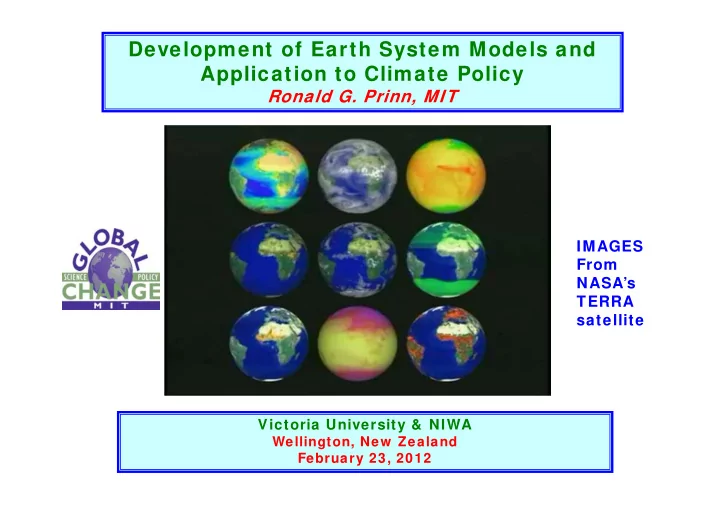
IMAGES From NASA’s TERRA satellite
Development of Earth System Models and Application to Climate Policy
Ronald G. Prinn, MIT
Victoria University & NIWA
Wellington, New Zealand February 23, 2012
SLIDE 2
WE DO NOT HAVE ANOTHER EARTH WITHOUT HUMAN INFLUENCE TO CALIBRATE THE CONFLICT BETWEEN ENVIRONMENT AND DEVELOPMENT
Climate Change Urban Air Pollution Water Quality Land Degradation Ecosystem Disruption Waste Disposal Energy Food Transportation Manufacturing Urban Development Population Grow th Potable Water Human Health THE CLIMATE ISSUE EXEMPLIFIES THE CHALLEGE FOR SUSTAINING A HABITABLE EARTH
WHY DO WE NEED EARTH SYSTEM MODELS?
SLIDE 3 Arndt, D. S., M. O. Baringer, and M. R. Johnson, Eds., 2010: State of the Climate in
Amer. Meteor. Soc., 91 (7), S1- S224
There are now Multiple Indicators of Warming Global Climate: Indicators w ith Positive Trends*
Courtesy
Tom Karl, Director, National Climate Data Center, NOAA
THE THREE WARMEST YEARS RECORDED WITH THERMOMETERS IN THE LAST 150 YEARS WERE 1998, 2005 and 2010
SLIDE 4 Arndt, D. S., M. O. Baringer, and M. R. Johnson, Eds., 2010: State of the Climate in
Amer. Meteor. Soc., 91 (7), S1- S224
Courtesy
Tom Karl, Director, National Climate Data Center, NOAA
There are now Multiple Indicators of Warming Global Climate: Indicators w ith Dow nw ard Trends*
SLIDE 5 WHAT ARE THE RELATIVE ROLES OF HUMAN & NATURAL PROCESSES IN DRIVING THE OBSERVED GLOBAL & CONTINENTAL TEMPERATURE CHANGES FROM 1906 to 2005?
Red band: full range for multiple independent model simulations using natural and human forcing. Blue band: full range for multiple independent model simulations using natural forcing only. Black line: observed changes. Ref: IPCC 4th Assessment, Summary for Policymakers, 2007
HUMAN-DRIVEN GLOBAL CLIMATE FORCING by greenhouse gases and aerosols is about 1.6 W m -2 x 5.1 x 10 14 m 2 = 8.16 x 10 14 W = 816 TW (about 52 times current global energy consumption)
SLIDE 6 5000 10000 15000 20000 25000 30000 35000 1990 1995 2000 2005 2010 2015 MtCO2/year CDIAC EIA
.76% .91% 3.5% 1.9%
Since its peak in 2007, emissions in US dow n about 6.2%; OECD as w hole dow n 6.4%; Europe dow n 7.2%. But emissions have grow n in China and elsew here to
reductions. Even as world leaders have recently discussed tougher targets in Copenhagen, Cancun and Durban, global CO2 emissions grow th have mostly accelerated. AND THE PROBLEM IS FURTHER EXACERBATED BY THE RAPID CONTINUING RISE OF THE NON-CO2 GASES (for policy discussions, levels of non-CO2 gases are typically converted to their equivalent levels of CO2 that would have the same effect on climate; w e are currently at about 474 ppm CO2 equivalents & rising)
SLIDE 7
TWO COMMON WAYS TO EXPRESS POLICY GOALS FOR CLIMATE MITIGATION
(1) AIM TO KEEP GLOBAL GREENHOUSE GASES BELOW SPECIFIED LEVELS (for this purpose levels of non-CO2 gases are typically converted to their equivalent levels of CO2 that would have the same effect on climate; w e are currently at about 474 ppm CO2 equivalents) (2) AIM TO KEEP GLOBAL TEMPERATURE INCREASES BELOW SPECIFIED AMOUNTS (relative to say pre-industrial or 1990; w e are currently about 0.8 oC above pre-industrial)
BUT THESE SIMPLE CONCEPTS ARE AFFECTED BY THE SIGNIFICANT UNCERTAINTIES IN PROJECTIONS OF ECONOMIES AND CLIMATE: NEED TO EVALUATE POLICIES BASED ON THEIR ABILITY TO LOWER RISK, AND RE-EVALUATE DECISIONS OVER TIME
SLIDE 8
TO FORECAST CLIMATE CHANGE AND DEVELOP SENSIBLE RESPONSES, WE NEED TO:
COUPLE THE HUMAN & NATURAL COMPONENTS OF THE EARTH SYSTEM.
SUCH INTEGRATED
ASSESSMENTS HAVE MANY ADDITIONAL POTENTIAL BENEFITS.
Understanding connections to other science and policy issues (e.g. air pollution, biodiversity, agriculture, energy, w ater quality) Objective assessment of uncertainty in economic and climate projections Critical and quantitative analysis of policy proposals Discovery of new interactions among natural and human climate system components MIT JOINT PROGRAM ON THE SCIENCE & POLICY OF GLOBAL CHANGE http://w eb.mit.edu/global change
SLIDE 9 WHAT IS THE RELATIONSHIP BETWEEN GREENHOUSE GAS STABILIZATION TARGETS AND FUTURE TEMPERATURE?
(non-CO2 gases converted to their equivalent levels of CO2 that would have the same effect on climate; currently at about 474 ppm CO2 equivalents) THE MIT INTEGRATED GLOBAL SYSTEM MODEL http://w eb.mit.edu/global change
SLIDE 10
THE MAJOR CLIMATE FORECAST MODEL UNCERTAINTIES INVOLVE CLOUDS, OCEAN MIXING & AEROSOL FORCING. ADDED TO THESE ARE SUBSTANTIAL UNCERTAINTIES IN EMISSION FORECASTING THESE UNCERTAINTIES SIGNIFICANTLY LIMIT THE ACCURACY OF PREDICTIONS OF FUTURE CLIMATE THESE UNCERTAINTIES ARE CONSTRAINED BY OBSERVATIONS WE USE VERY LARGE ENSEMBLES (400 IN EACH) OF INTEGRATED GLOBAL SYSTEM MODEL FORECASTS TO ESTIMATE THE PROBABILITY OF VARIOUS AMOUNTS OF CLIMATE CHANGE under No Policy (median about 1400 ppm CO2 equivalents) and Four Stabilization Polices (medians about 550, 660, 790, and 900 ppm CO2 equivalents)
HOW ACCURATE ARE CLIMATE FORECASTS?
SLIDE 11 ∆T > 2 oC
(values in red relative to 1860 or pre-industrial)
∆T > 4 oC ∆T > 6 oC No Policy at 1400 100% (100%) 85% 25% Stabilize at 900 (L4) 100% (100%) 25% 0.25% Stabilize at 790 (L3) 97% (100%) 7% < 0.25% Stabilize at 660 (L2) 80% (97%) 0.25% < 0.25% Stabilize at 550 (L1) 25% (80%) < 0.25% < 0.25%
WHAT ARE THE ODDS OF GLOBAL AVERAGE SURFACE AIR WARMING from 1981-2000 to 2091-2100 EXCEEDING VARIOUS LEVELS, WITHOUT (median 1400 ppm-equiv. CO2) & WITH A 550, 660, 790 or 900 median ppm-equiv. CO2 GHG STABILIZATION POLICY (400 IGSM forecasts per case)
Ref: Sokolov et al, Journal of Climate, 2009; Webster et al, Climatic Change, 2011
SLIDE 12 STABILITY OF WEST ANTARCTIC ICE SHEET
5 meters sea level rise
POLES WARM MUCH FASTER THAN TROPICS; IF ICE SHEETS MELT, HOW MUCH SEA LEVEL RISE COULD OCCUR?
7 meters sea level rise
STABILITY OF GREENLAND ICE SHEET
The last time the polar regions w ere significantly w armer (~4 oC) than present for an extended period (about 125,000 years ago), reductions in polar ice volume led to 4 to 8 meters of sea level rise.
REFs: Bindschadler et al; ACIA, Impacts of a Warming Arctic, Climate Impact Assessment Report, 2004
SLIDE 13 REF: ACIA, Impacts of a Warming Arctic, Climate Impact Assessment Report, 2004
WHAT WOULD HAPPEN IF ARCTIC TUNDRA & PERMAFROST THAWS?
THIS WOULD INDUCE EMISSION OVER TIME OF THE 1670 BILLION TONS OF CARBON STORED IN ARCTIC TUNDRA & FROZEN SOILS (TARNOCAI et al, GBC, 2009). THIS RESERVOIR IS ABOUT 200 TIMES CURRENT ANNUAL ANTHROPOGENIC CARBON EMISSIONS. THESE EMISSIONS WOULD INCLUDE METHANE FROM NEW & WARMER WETLANDS. IS ARCTIC SEA ICE AT THE END OF WINTER & SUMMER DECREASING? Time series of the percent difference in ice extent in March (the month of ice extent maximum) and September (the month of ice extent minimum) relative to the mean values for the period 1979–2000. www.arctic.noaa.gov/reportcard/ ArcticReportCard_full_report.pdf For the period 1979-2011, the rate of decrease of ice extent is 2.7% per decade (March) and 11.6% per decade (September).
SLIDE 14 OCEAN BOTTOM DEPTHS (meters) (MIT IGSM 3D OCEAN MODEL
INCREASED RAINFALL, SNOWFALL & RIVER FLOWS, & DECREASED SEA ICE, EXPECTED WITH GLOBAL WARMING OVERTURN DRIVEN BY SINKING WATER IN THE POLAR SEAS (Norw egian, Greenland, Labrador,Weddell, Ross) SLOWED BY DECREASED SEA ICE & INCREASED FRESH WATER INPUTS INTO THESE SEAS
IF THE POLAR LATITUDES WARM TOO MUCH, COULD THE DEEP OCEAN CARBON & HEAT SINK COLLAPSE?
Runs of the MIT IGSM 3D OCEAN MODEL w ith 100 years of CO2 INCREASE then STABILIZATION of CO2 for 900 years indicate IRREVERSIBLE COLLAPSE of OCEANIC OVERTURN if CO2 exceeds 620 ppm and CLIMATE SENSITIVITY exceeds its current best estimate of 3.5 oC
Ref: Scott et al, MIT Joint Program Report 148, Climate Dynamics, v30, p441-454, 2008
SLIDE 15 Hurricane/Typhoon/Cyclone Global Pow er Dissipation
Pow er Dissipation Index (PDI) is globally aggregated T∫0 V max
3 dt
(a measure of storm destruction)
[Courtesy of Tom Karl, Director, National Climate Data Center, NOAA]
Adapted/updated from Kossin, J. P., K. R. Knapp, D. J. Vimont, R. J. Murnane, and B. A. Harper, 2007: A globally consistent reanalysis
- f hurricane variability and trends. Geophys.
- Res. Lett., 34, L04815,
doi:10.1029/2006GL028836.
Thick w avy lines are smoothed versions of thin annual lines using a binomial filter. Thick straight lines are linear trends.
SLIDE 16 IGSM’s Model of ECONOMIC DEVELOPMENT—Emissions Prediction and Policy Analysis (EPPA) Model
HOW CAN WE MANAGE THE CLIMATE ISSUE?
FOR MORE INFORMATION ON THE GLOBAL CHANGE JOINT PROGRAM SEE: http://globalch ange.mit.edu/
SLIDE 17
Sectors Non‐Energy Agriculture Energy Intensive Other Industry Services Industrial Transport Household Transport Other Household Cons. Energy Crude & Refined oil Biofuel Shale oil Coal Natural gas Synthetic gas (from coal) Electricity
Crops Livestock Forestry Food processing Biofuel crops Biomass Elec. Technologies Included: Fossil (oil, gas & coal) IGCC with capture NGCC with capture NGCC without capture Nuclear, Hydro Wind and solar, Biomass Crude, slate, gasoline, diesel, petcoke, heavy oil, biodiesel, ethanol, NGLs & explicit upgrading Transport Alternatives Conventional Gasoline/Diesel (continue to improve) Hybrid Electric Vehicle Plug-in Hybrid Electric Vehicle Pure Electric Vehicle Bio-fueled Vehicle Compressed Natural Gas Vehicle
WHAT IS THE SCALE OF THE CHALLENGE TO TRANSFORM THE GLOBAL ENERGY SYSTEM? MIT IGSM ECONOMIC MODEL (EPPA) Sectors and Technologies
SLIDE 18 ∆WL>1% ∆WL>2% ∆WL>3% No Policy
900 ppm 1% 0.25% <0.25% Stabilize at 790 ppm 3% 0.5% <0.25% Stabilize at 660 ppm 25% 2% 0.5% Stabilize at 550 ppm 70% 30% 10%
USING EPPA MODEL, WHAT IS THE PROBABILITY FOR GLOBAL MITIGATION COSTS (expressed as % WELFARE* LOSSES in 2050), WITH A MEDIAN 550, 660, 790 or 900 ppm-eq CO2 STABILIZATION POLICY?
* Approximately the total consumption of goods & services
* Long term grow th rate of w elfare ~ 3%/year
SLIDE 19 Efficiency Gains (Transport & Buildings)
Coal Gas Oil
Bio- Bio- fuels fuels
Coal Coal with C with C ca captur pture and and stor storage
Nuc Nuclea lear
TO MITIGATE CLIMATE CHANGE, WHAT IS THE SCALE OF THE CHALLENGE TO TRANSFORM THE GLOBAL ENERGY SYSTEM?
e.g. Using EPPA Model, Global Primary Energy for a ~660 ppm CO2-equivalent stabilization scenario w ith nuclear restricted. (Carbon price ~$1750/tonC in 2100) IF UNRESTRICTED, NUCLEAR COMPETES WITH & COULD REPLACE COAL WITH CCS. SOLAR & WIND NEED LARGE COST REDUCTIONS & SOLVING INTERMITTENCY TO COMPETE.
SLIDE 20 FRACTION OF LAND IN 2100 DEVOTED TO BIO-FUELS PRODUCTION for TRANSPORTATION,
- etc. WITH A 660 ppm CO2-equivalent STABILIZATION POLICY & DEFORESTATION
ARE THERE ISSUES REGARDING THE CONVERSION OF LAND FOR RENEWABLE ENERGY AT LARGE SCALES?
For bio-fuels to provide 240 EJ/year (7.5 TW or 60% of current demand or 18% of 2100 demand) requires more than 3.4 billion acres of land dedicated to crops producing ethanol, w hich is 8.5 times the total US cropland, assuming 40% efficiency in the conversion of the biomass (cellulose).
Ref: Melillo, et al, 2009 ISSUES FOR CONCERN COMPETITION WITH FOOD FOR LAND & WATER GREENHOUSE GAS RELEASE DURING LAND CONVERSION LOSS OF NATURAL ECOSYSTEMS (TROPICAL FORESTS) CLIMATE EFFECTS OF LAND CONVERSION
SLIDE 21 FACTOR of 1.5 to 6 SEASONAL VARIATIONS IN CONTINENTAL LAND TOTALS FACTORS OF 2-4 INTER-SEASONAL VARIATIONS IN CONTINENTAL COASTAL OCEAN TOTALS
Monthly (land) or seasonal (ocean) average w ind pow er consumption (TW) by installations over various continents and continental shelves: North America (NA), South America (SA), Africa and Middle East (AF), Australia (AU), and Eurasia (EA), Europe (EU), South-East & South
Asia (AS), and Oceania (OC).
(Ref: Wang & Prinn, Atmos. Chem. Phys., 2010; Env. Res. Lett., 2011)
ARE THERE ISSUES REGARDING THE HARVESTING OF WIND ENERGY AT LARGE SCALES (many Tera-Watts)?
NEED BACKUP GENERATION CAPACITY, PROBABLY INCLUDING GAS TURBINES & ON-SITE ENERGY STORAGE SUBSTANTIALLY INCREASING CAPITAL COSTS
ANOTHER ISSUE FOR CONCERN:
WIND TURBINES ON CONTINENTS SIGNIFICANTLY WARM INSTALLED LAND REGIONS, & WARM OR COOL ELSEWHERE IN CONTRAST COASTAL OCEAN INSTALLATIONS MORE BENIGN: COOL INSTALLED REGIONS
SLIDE 22 WHAT ARE EFFECTS OF SOLAR ARRAYS AT LARGE SCALES (5.3 TW OVER SAHARAN & ARABIAN DESERTS) ON SURFACE TEMPERATURE (oC)? (Ref: Wang & Prinn, 2009) SOLAR PANELS WARM INSTALLED DESERT REGIONS & WARM/COOL ELSEWHERE
CAN AVOID THESE EFFECTS BY ADDING REFLECTORS TO THE ARRAY TO YIELD ORIGINAL REFLECTIVITY
BUT TO ADDRESS INTERMITTENCY, STILL NEED BACKUP GENERATION CAPACITY, POSSIBLY INCLUDING ON-SITE ENERGY STORAGE
SLIDE 23 FOR EXAMPLE, IF WE WANTED TO VERIFY NATIONAL CLAIMS OF EMISSION REDUCTIONS FOR CO2, WHAT WOULD BE AN “OPTIMAL” APPROACH USING CONTROL THEORY?
Ref: Prinn et al, A Strategy for a Global Observing System for Verification of National Greenhouse Gas Emissions, MIT Joint Program Report 200, 2011
Whether Emission Reductions are claimed through Cap & Trade, Taxes, or Mandates Reliable Estimates of Anthropogenic Emissions of Greenhouse Gas Emissions are ESSENTIAL
SLIDE 24
DO WE NEED CLIMATE ADAPTATION in addition to CLIMATE MITIGATION?
ADAPTATION MEASURES SHOULD INCLUDE: WATER MANAGEMENT (QUALITY, QUANTITY) FOOD PRODUCTION (FLEXIBILITY, GENETICS) DEFENDING OR RETREATING FROM COASTAL REGIONS HUMAN HEALTH INFRASTRUCTURE (HEAT, DISEASE) DEFENSE AGAINST SEVERE STORMS REBUILDING PERMAFROST INFRASTRUCTURE WE ARE ALREADY COMMITTED TO SOME UNAVOIDABLE WARMING EVEN AT CURRENT GREENHOUSE GAS LEVELS (ABOUT 0.6 oC; IPCC, 2007) ADAPTATION CAN HELP IN THE SHORT TERM WHILE MITIGATION HELPS IN THE LONG TERM
SLIDE 25 NO POLICY 750 ppm 650 ppm 550 ppm 1.5% solar reduction 2.0% solar reduction 2.5% solar reduction BUT “SHADING” THE EARTH DOES NOT PREVENT THE DECIMATION OF CARBONATE SHELLED PHYTOPLANKTON OF COURSE TO SOLVE THIS PROBLEM, WE COULD ADD SODIUM HYDROXIDE TO THE GLOBAL OCEANS AND/OR GENETICALLY ENGINEER NEW PHYTOPLANKTON
AND,THERE ARE SURE TO BE UNINTENDED CONSEQUENCES LEADING TO INTERNATIONAL CONFLICT
NO POLICY REDUCE 1.5% REDUCE 2.0% REDUCE 2.5%
GEO-ENGINEERING: VIABLE OPTION OR DANGEROUS DIVERSION?
e.g. EFFECTS ON TEMPERATURE (oC) OF REDUCING SOLAR INPUT betw een 2015 and 2100) WITH NO POLICY COMPARED TO FOUR GREENHOUSE GAS STABILIZATION POLICIES (MIT IGSM results)
SLIDE 26 Compared w ith NO POLICY What would w e buy w ith STABILIZATION at 660 ppm-equivalent of CO2? A NEW WHEEL w ith low er odds
HOW CAN WE EXPRESS THE VALUE OF A CLIMATE POLICY UNDER UNCERTAINTY?
SLIDE 27
http://w eb.mit.edu/global change
WE ARE CURRENTLY GAMBLING OUR PLANET’S FUTURE ON THE LEFT HAND WHEEL. WHY ARE WE NOT MOVING TO A LESS RISKY WHEEL LIKE THE RIGHT HAND ONE?