
SLIDE 1
Ron Strauss Lynn Williford Jim Dean Office of the Provost
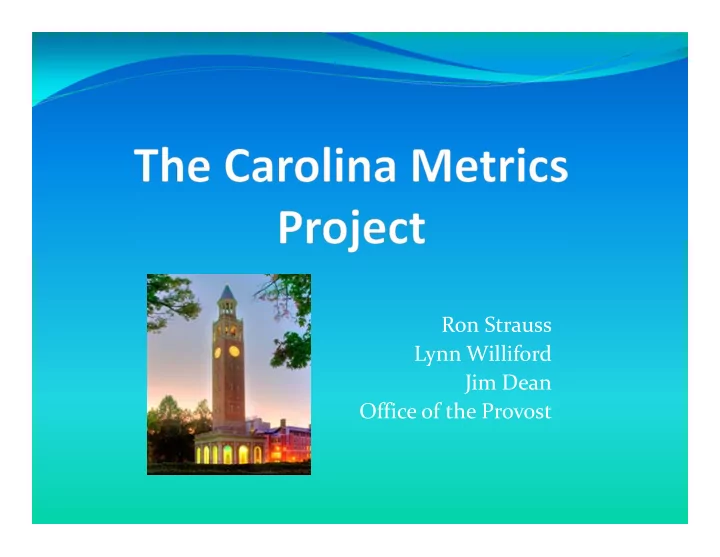
Ron Strauss Lynn Williford Jim Dean Office of the Provost Goals: - - PowerPoint PPT Presentation
Ron Strauss Lynn Williford Jim Dean Office of the Provost Goals: Build a set of visible and accessible metrics to measure UNC Chapel Hills academic status Develop an on line dashboard visible to stakeholders Assess
Ron Strauss Lynn Williford Jim Dean Office of the Provost
relevant academic domains and measures
Committee
Chapel Hill’s academic performance?”
I. Faculty Quality & Outcomes II. Campus Environment III. Student Quality & Outcomes IV. Public Benefits
Faculty recruitment Faculty satisfaction and excitement Faculty retention Faculty diversity Faculty global origins and expertise Interdisciplinarity of colleagues Faculty productivity
teaching
(e.g., e‐learning)
growing external support
Faculty engagement with the community, state, and world
Sources: Underrepresented Minority Faculty – IPEDS Employees by Assigned Position Survey, FY 2012. Student Ratings of Quality of Instruction -- Student Experience in the Research University Survey, 2013. Faculty Satisfaction with Institution: Collaborative on Academic Careers in Higher Education (COACHE) Survey, 2012.
Intellectual climate and energy Experimental, entrepreneurial and risk‐taking ethos Inviting traditions and landscape Welcoming differences, respect for equity and access Interdisciplinary collaboration with “low walls” between units and disciplines Partnerships with communities in NC, nation and the world Visible arts presence Positive public relations and news Vibrant curriculum Experiential learning availability Athletic participation Access to information‐library & information technology Development, fundraising, endowment Positive and engaged staff Strong administration, supportive and facilitating leadership
Sources: Student Ratings of Intellectual Climate and Institution’s Affordability -- Student Experience in the Research University Survey, 2013. Faculty Satisfaction with Intellectual Vitality of Colleagues -- Collaborative on Academic Careers in Higher Education (COACHE) Survey, 2012.
Student qualifications Student satisfaction and excitement Student retention Student diversity Global students Access to higher education/affordability Co‐curricular engagement with the campus community Public engagement with the town and state Student research & creative projects Graduate/professional student and post‐doc completion and placement International study and engagement Student learning outcomes (e.g., critical thinking) Students’ own sense of intellectual growth Alumni satisfaction Alumni engagement
Sources: Student Perceptions of Growth in Intellectual Skills -- Student Experience in the Research University Survey, 2013. First Destination of 2013 Undergraduates – UNC-Chapel Hill University Career Services 2013 First Destination Survey. Undergraduate Underrepresented Minorities – IPEDS Institutional Characteristics Report for 2011.
Community engagement Give‐back ethos and service culture Creating responsible citizens Employment of graduates Economic impact and development Preparation for advanced training in graduates National reputation, global stature, and peer comparisons Partnerships with NGOs, government and other universities; Global partnerships Informing public policy Political support and relation to the state Raising quality of life, health, and
Answering questions of pressing concern to society and the world
Sources: Reputation: Peer Assessment Scores – US News & World Report Best Colleges, 2013. State Appropriations as Percentage of Total Revenue – IPEDS Finance Survey, FY 2012. Teach for America – Teach for America website. Academic Ranking – Shanghai University Academic Ranking of World Universities 2013.
Federal databases – Integrated Postsecondary Education Data
System (IPEDS), National Science Foundation (NSF), etc.
Association of American Universities (AAU) Data Exchange The Common Data Set Databases of media outlets and other organizations that
collect data and publish rankings ‐‐ Princeton Review, US News and World Report, Kiplinger’s, etc.
Publication and citation databases Surveys of faculty and students conducted by UNC‐Chapel
Hill and peer universities
and review
Faculty recruitment Faculty satisfaction and excitement Faculty retention Faculty diversity Faculty global origins and expertise Interdisciplinarity of colleagues Faculty productivity
(e.g., e‐learning)
external support
Faculty engagement with the community, state, and world
Student qualifications Student satisfaction and excitement Student retention Student diversity Global students Access to higher education/affordability Co‐curricular engagement with the campus community Public engagement with the town and state Student research & creative projects Graduate/professional student and post‐doc completion and placement International study and engagement Student learning outcomes (e.g., critical thinking) Students’ own sense of intellectual growth Alumni satisfaction Alumni engagement
Intellectual climate and energy Experimental, entrepreneurial and risk‐taking ethos Inviting traditions and landscape Welcoming differences, respect for equity and access Interdisciplinary collaboration with “low walls” between units and disciplines Partnerships with communities in NC, nation and the world Visible arts presence Positive public relations and news Vibrant curriculum Experiential learning availability Athletic participation Access to information‐library & information technology Development, fundraising, endowment Positive and engaged staff Strong administration, supportive and facilitating leadership
comparisons
universities; Global partnerships
indicators
to society and the world